](https://deep-paper.org/en/paper/2502.19694/images/cover.png)
Introduction
Imagine driving down a highway at night in pouring rain. Your eyes strain to distinguish between a parked car on the shoulder and a shadow, or between a distant streetlight and an oncoming vehicle. Now, imagine you are a computer algorithm trying to do the same thing.
In autonomous driving, the vehicle’s “brain” typically relies on a Bird’s-Eye-View (BEV) representation. This is a top-down, grid-like map of the surroundings generated from onboard cameras and LiDAR sensors. This map is the foundation for everything the car does next: detecting objects, predicting movement, and planning a path.
However, generating this map is fraught with difficulty. Sensors are imperfect. Cameras struggle with glare and darkness; occlusion hides objects; and the deep learning models used to stitch these views together often introduce “noise.” This noise can manifest as “hallucinations” (seeing a car where there is none) or “blind spots” (missing a pedestrian entirely).
Typically, researchers try to fix this by building larger, slower models. But a team from Bosch Research and BCAI has proposed a smarter way. They introduced BEVDiffuser, a novel approach that uses diffusion models—the same tech behind art generators like Midjourney—to “denoise” these maps.
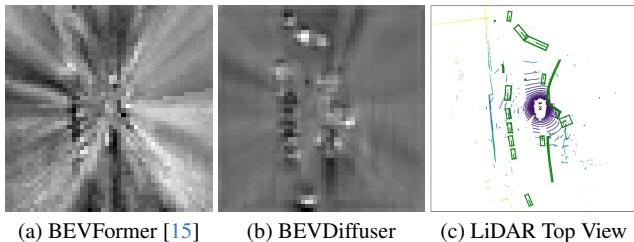
As shown above, the difference is stark. On the left is a standard noisy feature map; on the right, the cleaner version produced by BEVDiffuser. The best part? It improves the car’s perception accuracy significantly without adding any computational delay during the actual drive. Let’s dive into how this works.
Background: The Noise Problem in BEV
To understand BEVDiffuser, we first need to understand the current state of BEV perception.
The BEV Pipeline
In a standard setup (like BEVFormer or BEVFusion), the model takes inputs from multiple cameras around the car. It passes these images through an encoder to create a BEV feature map. This map acts as a unified canvas where features from different cameras are stitched together. Finally, “task heads” look at this map to draw bounding boxes around cars, pedestrians, and obstacles.
The Problem
The issue is that the intermediate BEV feature map is rarely supervised directly. The model is trained to minimize the error of the final bounding boxes (the task loss), not to make the map itself clean. Consequently, the feature map becomes a “black box” that may contain artifacts, blurry boundaries, or sensor noise. This degradation makes the final detection task harder, especially for small objects or in bad weather.
Enter Diffusion Models
Diffusion models are generative models that learn to create data by reversing a noise process. You start with pure static (Gaussian noise) and iteratively refine it until a clear image (or in this case, a feature map) emerges. The researchers realized that if they could treat the messy BEV maps as “noisy images,” they could use a diffusion model to “clean” them.
The BEVDiffuser Methodology
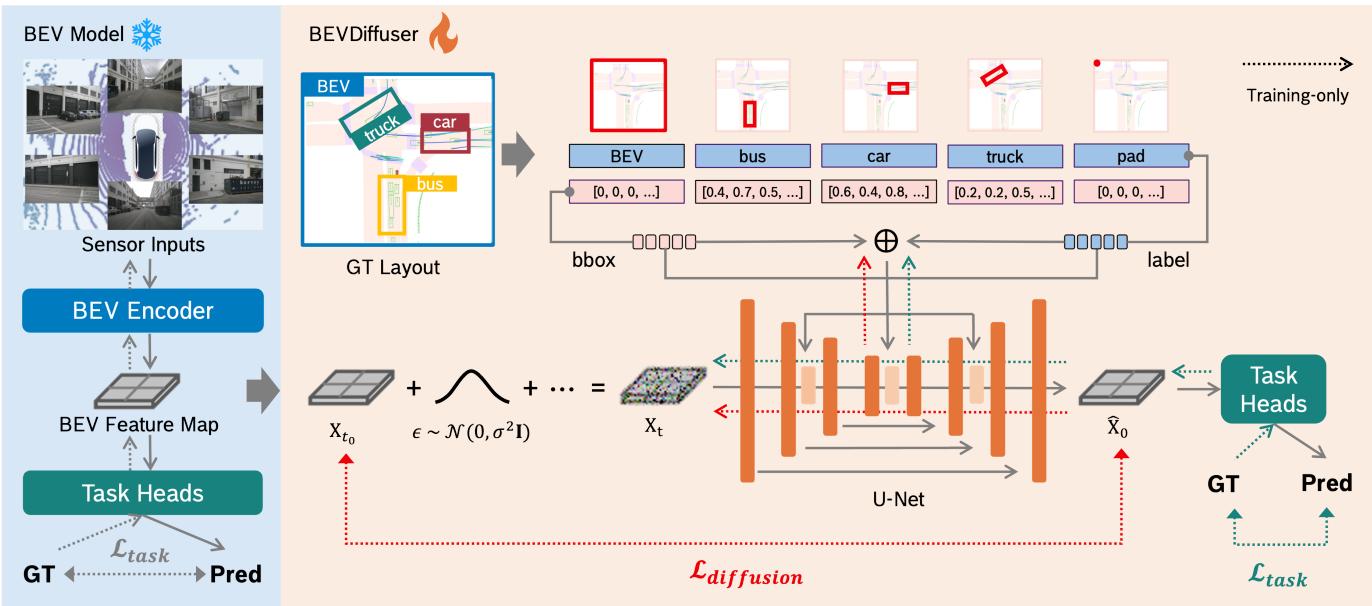
BEVDiffuser is not just a standard diffusion model; it is a conditional diffusion model designed specifically for the geometry of autonomous driving.
1. Ground-Truth Guidance
A diffusion model needs to know what “clean” looks like. In image generation, you might condition the model on a text prompt like “a photo of a cat.” In BEVDiffuser, the condition is the Ground-Truth (GT) Layout.
The researchers treat the annotated 3D bounding boxes (the labels provided in datasets like nuScenes) as a layout. They encode the position, size, and category of every object in the scene into a structured embedding. This layout tells the diffusion model: “There should be a car here, a pedestrian there, and empty road here.”
This guidance is crucial. It forces the diffusion model to reconstruct feature maps that mathematically respect the physical reality of the scene.
2. The Training Process
The training involves a U-Net architecture (a common neural network shape for image processing). The process works as follows:
- Take a BEV feature map produced by an existing model (like BEVFormer).
- Add random noise to it.
- Feed this noisy map into the U-Net, along with the Ground-Truth Layout embedding.
- The U-Net attempts to predict the clean feature map (or the noise that was added).
The model is optimized using a combination of diffusion loss and a downstream task loss (ensuring the cleaned map is actually useful for detection).
The diffusion loss is calculated as:

And the total loss combines this with the task-specific loss:

3. The “Plug-and-Play” Magic
This is the most innovative part of the paper. Using a diffusion model during inference (while the car is driving) is too slow. It requires multiple steps to denoise a map, which creates unacceptable latency for a moving vehicle.
The researchers solved this by using BEVDiffuser only during training.
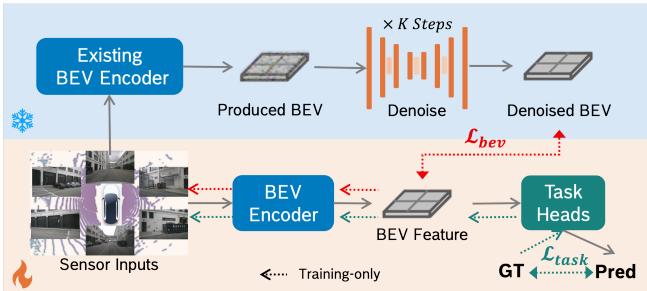
Here is the “Teacher-Student” workflow:
- Train the Teacher: First, train BEVDiffuser to become an expert at cleaning noisy feature maps using the Ground-Truth guidance.
- Train the Student (The Perception Model): Take a standard model (e.g., BEVFormer). Pass its noisy output into the frozen BEVDiffuser.
- Supervision: The BEVDiffuser outputs a high-quality, denoised map. We then force the student model to produce a map that looks like this clean version.
We introduce a specific BEV consistency loss (\(L_{BEV}\)) that penalizes the student model if its output differs from the teacher’s denoised output:

This creates a new total loss for the student model:

The Result: The student model learns to generate cleaner, higher-quality maps internally, effectively mimicking the diffusion model. Once training is done, you delete the BEVDiffuser. The student model runs at its original speed but with significantly higher accuracy.
Experiments and Results
The team tested BEVDiffuser on the nuScenes dataset, a gold standard benchmark for autonomous driving. They applied it to four different baseline models: BEVFormer-tiny, BEVFormer-base, BEVFormerV2, and BEVFusion.
Quantitative Improvements
The improvements were consistent and substantial. In computer vision, gaining 1-2% on a benchmark is considered good. BEVDiffuser achieved significantly more.
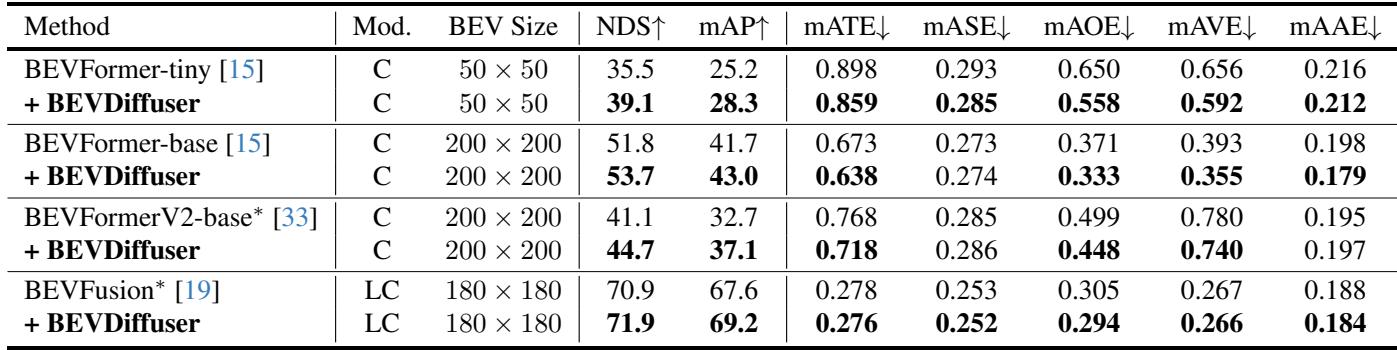
As shown in Table 1:
- BEVFormer-tiny: The Mean Average Precision (mAP) jumped from 25.2% to 28.3%, and the NDS (nuScenes Detection Score) rose from 35.5% to 39.1%.
- BEVFormerV2: Saw a massive jump in mAP from 32.7% to 37.1%.
- BEVFusion: Even this state-of-the-art model, which combines camera and LiDAR, saw improvements.
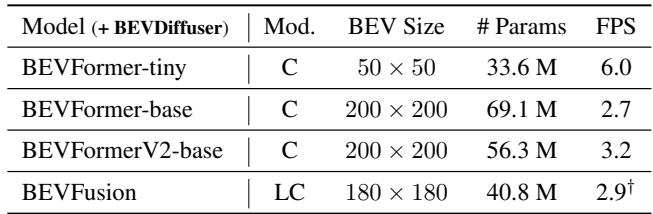
Because the architecture remains unchanged at inference time, the computational efficiency (FPS) remains identical to the baseline models:
Effectiveness of Denoising
To prove that the diffusion process is actually doing the heavy lifting, the authors analyzed performance relative to the number of denoising steps used during the training phase.
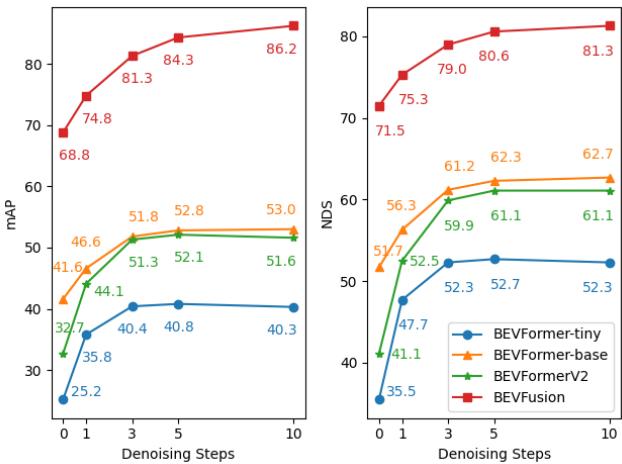
The graphs in Figure 4 show a clear trend: as the number of denoising steps increases (up to about 5), the quality of the feature map (and thus the detection score) skyrockets.
Fixing the “Long Tail”
One of the hardest problems in AI is the “long tail”—detecting objects that appear rarely, like construction vehicles, trailers, or bendy buses. Standard models often ignore these in favor of common objects like cars.
Because BEVDiffuser is guided by the Ground Truth layout (which treats all objects equally regardless of frequency), it forces the model to pay attention to these rare classes.
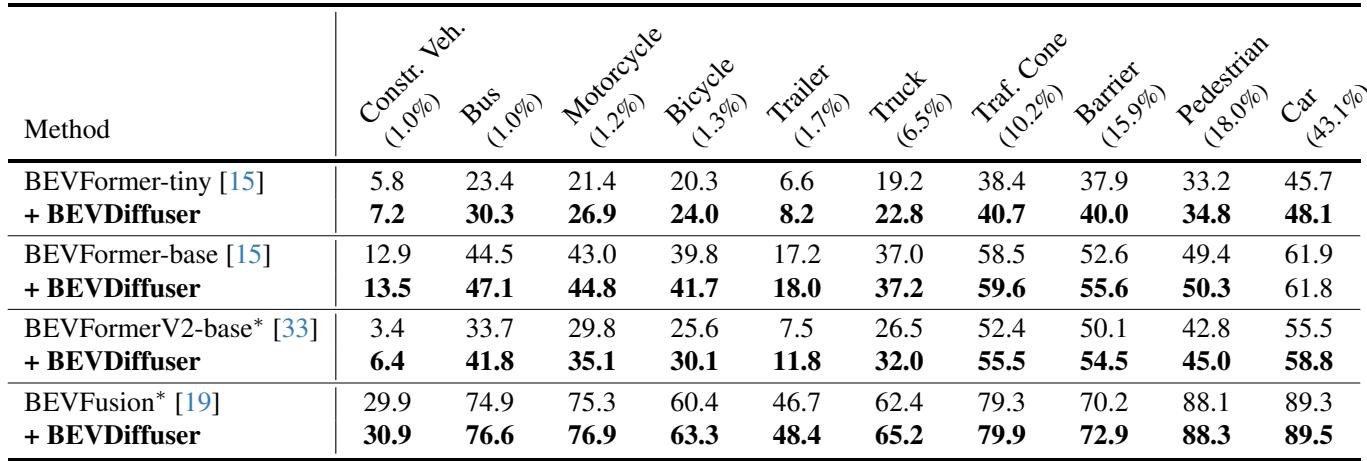
Table 3 highlights this dramatically. For Construction Vehicles, the BEVFormer-tiny model improved its mAP from 5.8% to 7.2%, and the base model saw even larger relative gains. This suggests the denoised features retain critical geometric details that standard encoders blur out.
Robustness in Difficult Conditions
The real test of a self-driving car is a rainy night. Camera noise is highest when lighting is low. The researchers visualized the detections to see if BEVDiffuser helped reduce “hallucinations” (false positives) and missed detections (false negatives).
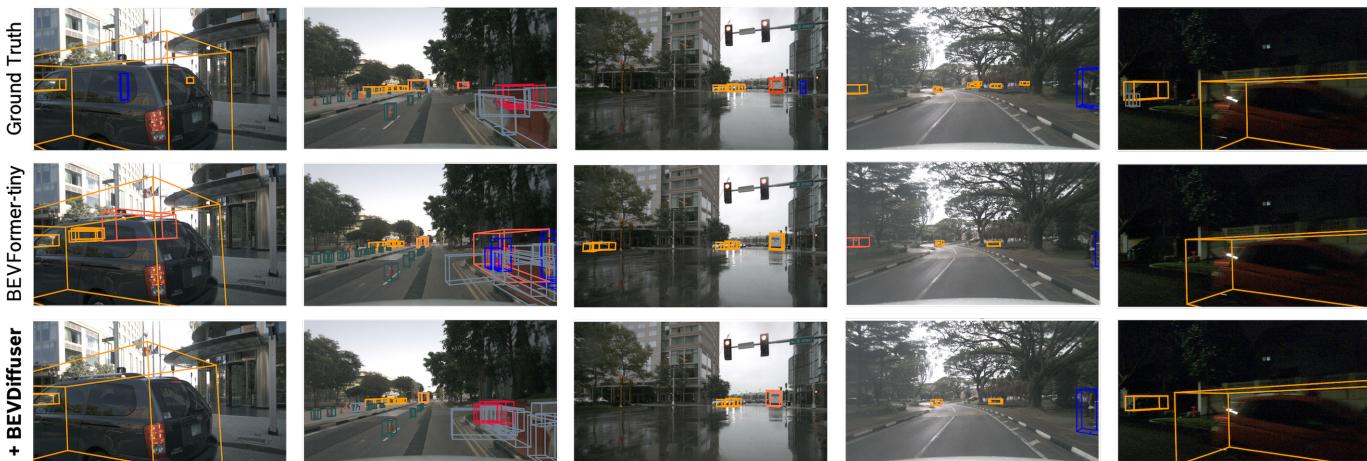
In the visualization above (Figure 6), look at the difference between the middle row (Baseline) and the bottom row (+ BEVDiffuser).
- Columns 1-3: The baseline model hallucinates objects (blue boxes) that aren’t there. BEVDiffuser cleans the map, removing these ghosts.
- Columns 4-5: The baseline misses pedestrians or cars. BEVDiffuser successfully recovers them.
This robustness extends to night driving, where the visual signal is weak.
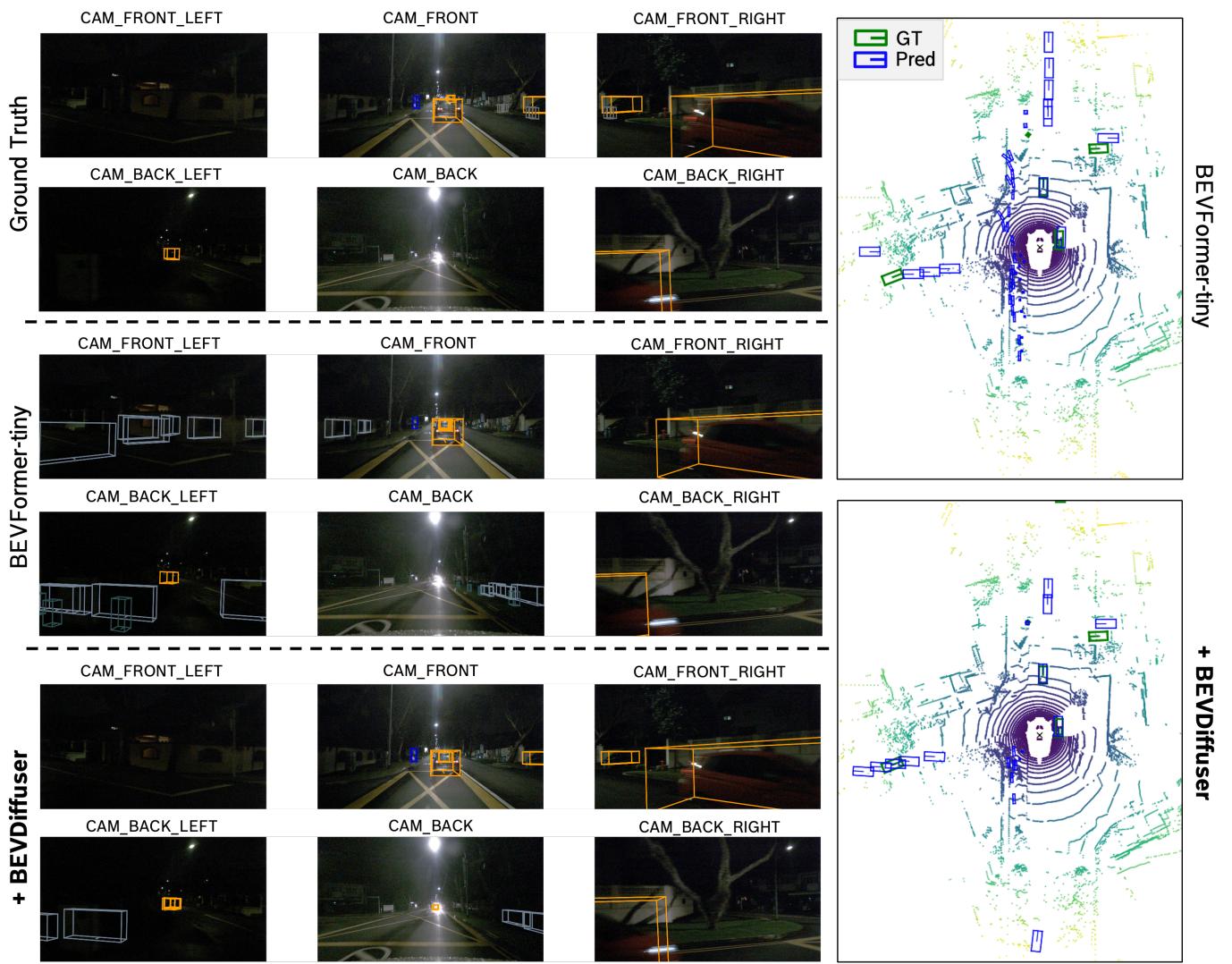
In Figure 8, the baseline model struggles with the glare and darkness, missing the vehicle crossing the road. The BEVDiffuser-enhanced model (bottom) picks it up clearly. This capability is safety-critical.
Generative Capabilities: A Driving World Model?
Beyond just cleaning up noisy maps, BEVDiffuser is a generative model. This means it can generate data from scratch. The authors experimented with creating BEV maps from pure noise, conditioned on a custom layout.
They demonstrated “god-mode” editing: taking a scene, removing a car, adding a truck, or moving a pedestrian in the layout, and asking BEVDiffuser to generate the corresponding feature map.
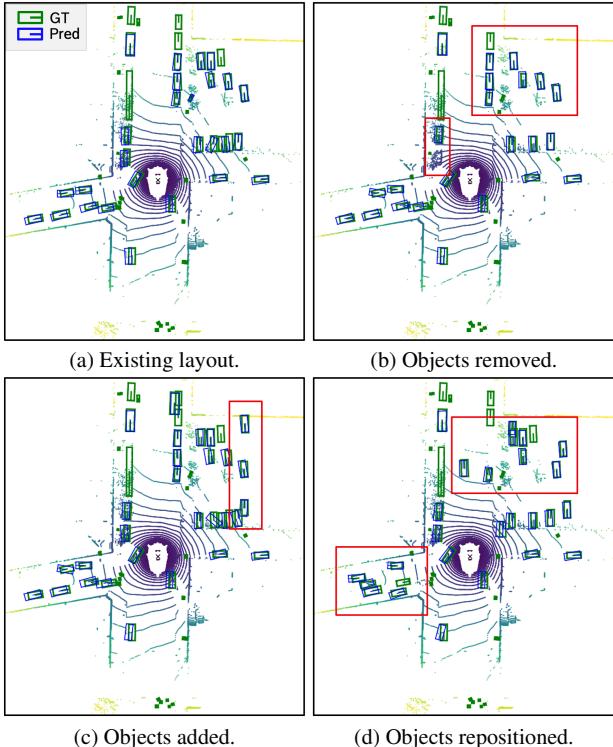
Figure 7 shows this capability. The model successfully generates features where objects are added or moved (highlighted in red boxes). This has massive potential for data augmentation. Instead of driving millions of miles to find rare corner cases, engineers could simply “paint” a scenario layout and generate the synthetic sensor features to train their cars.
Conclusion
BEVDiffuser represents a significant step forward in autonomous perception. It addresses the root cause of poor detection—noisy, unsupervised internal representations—rather than just tweaking the final output layers.
The key takeaways are:
- Denoising works: Treating BEV maps as images that need cleaning significantly improves feature quality.
- Ground-Truth Guidance is powerful: Using object layouts to condition the denoising process forces the model to learn better geometry.
- Zero cost at inference: By using the diffusion model as a “teacher” during training and discarding it afterwards, we get the accuracy benefits of a massive generative model with the speed of a standard detector.
As autonomous driving moves from clear sunny days to complex, unpredictable environments, techniques like BEVDiffuser that squeeze more signal out of noisy sensor data will be essential for reaching full autonomy.