](https://deep-paper.org/en/paper/2502.20099/images/cover.png)
In the rapidly evolving world of Artificial Intelligence, there is a massive effort to move beyond simple correlation and towards causation. Deep learning models are excellent at recognizing that “A usually happens with B,” but they often struggle to understand why or to predict what happens if we change the system.
Enter Causal Representation Learning (CRL). This is a subfield of machine learning dedicated to uncovering the high-level causal variables—the “ground truth” factors—hidden within low-level observational data (like pixels). The promise of CRL is immense: robots that understand physics, medical AIs that understand biological mechanisms, and models that are robust to changes in their environment.
However, there is a catch. Most CRL methods are developed and validated using synthetic data—video game sprites, rendered shapes, or purely mathematical simulations.
In this post, we break down a fascinating paper titled “Sanity Checking Causal Representation Learning on a Simple Real-World System.” The authors built a physical device—a “sanity check”—to see if state-of-the-art CRL methods could survive contact with the real world. The results were surprising, revealing a significant gap between theoretical promise and practical application.
The Problem with Synthetic Benchmarks
Before diving into the experiment, we need to understand the status quo. Typically, when researchers invent a new CRL algorithm, they test it on datasets generated by code. For example, they might generate images of colored balls moving on a screen. Because the code generates the data, the researchers know exactly what the “latent” (hidden) factors are—position, color, velocity.
While useful for proving theorems, synthetic data is often “too clean.” It lacks the noise, sensor imperfections, and physical quirks of reality. If a method works on a clean mathematical simulation but fails on a simple real-world task, we have a problem.
The Solution: A Physical “Sanity Check”
To bridge this gap, the authors constructed a physical experiment designed to be the simplest possible real-world testbed for CRL. They built a Light Tunnel.
The Setup
The system is a controlled optical experiment. It follows the core assumption of CRL: there are hidden “causal factors” (inputs) that get mixed up to produce high-dimensional “observations” (outputs).
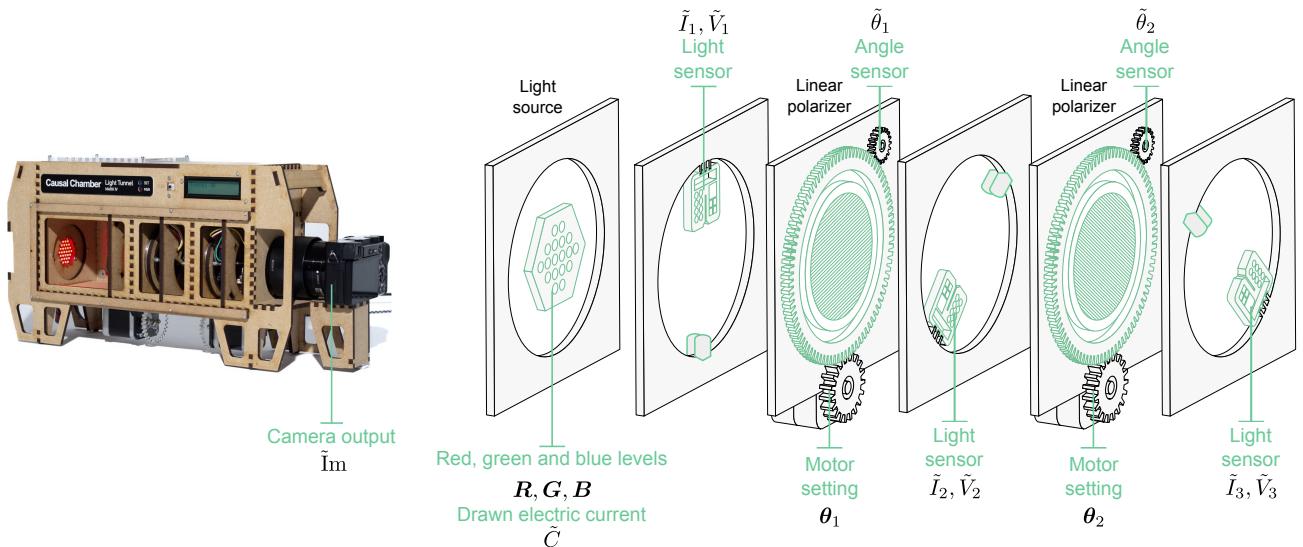
As shown in Figure 1, the device consists of:
- A Light Source: Controllable Red (\(R\)), Green (\(G\)), and Blue (\(B\)) LEDs.
- Polarizers: Two linear polarizers mounted on motors that can rotate to specific angles (\(\theta_1\) and \(\theta_2\)).
- Sensors: A camera taking photos, and several light sensors measuring intensity and current.
The Ground Truth Factors are the inputs we control: \((R, G, B, \theta_1, \theta_2)\). The Observations are the images and sensor readings the machine sees.
The challenge for the AI is simple: Look at the images and sensor readings, and figure out what the original \(R, G, B, \theta_1\), and \(\theta_2\) values were, without being told.
The Data
The authors collected thousands of images from the tunnel. They look like the hexagonal LED array seen below.
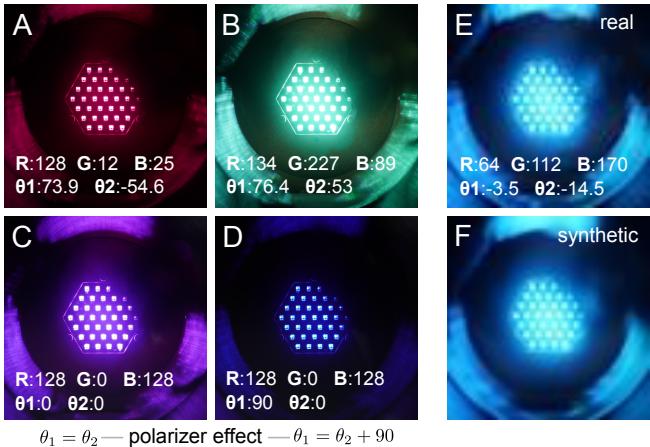
In Figure 2 (A-D), you can see how changing the inputs changes the image.
- Changing \(R, G, B\) changes the color.
- Changing the angles \(\theta_1, \theta_2\) changes the brightness and creates subtle visual artifacts (like reflections) due to polarization physics (Malus’s law).
Crucially, the authors also built a Synthetic Ablation (shown in E/F above). This is a “digital twin” of the tunnel—a computer simulation that generates images that look almost exactly like the real ones but are mathematically perfect and noise-free. This allows them to test if a failure is caused by real-world noise or if the algorithm is just fundamentally broken.
The Experiments: Testing the State of the Art
The researchers selected representative methods from three major families of CRL approaches:
- Contrastive CRL: Learning from interventions (changing one thing at a time).
- Multiview CRL: Learning from different sensors looking at the same thing.
- Time-Series CRL: Learning from data evolving over time.
Let’s look at how each one performed.
1. Contrastive CRL (CCRL)
The Idea: This method relies on “interventions.” Imagine you have a dataset where you only change the Red light, then another where you only turn the Polarizer. The algorithm looks for changes in the data to isolate the causal variables.
The Result:
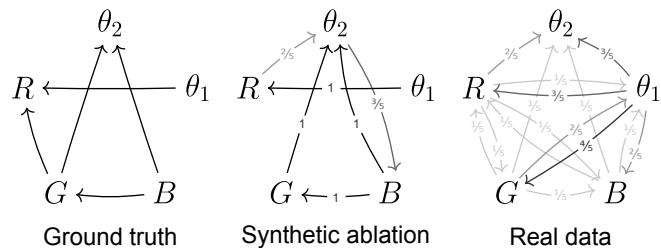
The results in Figure 3 tell a tale of two datasets.
- On Synthetic Data (Bottom Row): The method worked beautifully! The “MCC” score (a measure of correlation, higher is better) is 0.891. The graph on the right shows it correctly identified the causal structure.
- On Real Data (Top Row): The method collapsed. The MCC score dropped to 0.285, which is very poor. The estimated graphs (top right) are messy and incorrect.
The Takeaway: The algorithm is mathematically sound (it works on the simulation), but it is incredibly brittle. The slight noise from the real sensors and light flicker—which the authors note is not just simple additive noise—broke the method’s ability to detect interventions.
2. Multiview CRL
The Idea: This approach uses multiple “views” of the data. In this experiment, the views were:
- The Camera Image.
- The Light Sensor readings.
- The Angle Sensor readings.
The theory is that the AI should learn to separate information shared between views (“Content”) from information unique to one view (“Style”). For example, the angle \(\theta_1\) drives both the angle sensor and affects the image.
The Result:
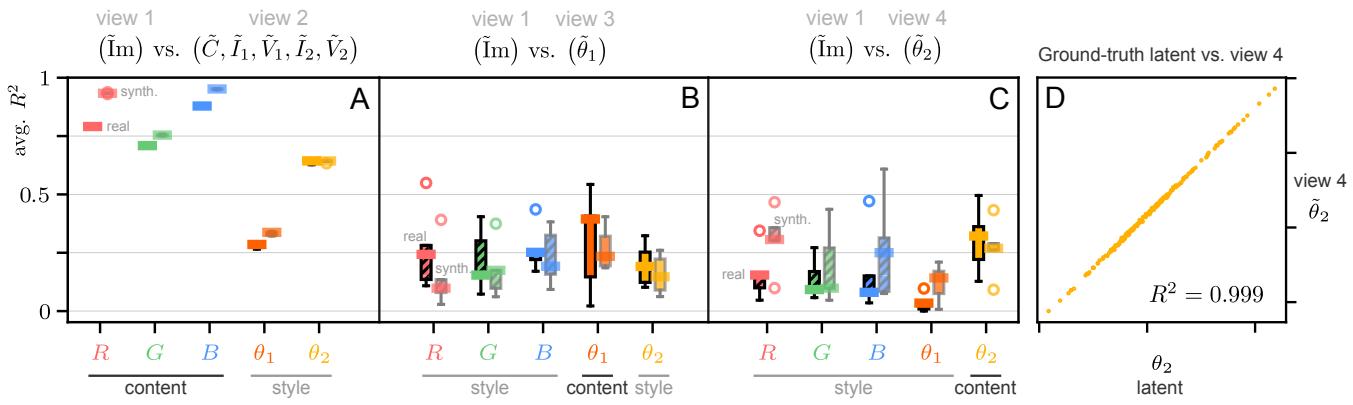
Figure 5 shows the \(R^2\) score (prediction accuracy). We want the score to be close to 1.0.
- Panel A: The model successfully learned the color inputs (\(R, G, B\)) because they are very obvious in the images.
- Panel B & C: The model struggled significantly with the angles (\(\theta_1, \theta_2\)). Notice the scores are much lower.
The most damning result is shown in Panel D. This scatter plot compares the actual angle \(\theta_2\) with the learned representation of that view. It is a straight line—meaning the model had the information! It perfectly encoded the angle sensor data. However, it failed to realize that this same information was present in the camera image view. It failed to link the “angle view” to the “image view,” failing the core objective of Multiview learning.
Unlike the Contrastive method, this one failed on both real and synthetic data. This suggests a fundamental issue with the method’s ability to disentangle subtle features (like polarization effects) compared to obvious ones (like color), regardless of noise.
3. Temporal CRL (CITRIS)
The Idea: This method, called CITRIS, looks at time-series data. It assumes the world evolves according to a dynamic process (Markov chain). By watching how variables change over time after random interventions, it tries to deduce the causal factors.
The Result:
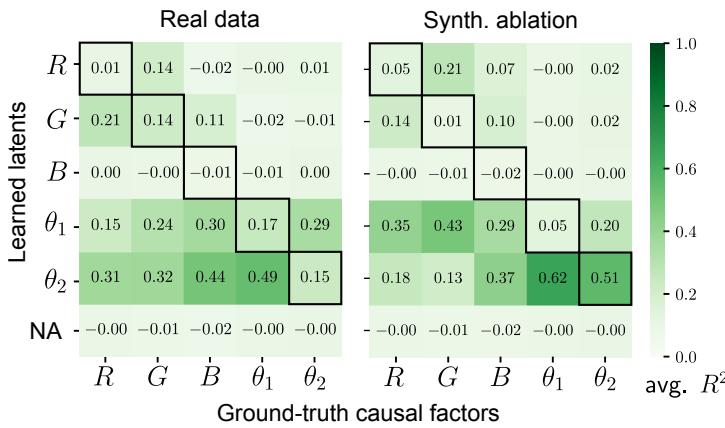
Figure 6 presents a correlation matrix.
- The Goal: We want a “diagonal” matrix. The first learned variable should correlate with \(R\), the second with \(G\), etc. We want bright green squares along the diagonal and dark squares everywhere else.
- The Reality: The matrices are messy. The diagonal scores (\(R^2\) diag) are tiny (~0.09 and ~0.12). The off-diagonal scores are high.
This indicates a “catastrophic failure.” The model did not learn to separate the causal factors at all. It simply mixed everything up. Even on the “easy” synthetic ablation data, the method failed to recover the ground truth factors (\(R, G, B, \theta_1, \theta_2\)).
The authors hypothesize that because CITRIS is a complex pipeline with many moving parts (encoders, transition priors, normalizing flows), a failure in just one component (like the image encoder struggling to see the angle) causes the whole system to collapse.
Why Did They Fail?
The authors performed a “Supervised Sanity Check” (training a standard neural network with the answers provided) and found that a simple network could predict the variables from the images with near-perfect accuracy (\(R^2 > 0.9\)).
This proves the information is in the images. The task is solvable. The unsupervised CRL methods simply failed to solve it.
The failures generally fell into two buckets:
- Sensitivity to Noise: (Contrastive CRL) The math assumes a deterministic world. Real-world sensors have jitter, and lights have flicker. This “stochasticity” broke the method.
- Implementation/Assumption Mismatch: (Multiview & CITRIS) Even on the noise-free simulator, these methods failed. This suggests that their assumptions about how data is mixed, or the specific architectures used (like how the neural networks are built), are not robust enough for this type of physical data.
Conclusion: A Call for Real Benchmarks
This paper serves as a sobering “reality check” for the field of Causal Representation Learning. We have sophisticated mathematical theories and algorithms that perform well on video games, but when faced with a simple box of lights and sensors—a system governed by high-school physics—they crumble.
The authors highlight a critical lesson: Theoretical promise does not equal practical utility.
By releasing this dataset and the designs for the “Causal Chamber,” the researchers have provided the community with a new standard. If a new causal AI method claims to be robust, it shouldn’t just work on synthetic shapes. It should be able to look at a light tunnel and tell you how bright the LEDs are.
The path forward for CRL requires moving away from purely synthetic validation and embracing the messy, noisy, and challenging nature of the real world. Only then can we build AI that truly understands cause and effect.