](https://deep-paper.org/en/paper/2502.20111/images/cover.png)
Imagine you are watching a soccer game. If a player runs behind a referee, you don’t panic and assume the player has vanished from existence. Your brain uses context, trajectory, and perhaps a view from a different angle (if you were watching a multi-camera broadcast) to predict exactly where that player will emerge.
Computer vision systems, however, often struggle with this exact scenario. In the world of Visual Object Tracking (VOT), losing sight of an object due to occlusion (being blocked by another object) is a primary cause of failure. Traditional trackers rely on a single camera view. If the target walks behind a pillar, the tracker is blind.
But what if the tracker had access to a “team” of cameras? If Camera A loses the target, surely Camera B, positioned at a different angle, can see it. This concept is the core of Multi-View Object Tracking (MVOT).
In this post, we are doing a deep dive into MITracker, a new research paper that proposes a robust solution to the multi-view problem. We will explore how the researchers constructed a massive new dataset to train these systems and the novel architecture that allows a tracker to “hallucinate” an object’s location in an occluded view by borrowing information from visible views.
The Problem: Why is Multi-View Tracking So Hard?
Single-view tracking has advanced significantly with the rise of Transformers (like ViT) and Siamese networks. However, they are fundamentally limited by their perspective. You cannot track what you cannot see.
Multi-view systems offer a solution, but they come with two major bottlenecks that have stifled progress until now:
- Data Scarcity: Deep learning requires massive amounts of data. While there are plenty of single-view datasets, multi-view datasets are rare. The few that exist usually focus exclusively on humans (surveillance style) or distinct categories like birds. There has been no large-scale benchmark for tracking generic objects (like a backpack, a toy, or a laptop) across multiple cameras.
- Integration Complexity: Even if you have multiple cameras, fusing that information is difficult. How do you tell the system that the “blob” of pixels in Camera 1 corresponds to the same object in Camera 2, especially when the object looks completely different from the side versus the front?
The MITracker paper tackles both problems head-on.
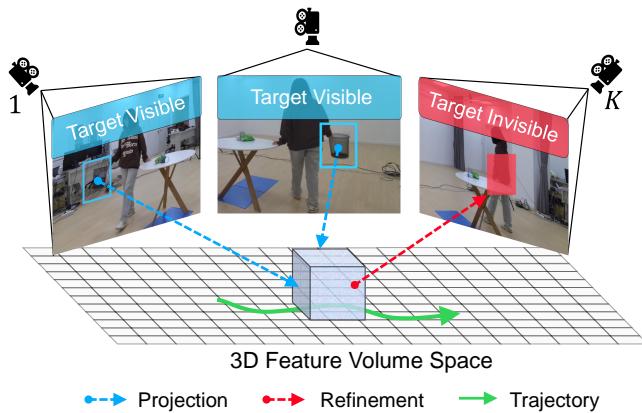
As shown in Figure 1, the core idea is simple yet powerful: specific camera views project their features into a shared 3D space. Even if the target is invisible in one view (indicated by the red “Target Invisible” label), the 3D space retains the object’s presence, allowing the system to refine the tracking for the blind camera.
The Foundation: The MVTrack Dataset
Before building a model, the researchers needed a playground. They introduced MVTrack, a large-scale dataset designed to train class-agnostic trackers (trackers that can follow any object, not just people).
To understand why this is significant, let’s look at the landscape of tracking datasets:
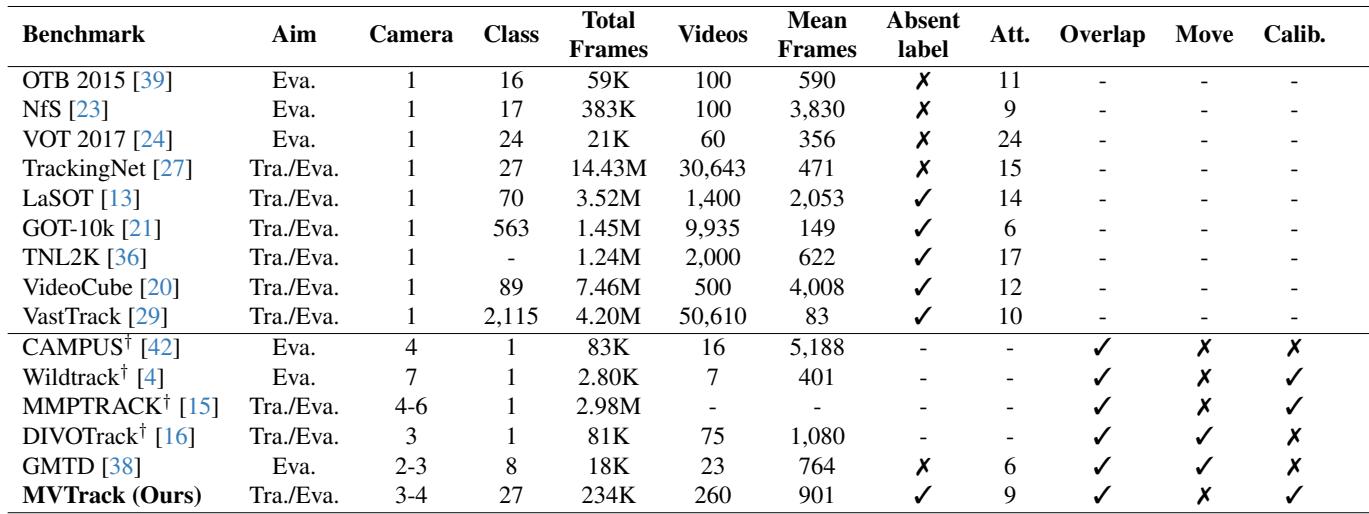
As you can see in the table above, most existing multi-view datasets (the bottom rows) are limited to 1 or very few classes (mostly humans). MVTrack changes the game by including:
- 234,000 frames of video.
- 27 distinct object categories (generic objects).
- 3-4 synchronized cameras per scene.
- Precise 3D calibration data.
This diversity is crucial. A model trained only on walking humans will fail when trying to track a tumbling umbrella or a sliding phone. The researchers captured scenarios specifically designed to break trackers, including fast motion, heavy occlusion, and deformation.
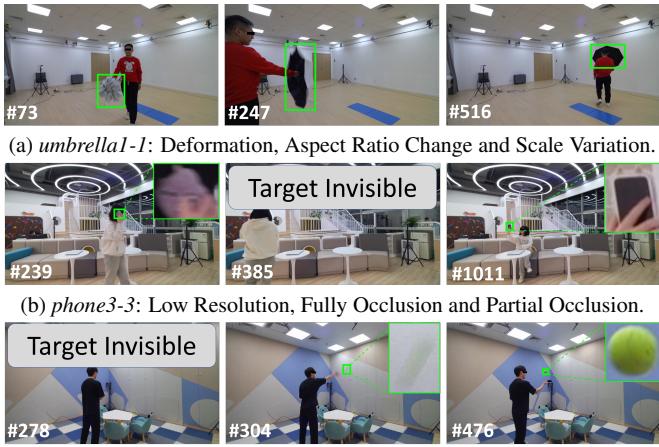
Figure 2 gives us a glimpse of these challenges. In row (a), an umbrella changes shape entirely as it opens. In row (b), a phone is completely hidden behind a clutter of objects. A robust tracker needs to handle these extreme appearance changes while coordinating across different camera angles.
The Core Method: Inside MITracker
Now, let’s unpack the architecture of the Multi-View Integration Tracker (MITracker). The goal is to track any object across arbitrary viewpoints.
The architecture is divided into two main stages:
- View-Specific Feature Extraction: Analyzing what each camera sees individually.
- Multi-View Integration: Fusing those individual views into a 3D understanding to correct errors.
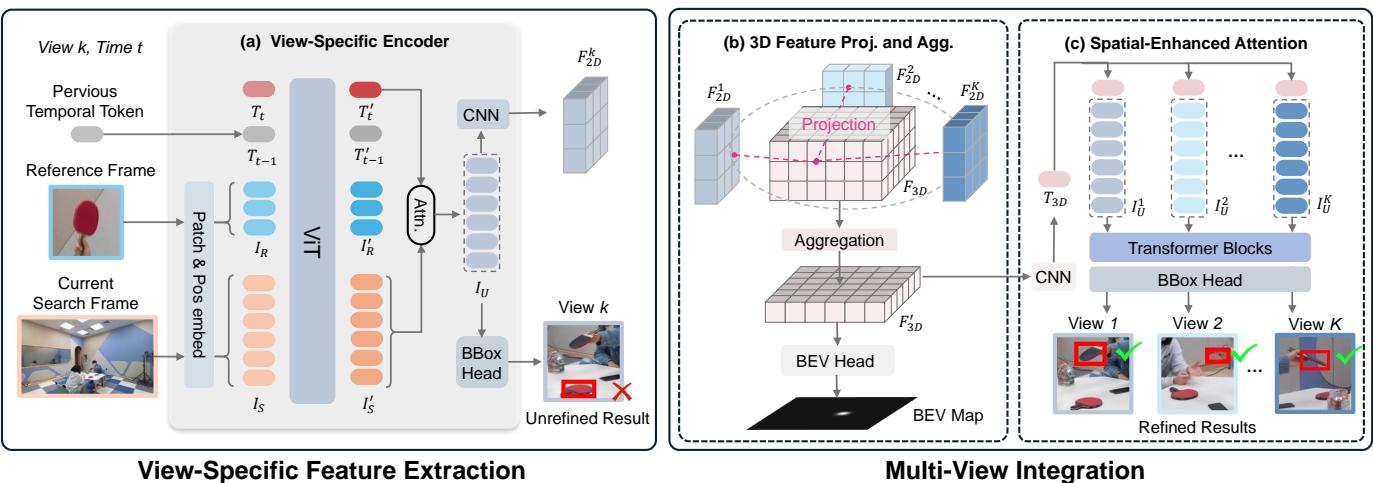
Let’s break down the architecture diagram below.
1. View-Specific Feature Extraction (The “Eyes”)
The left side of the diagram (Part a) shows the process for a single camera view. This part of the system looks similar to modern single-view trackers.
The model uses a Vision Transformer (ViT) as its backbone. It takes two inputs:
- Reference Frame (\(I_R\)): An image showing what the target looks like (the template).
- Search Frame (\(I_S\)): The current video frame where we are looking for the target.
However, static images aren’t enough. Objects move, rotate, and blur. To give the model a sense of time, the researchers introduce Temporal Tokens.
\[ I _ { U } = I _ { S } ^ { \prime } \cdot ( I _ { S } ^ { \prime } \times ( T _ { t } ^ { \prime } ) ^ { \top } ) , \]As seen in the equation above, the model maintains a temporal token \(T_t\) that carries information from the previous frame to the current frame. This helps the model understand the object’s immediate history—essentially giving the tracker a short-term memory. If the object was moving left in the last frame, the temporal token helps the model anticipate it will likely continue left.
The output of this stage is a set of 2D feature maps (\(F_{2D}\)) for each camera view. At this point, the cameras haven’t talked to each other yet.
2. Multi-View Integration (The “Brain”)
This is where MITracker innovates. If Camera 1 sees the object but Camera 2 is blocked, we need to transfer that knowledge. The researchers achieve this by lifting the 2D features into a 3D world.
Step A: 3D Feature Projection
Since the cameras are calibrated, we know exactly where they are in the room. The system takes the 2D feature pixels \((u, v)\) from the image and projects them into a 3D voxel grid (a 3D volume of pixels) at coordinates \((x, y, z)\).
The projection follows this transformation:
\[ \begin{array} { r } { \left( \begin{array} { l } { u } \\ { v } \\ { 1 } \end{array} \right) = C _ { K } [ C _ { R } | C _ { t } ] \left( \begin{array} { l } { x } \\ { y } \\ { z } \\ { 1 } \end{array} \right) , } \end{array} \]Here, \(C_K\), \(C_R\), and \(C_t\) represent the camera’s intrinsic settings, rotation, and translation (position). By running this projection for every camera, the system populates a shared 3D Feature Volume.
Imagine shining a flashlight from every camera through the image and into the 3D room. Where the beams intersect, we have high confidence the object exists.
Step B: BEV Compression
Processing a dense 3D cube of data is computationally expensive. Furthermore, in most tracking scenarios (like robots or surveillance), objects move primarily along the ground.
To make the system efficient, the researchers compress the vertical axis (\(Z\)) of the 3D volume, flattening it into a Bird’s Eye View (BEV) feature map. This BEV map acts as a master floor plan, showing the object’s location on the ground plane, aggregated from all cameras.
Step C: Spatial-Enhanced Attention
Now comes the “feedback loop” (shown in Figure 3c). We have our master BEV map which knows the “true” location of the object based on all visible angles.
The system embeds this BEV information into a 3D-aware token (\(T_{3D}\)). This token is fed back into the transformers for each specific camera view.
This is the “Spatial-Enhanced Attention” mechanism. It forces the view-specific trackers to pay attention to the location suggested by the 3D volume.
- Scenario: Camera 2 is blocked by a wall. The view-specific extractor sees nothing.
- Correction: The 3D token (\(T_{3D}\)), derived from Camera 1 and 3, tells Camera 2’s transformer: “The object is at coordinate X.”
- Result: Camera 2’s tracker recovers and predicts the bounding box correctly, even though the visual evidence is weak or missing.
Training the Beast
To train this complex system, the researchers use a combination of loss functions to ensure accuracy in both 2D and 3D.
\[ L _ { \mathrm { t r a c k } } = L _ { \mathrm { c l s } } + \lambda _ { \mathrm { g i o u } } L _ { \mathrm { g i o u } } + \lambda _ { L _ { 1 } } L _ { 1 } + \lambda _ { \mathrm { b e v } } L _ { \mathrm { b e v } } , \]The loss function (Equation 3) combines:
- Classification Loss (\(L_{cls}\)): Is the object recognized correctly?
- BBox Regression Loss (\(L_{giou}, L_1\)): Is the box drawn tightly around the object?
- BEV Loss (\(L_{bev}\)): Is the 3D position on the ground plane accurate?
By training end-to-end, the model learns to balance its own visual input with the global 3D consensus.
Experiments and Results
Does this complex 3D projection actually help? The results suggest a resounding yes.
State-of-the-Art Performance
The researchers compared MITracker against leading single-view trackers (like OSTrack and MixFormer). Note that single-view trackers can’t naturally do multi-view tracking, so they were adapted using post-processing fusion for a fair comparison.
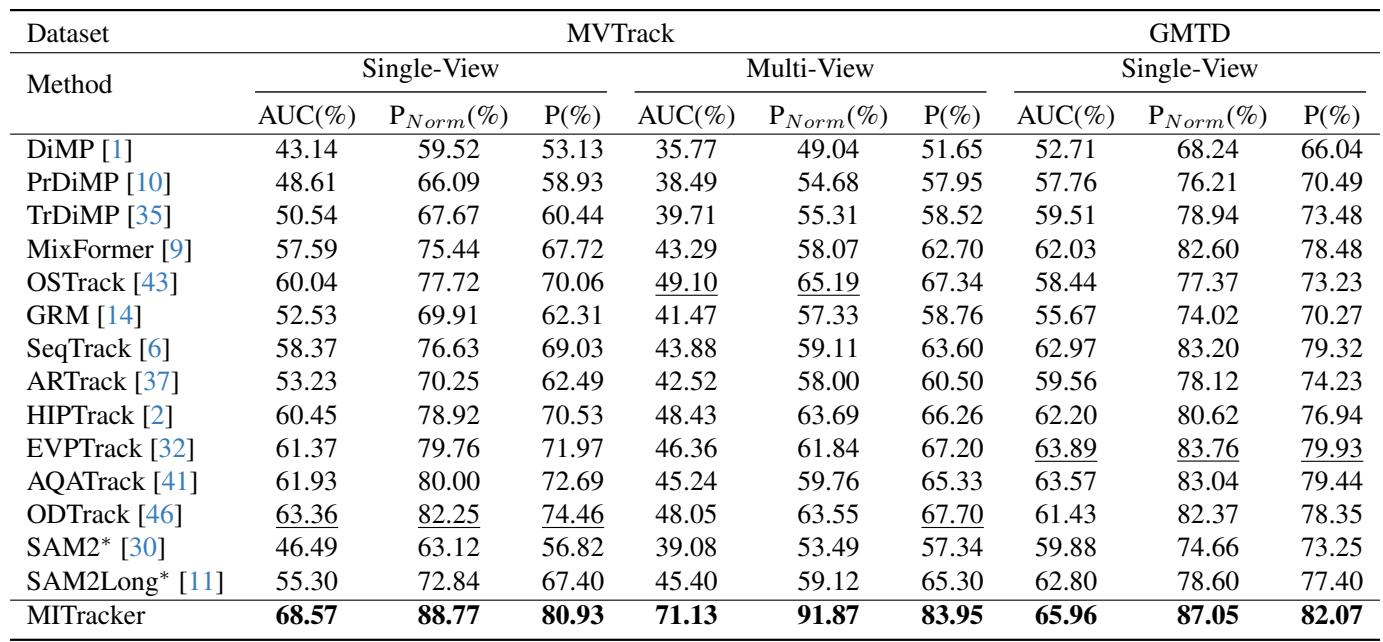
As shown in Table 2, MITracker dominates the leaderboard.
- On the MVTrack dataset, it achieves a Precision (PNorm) of 88.77%, almost 10 points higher than the next best competitor (EVPTrack).
- On the GMTD dataset, the gap is even wider, with MITracker reaching 91.87% Precision.
This indicates that simply fusing the outputs of single-view trackers (the strategy used by the competitors) is inferior to fusing the features inside the network like MITracker does.
The Recovery Test
The most critical test for a multi-view tracker is recovery. If the target disappears completely from a view, how quickly can the tracker find it again when it reappears? or better yet, keep tracking it while it is hidden?
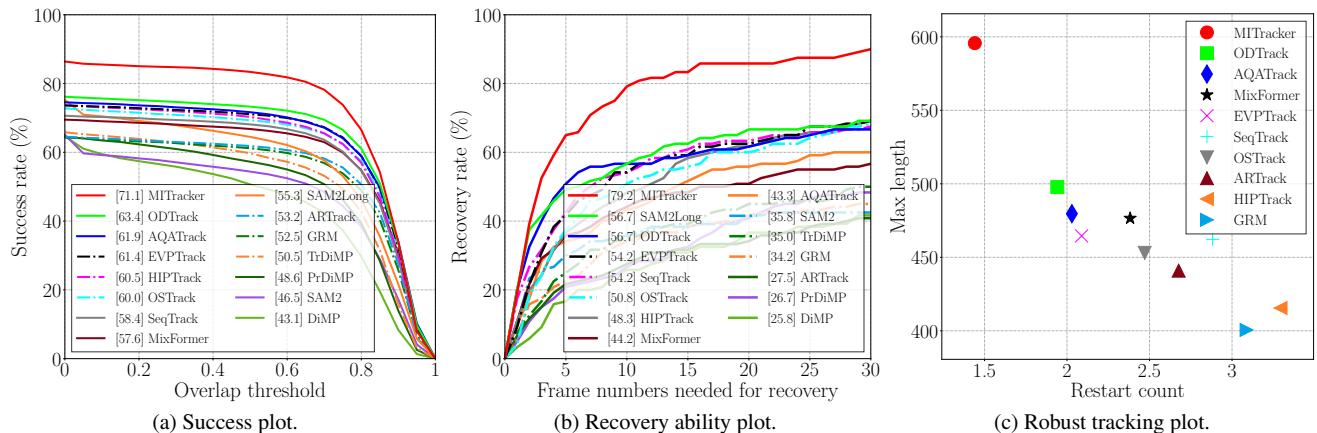
Figure 4(b) (the center graph) is particularly revealing. It plots the “Recovery Rate” against the number of frames.
- MITracker (Red line) shoots up immediately, achieving a 79.2% recovery rate within 10 frames.
- Competitors like SAM2Long (Purple line) lag behind at roughly 56%.
This proves the Spatial-Enhanced Attention works: the 3D memory of the object keeps the tracker “warm,” so it snaps back onto the target instantly.
Visual Proof
Let’s look at what this performance difference actually looks like in a video sequence.
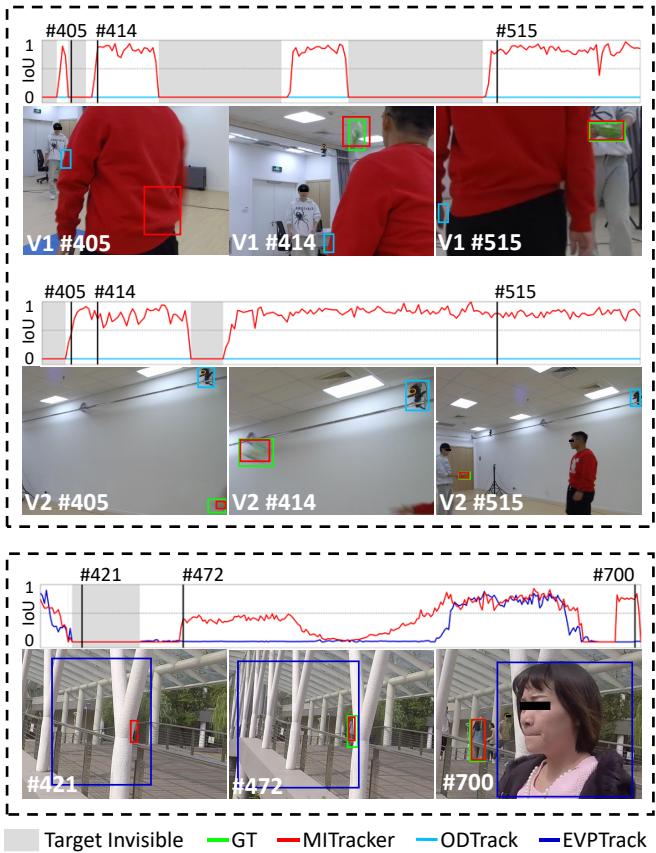
In Figure 5, we see a comparison between MITracker (Red) and ODTrack (Blue).
- Top Graph (IoU): High is good. Low is bad.
- Look at the gray regions in the graph—these represent times when the target is invisible or occluded.
- Notice how the Blue line (ODTrack) often drops to zero and stays flat even after the object reappears (the white gaps). It has lost the target permanently.
- The Red line (MITracker) might dip during full occlusion, but it bounces back to 1.0 (perfect tracking) almost immediately.
Trajectory Analysis
Finally, the 3D understanding allows MITracker to plot the path of the object in the real world (Bird’s Eye View), not just on the screen.
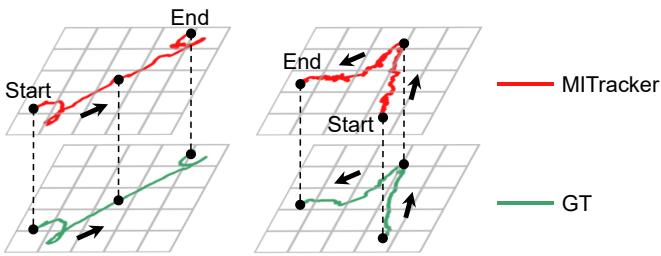
Figure 6 shows the predicted path (Red) versus the Ground Truth (Green). The alignment is remarkably tight, showing that the model has successfully built a coherent 3D understanding of the scene from the 2D camera inputs.
Conclusion and Future Implications
MITracker represents a significant step forward in computer vision. By moving away from treating cameras as isolated observers and instead integrating them into a unified 3D feature space, the system solves one of the most persistent problems in tracking: occlusion.
Key Takeaways:
- Data Matters: The creation of MVTrack fills a critical gap, allowing researchers to train models on generic objects across multiple views.
- 3D > 2D: Projecting features into 3D space allows different views to communicate. If one camera is blind, the others can guide it.
- Spatial Attention: Using specific architectural blocks (BEV-guided attention) allows the system to recover from target loss significantly faster than state-of-the-art single-view methods.
While the current system relies on calibrated cameras (knowing exactly where cameras are), the authors suggest future work could focus on uncalibrated setups, which would allow this technology to be deployed even more flexibly—perhaps in swarms of drones or ad-hoc security setups where “seeing through walls” becomes a reality.