](https://deep-paper.org/en/paper/2502.20162/images/cover.png)
Introduction
Imagine you are training a robot to recognize cows. You show it thousands of pictures of cows standing in grassy fields. The robot gets a perfect score during training. Then, you take the robot to a snowy mountain range, show it a cow, and it stares blankly, identifying the object as a “rock.”
Why did it fail? Because the robot didn’t learn what a cow looks like; it learned that “green background = cow.” When the green background disappeared (replaced by white snow), the model’s confidence collapsed.
This is the classic problem of Domain Generalization (DG). In machine learning, we often assume that the data we test on will look statistically similar to the data we trained on. In the real world, this assumption rarely holds. Distributions shift, lighting changes, and backgrounds vary.
Standard training methods often fail in these scenarios because they are “lazy”—they latch onto the easiest features (like the green grass) rather than the robust, invariant features (the shape of the cow). In a fascinating new research paper, Gradient-Guided Annealing for Domain Generalization, researchers propose a novel way to fix this by looking at the geometry of the learning process itself. They introduce a method called GGA that forces the model to ignore conflicting, domain-specific signals and focus on what truly matters.
In this deep dive, we will explore why standard training fails, how “gradient conflict” signals this failure, and how the authors’ proposed annealing process aligns the model’s compass toward true generalization.
The Failure of Standard Training (ERM)
To understand the solution, we first have to understand the problem with the status quo. The standard way we train neural networks is called Empirical Risk Minimization (ERM).
In ERM, we pool all our training data together—regardless of where it came from—and ask the model to minimize the average error (or loss). If we have data from “Domain A” (photos) and “Domain B” (sketches), ERM treats them as one big bucket.
The problem is that the path of least resistance for minimizing loss often involves cheating. If Domain A has a specific bias (e.g., all dogs are indoors) and Domain B has a different bias (e.g., all dogs are outdoors), the model might learn separate “rules” for each domain to cheat its way to a low loss, rather than learning what a dog actually is.
Visualizing the Trap
The researchers illustrate this problem beautifully with a synthetic experiment involving 2D data.
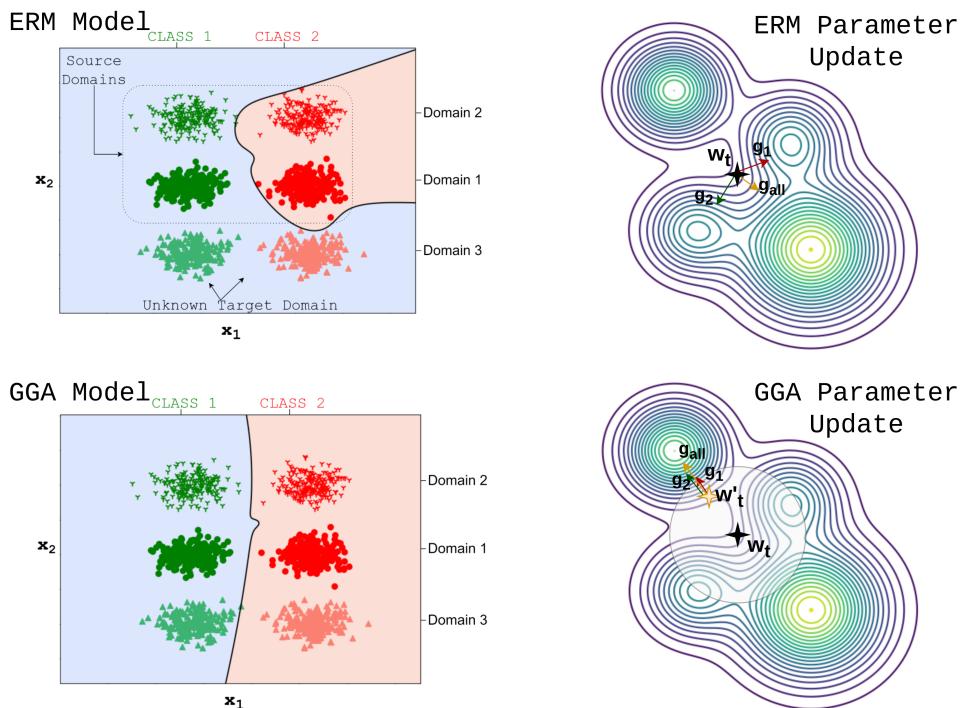
Let’s look at the left side of Figure 1 above.
- The Setup: We have two features, \(x_1\) and \(x_2\).
- \(x_1\) is the class-specific feature (the “signal”). It predicts the label correctly regardless of the domain.
- \(x_2\) is the domain-specific feature (the “noise”). It shifts depending on the domain.
- The Goal: We want a vertical decision boundary that relies only on \(x_1\).
The Result (Top-Left): The standard ERM model creates a curved, wavy boundary. It is trying to accommodate the shifts in \(x_2\) to squeeze out a tiny bit more accuracy on the training data. This is overfitting to the domain. When a new domain appears (the faded points), this wavy boundary will likely misclassify the data.
The Solution (Bottom-Left): The proposed GGA method creates a nearly vertical boundary. It effectively ignores the shifting \(x_2\) feature and focuses on \(x_1\).
Why does this happen? It comes down to Gradient Conflict.
The Root Cause: Gradient Conflict
When a neural network learns, it calculates a gradient—a vector telling it which direction to move its parameters to reduce error.
In a multi-domain dataset, you calculate a gradient for Domain A (\(g_1\)) and a gradient for Domain B (\(g_2\)).
- If both domains rely on the same invariant feature (the shape of a cow), \(g_1\) and \(g_2\) will point in roughly the same direction.
- If Domain A wants to learn “green grass” and Domain B wants to learn “white snow,” \(g_1\) and \(g_2\) will point in different, conflicting directions.
In standard ERM (shown in the top-right of Figure 1), the optimizer just averages these conflicting arrows. If one points North-West and the other North-East, the model goes North. But in doing so, it might get trapped in a “local minimum”—a valley in the loss landscape that is good for the specific training domains but terrible for generalization.
The authors postulate that gradient disagreement is a symptom of overfitting. If the gradients from different domains are fighting each other, the model is likely learning domain-specific garbage.
The Theoretical Framework
To formalize this, the authors present a simplified generative model.
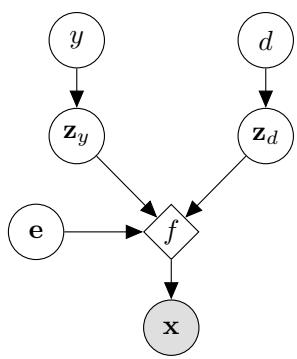
As shown in Figure 2, any data point \(x\) is generated by a combination of:
- \(z_y\): The latent representation of the class (what we want).
- \(z_d\): The latent representation of the domain (what we want to ignore).
- \(e\): Random noise.
A perfectly robust model is one that depends only on \(z_y\). If the model ignores \(z_d\), then the mathematical expectation of the gradients across different domains should be identical.
The researchers derive the following relationship for the total gradient:
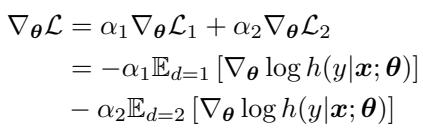
This equation shows that the total update is a weighted sum of updates from different domains (\(d=1\) and \(d=2\)). If the model is truly generalizing, it shouldn’t matter which domain the data came from—the gradient direction should be the same.
Therefore, the necessary condition for domain invariance is Gradient Agreement.
The Solution: Gradient-Guided Annealing (GGA)
The authors propose a new training strategy called Gradient-Guided Annealing (GGA). The core idea is simple but powerful: Don’t let the model descend into a valley where the domains disagree.
If the model finds itself in a spot where Domain A says “go left” and Domain B says “go right,” the model should stop, shake itself up, and look for a nearby spot where both domains say “go straight.”
The Algorithm Step-by-Step
GGA isn’t a completely new optimizer; it’s a strategy applied during the early stages of standard training.
- Warm-up: Start by training the model normally (ERM) for a few iterations to get it into a reasonable region of the parameter space.
- The Annealing Phase: This is where the magic happens. Before taking a step, the algorithm checks the Cosine Similarity between the gradients of the different source domains.
- If the gradients are aligned (pointing the same way), great. Proceed.
- If they conflict, the algorithm performs annealing. It adds random noise (perturbations) to the model’s weights.
- Search and Accept: The algorithm samples several perturbed versions of the weights in the local neighborhood. It looks for a new set of weights that satisfies two conditions:
- Better Alignment: The cosine similarity between domain gradients is higher.
- Low Loss: The training error doesn’t explode (it must be lower or roughly equal to the current error).
- Update: The model jumps to this new, more “aligned” set of weights and continues training.
This process essentially “guides” the optimization path. Instead of rolling down the hill blindly, the model constantly checks its compass. If the compass needles from different domains diverge, it moves laterally along the hill until the needles align, and then continues downward.
Visualizing the Alignment
Does this actually work in practice? The authors visualized the gradient similarity during training on the VLCS benchmark dataset.

Figure 3 tells a compelling story:
- Green/Purple Lines (ERM): Notice the dotted purple line representing “Grad Agreement.” As training progresses (x-axis), the agreement drops and stays low (around 0.45). This means the domains are fighting each other even though the loss (green dashed line) is low. The model has overfit.
- Red/Blue Lines (GGA): Look at the solid blue line. When GGA is applied (around iteration 100-200), there is a massive spike in gradient agreement. Crucially, even after the annealing stops, the agreement stays significantly higher than ERM for the rest of the training. The model has found a “basin” of attraction where generalization is naturally higher.
Experimental Results
The researchers tested GGA on five challenging Domain Generalization benchmarks: PACS, VLCS, OfficeHome, TerraIncognita, and DomainNet. These datasets consist of images varying from photos to sketches, clip art, and paintings.
The evaluation protocol is “Leave-One-Domain-Out.” For example, you train on Photos, Sketches, and Cartoons, and then you are tested on Art Paintings.
Performance vs. State-of-the-Art
The results show that GGA is highly effective.
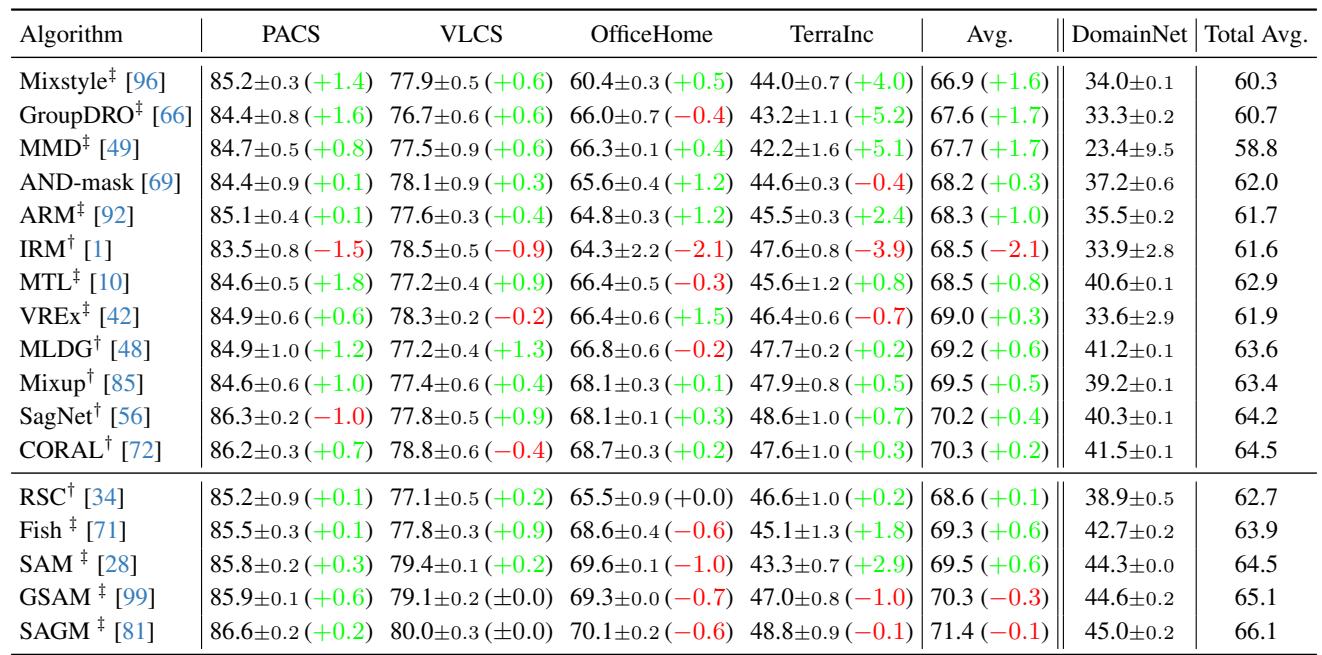
Table 2 highlights two key findings:
- Competitive Standalone: Even without fancy architectures, GGA alone (applied to a standard ResNet-50) beats or matches many complex state-of-the-art methods.
- The “Booster” Effect: This is perhaps the most important result. Because GGA is an optimization strategy, it is method-agnostic. You can apply it on top of other algorithms.
- Look at the columns with green text. When GGA is combined with methods like GroupDRO, MMD, or MixStyle, it almost universally boosts their performance (e.g., +1.7% on average for GroupDRO).
- This suggests that GGA addresses a fundamental optimization issue that other methods miss.
Sensitivity Analysis
One specific question arises with methods that involve “random perturbations”: How sensitive is it to the amount of noise? If you perturb the weights too much, you destroy the learning. If you perturb too little, you stay stuck.
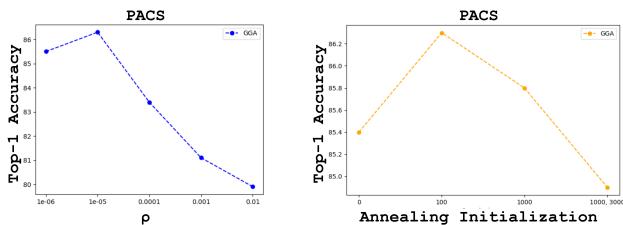
Figure 4 (Left) shows the impact of the perturbation magnitude (\(\rho\)). There is a clear “sweet spot” around \(10^{-5}\).
- Too small (\(10^{-6}\)): The model behaves like standard ERM.
- Too large (\(10^{-2}\)): The performance collapses because the noise pushes the model out of the useful loss landscape.
Figure 4 (Right) answers when we should apply GGA. The data shows that applying it in the early stages (initialization ~100 steps) is best. This aligns with the “Initial Basin” theory in deep learning—where you start determines where you end up. GGA steers the ship out of the harbor correctly so it can sail smoothly later.
Faster Alternatives: GGA-L
The standard GGA algorithm requires computing gradients multiple times to “search” the neighborhood, which adds computational overhead. To address this, the authors also proposed GGA-L (inspired by Langevin Dynamics).
Instead of a separate search step, GGA-L injects noise directly into the gradient update step:

Here, \(\alpha\) is a scaling factor that depends on the gradient similarity:
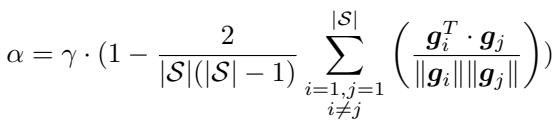
The intuition is brilliant: If the domains disagree (low similarity), inject more noise. This forces the model to explore and jump out of that region. If the domains agree (high similarity), reduce the noise and settle down. This achieves similar results to standard GGA but is much faster to compute.
Conclusion and Implications
The paper “Gradient-Guided Annealing for Domain Generalization” offers a refreshing perspective on the robustness problem. Rather than designing complex new architectures or data augmentation pipelines, it looks at the fundamental geometry of optimization.
The key takeaways are:
- Gradient Conflict is a Warning Sign: When source domains pull the model in different directions, the model is likely learning spurious features.
- Early Dynamics Matter: Fixing this conflict early in training puts the model on a trajectory toward better generalization.
- Optimization is Key: Sometimes, the problem isn’t the data or the model, but how we navigate the loss landscape.
By “annealing” the model—shaking it until the gradients align—GGA ensures that when the robot sees a cow in the snow, it looks at the cow, not the ground. This method is a powerful, flexible tool that can be added to the toolkit of almost any deep learning practitioner working on out-of-distribution generalization.