](https://deep-paper.org/en/paper/2502.20390/images/cover.png)
Introduction
In the world of computer animation and robotics, walking is a solved problem. We can simulate bipedal locomotion with impressive fidelity. However, as soon as you ask a virtual character to interact with the world—pick up a box, sit on a chair, or push a cart—the illusion often breaks. Hands float inches above objects, feet slide through table legs, or the character simply flails and falls over.
This is the challenge of Physics-Based Human-Object Interaction (HOI). Unlike standard animation, where characters move along predefined paths (kinematics), physics-based characters must use virtual muscles (actuators) to generate forces. They must balance, account for friction, and manipulate dynamic objects that have mass and inertia.
The primary source of data for learning these movements is Motion Capture (MoCap). However, MoCap data is notoriously imperfect. Sensors get occluded, resulting in “jittery” motions, and physical contacts are rarely captured accurately. When you feed this messy data into a physics simulator, the simulation rejects it—hands pass through objects or objects fly away upon contact.
In this post, we dive deep into InterMimic, a new framework presented at CVPR that bridges the gap between imperfect data and realistic physical control. The researchers propose a novel “Teacher-Student” curriculum that not only imitates complex interactions but fixes the errors in the source data, enabling universal whole-body control.

The Core Problem: The Gap Between Data and Physics
To understand why InterMimic is necessary, we must understand the limitations of current approaches.
1. MoCap Imperfection
Motion capture provides the kinematics (positions over time) but not the dynamics (forces). In a raw MoCap recording of someone lifting a box, the virtual hand might be 2 centimeters inside the box due to sensor error. In an animation, this looks a bit weird. In a physics simulation, this causes a collision explosion, sending the box into orbit. Conversely, if the hand is 2 centimeters too far away, the physics character grasps nothing and fails the task.
2. The Scalability Bottleneck
Previous methods typically trained a specific policy for a specific task (e.g., “pick up this specific mug”). Scaling this up to thousands of different objects and interactions is computationally expensive and notoriously unstable.
The InterMimic Solution: A Two-Stage Curriculum
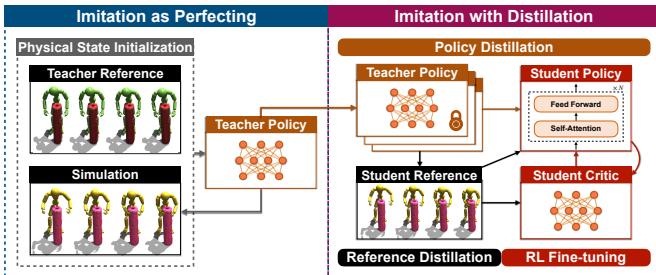
The researchers treat this as a learning problem with a specific philosophy: Perfect first, then scale up. They utilize a two-stage process involving specialized “Teacher” policies and a generalized “Student” policy.
Stage 1: Imitation as Perfecting (The Teachers)
In the first stage, the system trains multiple Teacher Policies. Each teacher is an expert on a small subset of the data (e.g., one specific human subject doing a set of tasks).
The goal of the teacher is not just to mimic the MoCap data, but to refine it. Since the teacher operates in a physics simulator, it is forced to find a physically valid way to perform the action. If the MoCap data says “hand inside object,” the teacher learns to place the hand on the surface of the object to achieve a stable grasp.
The Challenge of Initialization
A major hurdle in training physics agents is “Reference State Initialization” (RSI). Normally, to speed up training, the simulator starts the character at a random point in the motion (e.g., halfway through lifting a box).
However, because the MoCap reference is imperfect, starting the simulation exactly where the MoCap dictates often results in an invalid state (e.g., interpenetration). The physics engine detects a collision immediately, the rollout fails, and the agent learns nothing.
The authors introduce Physical State Initialization (PSI). Instead of blindly trusting the MoCap reference, the system maintains a buffer of successful states reached during previous simulation runs. When resetting the environment, the agent starts from one of these physically valid states.
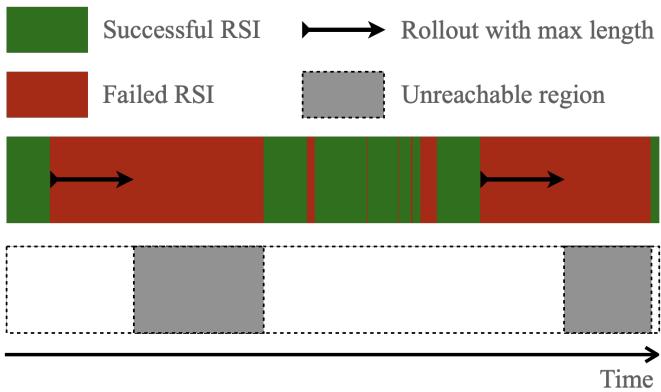
As shown in the figure above, standard RSI leads to “unreachable regions” (red) where the reference is physically impossible. PSI bridges these gaps by initializing from valid states the agent has previously discovered, allowing the policy to explore and connect the motion segments.
Contact-Guided Rewards
To teach the agent how to interact, the researchers design a reward system that is aware of contact. They infer “reference contact markers” from the messy MoCap data.
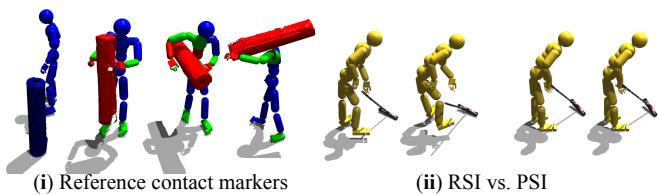
- Red zones: The system detects the human should be touching the object (inferred from object acceleration). The agent is rewarded for making contact here.
- Blue zones: The agent is penalized for touching the object here (to prevent accidental collisions).
- Green zones: Neutral buffers where contact is neither forced nor punished, accommodating sensor noise.
The contact reward equation uses these markers to guide the learning:
\[ E _ { b } ^ { c } = \sum \left\| \hat { \boldsymbol { c } } _ { b } - \boldsymbol { c } \right\| \odot \hat { \boldsymbol { c } } _ { b } , \]Here, the system calculates the difference between the desired contact state \(\hat{c}\) and the actual simulated contact \(c\).
Stage 2: Imitation with Distillation (The Student)
Once the Teachers have mastered their specific tasks and “cleaned up” the data, it’s time to train the Student Policy. The Student is a single, powerful model (using a Transformer architecture) designed to learn all skills across all objects.
This stage uses a technique called Distillation. The Student learns from the Teachers in two ways:
- Reference Distillation: The Student doesn’t try to mimic the original, messy MoCap data. Instead, it tries to mimic the refined trajectories generated by the Teachers. This provides a clean, physically plausible target.
- Policy Distillation: The Student tries to match the actions (muscle torques) output by the Teachers.
RL Fine-Tuning
Crucially, the Student isn’t just a copycat. After the initial “Behavior Cloning” phase (where it blindly copies the teachers), the Student undergoes Reinforcement Learning (RL) Fine-Tuning. This allows the Student to resolve conflicts (e.g., if two teachers suggest slightly different ways to hold a chair) and optimize the motion further, often surpassing the teachers in quality.
Architecture: MLP vs. Transformer
The Teacher policies use Multi-Layer Perceptrons (MLPs). These are simple networks good for specific tasks but struggle with complex, long-term dependencies.
The Student policy uses a Transformer. Transformers are excellent at handling sequential data and temporal dependencies. This allows the Student to “look back” at a history of observations, understanding the context of the motion (e.g., “I am currently in the middle of a squat to pick up a box”). This architecture is vital for scaling up to large, diverse datasets.
Experiments and Results
The authors evaluated InterMimic on several challenging datasets, including OMOMO and BEHAVE, which contain highly dynamic interactions with objects like boxes, balls, chairs, and tables.
1. Correcting Artifacts
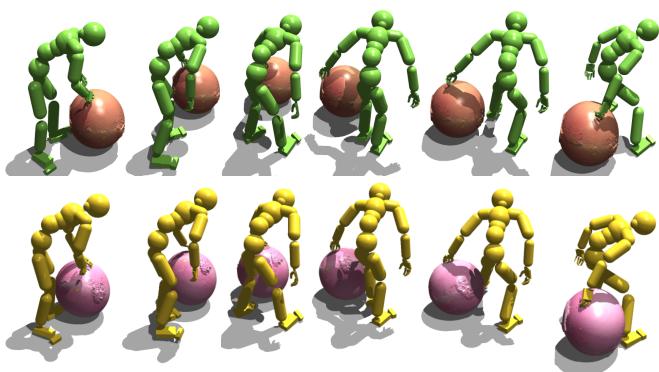
One of the most impressive results is the system’s ability to fix “broken” data. In the comparison below, the baseline method (PhysHOI) fails because it tries to strictly follow the imperfect reference. InterMimic’s teacher corrects the hand position, establishing a solid grip.
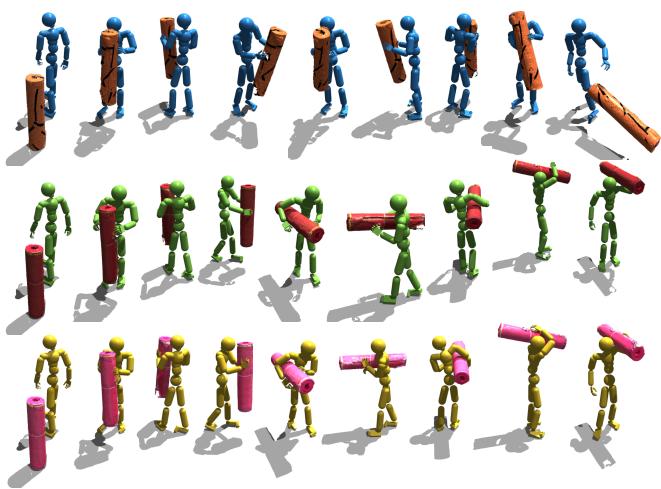
Furthermore, the system corrects physics violations like “sliding.” In MoCap, a symmetric object (like a medicine ball) might appear to slide on the ground because the rotation wasn’t captured perfectly. InterMimic’s physics simulation forces the ball to roll naturally.
2. Quantitative Success
The table below highlights the performance on the BEHAVE dataset. The “Success Rate” indicates how often the agent successfully completes the motion without dropping the object or falling.
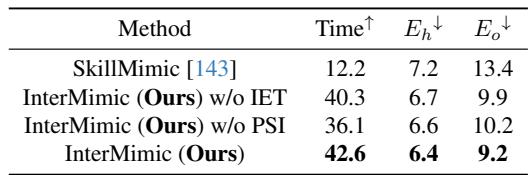
Notable metrics:
- Time: The duration the agent stays in the correct state. InterMimic (42.6s) vastly outperforms the baseline (12.2s).
- Ablation: Removing PSI (“w/o PSI”) drops performance significantly, proving that the initialization strategy is critical.
3. Generalization
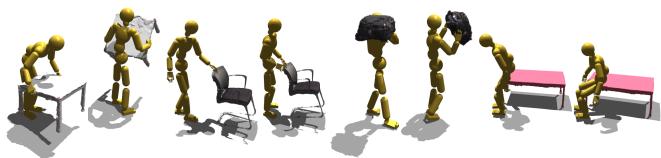
The ultimate test of a physics agent is Zero-Shot Generalization. Can the Student policy handle objects it has never seen before?
The experiments show that because the Student learns a general understanding of body mechanics and object geometry (via the Transformer), it can interact with novel shapes outside its training set.
4. Generative Capabilities
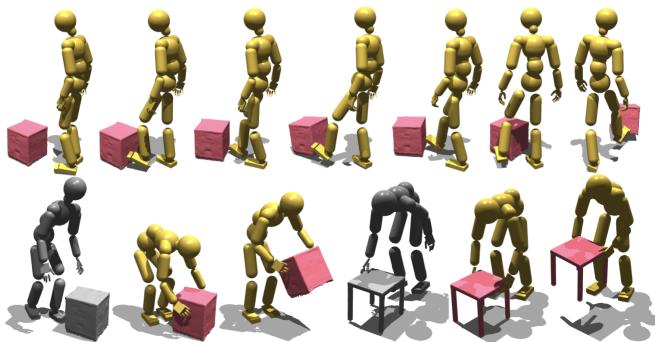
Finally, InterMimic bridges the gap between imitation and generation. By integrating with kinematic generators (models that hallucinate motion based on text), InterMimic can physically execute commands like “Kick the large box,” even if that specific motion wasn’t in the training data.
Conclusion
InterMimic represents a significant step forward in digital human simulation. By acknowledging that real-world data is messy and using physics as a “filter” to clean it, the researchers have created a framework that is both robust and scalable.
The implications extend beyond just better movie special effects.
- Robotics: The “Sim-to-Real” gap is a major hurdle. InterMimic’s ability to retarget messy human data onto a consistent physical model (and potentially humanoid robots) paves the way for robots that can learn complex manipulation skills by watching humans.
- VR/AR: Interactive avatars that can realistically handle objects allow for more immersive experiences.
By combining the precision of Reinforcement Learning with the scalability of Transformers, InterMimic moves us closer to a world where virtual characters don’t just look like they are interacting with their environment—they actually are.
This blog post explains the paper “INTERMIMIC: Towards Universal Whole-Body Control for Physics-Based Human-Object Interactions” by Sirui Xu et al.