](https://deep-paper.org/en/paper/2502.20391/images/cover.png)
The dream of general-purpose robotics is a machine that can watch a human perform a chore—like folding a towel or putting dishes away—and immediately replicate that behavior. In the fields of Computer Vision (CV) and Natural Language Processing (NLP), we have seen massive leaps in capability driven by internet-scale data. Models like GPT-4 or Sora are trained on vast oceans of text and video scraped from the web.
Robotics, however, faces a stubborn bottleneck. Unlike text or images, robotic data usually requires physical interaction. Collecting data means driving a robot, often via tedious teleoperation, which takes time, money, and human labor. If we could teach robots using the millions of “how-to” videos already existing on YouTube, we could unlock a revolution in robotic capability.
But there is a catch: the morphology gap. A human hand does not look or move exactly like a two-finger robotic gripper. A human arm has different joints and constraints than a robotic arm.
In this post, we will deep dive into Point Policy, a fascinating research paper that proposes a solution to this problem. The researchers introduce a framework that allows robots to learn policies exclusively from offline human demonstration videos—without a single frame of teleoperated robot data.
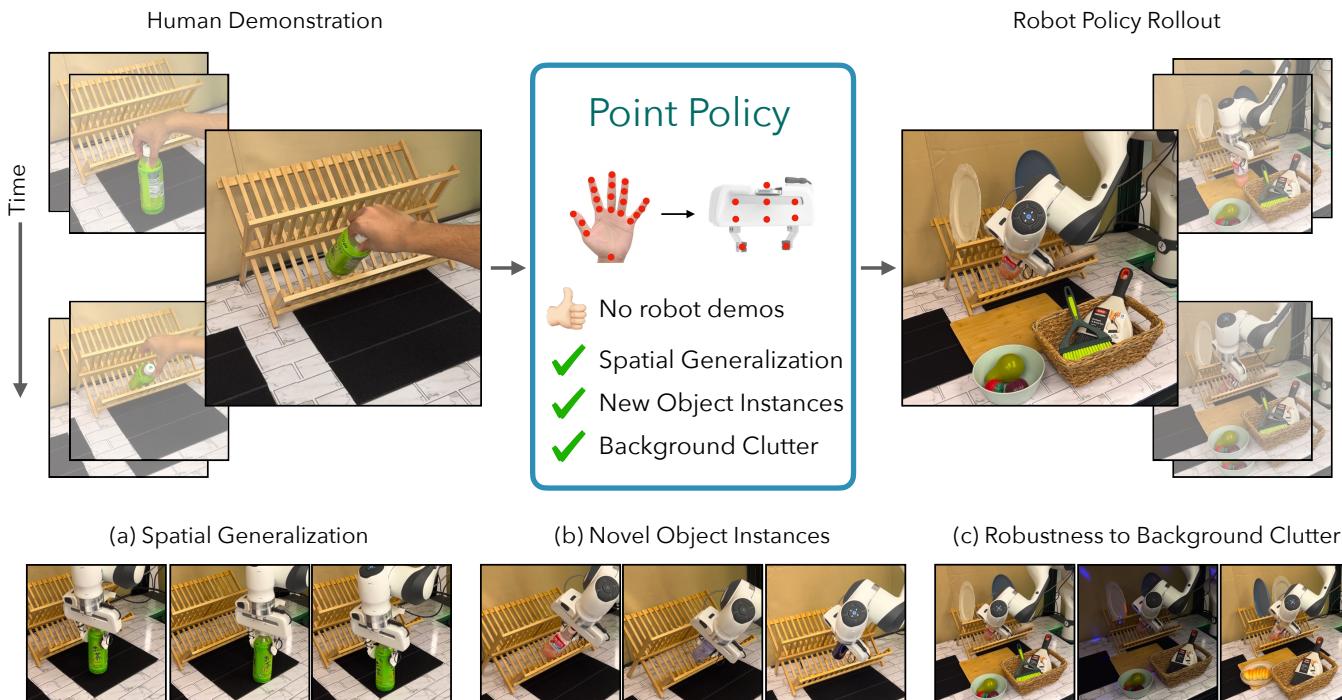
The Core Problem: Data Scarcity and the Morphology Gap
Before understanding the solution, we must appreciate the difficulty of the problem. Traditional imitation learning in robotics relies on “expert demonstrations.” A human controls the robot (via a VR headset or joystick) to perform a task, and the robot learns to map its visual observations to the motor commands recorded during that session.
While effective, this is unscalable. You cannot download teleoperation data from the internet; you have to produce it.
The alternative is learning from human videos. However, feeding a video of a human hand into a robot control policy usually fails because the visual features of a hand (flesh, five fingers) are statistically very different from a metal gripper. Previous attempts to solve this have involved:
- Visual Domain Adaptation: Trying to make robot images look like human images or vice versa.
- Reward Learning: Using human videos to define a “success” score, then training the robot via Reinforcement Learning (which still requires expensive trial-and-error in the real world).
Point Policy takes a different approach. It posits that while the appearance of agents differs, the geometry of the task remains the same. Both humans and robots occupy the same 3D world. If we can abstract the task into 3D key points, we can bridge the gap.
Background Concepts
To understand how Point Policy works, we need to briefly touch upon a few foundational concepts in computer vision and imitation learning.
Imitation Learning and Behavior Cloning
The goal of Imitation Learning (IL) is to learn a policy \(\pi\) that mimics an expert. The simplest form is Behavior Cloning (BC). Given a dataset of observations \(o\) and actions \(a\), we train a neural network to minimize the difference between its predicted action and the expert’s action.

In Point Policy, the authors use a specific transformer-based architecture called BAKU for behavior cloning, which excels at handling multi-task policies.
Semantic Correspondence and Point Tracking
How do we find the “same” point across different images?
- Semantic Correspondence: If I show you a picture of a bottle and then a picture of a different bottle in a different room, “Semantic Correspondence” is the ability to identify the bottle cap in both images, even if they look different. The authors use a model called DIFT (Diffusion Features) for this.
- Point Tracking: Once we identify a point (like the corner of a box), we need to follow it as it moves through a video. The authors use Co-Tracker, a state-of-the-art model that can track points even when they are temporarily occluded.
The Point Policy Framework
The core innovation of this paper is treating key points as the universal language between humans and robots. Instead of processing raw pixels (which contain background noise and appearance shifts), the policy perceives the world as a cloud of sparse, meaningful 3D points.
The framework operates in three distinct stages, as illustrated below:
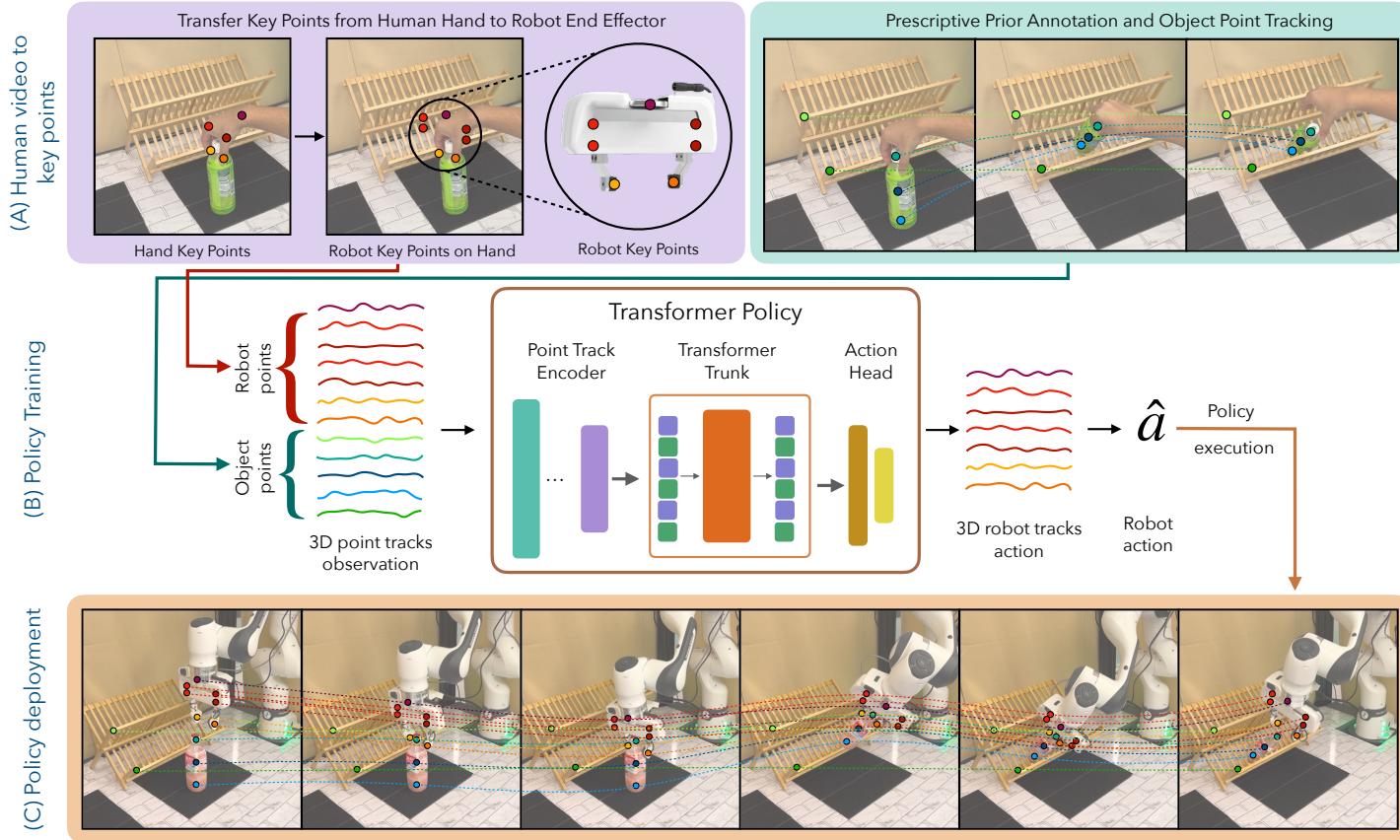
Let’s break down these stages step-by-step.
1. Human-to-Robot Pose Transfer
The first challenge is converting a video of a human hand doing a task into a “robot-compatible” representation.
Extracting Hand Points: The system uses an off-the-shelf hand detector (MediaPipe) to find the index finger and thumb of the human in every frame.
The Power of Triangulation: Using just one camera provides 2D points, which lose depth information. Using a depth camera (RGB-D) is an option, but sensor depth is often noisy and unreliable, especially for small objects or reflective surfaces. The authors use stereo triangulation. By recording the human from two camera views, they can mathematically triangulate the exact 3D coordinates (\(\mathcal{P}_h^t\)) of the hand with high precision.
Mapping to the Robot: The robot’s “position” is defined as the midpoint between the human’s index finger and thumb. But what about orientation? The robot needs to know how to twist its wrist.
The authors calculate the orientation change relative to the first frame. If the human rotates their hand 90 degrees, the robot should rotate its end-effector 90 degrees.
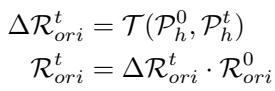
Here, \(\mathcal{T}\) represents the rigid transform between the hand in the first frame and the current frame. This relative rotation is applied to the robot’s starting orientation.
Once the robot’s end-effector pose (\(T_r^t\)) is determined, the system generates a set of “virtual” robot key points (\(\mathcal{P}_r^t\)) that rigidly move with the gripper.

This step effectively “ghosts” the robot over the human hand, creating a training dataset of robot movements derived entirely from human motion.
2. Capturing the Object State
A robot doesn’t just move its arm; it interacts with the world. Therefore, the policy needs to “see” the object (e.g., the bottle, the towel).
Point Policy uses a clever “human-in-the-loop” initialization that is extremely low-effort:
- Annotation: A human annotator takes one frame from one demonstration video and clicks on a few important points on the object (e.g., the handle of a mug).
- Propagation: Using the DIFT semantic correspondence model, those clicked points are automatically found in the first frames of all other demonstration videos.
- Tracking: Using Co-Tracker, those points are tracked through the entire duration of every video.
This results in a set of 3D object key points (\(\mathcal{P}_o\)) for every moment in time.
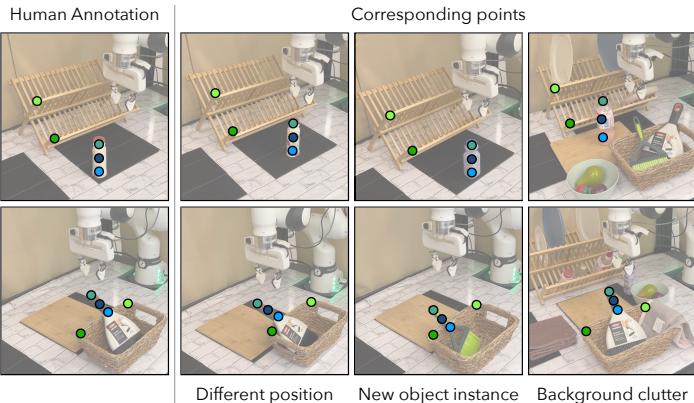
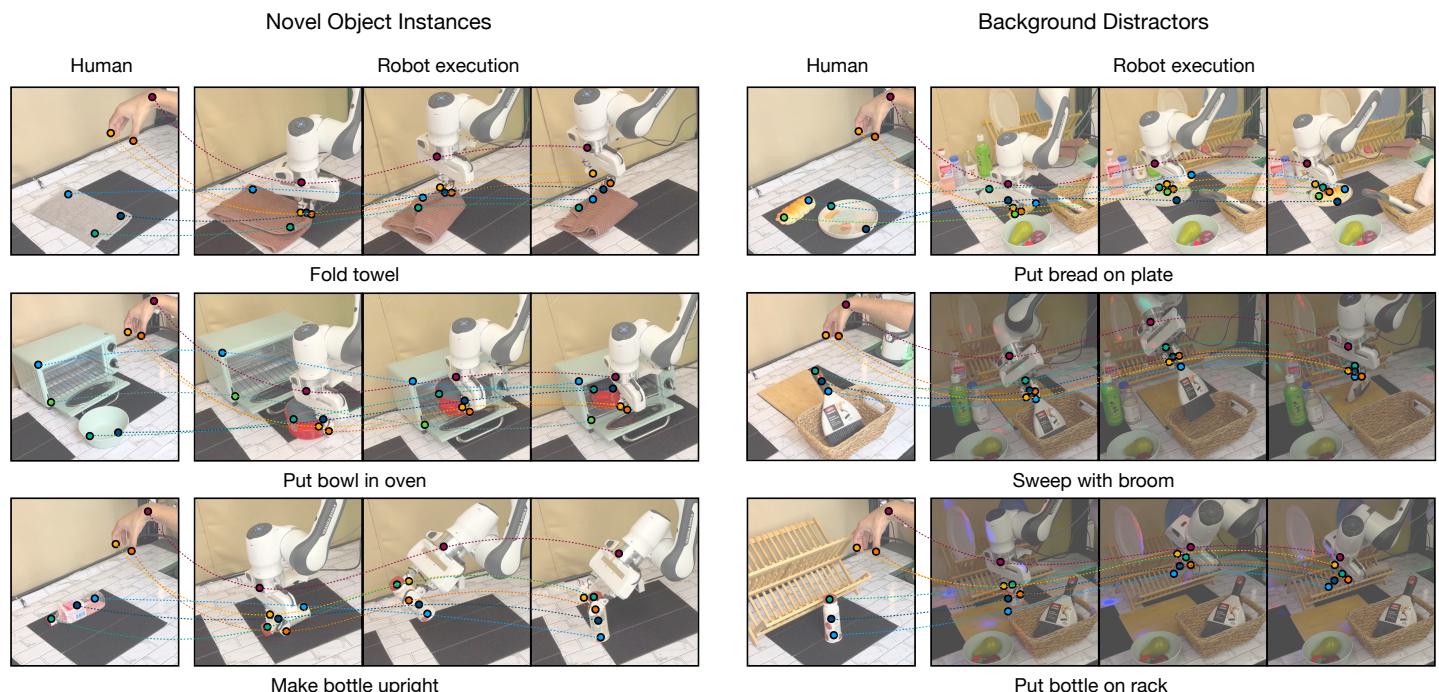
As shown in the image above, because the system relies on semantic correspondence, it can find the “rim of the bottle” even if the bottle is a different shape or color than the one originally annotated. This is crucial for generalization.
3. Policy Learning and Action Prediction
Now we have a dataset consisting of:
- Robot Key Points (\(\mathcal{P}_r\)): Where the robot should be (derived from human hands).
- Object Key Points (\(\mathcal{P}_o\)): Where the object is.
We train a Transformer policy (BAKU) to predict the future trajectory of the robot key points based on the history of observations.
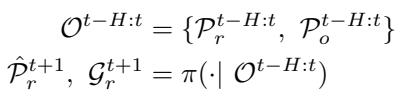
The policy \(\pi\) takes a history of observations (\(t-H\) to \(t\)) and predicts the robot points for the next step, along with the gripper state (open/closed).
4. Backtracking Actions
The neural network outputs a cloud of predicted points for the robot. However, a physical robot requires a 6-DoF (Degrees of Freedom) pose command (position + orientation).
The authors use Rigid Body Geometry to reverse the process. Since the arrangement of points on the robot gripper is fixed and known, they can mathematically solve for the optimal position (\(\hat{\mathcal{R}}_{pos}\)) and orientation (\(\hat{\mathcal{R}}_{ori}\)) that aligns the robot with the predicted point cloud.

This computed action is then sent to the robot controller at 6Hz.
Experimental Results
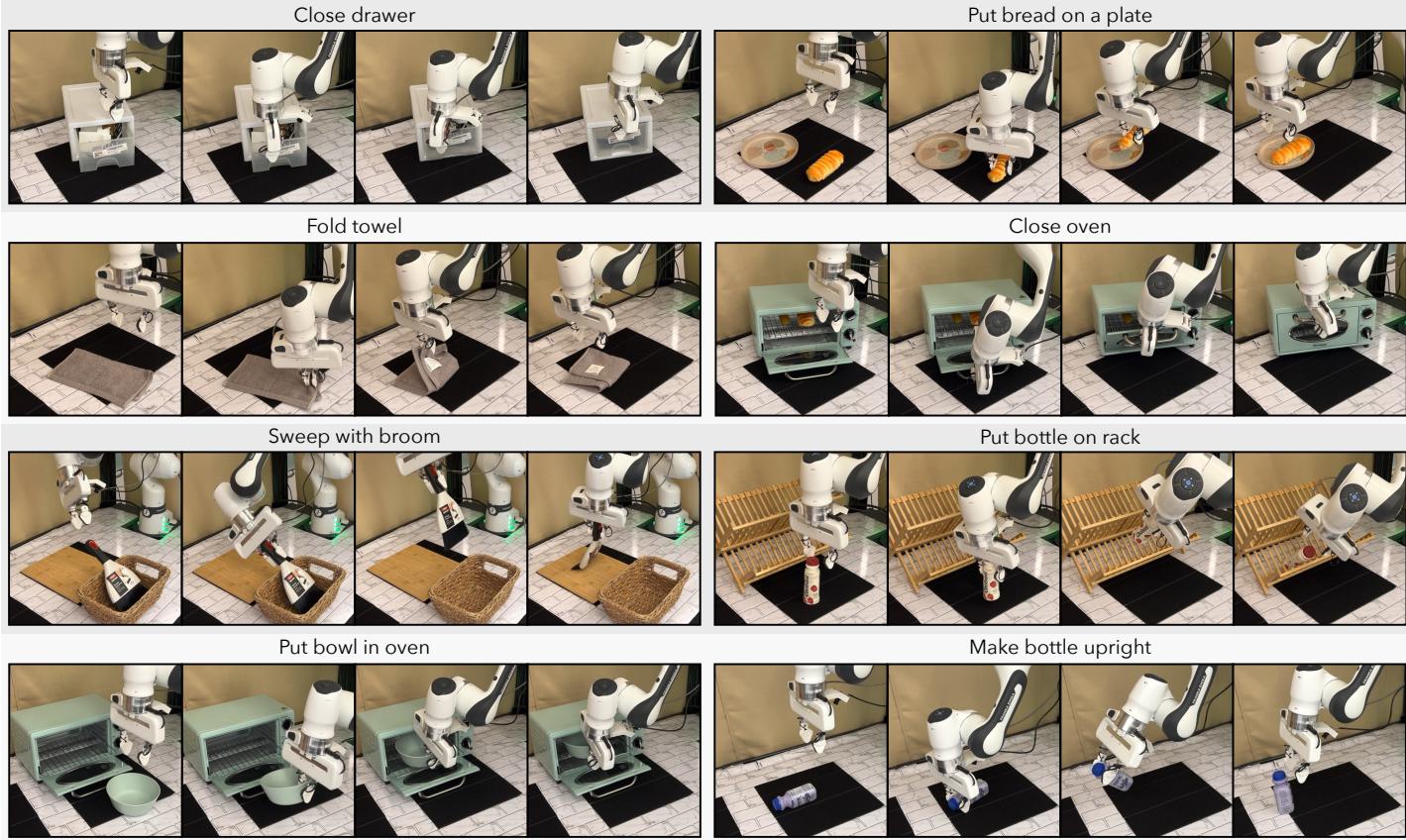
The researchers evaluated Point Policy on a Franka Emika robot across 8 real-world tasks, including closing drawers, folding towels, sweeping brooms, and placing bottles on racks.
They compared their method against several baselines:
- BC (RGB): Standard behavior cloning using raw images.
- BC (Depth): Behavior cloning using depth images.
- MT-\(\pi\): A strong baseline that also uses motion tracks but relies on 2D image inputs rather than explicit 3D unification.
- P3-PO: Another point-based method.
1. Performance on Seen Objects
The first test was “in-domain”—testing the robot on the same objects used in the human videos.
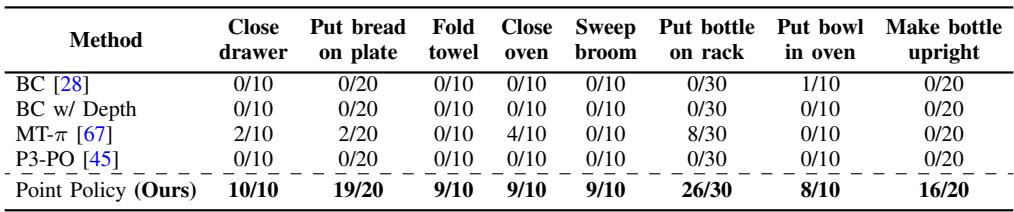
The results were staggering. Standard image-based behavior cloning failed almost completely (0% success on most tasks). This confirms that raw pixel data from human videos is too different from the robot’s perspective to be useful directly.
Point Policy achieved an 88% average success rate, outperforming the strongest baseline (MT-\(\pi\)) by an absolute margin of 75%.
2. Generalization to New Objects
The true test of a robotic system is whether it can handle objects it has never seen before. If the robot learned to “pick up the green bottle,” can it “pick up the blue bottle”?
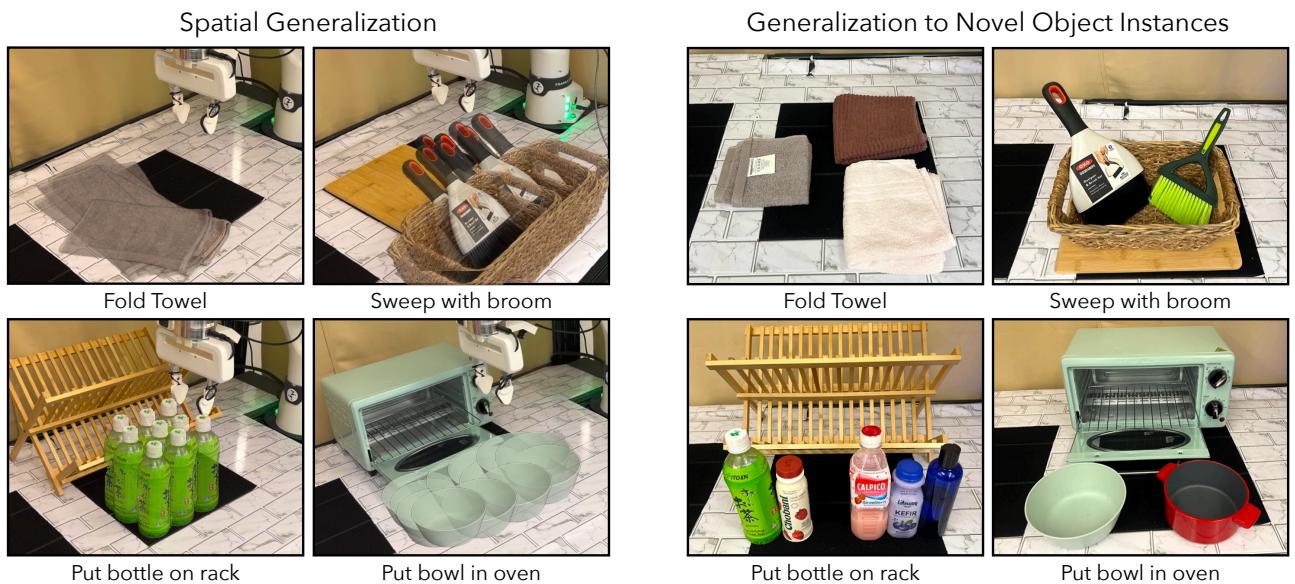
Because Point Policy relies on semantic key points rather than texture or color, it generalizes exceptionally well. The vision system (DIFT) identifies the “top of the bottle” regardless of color, and the policy simply reasons about the geometry of that point.
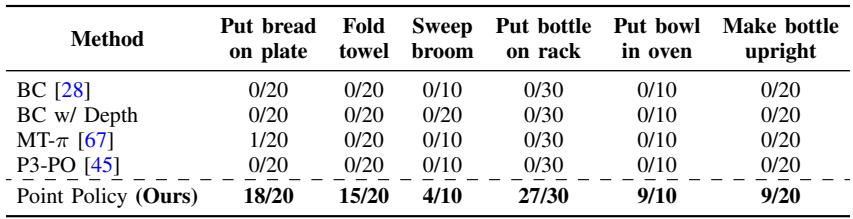
Point Policy achieved a 74% success rate on novel objects, whereas image-based baselines failed completely.
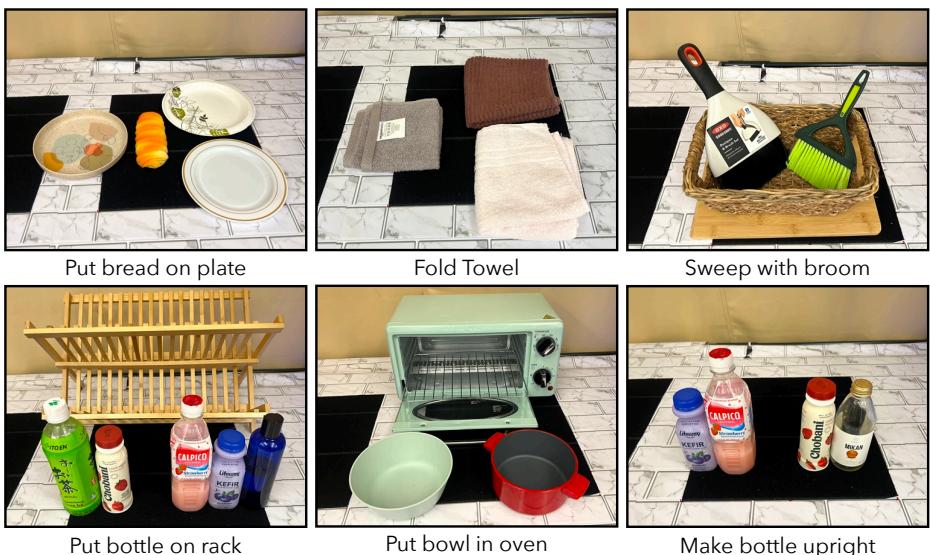
3. Robustness to Clutter
In the real world, tables are rarely empty. The authors introduced “distractors”—random objects scattered around the workspace—to see if the robot would get confused.

The performance remained stable. This highlights the benefit of the sparse point representation: the policy essentially “ignores” the clutter because no key points are generated for the irrelevant background objects.
Why Design Choices Matter
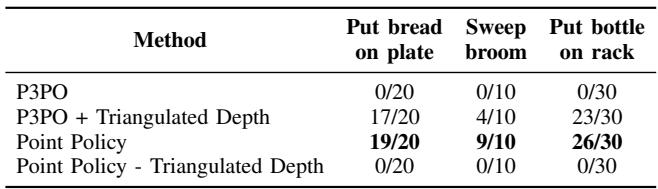
The paper includes a fascinating ablation study regarding depth. A common assumption is that modern depth cameras (like the Intel RealSense) are good enough for robotics.
However, the authors found that triangulation (using two standard cameras to calculate depth) was critical. When they replaced their triangulated points with sensor depth, performance plummeted to near zero.
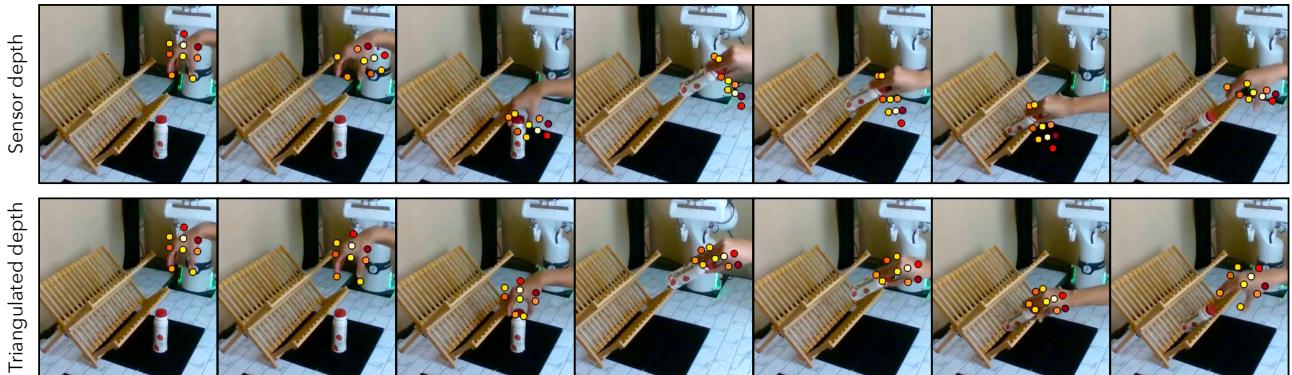
As shown in the image above (Figure 9 from the paper), sensor depth (top row) is noisy and inconsistent compared to the clean geometric signal from triangulation (bottom row). This noise leads to jittery, unreliable robot actions.
Conclusion and Implications
Point Policy represents a significant step forward in solving the data bottleneck for robotics. By abstracting the world into 3D key points, the authors have created a way to transfer skills from humans to robots without the need for:
- Teleoperated data collection.
- Complex reward engineering.
- Online reinforcement learning.
The key takeaway is that geometry acts as a universal bridge. While a human hand and a robot gripper look different, the geometric path required to place a bottle on a rack is identical in 3D space.
Limitations: The system is heavily dependent on the quality of the underlying vision models. If the hand detector fails or the point tracker loses track of the object (due to severe occlusion), the policy will fail. Additionally, using sparse points means the robot loses some context—it might not see an obstacle that hasn’t been assigned a key point.
However, as computer vision foundation models continue to improve, frameworks like Point Policy will likely become even more robust, bringing us closer to robots that can learn simply by watching us.