](https://deep-paper.org/en/paper/2502.20396/images/cover.png)
Introduction
We are currently witnessing a golden age of humanoid robotics. We see robots running, jumping, and performing backflips with impressive agility. Yet, there remains a glaring gap in their capabilities: manipulation. While a robot might be able to navigate a warehouse, asking it to perform a contact-rich task—like picking up a delicate object, reorienting it in its hand, or handing it over to another hand—remains incredibly difficult.
The complexity stems from the hardware itself. Humanoid hands are sophisticated, multi-fingered mechanisms with high degrees of freedom (DoF). Controlling them requires precise coordination. Traditional approaches often rely on Imitation Learning (IL), where robots mimic human demonstrations. While effective, IL is data-hungry, expensive, and labor-intensive. You need thousands of hours of teleoperation data to cover every possible edge case.
Reinforcement Learning (RL) offers a compelling alternative: let the robot learn by trial and error in a simulation. Simulators are fast, safe, and provide infinite data. However, the “Reality Gap”—the discrepancy between physics in a simulator and the real world—often causes policies trained in simulation to fail spectacularly when deployed on physical hardware.
In the paper “Sim-to-Real Reinforcement Learning for Vision-Based Dexterous Manipulation on Humanoids,” researchers from UC Berkeley, NVIDIA, and UT Austin propose a comprehensive “recipe” to solve this. They successfully trained a humanoid robot to perform complex, bimanual (two-handed) tasks using only simulation data, achieving robust zero-shot transfer to the real world.
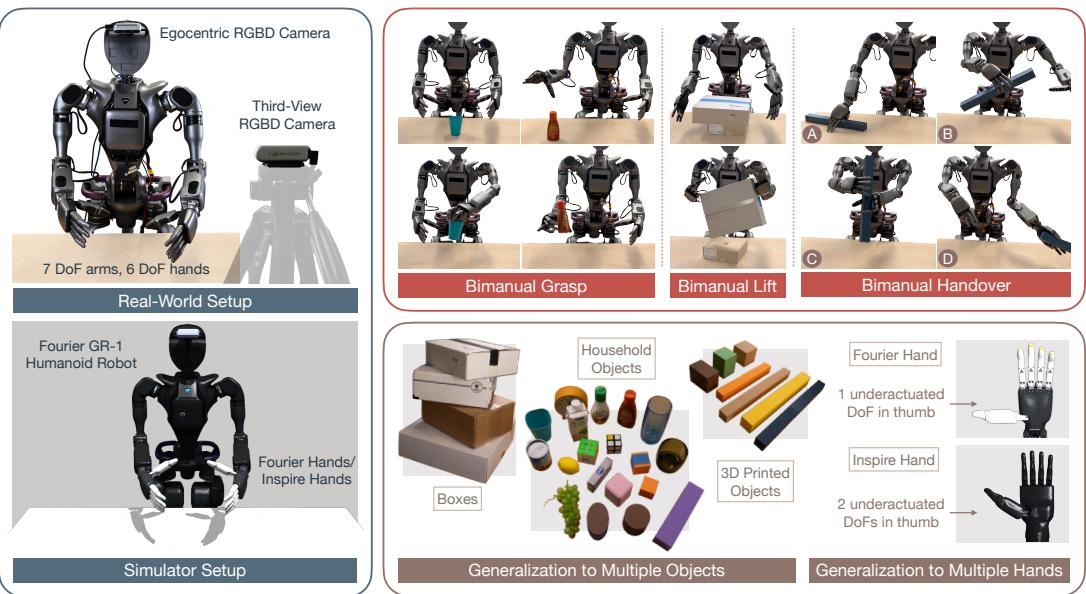
This post breaks down their methodology, explaining how they overcame the hurdles of low-cost hardware, complex coordination, and visual perception to create a generalized dexterous manipulation system.
Background: The Sim-to-Real Challenge
Before diving into the solution, we must understand the specific constraints of the problem.
The Hardware Constraint
The researchers used a Fourier GR1 humanoid robot. Unlike industrial robotic arms (like a Kuka or Franka) which have highly precise, expensive motors, humanoid platforms often use lightweight, lower-cost motors to keep the robot agile and affordable. These motors are “noisier”—they have higher friction, backlash, and less accurate torque sensing. A control policy that works perfectly in a pristine physics engine (like Isaac Gym) will fail on this hardware because the motors won’t respond exactly as predicted.
The Exploration Bottleneck
Reinforcement Learning agents learn by exploring. In a simple grid world, an agent can wander until it finds a goal. In bimanual dexterous manipulation, the “search space” is astronomical. With two arms and two multi-fingered hands, the number of possible joint configurations is massive. Without guidance, an RL agent might flail for millions of steps without ever accidentally achieving a complex task like a “handover,” meaning it never gets a reward signal to learn from.
The Perception Gap
Finally, there is vision. The robot must see the object to pick it up. However, rendered images in a simulator look different from real-world camera feeds (lighting, shadows, textures). This visual domain shift is a classic killer of sim-to-real policies.
The Core Method: A Four-Part Recipe
To bridge these gaps, the authors developed a four-part strategy. This isn’t just a single algorithm, but a pipeline designed to tackle each failure point of sim-to-real transfer.
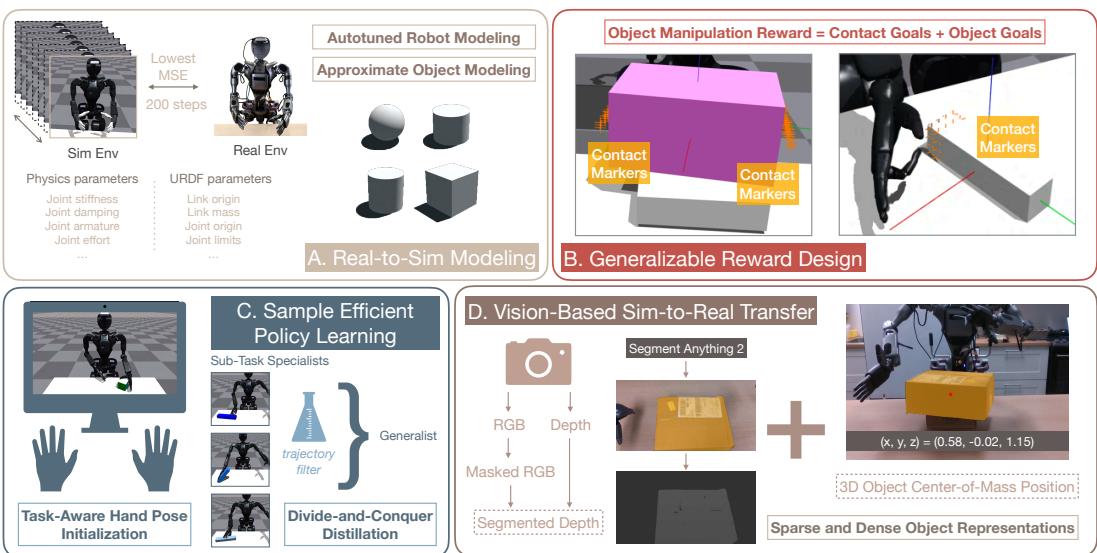
1. Real-to-Sim Modeling (The Autotuner)
The first step is making the simulator behave more like the real robot. Standard Unified Robot Description Format (URDF) files provided by manufacturers are often idealized. They don’t account for the wear and tear, specific friction coefficients, or damping of the actual unit you are using.
The authors introduced an automated real-to-sim tuning module. Instead of manually tweaking friction values for weeks, they use a data-driven approach:
- Real Data: They collect a small dataset (less than 4 minutes) of the real robot moving its joints.
- Parallel Sim: They spawn thousands of simulations with randomized physical parameters (joint stiffness, damping, friction).
- Optimization: They run the same motions in sim and measure the tracking error (MSE) against the real data. The parameters that minimize this error are selected.
This process essentially “calibrates” the simulator to match the specific quirks of the physical robot, creating a high-fidelity training ground.
2. Generalizable Reward Design
In RL, you get what you reward. If you reward a robot just for lifting a box, it might smash the box between its palms rather than grasping it delicately. For bimanual tasks, the coordination required is complex.
The researchers propose disentangling the reward into two components: Contact Goals and Object Goals.
They introduce the concept of “Contact Stickers.” These are virtual markers placed on the simulated object that represent ideal touch points for the fingertips.
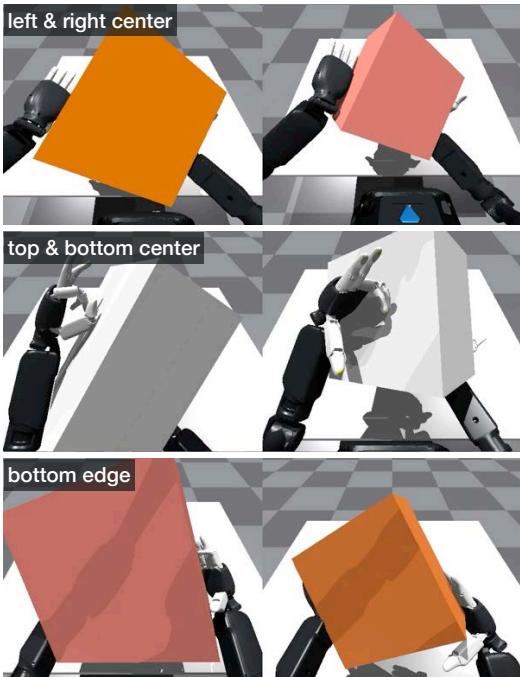
The reward function encourages the robot’s fingertips (\(F\)) to minimize the distance to these contact stickers (\(X\)) on the object. The mathematical formulation for the contact reward combines the distances for both the left (\(L\)) and right (\(R\)) hands:

For a complex task like a handover, the reward needs to be staged. The robot shouldn’t be rewarded for the receiving hand touching the object until the giving hand has successfully brought it close. The authors use a stage variable \(a\) (where \(a=0\) is the grasp phase and \(a=1\) is the transfer phase) to switch the active reward terms:

This structured reward design guides the agent through the long-horizon sequence of “grasp, lift, approach, transfer,” rather than hoping it stumbles upon the solution by chance.
3. Sample Efficient Policy Learning
Even with a good simulator and clear rewards, the exploration problem remains. To speed up training, the authors employ two clever strategies.
Task-Aware Initialization: Instead of starting every training episode with the hands in a neutral position far from the object, they use “human-guided” initialization. A human operator briefly uses a VR controller or teleoperation rig to place the robot’s hands in a relevant starting pose (e.g., near the object). These poses are recorded and used as starting points for the RL agent. This acts as a “hint,” placing the agent in a state where it is likely to encounter a reward quickly.
Divide-and-Conquer Distillation: Learning a single policy to pick up any object is hard. Learning to pick up one specific cylinder is easier. The team uses a “Student-Teacher” approach (specifically, distillation):
- Specialists: They train separate “specialist” policies for specific sub-tasks or specific object groups (e.g., one policy just for boxes, one just for cylinders).
- Distillation: They collect successful trajectories from all these specialists.
- Generalist: They train a single “Generalist” policy via Behavior Cloning (supervised learning) to mimic the successes of all the specialists.
This allows the system to conquer the difficulty of the task piece by piece before merging the skills into one robust brain.
4. Vision-Based Sim-to-Real Transfer
Finally, the robot needs to see. Using raw RGB pixels is difficult because of the visual reality gap. Using only ground-truth state (like positions from a mocap system) is cheating—you can’t use that in the real world easily.
The solution is a Hybrid Object Representation:
- Sparse Feature: The 3D center-of-mass of the object (estimated via a camera).
- Dense Feature: A segmented depth image.
They use Segment Anything Model 2 (SAM2) to isolate the object from the background in the RGB image. This mask is applied to the depth map. This removes background noise and focuses the neural network on the geometry of the object itself. By relying on depth (geometry) rather than RGB (texture/color), the gap between simulation and reality is significantly narrowed.
Experiments & Results
The team validated their recipe on three tasks: Grasp-and-Reach, Box Lift, and Bimanual Handover.
Training in Simulation
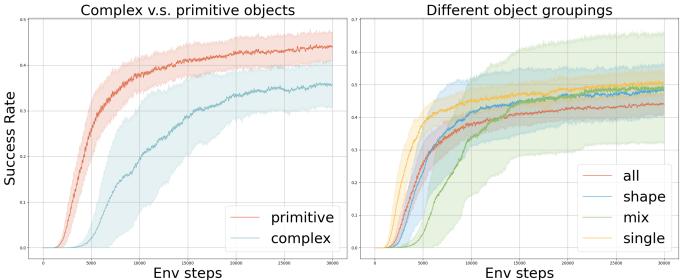
The training curves demonstrate the effectiveness of their “Divide-and-Conquer” strategy. The graph below on the left shows that policies learn faster on complex objects (blue) than primitives, but eventually plateau.
More interestingly, the graph on the right compares training strategies. The “Single” lines (training on one object) rise fastest. The “Mix” strategy (grouping objects) performs well. The “All” strategy (trying to learn everything at once from scratch) is the slowest and least effective. This validates the need for distillation—train easy specialists first, then combine them.
The result is a set of policies in simulation that are remarkably smooth and coordinated:

Validation of Real-to-Sim Autotuning
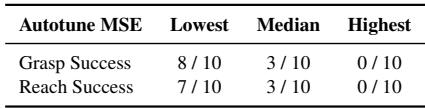
Does the automated tuning actually help? The researchers compared policies trained with parameters that had high error (poor tuning) vs. low error (autotuned).
The results in Table 1 are stark. Policies trained with the “Lowest MSE” (best tuning) achieved an 80% success rate on grasping. Policies trained with “Highest MSE” (poor tuning) failed completely (0%). This proves that for low-cost hardware, accurate physics calibration is not optional—it’s a prerequisite for success.
The Power of Hybrid Vision
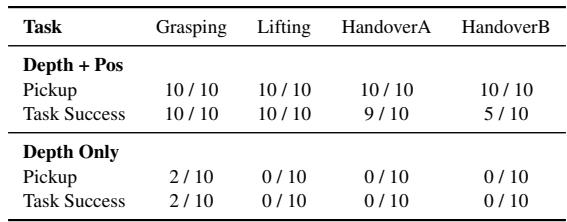
One of the most significant findings was the importance of the hybrid visual representation. They compared their method (Depth + 3D Position) against using Depth only.
In Table 3, looking at the “Lifting” and “Handover” tasks, the hybrid method achieves 10/10 and 9/10 success respectively. The Depth-only approach fails almost entirely (0/10). This suggests that while depth maps provide good geometric info for grasping, the “sparse” 3D position is crucial for the robot to understand where the object is in global space relative to its body.
Real-World Robustness and Generalization
The ultimate test is the real world. The robot achieved:
- 90% success on seen objects.
- 60-80% success on novel objects (objects it never saw in simulation).
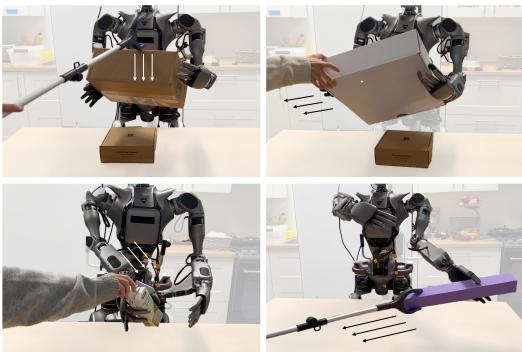
The policies proved incredibly robust. Because they were trained with domain randomization (varying physics and forces in sim), the real robot could withstand significant perturbations. As seen in Figure 6, the robot maintains its grasp even when a human actively pushes, pulls, or knocks the object.
Conclusion and Implications
The paper “Sim-to-Real Reinforcement Learning for Vision-Based Dexterous Manipulation on Humanoids” provides a blueprint for the future of robotic learning. It moves away from the idea that we need massive, expensive real-world datasets to teach robots dexterity.
Instead, it argues for a smarter use of simulation. By:
- Closing the physics gap (Autotuning),
- Structuring the learning problem (Rewards & Distillation), and
- Simplifying perception (Hybrid representations + SAM2),
…we can train capable, generalist robots almost entirely virtually.
This “recipe” makes high-end manipulation accessible even on lower-cost humanoid hardware, paving the way for robots that can truly assist in messy, unstructured human environments. The days of robots needing perfect conditions to pick up a box are numbered; the era of robust, adaptive manipulation is just beginning.