](https://deep-paper.org/en/paper/2502.20653/images/cover.png)
Introduction
In the era of deep learning, data is the new oil. But managing that oil is becoming an increasingly expensive logistical nightmare. Modern neural networks require massive datasets to train, leading to exorbitant storage costs and training times that can span weeks. This creates a high barrier to entry, often locking out students and researchers who don’t have access to industrial-grade computing clusters.
What if you could take a massive dataset like ImageNet—millions of images—and “distill” it down to a tiny fraction of its size, while retaining almost all the information needed to train a model?
This is the promise of Dataset Distillation. The goal is to synthesize a small set of images (synthetic data) so that a model trained on this tiny set achieves similar accuracy to a model trained on the original, massive dataset.
While the concept is enticing, making it work is incredibly difficult. Current methods often struggle to balance performance with computational efficiency. They either produce low-quality data or require so much GPU memory to run the distillation process that they defeat the purpose.
In this post, we are diving deep into a new paper: “Dataset Distillation with Neural Characteristic Function: A Minmax Perspective.” The authors introduce a groundbreaking approach called Neural Characteristic Function Matching (NCFM). By moving the problem into the complex plane and treating distillation as a minmax game, they achieve results that are not only more accurate but also radically more efficient—reducing GPU memory usage by over 300\(\times\).
Let’s explore how they managed to compress CIFAR-100 losslessly using only 2.3 GB of memory.
The Background: The Flaws of Distribution Matching
To understand why NCFM is necessary, we first need to look at how dataset distillation is currently done. One of the most popular families of methods is called Distribution Matching (DM).
The intuition behind DM is straightforward: If we can force the statistical distribution of our small synthetic dataset to look exactly like the distribution of the large real dataset, then a neural network shouldn’t be able to tell the difference during training.
The challenge lies in how we measure the “distance” between two distributions.
The Problem with MSE and MMD
Early approaches used Mean Squared Error (MSE) to match features. They would run real and synthetic images through a network and try to minimize the Euclidean distance between their features.
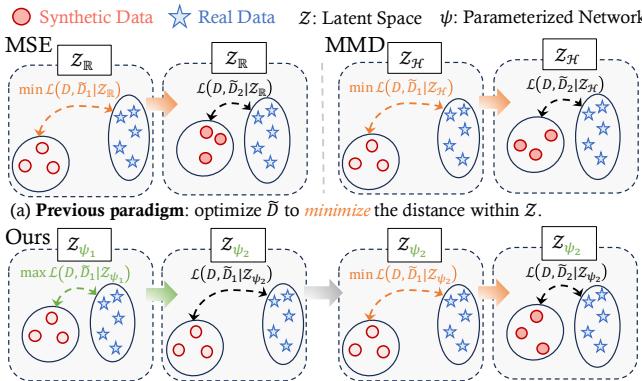
As shown in Figure 1(a), MSE operates in Euclidean space (\(\mathcal{Z}_{\mathbb{R}}\)). It compares points directly. However, matching point-wise features doesn’t necessarily mean you’ve captured the semantic structure of the data manifold. It’s a bit like trying to make two paintings look identical by matching the average color of specific pixels rather than the shapes and subjects.
To improve this, researchers adopted Maximum Mean Discrepancy (MMD). MMD tries to align the “moments” (statistical properties like mean and variance) of the distributions in a Hilbert Space (\(\mathcal{Z}_{\mathcal{H}}\)). While better than MSE, MMD has a theoretical flaw: aligning moments is a necessary condition for distributions to be identical, but it is not a sufficient one.
Consider Figure 2(b) below. The blue bars represent the real data distribution, and the pink bars represent the synthetic data optimized via MMD. Even after 10,000 iterations, the distributions are misaligned. MMD failed to capture the full picture because it relies on fixed kernel functions that might not look at the data in the right way.

The authors of this paper argue that we need a metric that is rigorous, unique, and captures the entirety of the distribution information.
The Core Method: Neural Characteristic Function Matching (NCFM)
The researchers propose two major shifts in perspective to solve the distillation problem:
- The Metric: Switch from PDFs or Moments to the Characteristic Function (CF).
- The Optimization: Switch from a static loss function to an Adversarial Minmax game.
1. The Characteristic Function (CF)
In probability theory, the Characteristic Function is the Fourier transform of the probability density function. Crucially, there is a one-to-one correspondence between a CF and a cumulative distribution function (CDF).
If two variables have the same Characteristic Function, they are identically distributed. No information is lost. This makes the CF a “sufficient” statistic for distribution matching.
The definition of the Characteristic Function \(\Phi_x(t)\) for a random variable \(x\) and frequency argument \(t\) is:

By Euler’s formula, this transforms the data into the complex plane, giving us both magnitude (amplitude) and phase (angle) information. This is a critical advantage over Euclidean metrics, which flatten this rich information.
2. The Minmax Perspective
Standard distribution matching uses a fixed yardstick (like MSE) to measure the gap between real and synthetic data. The authors realize that a fixed yardstick is rigid. Instead, they propose a dynamic, learnable metric.
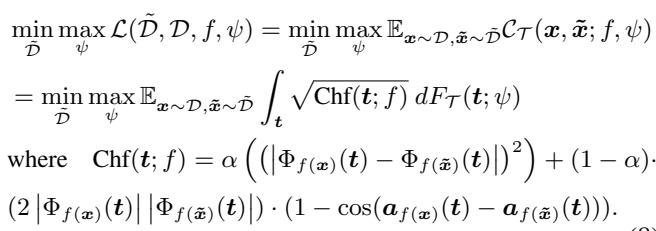
They formulate dataset distillation as a Minmax problem:
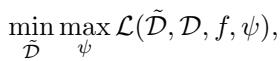
Here is the intuition:
- The Maximizer (\(\psi\)): A neural network (the Sampling Network) tries to find the specific “viewpoints” (frequency arguments \(t\)) where the real and synthetic distributions look the most different. It maximizes the discrepancy.
- The Minimizer (\(\tilde{\mathcal{D}}\)): The synthetic dataset is updated to minimize this discrepancy found by \(\psi\).
This creates a feedback loop. As the synthetic data gets better, the Sampling Network (\(\psi\)) has to work harder to find subtle differences. This forces the synthetic data to align with the real data with increasing precision.
Referring back to Figure 1(b), you can see this flow: we first optimize \(\psi\) to establish a latent space \(Z_\psi\) that highlights differences, and then we optimize the synthetic data within that space.
The Architecture of NCFM
How does this look in practice? The complete pipeline is illustrated in Figure 4.
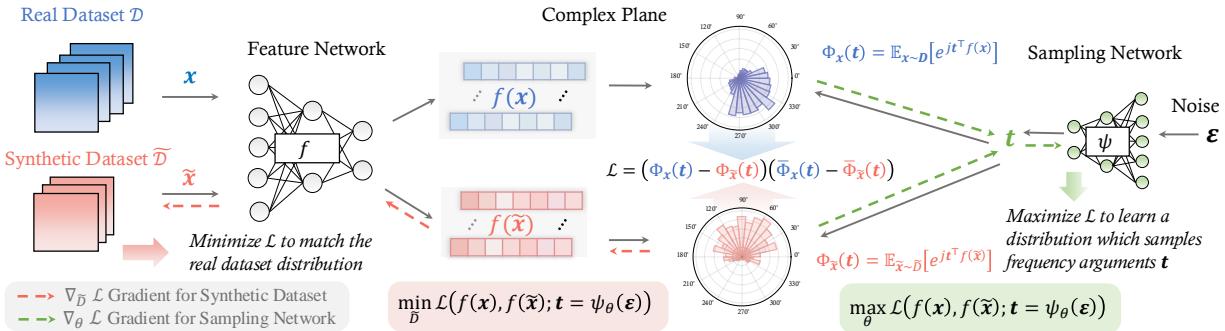
The process involves three main components:
- Feature Network (\(f\)): Both real (\(x\)) and synthetic (\(\tilde{x}\)) images are passed through a feature extractor (a ConvNet) to get high-level representations.
- Sampling Network (\(\psi\)): Instead of checking every possible frequency \(t\) (which is infinite), a lightweight neural network generates specific frequencies \(t\) to sample. It is trained to pick the \(t\) values that maximize the calculated difference.
- Complex Plane Mapping: The features are mapped to the complex plane using the characteristic function formula.
The Discrepancy Metric (NCFD)
The heart of the method is the Neural Characteristic Function Discrepancy (NCFD). This is the actual number that the system tries to minimize.

This integral looks intimidating, but it essentially sums up the differences across the frequencies \(t\) selected by the sampling network.
Decomposing Realism and Diversity
One of the most elegant insights in this paper is the decomposition of the loss function. Because they are working in the complex plane, they can split the error into two distinct parts: Amplitude and Phase.
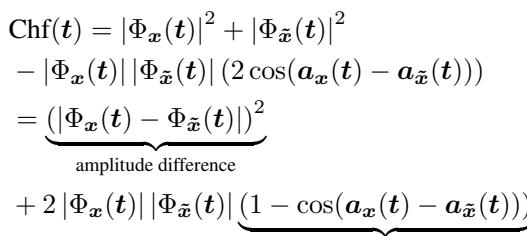
The authors define the roles of these two components clearly:
- Phase Difference (\(1 - \cos(...)\)): This encodes the “centers” of the data. Aligning the phase ensures Realism—making sure a synthetic cat looks like a cat.
- Amplitude Difference (\(|\Phi|^2\)): This captures the scale of the distribution. Aligning amplitude ensures Diversity—making sure the synthetic dataset covers the variety of cats (different colors, poses) found in the real set.
By introducing a hyperparameter \(\alpha\) to balance these two terms, NCFM can ensure the generated data is both realistic and diverse.
Experiments and Results
Does this complex math translate to better performance? The results suggest a resounding yes.
Performance on Benchmarks
The authors tested NCFM on standard benchmarks like CIFAR-10, CIFAR-100, and subsets of ImageNet (Tiny ImageNet, ImageNette, etc.).
Table 1 below shows the results on CIFAR-10 and CIFAR-100.
- IPC: Images Per Class. “IPC 1” means distilling the whole dataset down to just one image per category.
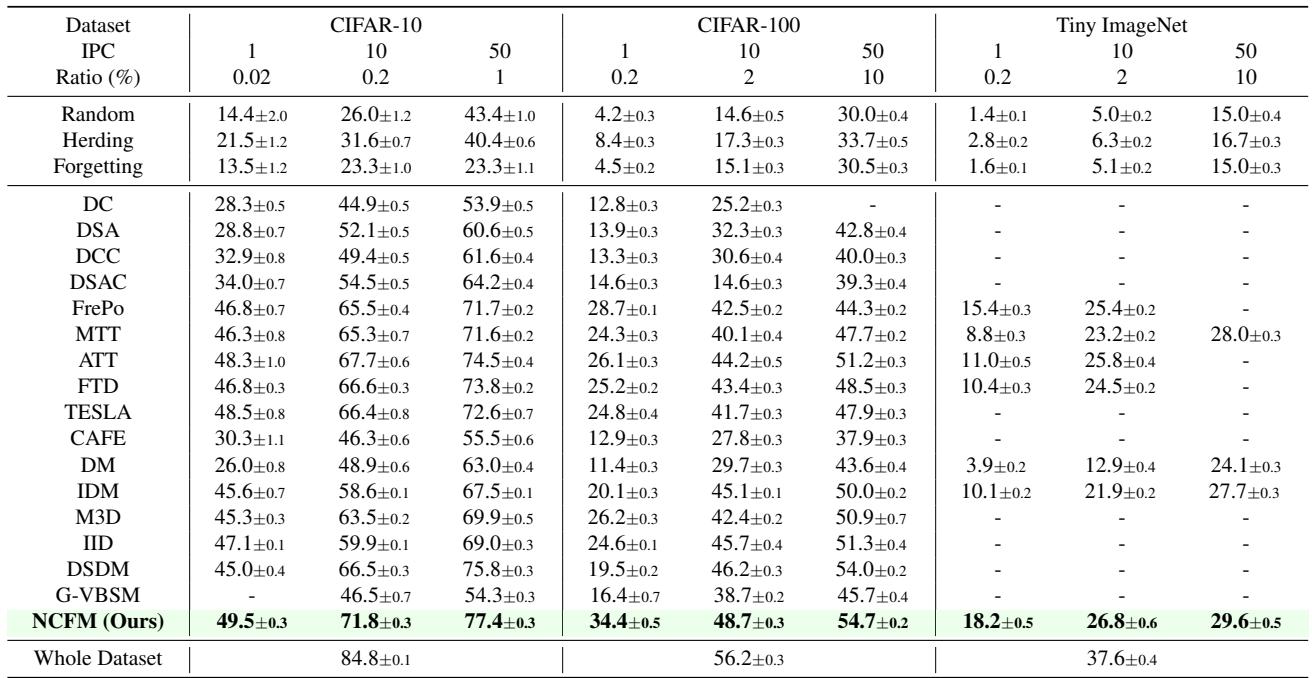
Look at the CIFAR-100 column (IPC=1). The previous best distribution matching method (DM) achieved 11.4%. NCFM achieved 34.4%. That is a massive jump in accuracy for such a highly compressed regime. Even against trajectory matching methods (like MTT) which are usually computationally heavier, NCFM holds its own or wins.
On higher resolution datasets like ImageNet subsets (Table 2), the trend continues. On “ImageSquawk,” NCFM improved accuracy by 20.5% over state-of-the-art methods at IPC 10.

The “Mic Drop” Moment: Efficiency
While accuracy is great, the efficiency numbers are arguably the most important contribution of this paper. Dataset distillation is notoriously memory-hungry. Many methods (like MTT or DATM) require buffering training trajectories, which fills up GPU VRAM instantly.
Figure 3 illustrates the trade-off between accuracy, speed, and memory.
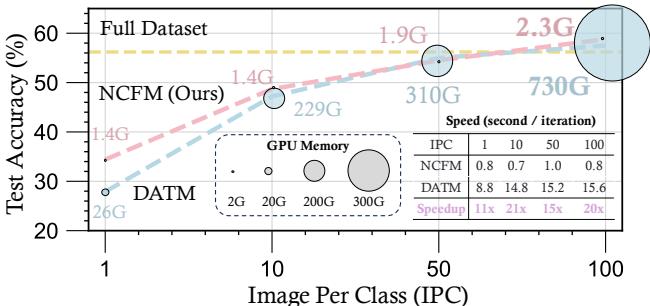
- Blue Line (NCFM): High accuracy, very low memory usage (the small dots).
- Red Line (DATM): High memory usage (the large circles).
Table 3 puts exact numbers to this efficiency. On CIFAR-100 (IPC 50), the method DATM runs out of memory (OOM) on an 80GB A100 GPU. NCFM runs comfortably using less than 2GB.
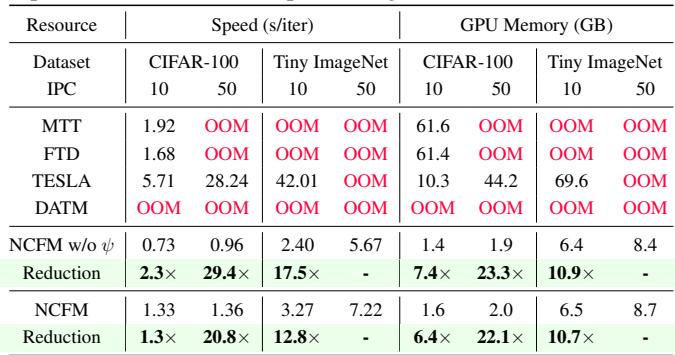
The authors state: “NCFM reduces GPU memory usage by over 300x… and achieves 20x faster processing speeds.” This efficiency allows them to run high-IPC experiments on a single, older consumer GPU (NVIDIA 2080 Ti), democratizing this research area.
Why does it work? (Ablation Studies)
To ensure the gains weren’t just luck, the authors analyzed specific components.
1. Does the Sampling Network (\(\psi\)) matter? They ran the experiment without the adversarial sampling network (just using random frequencies). Table 5 shows that the learned sampling network provides a consistent boost, especially at higher IPCs (e.g., +3.2% on CIFAR-10 IPC 50). This proves that learning where to measure the difference is valuable.

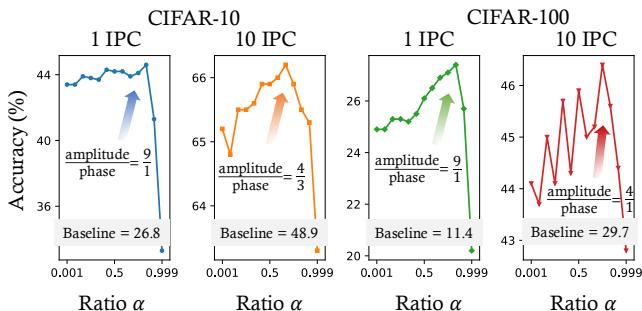
2. The Balance of Phase and Amplitude Remember the \(\alpha\) parameter that balances Phase (Realism) and Amplitude (Diversity)? Figure 5 shows what happens when you tweak it. If you rely too much on Amplitude (high \(\alpha\)) or too much on Phase (low \(\alpha\)), performance drops. The “sweet spot” confirms that you need both geometric realism and statistical diversity for effective distillation.
Discussion: Stability and Theory
One common criticism of minmax (adversarial) approaches—like GANs—is that they are unstable to train. The generator and discriminator often oscillate without converging.
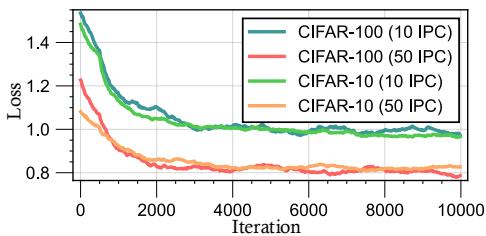
However, NCFM displays remarkable stability. Figure 7 shows the training loss smoothly converging over iterations across different datasets.
Why is it stable? The authors link their method to Lévy’s Convergence Theorem. Because the Characteristic Function is a continuous, bounded transformation, it doesn’t suffer from the same exploding gradient problems that can plague standard GANs.
Furthermore, the authors draw a fascinating theoretical connection: MMD is actually a special case of NCFM. If you restrict the Characteristic Function to match only specific moments, it mathematically collapses into MMD. This explains why NCFM is strictly superior—it generalizes MMD to capture the full distributional picture.
Conclusion
The paper “Dataset Distillation with Neural Characteristic Function: A Minmax Perspective” represents a significant maturation in the field of data condensation. By abandoning the “Euclidean” view of data and embracing the complex plane via Characteristic Functions, the authors have solved two problems at once:
- Accuracy: They align distributions more precisely than ever before.
- Efficiency: They do so using linear-time computations rather than quadratic, slashing memory requirements.
For students and researchers, the implication is clear: you no longer need a massive compute cluster to experiment with dataset distillation. With NCFM, high-quality data synthesis is possible on a standard desktop GPU, opening new doors for efficient AI training and privacy-preserving data sharing.