](https://deep-paper.org/en/paper/2502.21201/images/cover.png)
Introduction
Imagine you are training a computer vision model to recognize a chimpanzee climbing a tree. You feed it thousands of hours of video footage. The model achieves high accuracy, and you are thrilled. But then, you test it on a video of an empty forest with no chimpanzee in sight, and the model confidently predicts: “Climbing.”
Why does this happen? The model has fallen into a trap known as shortcut learning. Instead of learning the complex motion of the limbs or the texture of the fur, the model took the path of least resistance: it learned that “vertical tree trunks” usually equal “climbing.” It memorized the background, not the behavior.
This phenomenon is a critical issue in computer vision, particularly in wildlife conservation. Conservationists rely on camera traps—motion-triggered cameras strapped to trees—to monitor endangered species. If an AI model cannot distinguish between a background environment and animal behavior, its ability to generalize to new locations (Out-of-Distribution or OOD data) collapses.
In this post, we are diving deep into a new research paper titled “The PanAf-FGBG Dataset: Understanding the Impact of Backgrounds in Wildlife Behaviour Recognition.” This paper introduces a novel dataset and a clever method to quantify and mitigate this background bias.
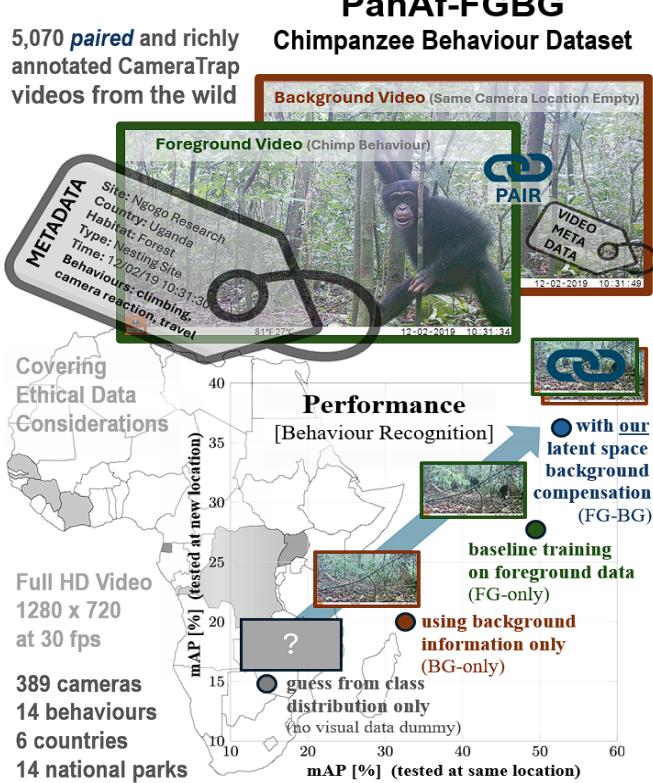
As shown in Figure 1 above, the researchers have created a unique resource: a dataset where every video of a chimpanzee is paired with a video of the exact same location without the chimpanzee. This allows us to mathematically subtract the forest from the equation and force the AI to look at the animal.
The Background: Shortcut Learning and The “Lazy” AI
To understand the significance of this paper, we first need to understand the behavior of Deep Neural Networks (DNNs). DNNs are notoriously “lazy.” If there is a strong correlation between a static background feature (like a termite mound) and a label (like “feeding”), the network will latch onto the termite mound because it is easier to detect than the subtle hand movements of a chimp using a tool.
In human action recognition, this is a well-known problem. Studies have shown that models can predict actions like “playing tennis” just by recognizing a tennis court, even if the players are removed from the image.
The Challenge in Wildlife Video
In the wild, this problem is exacerbated. Camera traps are static. They stare at the same background for months. If you train a model on data from “Camera A” (a forest trail) and “Camera B” (a fruit tree), the model might learn that the green texture of Camera B means “eating,” rather than identifying the act of eating itself.
When you move that camera to a new national park (a new distribution), the model fails because the background cues have changed. This is the Out-of-Distribution (OOD) generalization problem.
Previously, researchers tried to study this by synthetically removing animals from videos (using software to black them out or fill them in). However, synthetic data introduces artifacts that can confuse the model even further. What we really need is the “ground truth” of the background: a real video of the scene, completely empty.
Introducing the PanAf-FGBG Dataset
The researchers present PanAf-FGBG, a massive leap forward for ethological (animal behavior) computer vision. This dataset is derived from the Pan African Programme, covering 21 hours of footage from 389 camera locations across 14 national parks in 6 African countries.
What Makes it Unique?
The standout feature of PanAf-FGBG is the Foreground-Background (FG-BG) pairing.
- Foreground Video: A video clip containing a chimpanzee exhibiting a specific behavior.
- Background Video: A video clip from the same camera trap, at a similar time of day, but empty.
This pairing is not a trivial task. It requires sifting through massive amounts of footage to find empty clips that match the lighting and environmental conditions of the behavioral clips.
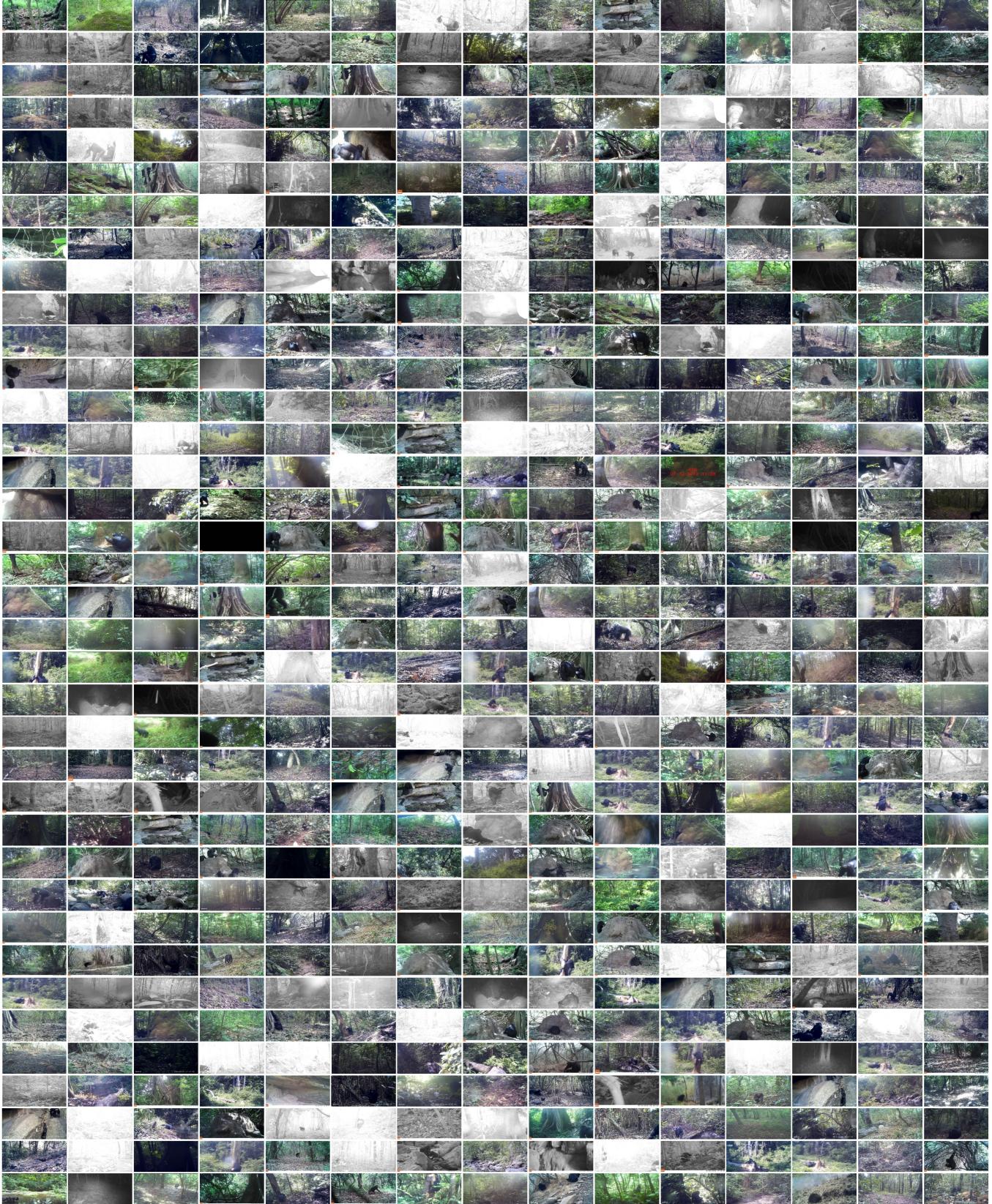
As you can see in the dataset overview above, the diversity is immense. The footage captures varying lighting conditions, weather, and habitats ranging from dense forests to savannas.
Behaviors and Class Imbalance
The dataset includes annotations for behaviors such as tool use, climbing, feeding, and resting. Like most real-world data, it follows a “long-tailed” distribution.
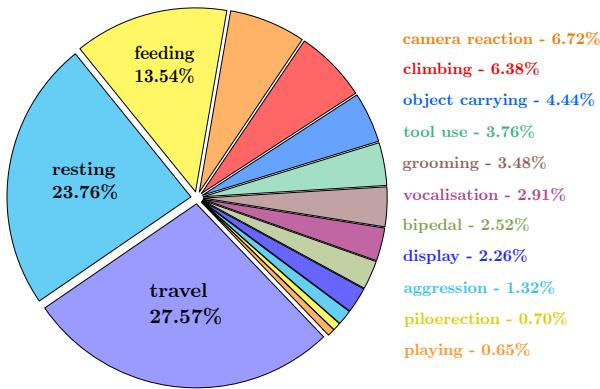
Some behaviors, like “Travel” and “Resting,” are very common (the head of the tail), while distinct behaviors like “Aggression” or “Playing” are rare (the tail). This imbalance adds another layer of difficulty for recognition models.
Real vs. Synthetic
Why go through the trouble of finding real background videos? Why not just use modern AI to remove the chimp?
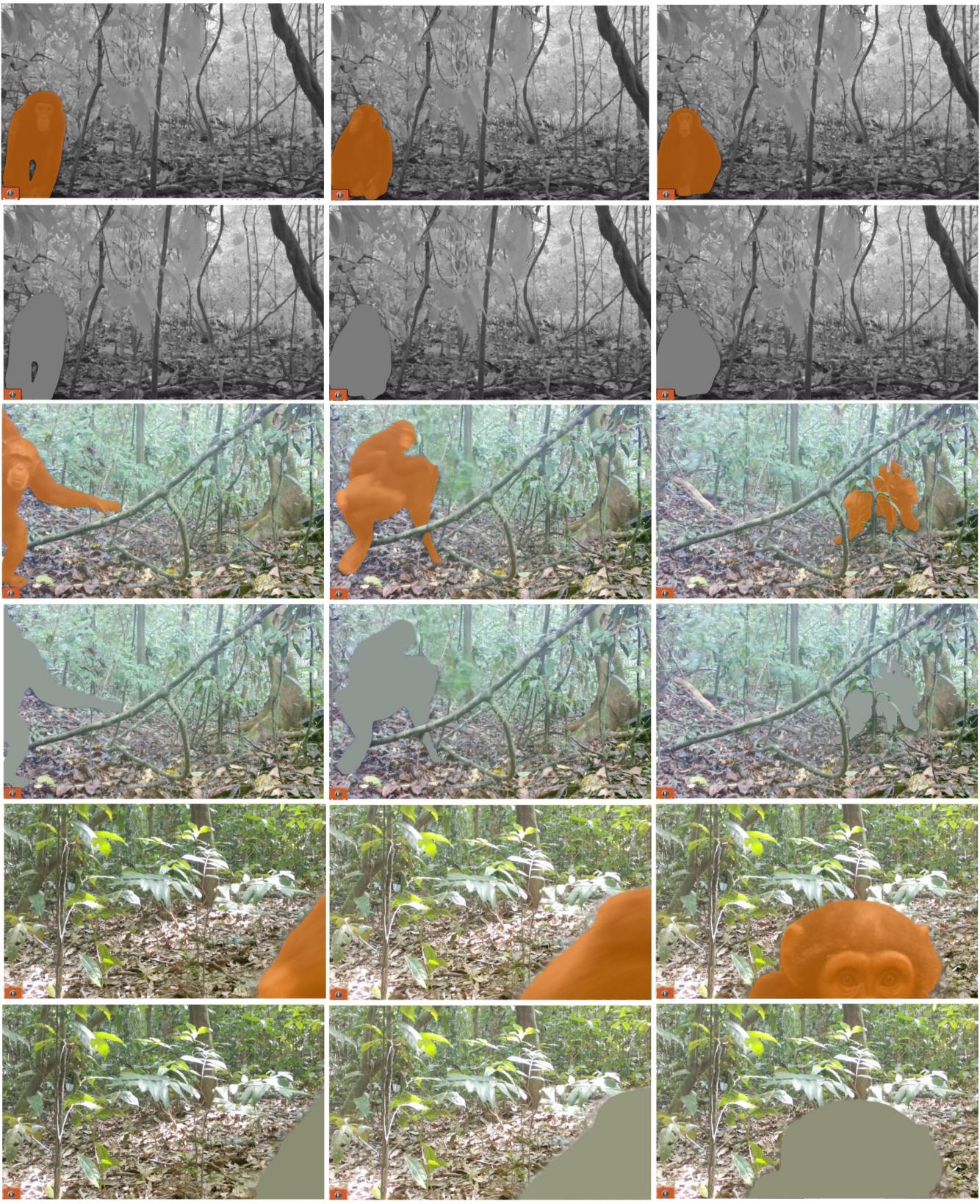
The image above shows synthetic backgrounds generated by masking the chimp and filling the space with the mean pixel value. While useful, these synthetic backgrounds lack the natural movement of leaves, shadows, and lighting changes found in a real background video. The paper demonstrates that using real paired backgrounds is far more effective for training robust models.
Experimental Setup: Overlapping vs. Disjoint
To rigorously test how well models generalize, the authors defined two distinct experimental configurations. This distinction is crucial for understanding the results.
- Overlapping Configuration (\(\mathcal{D}^{overlap}\)): The camera locations in the training set and the test set are shared. If Camera #123 is in the training data, other clips from Camera #123 are also in the test data. This tests the model’s ability to recognize behavior in familiar environments.
- Disjoint Configuration (\(\mathcal{D}^{disjoint}\)): The camera locations are mutually exclusive. If Camera #123 is in the training data, the model has never seen Camera #123 when it is being tested. This mimics the real-world scenario of deploying a trained AI to a brand-new national park.
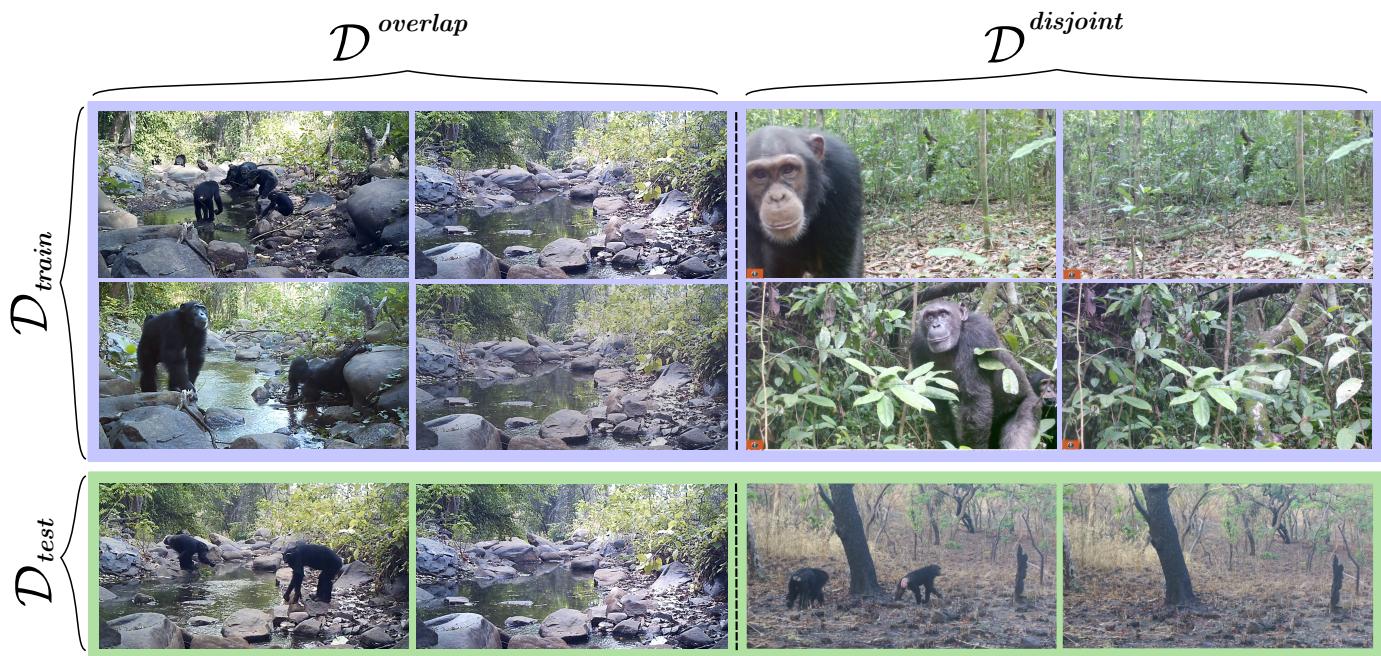
Figure 4 illustrates this beautifully. On the left (Overlapping), the test video looks very similar to the training video—same riverbed, same rocks. On the right (Disjoint), the test environment is completely new. This “Disjoint” setting is the ultimate test of whether the model has learned the behavior or just the background.
The Core Method: Latent Space Background Neutralisation
The researchers didn’t just provide data; they proposed a solution to the background bias problem. Their hypothesis was simple: if we can tell the network what the “background” looks like, it can subtract that information from the “foreground” video, leaving only the “behavior” behind.
They achieved this through a technique called Latent Space Background Neutralisation.
How it Works
- Dual Streams: The model takes two inputs: the video with the chimp (Foreground) and the paired empty video (Background).
- Feature Extraction: Both videos are passed through the same backbone network (like ResNet-50 or MViT).
- Latent Space: Instead of subtracting pixels (which is messy and sensitive to alignment), the subtraction happens deep inside the network, in the “latent space” (the high-dimensional feature vectors).
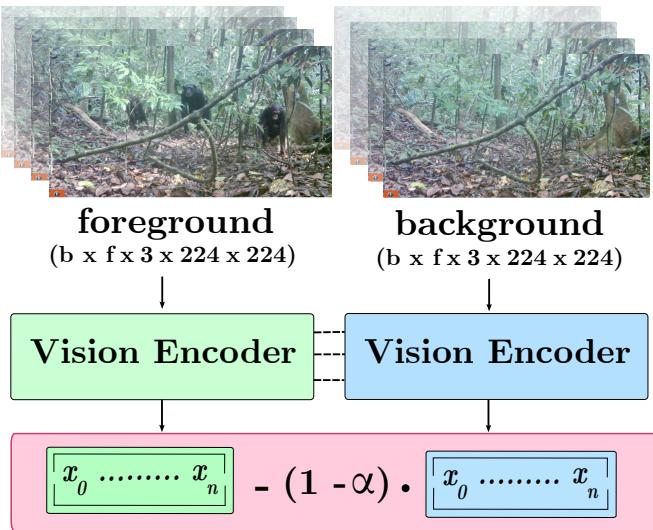
As shown in the architecture diagram above, the process involves a mathematical operation on the feature vectors (\(z\)).
The formula is conceptually:
\[z^{\text{result}} = z^{\text{Foreground}} - (1 - \alpha) \cdot z^{\text{Background}}\]Here, \(\alpha\) is a modulation parameter that changes during training. Initially, the model might rely on the background, but as training progresses, the system forces the features of the background to be “neutralized” or subtracted from the representation. This forces the classification layer to make decisions based solely on the unique features of the chimp’s action.
Experiments and Results
The authors conducted extensive experiments using Convolutional Neural Networks (ResNet-50) and Transformers (MViT-V2). Here are the key takeaways.
1. The Environment is a Cheat Sheet
The first question was: “How much does the background alone tell us?” To answer this, they trained models only on the empty background videos but assigned them the labels of the chimpanzee behaviors that would eventually happen there.
The results were striking. Background-only models achieved roughly 65% of the performance of models that actually saw the chimp. This confirms that the environment is a massive predictor. If the camera is pointed at a fruit tree, the chimp is likely “Feeding.” If it’s a trail, the chimp is “Traveling.” This proves why OOD generalization is so hard—the “cheat sheet” (the background) changes in new locations.
2. The “Background Duration” Problem
In wildlife monitoring, camera traps often trigger early, recording seconds of empty forest before the animal enters the frame. The researchers analyzed how this “background duration” affects performance.
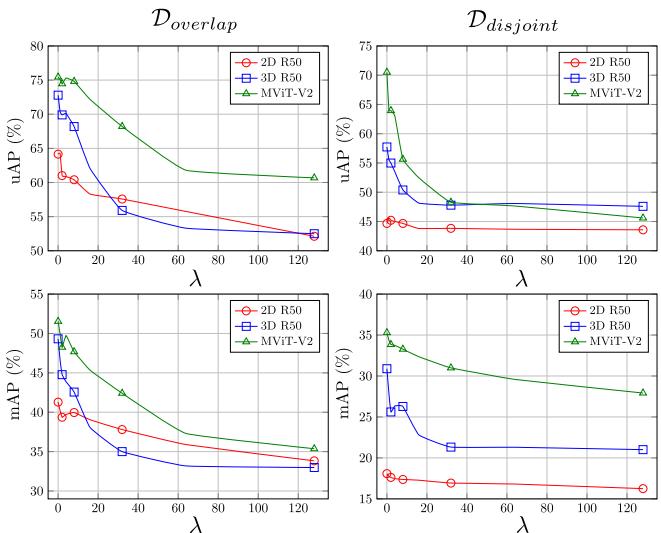
The graph above reveals a fascinating difference between architectures:
- 3D-ResNet (CNN): Performance drops significantly as you add more empty background frames (\(\lambda\)). The CNN gets “bored” or confused by the empty frames and loses track of the action.
- MViT-V2 (Transformer): This model is much more robust. Thanks to the “Attention” mechanism inherent in Transformers, it can effectively ignore the empty frames and focus on the specific tokens (patches of video) where the chimp appears. However, even the Transformer struggles when tested on OOD data (Disjoint) with high background duration.
3. The Power of Neutralisation
Finally, they tested their proposed Latent Space Neutralisation method.
- Input Space Subtraction: Simply subtracting the background pixels from the foreground video worked okay for simple 2D networks, but failed for advanced 3D networks.
- Latent Space Subtraction: This was the winner. By subtracting features in the embedding space using the paired real-world videos, they achieved significant gains.
Key Result: On the challenging Disjoint (OOD) dataset, the latent space method improved performance by +5.42% mAP for the ResNet model and +3.75% mAP for the Transformer model.
This is a substantial improvement in the world of computer vision, effectively proving that “teaching” the model what to ignore allows it to better understand what to focus on.
Conclusion and Implications
The PanAf-FGBG dataset serves as a wake-up call and a toolkit for the computer vision community. It empirically quantifies what many have suspected: that our best models are often over-relying on background scenery rather than understanding action.
By providing paired foreground and background videos, the authors have enabled a new way to train AI. We can now explicitly force models to decouple the “stage” from the “actor.”
For wildlife conservation, this is a game-changer. It means we can train models on data from one set of national parks and have higher confidence that they will work when deployed to protect species in a completely new, unmonitored location.
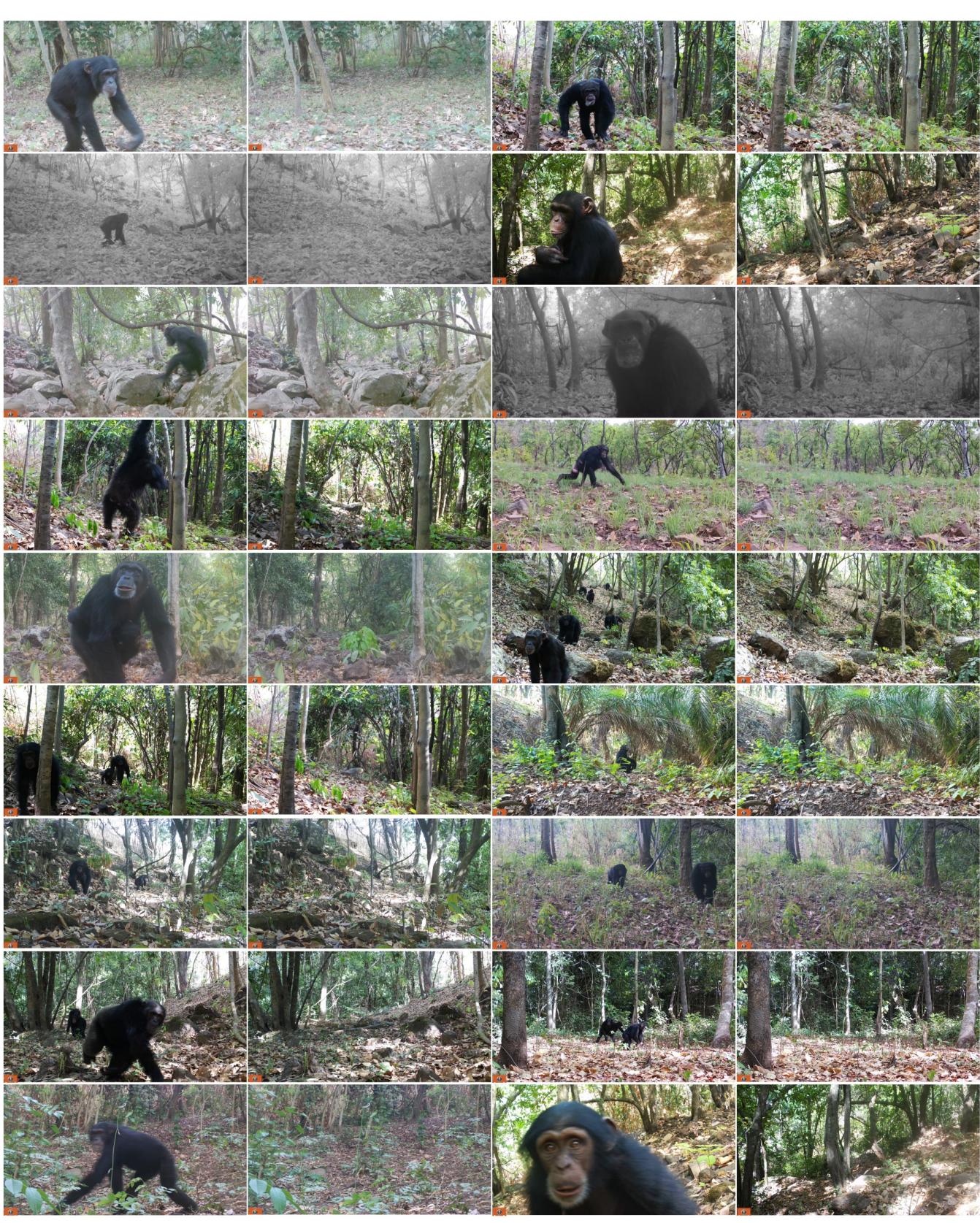
As we look at the pairs in Figure 6, we see the reality of the challenge: the difference between a chimp being present and absent is often just a few pixels of dark fur against a dark forest. Yet, solving this puzzle is essential for automated biodiversity monitoring. The PanAf-FGBG dataset provides the necessary ground truth to build AI that truly “sees” the wildlife it is meant to protect.