](https://deep-paper.org/en/paper/2503.00513/images/cover.png)
Imagine asking a robot to “pick up the red mug next to the laptop.” To us, this is a trivial request. To an AI, it is a geometric and semantic nightmare. The AI must identify objects in 3D space, understand what “red” and “mug” look like, and figure out the spatial relationship “next to.”
While Large Language Models (LLMs) have mastered text, and Vision-Language Models (VLMs) have conquered 2D images, 3D scene understanding remains a frontier filled with challenges. Most current approaches awkwardly stitch together 2D image data and 3D point clouds, often losing the fine-grained details that make a scene coherent. They struggle to understand how objects relate to one another in physical space and are notoriously computationally expensive.
In this post, we are diving deep into Inst3D-LMM, a new framework proposed by researchers from Zhejiang University and collaborators. This model introduces an “instance-aware” approach that unifies 3D geometry, 2D visual semantics, and spatial reasoning into a single, efficient, and powerful generalist model.
The Problem: The 2D-3D Disconnect
To understand a 3D scene, an AI needs two types of information:
- 3D Geometry: The shape and position of objects (usually from point clouds).
- 2D Semantics: The texture, color, and visual context (from RGB images).
Traditional methods typically encode these features separately. They might look at a point cloud to find a “chair-shaped blob” and an image to find “pixels that look like wood.” They then concatenate these features loosely.
The problem with this approach is twofold:
- Loss of Interaction: It neglects the fine-grained interaction between the 2D visual details and the 3D structure.
- Spatial Blindness: Merely knowing what objects are present doesn’t tell the model where they are relative to each other (spatial relationships).
Furthermore, previous models often required task-specific fine-tuning. You would need one model for 3D Question Answering (3D-QA) and a completely different one for 3D Visual Grounding (finding an object).
The Solution: Inst3D-LMM
Inst3D-LMM (Instance-aware 3D Large Multi-modal Model) proposes a unified architecture that handles multiple tasks simultaneously. As illustrated in Figure 1, unlike previous methods (a) that use separate inputs and task-specific tuning, Inst3D-LMM (b) fuses modalities at the instance level (object level) and explicitly models spatial relationships.
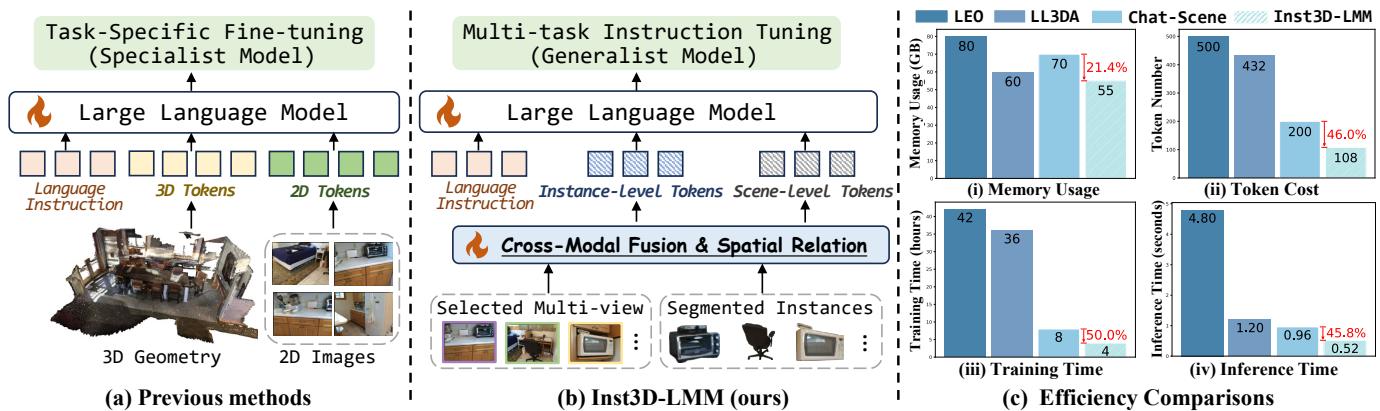
The result? A model that is not only more accurate but also significantly more efficient in terms of memory and speed (c).
Architecture Overview
The core philosophy of Inst3D-LMM is that the world is made of instances—distinct objects like a chair, a table, or a lamp. Instead of processing a scene as a giant soup of points, the model breaks the scene down into these instances and processes them.
The architecture pipeline, shown in Figure 2, follows these main steps:
- Instance Extraction: Using pre-trained models to identify object candidates in both 3D (point clouds) and 2D (images).
- MCMF Module: A fusion mechanism that injects 2D image details into 3D geometric features.
- 3D-ISR Module: A spatial reasoning engine that calculates how objects relate to one another (distances, angles).
- LLM Processing: Feeding these enriched “visual tokens” into a Large Language Model for instruction tuning.
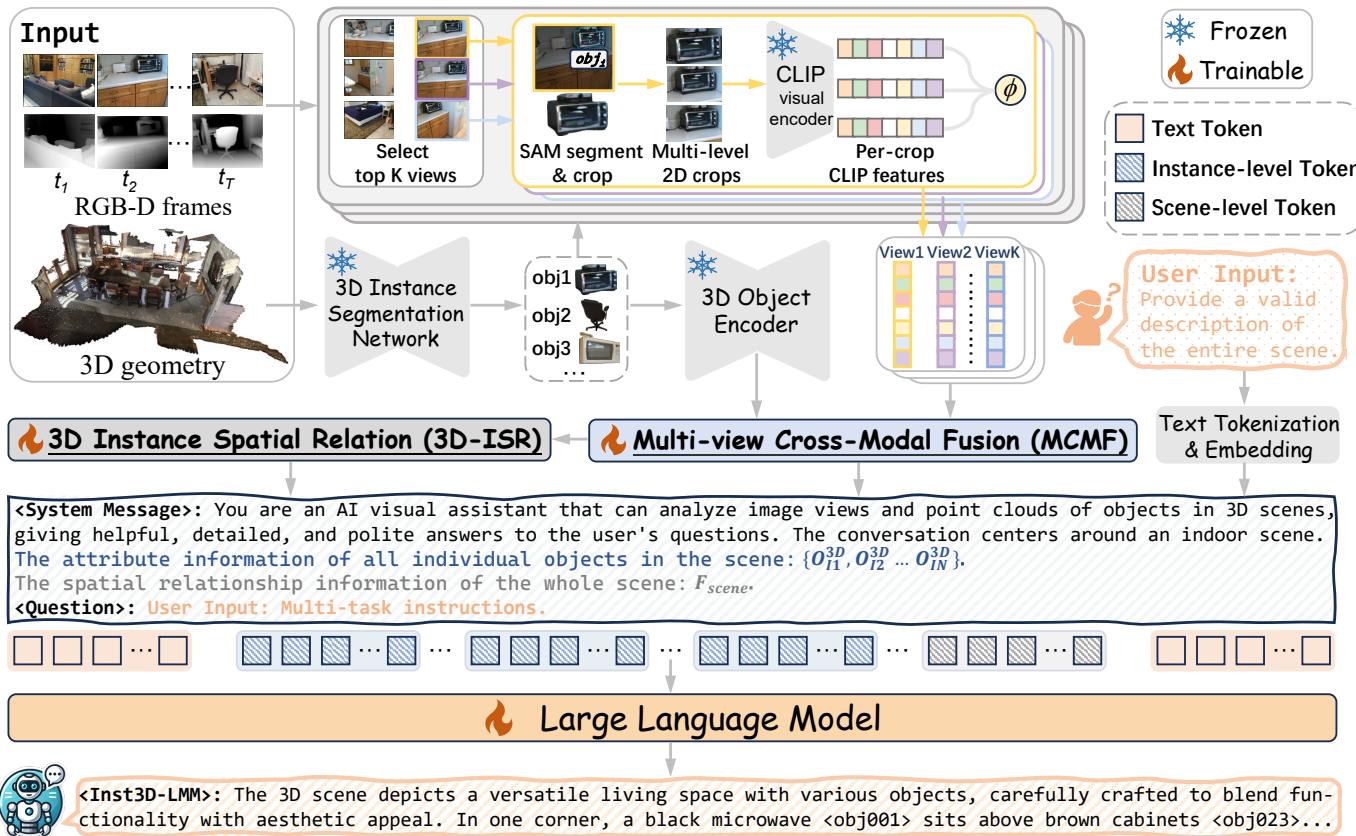
Let’s break down the two primary innovations: the MCMF and 3D-ISR modules.
The Core Method
1. Multi-view Cross-Modal Fusion (MCMF)
Point clouds are sparse. If you look at a 3D scan of a smooth white table, it might just look like a flat plane of dots. It lacks the texture and lighting information found in 2D images. Conversely, 2D images lack depth.
The MCMF module is designed to combine the best of both worlds. It takes the coarse 3D geometry of an object and “injects” it with rich semantic information from multiple 2D views of that same object.
The Process
- 3D Features: The model uses a 3D encoder (like Uni3D) to get a geometric representation of an object instance, denoted as \(O^{3D}\).
- 2D Multi-view Features: The model projects the 3D object onto 2D frames, selects the best views, and uses CLIP (a powerful vision model) to extract features, denoted as \(O^{2D}\).
The challenge is combining them. Simply concatenating them creates a massive feature vector that confuses the model. Instead, the authors use a Cross-Modal Injection Block.
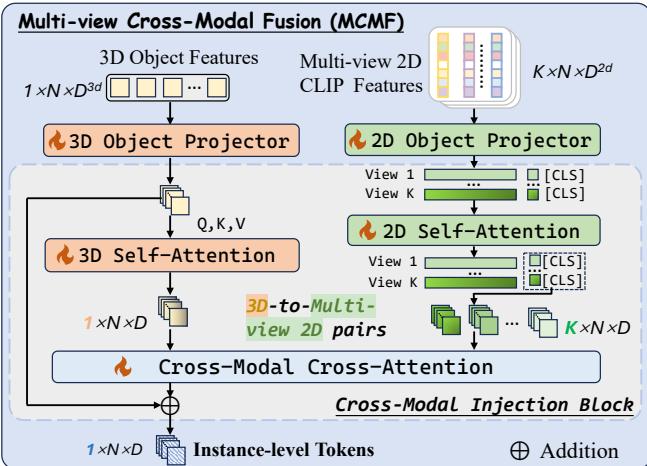
As shown in Figure 3, the fusion works in a coarse-to-fine manner:
- View Aggregation: For the 2D features, a learnable
[CLS]token is used to aggregate information from the different views of the object. - Cross-Attention: The 3D features act as the “Query,” while the enriched 2D features act as “Keys” and “Values.”
This forces the 3D representation to “look at” the 2D details and absorb the relevant visual semantics (like color and texture) into the geometric structure.
The injection is mathematically represented as:
\[ { \cal O } _ { f } ^ { 3 D } = \mathrm { C r o s s } { \cal A } { \mathrm { t t } } \mathrm { n } ( { \cal O } ^ { 3 D ^ { \prime } } , { \cal O } ^ { 2 D ^ { \prime } } ) . \]Here, the resulting feature \(O_f^{3D}\) is a 3D token that has been “supercharged” with 2D visual knowledge.
2. 3D Instance Spatial Relation (3D-ISR)
Knowing what an object looks like is only half the battle. To answer a query like “Find the chair between the table and the window,” the model needs Spatial Awareness.
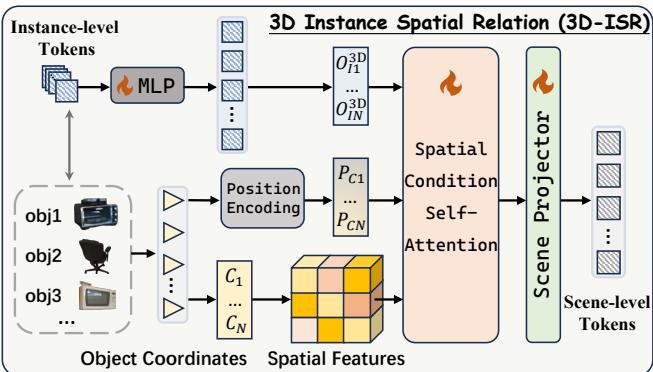
The 3D-ISR module creates a graph-like understanding of the scene without explicitly building a complex scene graph. It calculates pairwise spatial relationships between every object in the scene.
Constructing Spatial Features
For every pair of objects (Instance \(i\) and Instance \(j\)), the model calculates a spatial feature vector \(s_{ij}\) based on:
- Euclidean Distance (\(d_{ij}\)): How far apart are they?
- Horizontal Angle (\(\theta_h\)): Is one to the left/right of the other?
- Vertical Angle (\(\theta_v\)): Is one above/below the other?
The formula for this feature vector is:
\[ s _ { i j } = [ \sin ( \theta _ { h } ) , \cos ( \theta _ { h } ) , \sin ( \theta _ { v } ) , \cos ( \theta _ { v } ) , d _ { i j } ] . \]Spatial-Conditioned Self-Attention
The innovation here is how these features are used. The authors introduce a spatial-conditioned attention map.
Usually, attention mechanisms look at how similar two features are. Here, the attention is modulated by where the objects are. The model computes an attention weight based on the position embeddings (\(P\)) and the instance tokens (\(O^{3D}\)).
\[ l _ { i } = { W } _ { P } ^ { \top } ( \mathcal { P } _ { i } + O _ { I i } ^ { 3 D } ) , \]The final scene-level representation aggregates these relationships, allowing the LLM to understand the global layout of the room.
Multi-Task Instruction Tuning
Once the Instance Tokens (from MCMF) and Scene Tokens (from 3D-ISR) are generated, they are fed into a Large Language Model (specifically Vicuna-1.5-7B).
Crucially, the authors perform end-to-end multi-task instruction tuning. Instead of training separate weights for different jobs, they train the model simultaneously on:
- 3D Visual Grounding: “Where is the brown chair?”
- 3D Question Answering: “What is on the table?”
- 3D Dense Captioning: “Describe the object in the corner.”
This “generalist” approach ensures the model learns robust representations that are useful for any task involving 3D scenes.
Experiments and Results
The researchers tested Inst3D-LMM on standard benchmarks like ScanNet, ScanRefer, and ScanQA. The results were impressive, consistently outperforming state-of-the-art methods.
Visual Grounding Performance
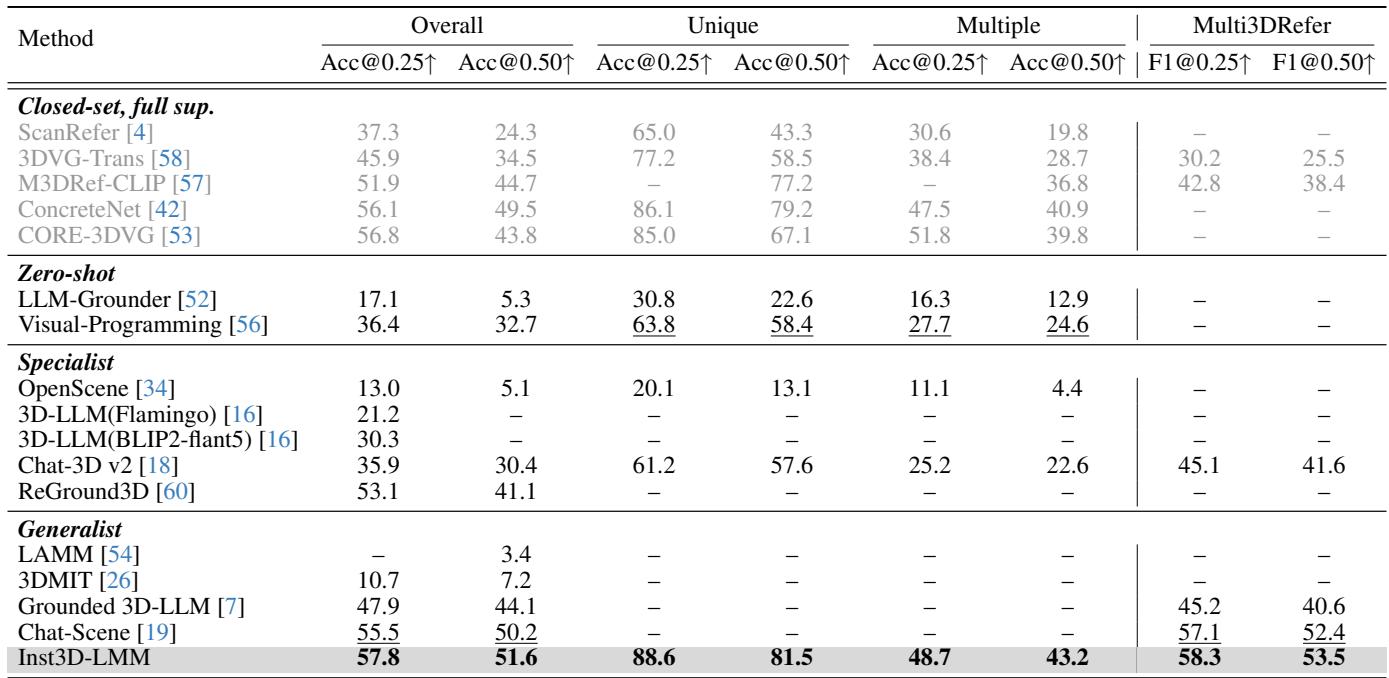
In 3D Visual Grounding, the goal is to locate an object described by text. As seen in Table 1 below, Inst3D-LMM achieves top-tier performance ([email protected] of 51.6%), beating both specialist models and other generalist LLMs like Chat-Scene.
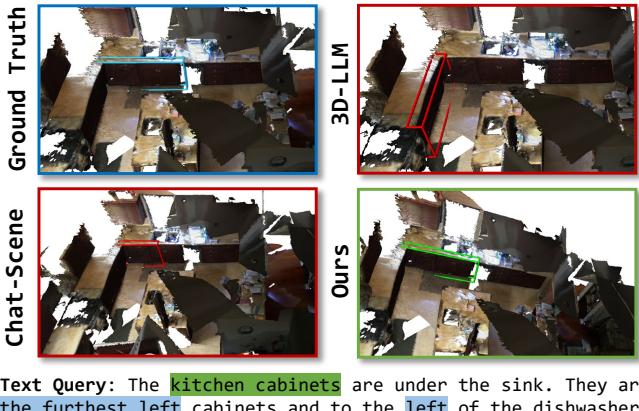
Qualitatively, the improvement is obvious. In Figure 5, we can see the model (Green box) accurately locating the “kitchen cabinets under the sink,” whereas other leading models (Red boxes) fail to capture the full extent of the object or identify the wrong cabinets entirely.
Why does it work better?
The ablation studies reveal the specific contributions of the new modules.
- MCMF Impact: Removing the Multi-view 2D fusion caused a significant drop in accuracy. This proves that 3D geometry alone isn’t enough; the texture details from images are vital.
- 3D-ISR Impact: Removing the spatial relation module hurt performance specifically on queries involving relationships (e.g., “next to”, “closest to”).
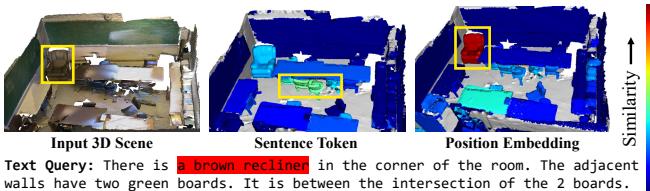
A fascinating visualization (Figure 6) compares how Inst3D-LMM “sees” a query compared to previous methods.
In the figure above:
- The Sentence Token heatmap shows the model finding objects that semantically match “recliner.”
- The Position Embedding heatmap shows the model isolating the specific location defined by the relationships in the sentence.
- Combining these allows for precise localization.
Efficiency
One of the most practical benefits of Inst3D-LMM is its speed. Because it operates on instances (a few dozen objects per room) rather than raw visual patches (thousands of pixels/points), it drastically reduces the number of tokens the LLM has to process.
Looking at the comparison table below (Table 9 from the paper), we see that Inst3D-LMM uses significantly less VRAM and is nearly 10x faster in inference time compared to methods that use separate encoding.
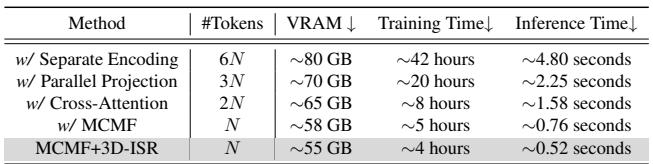
(Note: The table above highlights that moving from “Separate Encoding” to “MCMF+3D-ISR” reduces inference time from ~4.80 seconds to ~0.52 seconds.)
Conclusion and Implications
Inst3D-LMM represents a significant step forward in 3D scene understanding. By treating the world as a collection of instances rather than a cloud of points, and by explicitly modeling the spatial relationships between them, the authors have created a model that is both smarter and faster.
The key takeaways are:
- Fusion Matters: You cannot rely on 3D or 2D alone. The “injection” method used in MCMF is a superior way to combine these modalities.
- Context is King: The 3D-ISR module proves that understanding the space between objects is just as important as identifying the objects themselves.
- Efficiency via Instances: Processing at the object level is the key to making 3D LLMs practical for real-world applications.
While the model currently relies on the quality of pre-trained segmentation models (like Mask3D), its architecture lays the groundwork for future embodied agents—robots that can navigate, reason, and interact with our complex, three-dimensional world just as naturally as we do.