](https://deep-paper.org/en/paper/2503.00643/images/cover.png)
Forests are the lungs of our planet. Effective forestry management is crucial not just for the timber industry, but for climate stability and ecological health. To manage a forest, you need to monitor it—measure growth, assess health, and identify damage.
Traditionally, this has been done using satellite imagery or LiDAR. While useful, these methods have significant blind spots. Satellites often lack the resolution to see fine-grained changes in individual trees, and LiDAR, while great for structure, cannot capture the rich color and texture details needed to spot early signs of disease or blossoming.
This brings us to a specific problem in computer vision: Tree Change Detection (TCD). How do we build an AI that can look at a specific tree over a year and tell us exactly how it is changing, distinguishing between a tree losing its leaves (a physiological change) and a tree simply looking different because it’s a foggy day (an environmental change)?
In this post, we will dive into a research paper that proposes a two-fold solution: a massive new drone-based dataset called UAVTC, and a novel neural network architecture that abandons standard geometry in favor of Hyperbolic Geometry to better model the complex, hierarchical nature of nature itself.
The Challenge: Intrinsic vs. Extrinsic Changes
Before we look at the solution, we must understand the complexity of the problem. A tree changing appearance in an image doesn’t always mean the tree itself has changed.
Researchers categorize changes into two types:
- Intrinsic Changes (Physiological): These are real changes to the tree’s state. Examples include leaves turning yellow, flowers blossoming, branches falling off, or new sprouts appearing.
- Extrinsic Changes (Environmental): These are “noise” in the data. Examples include changes in sunlight intensity, shadows cast by neighboring trees, fog, or slight shifts in the camera angle.
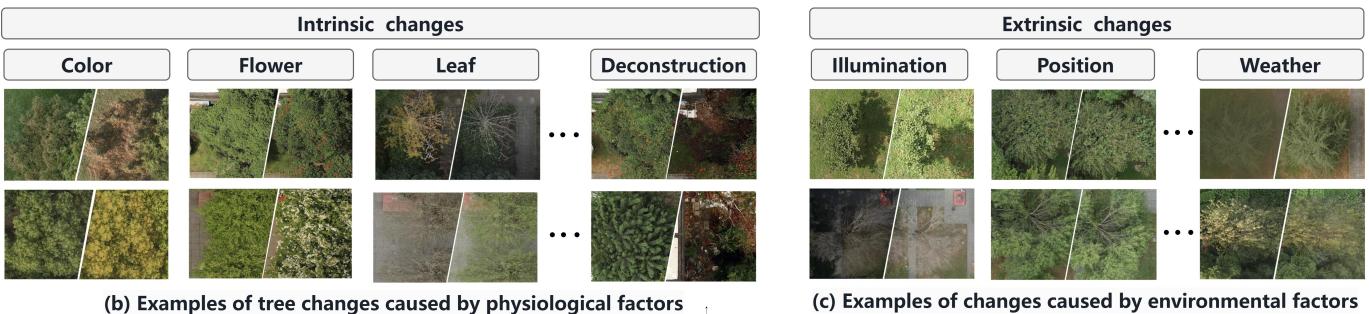
As shown in Figure 1 above, intrinsic changes often follow a hierarchy (e.g., a bud becomes a flower, which then withers). Extrinsic changes, however, are unstructured noise. The challenge for any AI model is to learn representations that are sensitive to the intrinsic hierarchy while ignoring the extrinsic noise. Standard deep learning models, which operate in “flat” Euclidean space, struggle to capture these hierarchical relationships effectively.
Part 1: The UAVTC Dataset
Deep learning requires data, and for fine-grained tree monitoring, existing datasets were insufficient. Satellite data was too coarse, and existing drone datasets focused on singular events like “treefall” rather than continuous monitoring.
To bridge this gap, the researchers introduced the UAVTC (Unmanned Aerial Vehicle Tree Change) dataset.
Data Collection
The team flew a DJI UAV equipped with a high-resolution Zenmuse P1 camera over a mixed urban forest test site. They didn’t just fly once; they flew consistently over the course of a full year (from July 2022 to March 2023), capturing the forest across all seasons.
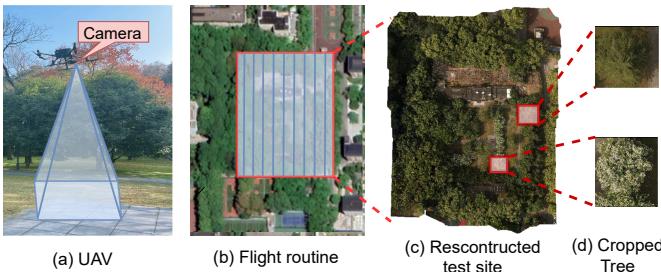
As illustrated in Figure 2, the process involved:
- Capture: Flying a predefined route to capture overlapping images.
- Reconstruction: creating a Digital Orthophoto Model (DOM) of the entire site.
- Cropping: Extracting specific Regions of Interest (ROIs) for 68 individual trees.
Why this Dataset Matters
The resulting dataset is massive and precise. It contains 245,616 pairs of tree images with a resolution of 0.5 cm/pixel. This is significantly higher resolution than previous datasets, allowing for the detection of tiny changes like a single branch breaking or a flower blooming.

Table 1 highlights the leap in quality. While other datasets might track leaf coverage generally, UAVTC provides annotations for specific states like color changes, blossoms, and branch/leaf interactions.
Part 2: The Hyperbolic Siamese Network (HSN)
The core innovation of this paper is not just the data, but the mathematics used to analyze it. The authors propose a Hyperbolic Siamese Network (HSN). To understand why this is necessary, we need a quick primer on geometry in deep learning.
Why Hyperbolic Geometry?
Most neural networks operate in Euclidean space. This is the geometry we learn in high school: flat planes, straight lines, and parallel lines that never meet. It works well for many things, but it is not efficient for representing hierarchies.
Think of a family tree or a biological taxonomy. As you go down the levels (from trunk to branch to twig to leaf), the number of nodes grows exponentially. In a flat Euclidean circle, the circumference only grows linearly as you move away from the center. There just isn’t enough “room” at the edges to separate all the growing branches of a hierarchy.
Hyperbolic geometry (specifically a space with negative curvature) is different. In hyperbolic space, the amount of “space” grows exponentially as you move away from the center. This makes it mathematically perfect for embedding trees, graphs, and hierarchies.
The researchers use the Poincaré Ball model, a way of visualizing hyperbolic space inside a circle.

In this model (defined above), the “edge” of the circle represents infinity. Points near the edge are actually very far apart from each other in hyperbolic terms, even if they look close in the drawing. This allows the model to pack complex, branching tree states into a compact representation.
The Architecture
The HSN architecture combines the power of Siamese networks (used for comparing two images) with hyperbolic embeddings.
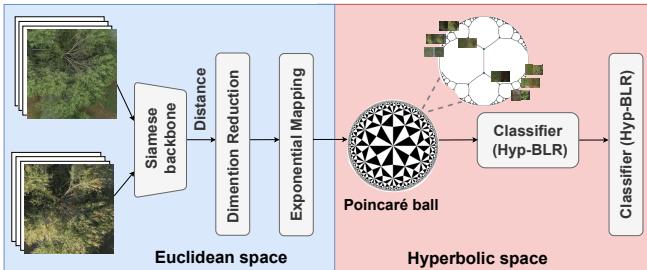
Here is the step-by-step flow shown in Figure 3:
- Siamese Backbone: The network takes a pair of images (Image A at Time 1 and Image B at Time 2). It uses a standard Convolutional Neural Network (like ResNet) to extract features from both.
- Comparison: It computes the difference between these features to understand what changed.
- Euclidean to Hyperbolic Mapping: This is the critical step. The network uses an Exponential Map to project the “flat” feature vectors into the curved Poincaré ball.

- Hyperbolic Classification: Once the data is in hyperbolic space, the network performs Hyperbolic Binary Logistic Regression (Hyp-BLR) to decide if a meaningful change occurred.
To make this work, the researchers had to redefine standard math operations. You cannot just “add” two hyperbolic vectors. You must use Möbius addition:

Similarly, calculating the distance between two points (to see how different the tree states are) requires a specific hyperbolic distance formula:

By using this geometry, the network naturally separates the hierarchical “intrinsic” changes from the random “extrinsic” noise.
Experimental Results
So, does swapping standard geometry for hyperbolic geometry actually improve performance? The experiments suggest a resounding yes.
Tighter Clusters, Better Separation
One of the best ways to visualize this is using t-SNE, a technique that plots high-dimensional data on a 2D graph.
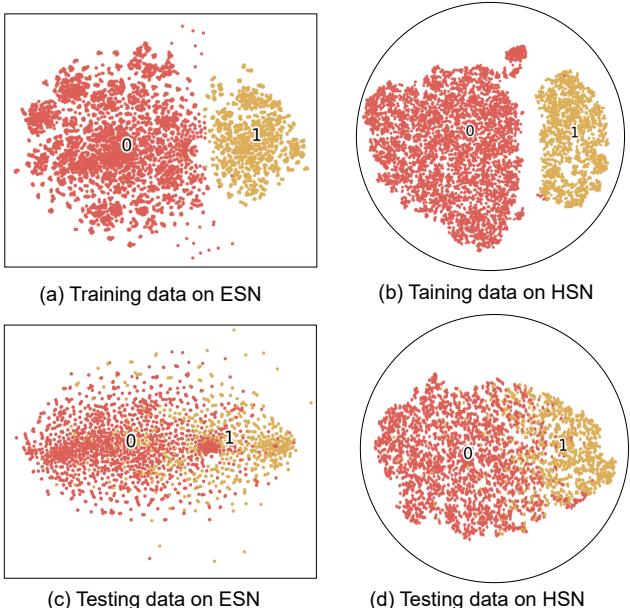
In Figure 5, look at the difference between the ESN (Euclidean Siamese Network) and HSN (Hyperbolic Siamese Network).
- Euclidean (Left): The red and yellow dots (representing “change” vs “no change”) are somewhat separated, but the boundaries are messy and overlapping.
- Hyperbolic (Right): The clusters are incredibly tight and distinct. This means the model is extremely confident and consistent in distinguishing between a changed tree and an unchanged one.
Focusing on the Right Things
The researchers also used Grad-CAM to visualize exactly which pixels the AI was looking at when making a decision.
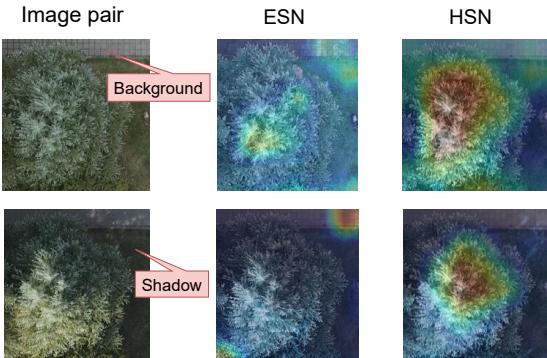
Figure 6 is particularly telling.
- Row 1 (Background): The Euclidean model (ESN) gets distracted by the background grass. The Hyperbolic model (HSN) focuses tightly on the tree crown.
- Row 2 (Shadow): The ESN is confused by the dark shadow cast by the tree. The HSN largely ignores the shadow and looks at the foliage.
This confirms the hypothesis: Hyperbolic space helps the model understand the structure of the tree, making it robust against environmental noise like shadows.
Impact of Dimensions
Interestingly, because hyperbolic space is so efficient at storing hierarchies, the model doesn’t need massive dimensions to work well.
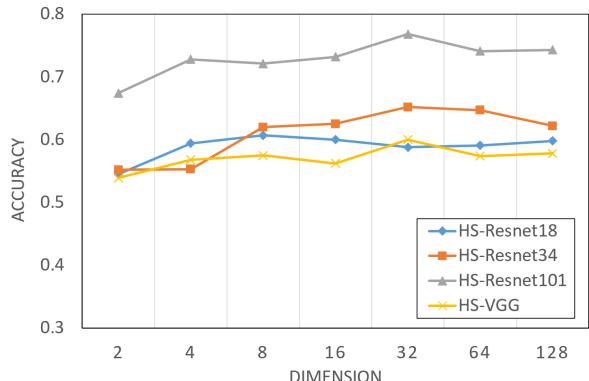
Figure 4 shows that accuracy peaks around 32 dimensions. In Euclidean space, you often need hundreds of dimensions to separate complex data. Hyperbolic space allows for “compact” representations—high accuracy with less computational luggage.
Beyond Trees: Generalizing to Faces
To prove that this isn’t just a “tree trick,” the authors applied HSN to a completely different task: Cross-Domain Face Anti-Spoofing (CD-FAS). This is the technology used to ensure that a face unlocking a phone is a real person, not a photo or a mask. Like tree monitoring, this task requires distinguishing between real “intrinsic” features (skin texture) and “extrinsic” noise (lighting, camera quality).
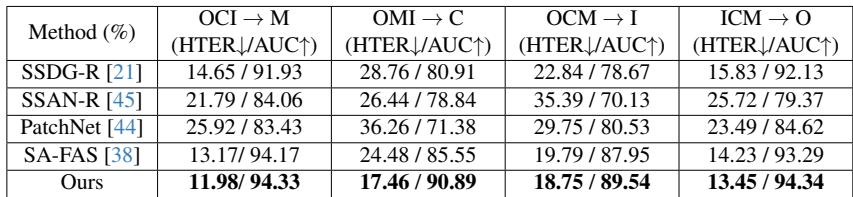
Table 5 shows that HSN outperforms specific state-of-the-art methods designed for face security. This suggests that hyperbolic learning is a powerful tool for any computer vision task involving subtle changes in complex, hierarchical data.
Conclusion and Future Implications
The UAVTC dataset and the Hyperbolic Siamese Network represent a significant step forward in environmental monitoring. By combining high-resolution drone imagery with advanced non-Euclidean geometry, the researchers have created a system that can see the forest and the trees—filtering out the noise of weather and lighting to focus on the biological health of the ecosystem.
Key takeaways:
- Geometry Matters: We don’t have to stick to Euclidean space. For hierarchical biological data, hyperbolic geometry offers a more natural and efficient representation.
- Data is King: The UAVTC dataset opens the door for long-term, fine-grained analysis that wasn’t possible with satellites.
- Robustness: HSNs are naturally better at ignoring environmental “noise” like shadows, a critical feature for any outdoor AI application.
As we face increasing climate challenges, tools like HSN will be essential for giving ecologists the precise, reliable data they need to protect our forests. The next time you look at a tree, remember: its structure might just be best described by a geometry that curves towards infinity.