](https://deep-paper.org/en/paper/2503.00779/images/cover.png)
Introduction: The Data Bottleneck
If you look at the recent explosions in Natural Language Processing (like GPT-4) or Computer Vision, there is a common denominator: massive datasets. These models are trained on billions of data points scraped effortlessly from the internet.
Robotics, however, is stuck in a data bottleneck. To train a robot to do the dishes, you typically need to “teleoperate” it—manually controlling the robot arm to perform the task hundreds of times to collect training data. This is slow, expensive, and hardware-dependent.
But what if we could just watch humans do the dishes and learn from them? Humans are everywhere, and videos of humans performing tasks are abundant. The problem is the Embodiment Gap. A human hand looks and moves nothing like a robotic gripper. If you train a robot on pixels of a human hand, and then turn it on, it will see a metal gripper and have no idea what to do.
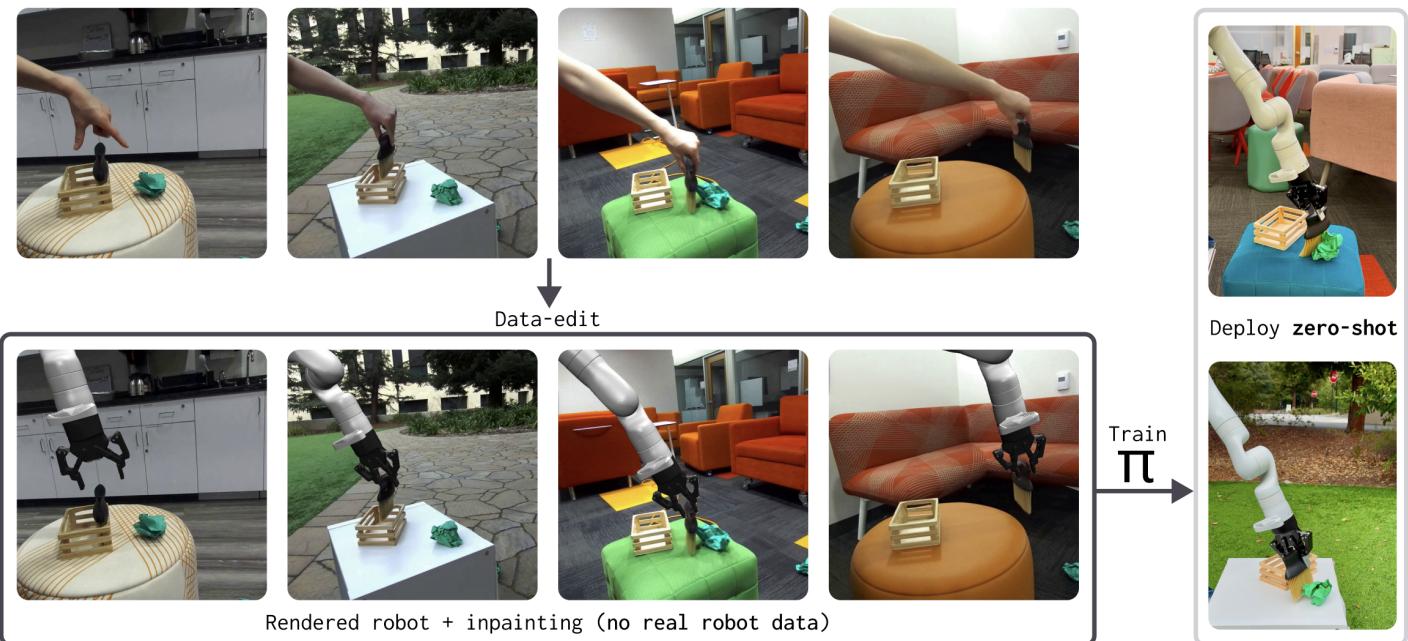
In this post, we are diving into Phantom, a fascinating paper from Stanford University. The researchers propose a method to train robot policies using only human videos—with zero real-world robot data required during training. They achieve this by visually “hallucinating” a robot over the human in the video, effectively bridging the gap between human and robot perception.
Background: The Challenge of Cross-Embodiment
To understand why Phantom is significant, we need to understand the problem of Visual Imitation Learning.
In a standard setup, a robot takes an image (observation) and predicts an action (movement). Neural networks are excellent at this, provided the test-time images look similar to the training images.
When we try to use human videos, we face two massive distribution shifts:
- Visual Shift: A fleshy hand looks different from a metal claw.
- Physical Shift: A human arm has 7+ degrees of freedom and complex kinematics; a robot arm moves differently.
Previous attempts to solve this usually required a “Rosetta Stone”—a small dataset of paired human-robot data to learn the translation, or heavy use of simulation. Phantom bypasses this by using Generative AI and Computer Vision techniques to edit the data itself, making human data look like robot data before the policy ever sees it.
The Phantom Method
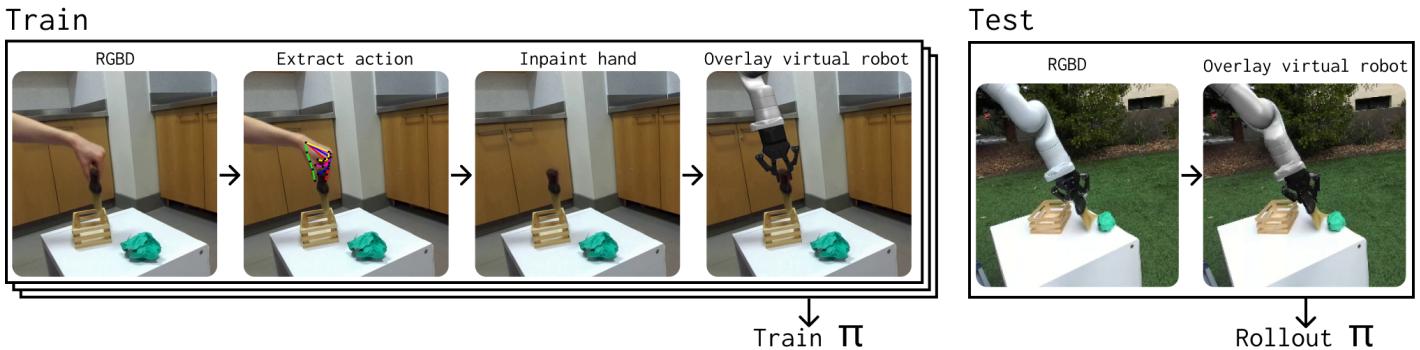
The core idea of Phantom is to transform a dataset of human demonstrations into a dataset of “robot” demonstrations. This process happens entirely offline. Once the data is converted, a standard policy (like Diffusion Policy) is trained on the “fake” robot data.
The pipeline consists of three main stages: Action Labeling, Visual Data Editing, and Inference Adaptation.
Step 1: Action Labeling (From Pixels to Poses)
A video is just a sequence of images. To train a robot, we need actions. Specifically, for every frame of the video, we need to know the 6-DOF (Degree of Freedom) pose of the end-effector (where the gripper should be) and the gripper width.
\[ a _ { r , t } = ( { \bf p } _ { t } , { \bf R } _ { t } , g _ { t } ) \]
Here, \(p_t\) is position, \(R_t\) is rotation, and \(g_t\) is gripper open/close state.
To get these numbers from a video of a human hand, the authors use a two-step process:
- Hand Pose Estimation: They use a model called HaMeR to predict the 3D mesh of the human hand from the image.
- Refinement via Depth: Monocular (single camera) estimation is often jittery or inaccurate in absolute 3D space. They refine this by taking the depth map from the camera, converting the hand to a point cloud, and using Iterative Closest Point (ICP) registration to lock the predicted mesh onto the actual depth readings.
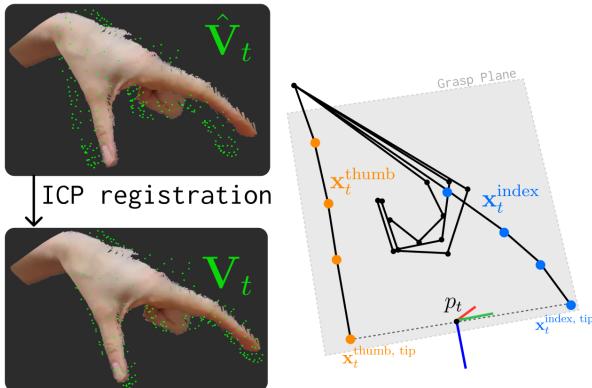
Once they have the accurate hand mesh, they map it to a robot gripper heuristic:
- Position: The midpoint between the thumb and index finger.
- Rotation: Calculated by fitting a plane through the fingers.
- Gripper Width: The distance between the thumb and index finger tips.
Step 2: Visual Bridging (The Magic Trick)
Now that we have the math (the action), we need to fix the pixels (the observation). If we train the robot on images of human hands, it will fail when it sees its own gripper.
The authors employ a “Data Editing” strategy. For every frame of the human video:
- Segmentation: Use SAM2 (Segment Anything Model 2) to find the pixels belonging to the human arm and hand.
- Inpainting: Erase the human. The researchers use video inpainting to fill in the background behind the arm.
- Overlay: Using the action pose calculated in Step 1, they render a virtual robot (using the MuJoCo physics engine) and paste it into the image.
This effectively creates a “Phantom” robot. To the neural network, it looks like a robot performed the task.
Why Inpainting Matters
You might ask: Why go through the trouble of inpainting? Can’t we just cover the human with a red box or a mask?
The researchers tested this. They compared their method (Hand Inpaint) against simpler methods like just masking the hand (Hand Mask) or drawing a line over it (Red Line).
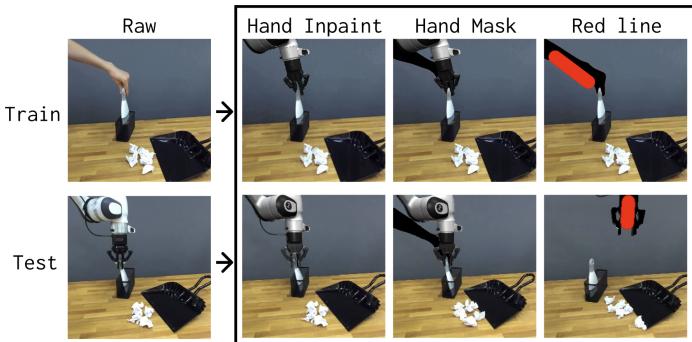
As we will see in the results, the Red Line method failed completely (0% success). The neural network relies on visual consistency. If the training data looks abstract (red lines) but the real world looks realistic, the policy fails. The Hand Inpaint method produces the most realistic training data, which transfers best to the real world.
Step 3: The Inference-Time Gap
Here is the cleverest part of the paper.
You might assume that once trained, you just run the policy on the robot. But there’s a problem: The virtual robot (rendered in MuJoCo) looks slightly different from the real physical robot. Lighting, shadows, and material textures won’t match perfectly.
To solve this, Phantom applies a similar trick at test time:
- The robot takes a picture using its camera.
- Using its own sensors (proprioception), the robot knows exactly where its arm is.
- The system renders the virtual robot on top of the real robot in the live video feed.
This ensures that the neural network only ever sees the virtual robot, both during training and during testing. This eliminates the “Sim-to-Real” visual gap because, visually, the robot never leaves the simulation.
Experiments and Results
The authors evaluated Phantom on 6 different tasks, including manipulating rigid objects, deformable objects (rope), and granular items (trash).
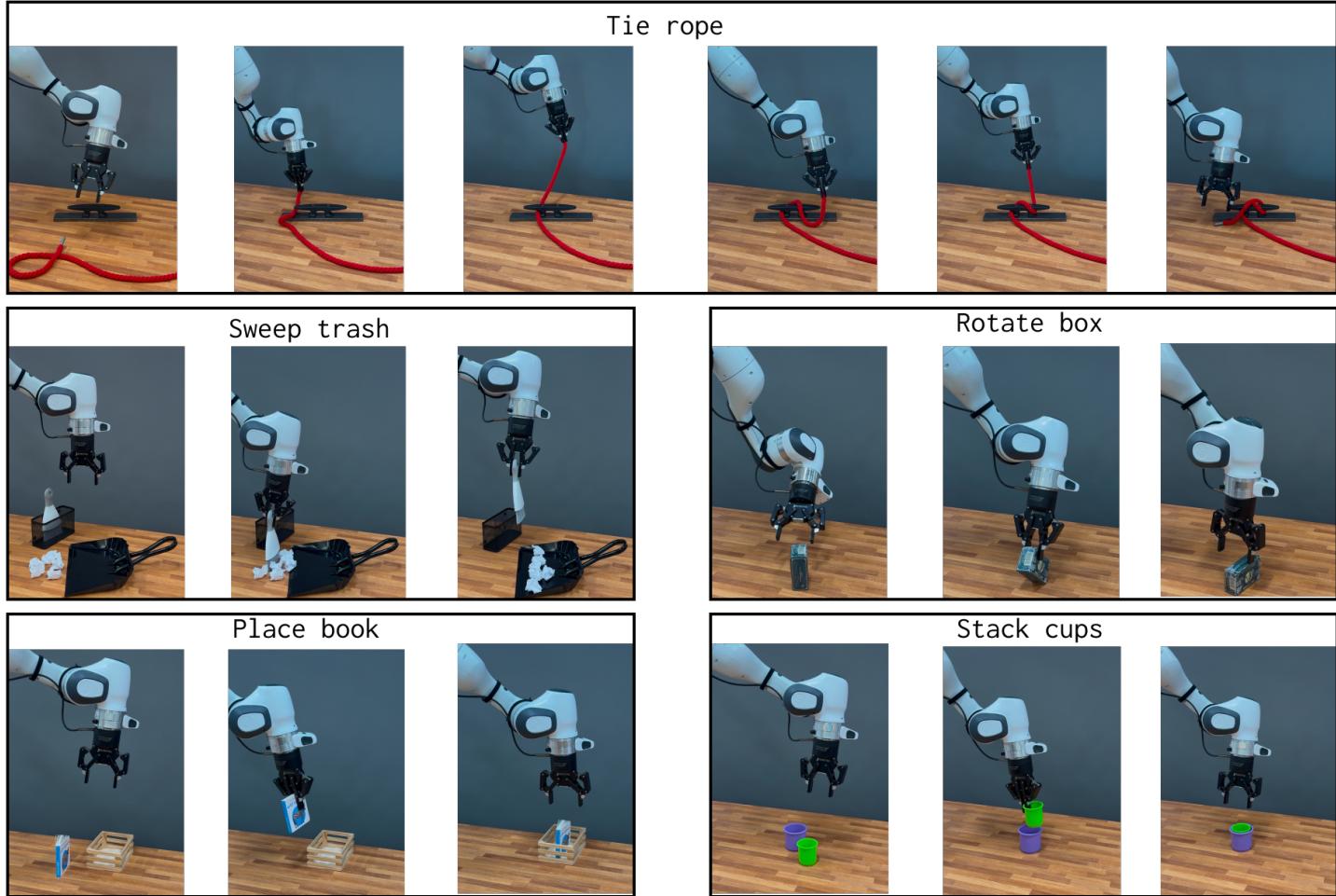
1. Does it work without robot data?
Yes. Across tasks like “Pick and Place,” “Stack Cups,” and “Tie Rope,” the Phantom method achieved high success rates.
- Pick/Place Book: 92% success.
- Tie Rope: 64% success (impressive for a deformable object).
Crucially, the Red Line and Vanilla (raw human video) baselines failed completely (0% success). This proves that visual data editing is necessary.
2. Can it generalize to new scenes?
One of the biggest promises of learning from human videos is diversity. It is hard to move a robot to a forest or a living room, but easy for a human to record a video there.
The researchers collected human sweeping demos in diverse environments (lounges, outdoor lawns, etc.) and tested the robot in scenes it had never seen before.
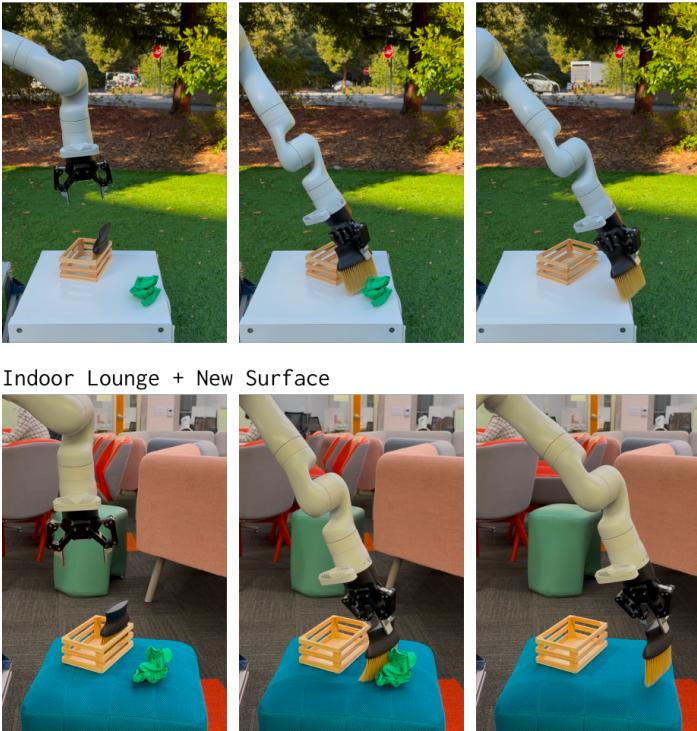
The method showed strong generalization. For example, training on human videos from various indoor rooms allowed the robot to work in an outdoor lawn setting (72% success), despite never seeing the outdoors or a robot in that setting during training.
3. Is it robot-agnostic?
Because the robot in the training data is rendered, you can swap the 3D model. The authors showed that the same human video could be processed to train a Franka robot, a UR5, or a Kinova robot.

4. Human vs. Robot Data Precision
There is a trade-off. Teleoperated robot data is precise (\(<1\)mm accuracy). Human hand estimation is noisy (estimated from pixels).
The study found that:
- A policy trained on 50 robot demos beat a policy trained on 50 human-to-robot demos.
- However, because human data is easier to collect, they scaled up to 300 human demos. At that scale, the human-data policy matched or beat the robot-data policy.
This confirms the hypothesis: Quantity can overcome the lack of precision.
Key Takeaways
Phantom represents a significant step toward “Generalist Robots.” Here is what makes this paper impactful:
- Accessibility: You don’t need a teleoperation rig or a twin robot to collect data. You just need an RGBD camera (like an iPhone with LiDAR or a RealSense) and your hands.
- The Visual Bridge: It highlights that for Convolutional Neural Networks, consistency is king. By forcing the training and test images to share the same “virtual” overlay, they bypass the difficult problem of domain adaptation.
- Scale: It unlocks the ability to collect robot training data in coffee shops, parks, and homes—places where robots currently cannot go to collect their own data.
By treating the “Embodiment Gap” as a data-editing problem rather than a learning problem, Phantom allows us to train robots using the most intelligent manipulators on the planet: us.