](https://deep-paper.org/en/paper/2503.01261/images/cover.png)
Introduction
The idiom “a picture is worth a thousand words” suggests that complex imagery conveys meaning more effectively than a brief description. However, in the world of Artificial Intelligence—specifically Vector Quantization (VQ) based image modeling—we have historically been feeding our models the equivalent of a few mumbled words and expecting them to understand a masterpiece.
Current state-of-the-art image generation models often rely on a “codebook”—a library of discrete features learned from images. To improve these codebooks, researchers have recently started aligning them with text captions. The logic is sound: if the codebook understands the semantic link between the visual “cat” and the word “cat,” the generation quality improves.
But there is a flaw in the data. Most image-text datasets provide captions that are incredibly brief. A photo of a zebra in a complex savanna might just be labeled “A zebra eating grass.” This brevity creates a “semantic gap.” The text fails to describe the background, the lighting, the textures, or the spatial relationships, making it impossible for the model to learn a truly fine-grained alignment between the visual codes and language.
In this post, we dive into TA-VQ (Text-Augmented Vector Quantization), a novel framework proposed by Liang et al. This paper flips the script by asking: What happens if we artificially generate massive, detailed descriptions for images and force the model to learn from them?
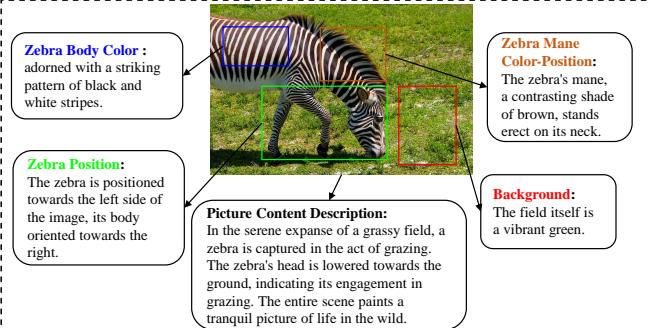
As shown in Figure 1, the difference is stark. TA-VQ leverages the power of modern Vision-Language Models (VLMs) to expand a simple caption into a rich narrative, providing the necessary signal for robust codebook learning.
Background: The VQ-VAE Paradigm
To understand why TA-VQ is significant, we first need to look at the foundation it builds upon: the Vector Quantized Variational Autoencoder (VQ-VAE).
How VQ Models Work
In a standard VQ-GAN or VQ-VAE, the goal is to compress an image into a discrete sequence of tokens (codes) and then reconstruct it. The process involves three main components:
- Encoder (\(E\)): Compresses the image \(x\) into a grid of feature vectors.
- Quantizer (\(Q\)): Replaces each feature vector with the closest entry from a learnable “codebook” (\(Z\)).
- Decoder (\(D\)): Takes the sequence of codebook entries and reconstructs the image \(\tilde{x}\).
The quantization step is mathematically defined as finding the nearest neighbor in the codebook:

The model is trained using a loss function that combines reconstruction error (how much the output looks like the input) and codebook commitment losses (keeping the encoder outputs close to the chosen codes):

The Alignment Problem
While effective, standard VQ models are “unimodal”—they only look at pixels. Recent works like LG-VQ attempted to introduce text semantics to guide the codebook. However, they hit the short-caption bottleneck.
If you try to align a complex visual feature map with a 5-word sentence, you are forcing the model to ignore vast amounts of visual information because there is no corresponding text to map it to. TA-VQ solves this by generating Long Text, but this introduces a new engineering challenge: specific words align with small visual details, while whole sentences align with the overall image structure. How do you map a paragraph to a grid of pixels?
The TA-VQ Method
The researchers propose a sophisticated framework that breaks down the long text and the image into different hierarchies, aligning them step-by-step.
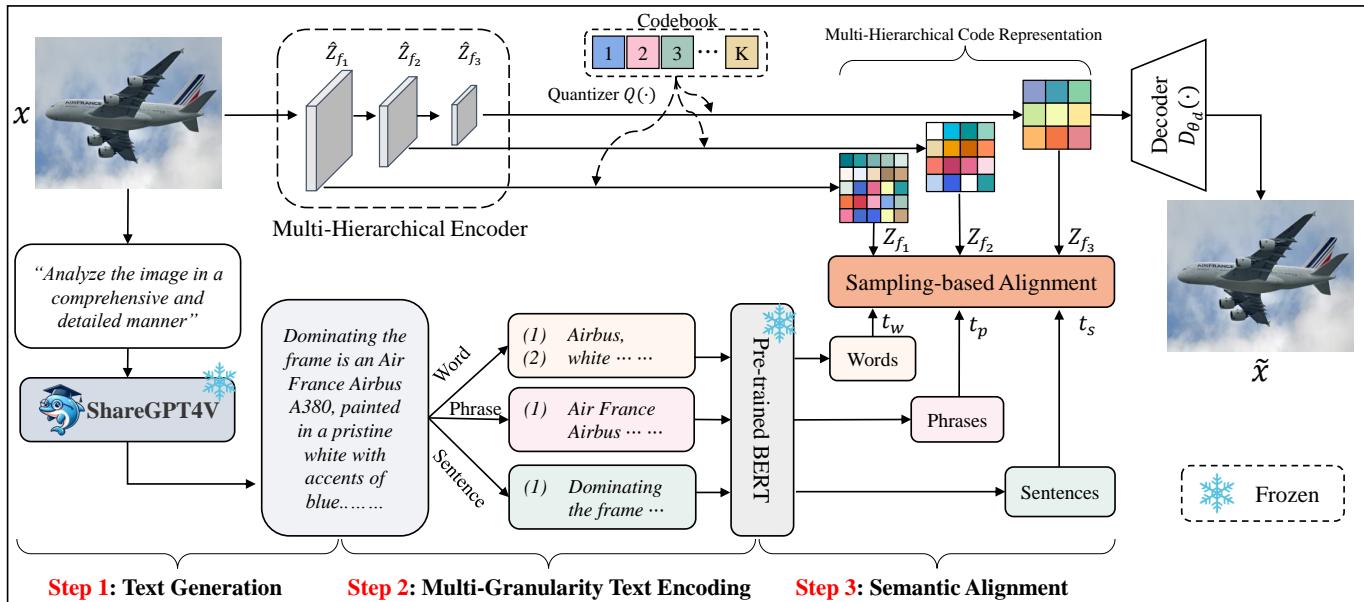
As illustrated in Figure 2, the framework consists of three distinct stages:
- Text Generation: Creating the long text.
- Multi-Granularity Text Encoding: Breaking text into meaningful chunks.
- Semantic Alignment: The hierarchical mapping process.
Step 1: Text Generation
The authors employ a VLM (specifically ShareGPT4V) to generate comprehensive descriptions for the training images. Instead of “A bird on a branch,” the model generates a paragraph describing the bird’s plumage color, the texture of the branch, the background blur, and the lighting conditions. This creates a rich semantic target.
Step 2: Multi-Granularity Encoding
A long paragraph is too complex to process as a single “blob” of data. To capture semantics effectively, the authors split the text into three granularities:
- Words (\(t_w\)): Nouns, adjectives, and quantifiers that describe specific objects or attributes.
- Phrases (\(t_p\)): Short combinations of words that describe interactions or local context.
- Sentences (\(t_s\)): Complete thoughts that capture global semantic information.
They use BERT to encode these splits, resulting in three sets of text embeddings.
Step 3: Hierarchical Codebook-Text Alignment
This is the core innovation. Images naturally possess a hierarchy: low-level features (edges, textures) form mid-level features (shapes, parts), which form high-level semantics (objects, scenes).
TA-VQ introduces a Hierarchical Encoder that outputs image features at three different scales (\(Z_{f1}, Z_{f2}, Z_{f3}\)). The model then aligns these visual scales with the corresponding text granularities:
- Word Semantics (\(t_w\)) \(\leftrightarrow\) Low-level Visual Features (\(Z_{f1}\))
- Phrase Semantics (\(t_p\)) \(\leftrightarrow\) Mid-level Visual Features (\(Z_{f2}\))
- Sentence Semantics (\(t_s\)) \(\leftrightarrow\) High-level Visual Features (\(Z_{f3}\))
Step 4: Sampling-Based Alignment Strategy
Here lies a mathematical challenge. We have a set of visual codes and a set of text embeddings, but they don’t match one-to-one. There is no pre-defined rule saying “the 5th visual code matches the 3rd word.”
To solve this, the authors treat the alignment as an Optimal Transport problem. They aim to minimize the “transport cost” (Wasserstein distance) between the distribution of image codes and the distribution of text features.
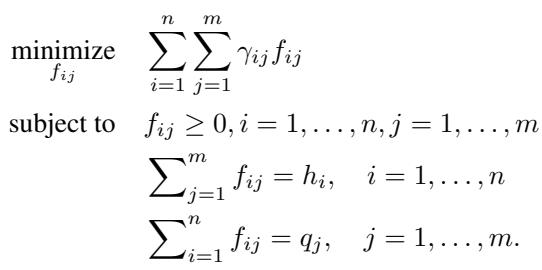
However, calculating exact Optimal Transport is computationally expensive (\(O(N^3)\)). To make this trainable, the authors devised a Sampling-Based Alignment Strategy.
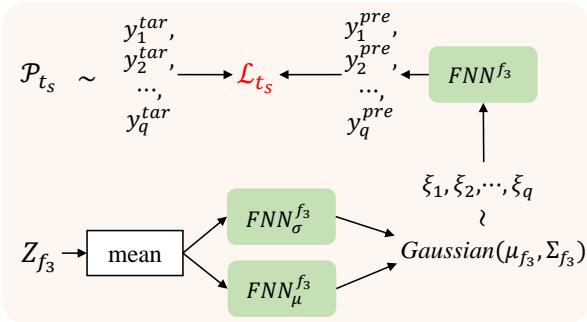
Instead of aligning the entire sets directly, they model the image codes as a Gaussian Distribution. They use Feed-Forward Networks (FNNs) to predict the mean (\(m\)) and variance (\(\Sigma\)) of this distribution from the image features:
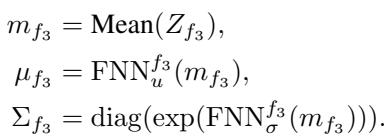
By sampling from this distribution and aligning the samples with the text targets (\(y^{tar}\)), they reduce the complexity significantly while maintaining accurate alignment. The loss function for sentence alignment (and similarly for words and phrases) becomes the Wasserstein distance between the predicted samples and the target text samples:

The Total Objective
The final training objective combines the standard VQ reconstruction loss with the new alignment losses for words, phrases, and sentences, controlled by hyperparameters (\(\alpha, \beta, \gamma\)):

Experiments and Results
The researchers tested TA-VQ against several baselines, including VQ-GAN, VQCT, and LG-VQ, across datasets like CelebA-HQ (faces), CUB-200 (birds), and MS-COCO (general objects).
Image Reconstruction Quality
The primary metric for image generation is the Fréchet Inception Distance (FID), where lower is better.
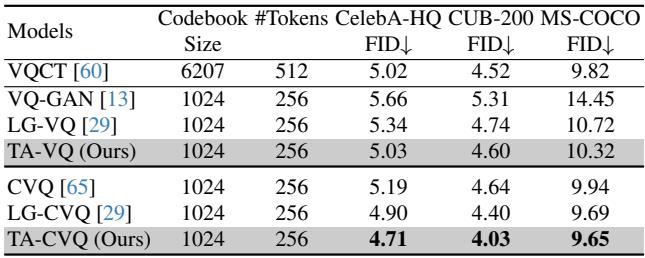
As shown in Table 1, TA-VQ consistently outperforms the baselines. On the CUB-200 dataset, it achieves an FID of 4.60 compared to VQ-GAN’s 5.31 and LG-VQ’s 4.74. This indicates that the long-text alignment helps the codebook capture more visual details necessary for reconstruction.
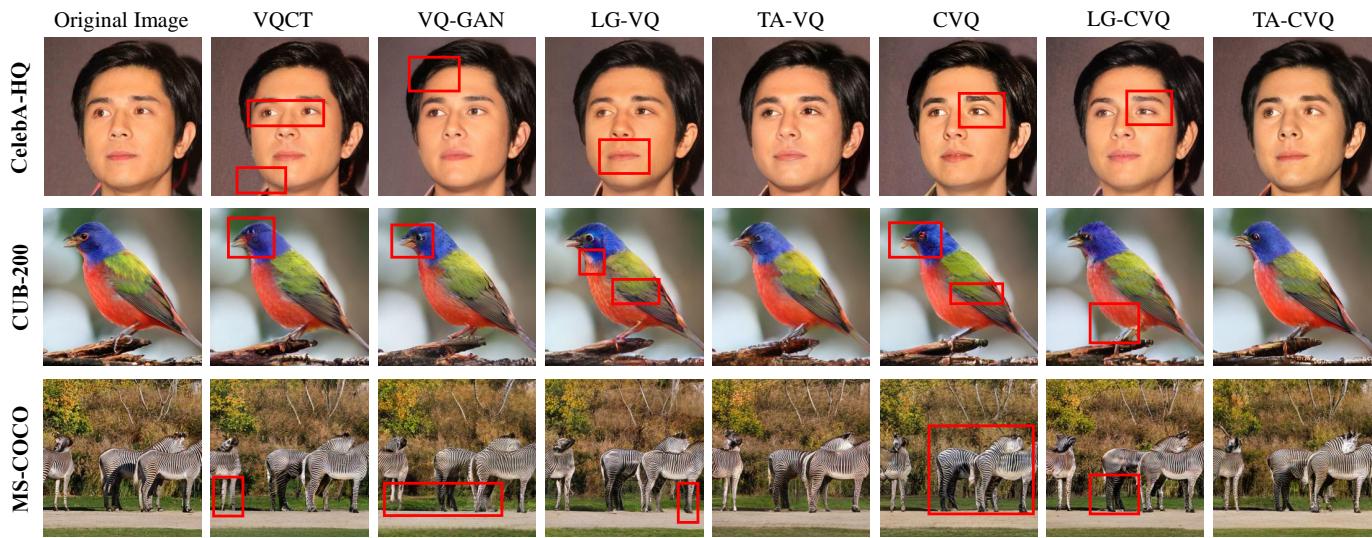
We can see this qualitatively in Figure 12 below. Notice the red boxes highlighting areas where other models struggle with artifacts or blurring, while TA-VQ maintains sharper details.
Why Does It Work? (Ablation Studies)
Is the complexity of multi-granularity (Words/Phrases/Sentences) actually necessary? The authors performed ablation studies to find out.
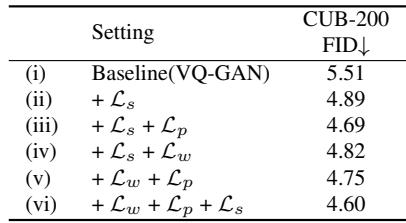
Table 2 shows that removing any level of the hierarchy hurts performance. Using only sentence alignment (Row ii) is better than nothing, but combining Word, Phrase, and Sentence alignment (Row vi) yields the best results. This confirms that the model benefits from aligning textures to words and scenes to sentences simultaneously.
Furthermore, is the sampling strategy actually efficient?
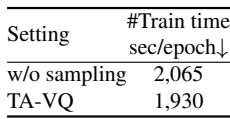
Table 5 confirms that without the sampling strategy, training time is significantly higher. TA-VQ with sampling is comparable in speed to LG-VQ but delivers superior performance.
Downstream Tasks
A better codebook should theoretically improve any task that relies on understanding the image content. The authors applied their pre-trained TA-VQ codebook to several downstream applications.
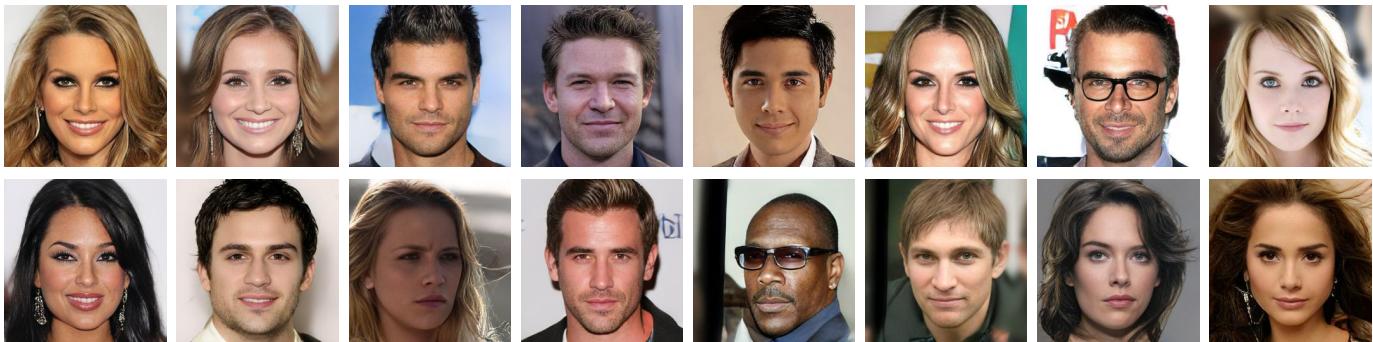
1. Unconditional Image Generation
Here, the model generates images from scratch (noise). TA-VQ generates high-fidelity faces with realistic textures and backgrounds.
2. Visual Grounding
This task involves locating specific objects in an image based on a text description. Because TA-VQ was trained with “word-level” alignment against low-level visual features, it excels here.
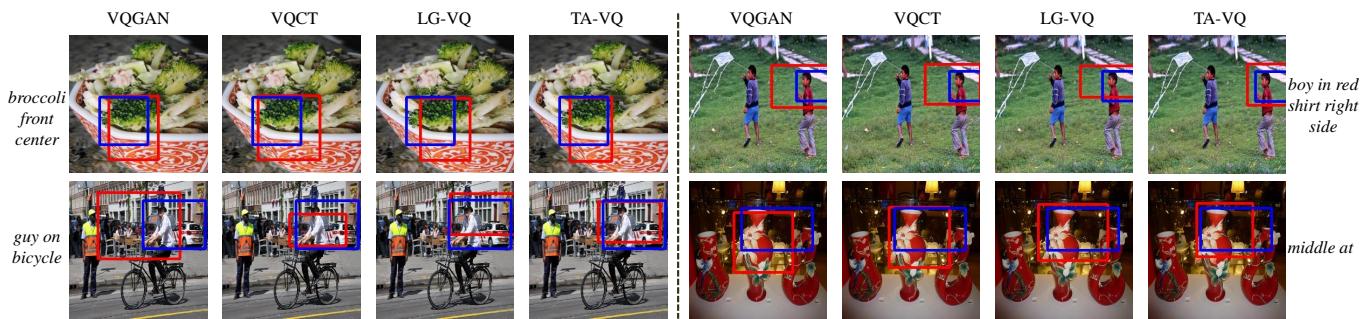
In Figure 17, we see the model locating objects (blue boxes are ground truth, red are predictions). TA-VQ (far right) shows much tighter and more accurate bounding boxes compared to VQ-GAN or VQCT.
3. Visual Question Answering (VQA)
Can the model answer questions about the image? This requires high-level semantic understanding.
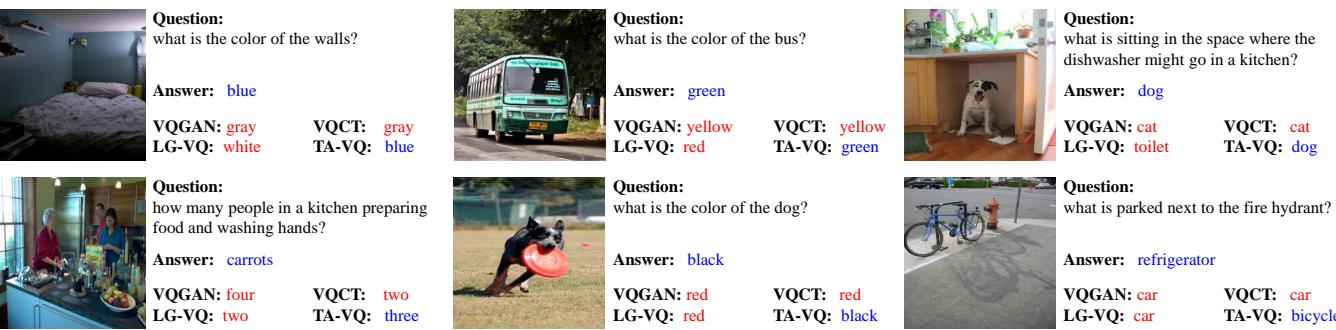
In Figure 18, TA-VQ demonstrates superior reasoning. For example, in the bottom-left panel, when asked how many people are preparing food, TA-VQ correctly identifies the count, whereas other models struggle. This suggests the “sentence-level” alignment successfully imparted high-level semantic logic into the visual codebook.
Conclusion
The paper “Towards Improved Text-Aligned Codebook Learning” presents a compelling argument: Data richness matters. By moving beyond concise captions and embracing long, detailed descriptions generated by VLMs, TA-VQ bridges the semantic gap that has limited previous VQ models.
The genius of the approach lies not just in using longer text, but in structuring the learning process. By mimicking the hierarchical nature of both vision (pixels to scenes) and language (words to sentences), and solving the alignment via efficient Optimal Transport, TA-VQ sets a new standard for text-aligned image modeling.
For students and researchers in generative AI, this work highlights the growing importance of Cross-Modal alignment. It’s no longer enough to train on images alone; understanding the deep semantic connection between what we see and how we describe it is the key to the next generation of AI creativity.