](https://deep-paper.org/en/paper/2503.01661/images/cover.png)
Imagine dumping a folder of random photos—taken with different cameras, from different angles, with no metadata—into a system and getting a perfect, dense 3D model out the other side. This is the “Holy Grail” of geometric computer vision: unconstrained Structure-from-Motion (SfM).
Recently, a method called DUSt3R (Dense Unconstrained Stereo 3D Reconstruction) made waves by solving this problem without the complex, handcrafted pipelines of traditional photogrammetry. It treated 3D reconstruction as a simple regression task. However, DUSt3R had a significant Achilles’ heel: it was fundamentally a pairwise method. It looked at two images at a time. If you wanted to reconstruct a scene from 100 images, you faced a combinatorial explosion of pairs to process and a messy global alignment problem to stitch them together.
Enter MUSt3R (Multi-view Network for Stereo 3D Reconstruction).
In this post, we will dive deep into a new paper from NAVER LABS Europe that evolves the paradigm from pairs to multi-view. We will explore how MUSt3R redesigns the neural architecture to handle arbitrary numbers of inputs, introduces a “working memory” to process video streams in real-time, and achieves state-of-the-art results in both offline reconstruction and online Visual Odometry (VO).
![Figure 1: Qualitative example of MUSt3R reconstructions of Aachen Day-Night [83] nexus4 sequence 5 (offline, top) and TUM-RGBD [58] Freiburgl-room sequence (online, bottom).More qualitative examples can be found in Sec. B.](/en/paper/2503.01661/images/001.jpg#center)
The Problem with Pairs
To understand why MUSt3R is necessary, we first need to look at its predecessor, DUSt3R.
DUSt3R works by taking two images and predicting a “Pointmap” for each. A Pointmap is essentially a dense 2D-to-3D mapping: for every pixel in the image, the network predicts its 3D coordinate \((x, y, z)\). Crucially, DUSt3R predicts these points in the coordinate system of the first camera of the pair.
This works beautifully for two images. But what happens when you have a sequence of video frames or a large collection of photos?
- Quadratic Complexity: To be thorough, you might need to compare every image against every other image, leading to \(O(N^2)\) complexity.
- Global Alignment Hell: Since every pair is reconstructed in its own local coordinate system, you end up with dozens or hundreds of “mini-worlds” that need to be rotated and scaled to fit into one global scene. This optimization is slow and prone to drift.
The researchers behind MUSt3R asked: Can we design a network that natively understands multiple views at once and outputs everything in a single, shared coordinate system?
The MUSt3R Architecture
The solution required a significant architectural overhaul. The researchers moved away from the specific binocular (two-camera) design of DUSt3R to a symmetric, scalable Multi-view design.
1. From Asymmetric to Symmetric
DUSt3R used two separate decoder branches—one for the first image and one for the second. To scale to \(N\) views, you can’t just keep adding decoder branches; the model would become massive.
MUSt3R simplifies this by using a Siamese architecture. This means the same decoder weights are shared across all input images. To distinguish the “reference” image (which defines the coordinate system origin, usually the first image) from the others, the network adds a learnable embedding vector \(\mathbf{B}\) to the features of the non-reference images.

This change seems subtle, but it is powerful. It allows the network to process any number of “source” views against a “reference” view using a single set of weights, halving the parameter count of the decoder compared to the original pairwise model.
2. The Working Memory Mechanism
The most critical innovation in MUSt3R is the introduction of memory.
In a standard Transformer-based vision model, “attention” is the mechanism that allows different parts of the input to talk to each other. In a multi-view setup, pixels in Image A need to attend to pixels in Image B to figure out 3D geometry.
However, calculating attention across a sequence of 100 images simultaneously is computationally impossible for standard GPUs. MUSt3R solves this by making the process iterative. It processes images sequentially but keeps a “memory” of the representations calculated for previous images.
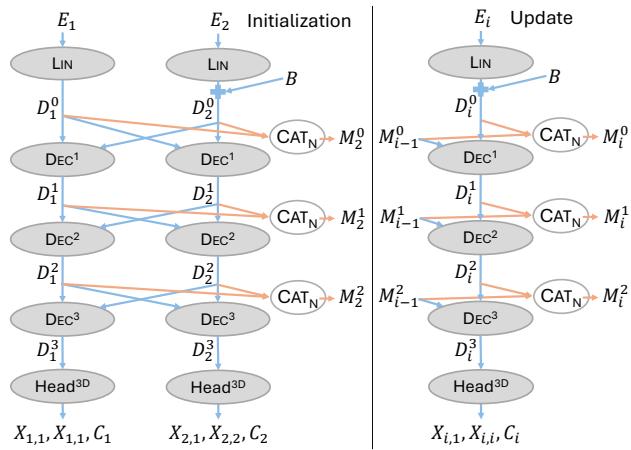
As shown in Figure 3 above, the process has two phases:
- Initialization (Left): The system starts with a pair of images to establish the scene.
- Update (Right): When a new image arrives, it doesn’t need to be paired individually with every past image. Instead, its features attend to the Memory (\(\mathbf{M}\)), which contains the concatenated features of all previous layers from previous images.
Mathematically, at each layer \(l\), the features for the new image \(n+1\) are updated by attending to the memory of that layer:
![]\n\\mathbf D _ { n + 1 } ^ { l } = { \\mathrm { D E C } } ^ { l } ( \\mathbf D _ { n + 1 } ^ { l - 1 } , \\mathbf M _ { n } ^ { l - 1 } ) .\n[](/en/paper/2503.01661/images/010.jpg#center)
This creates a system reminiscent of the “KV Cache” used in Large Language Models (LLMs) to speed up text generation. By caching the past, MUSt3R makes the computational cost of adding a new view linear—\(O(N)\)—rather than quadratic.
3. Global 3D Feedback (Injection)
There is a potential downside to processing images sequentially: the early layers of the network (which handle the new image) might not know about the global 3D structure established by the later layers of the previous images.
To fix this, the authors introduce a 3D Feedback Module. They take the highly processed, 3D-aware features from the end of the network (layer \(L-1\)) and inject them back into the beginning layers of the memory.
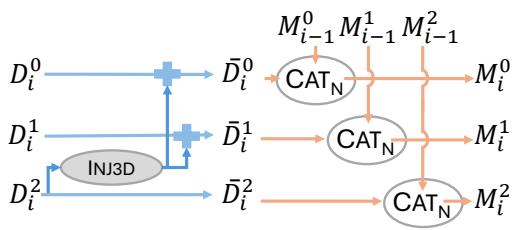
This feedback loop ensures that when the network starts processing a new frame, it already has a “hunch” about the global 3D geometry it needs to fit into. The injection equation looks like this:
![]\n\\bar { \\mathbf { D } } _ { i } ^ { l } = \\left{ \\begin{array} { l l } { \\mathbf { D } _ { i } ^ { l } + \\mathrm { I N } \\boldsymbol { y } ^ { \\mathrm { 3 D } } ( \\mathbf { D } _ { i } ^ { L - 1 } ) , } & { \\forall l < L - 1 \\mathrm { a n d } i \\in \\mathcal { P } } \\ { \\mathbf { D } _ { i } ^ { l } , } & { l = L - 1 \\mathrm { o r } i \\in \\mathcal { N } , } \\end{array} \\right.\n[](/en/paper/2503.01661/images/011.jpg#center)
Experiments showed that without this feedback, the system struggles to maintain consistency over long sequences. With it, the network effectively propagates global 3D knowledge backward and forward through the layers.
4. Training in Log-Space
Finally, the authors tweaked the loss function. In large-scale scenes, metric distances can vary wildly—from centimeters to hundreds of meters. Training a regression model on raw metric distances can be unstable. MUSt3R trains using a logarithmic compression of the 3D points:
![]\n\\begin{array} { r l } & { f : x \\longrightarrow \\displaystyle \\frac { x } { | x | } l o g ( 1 + | x | ) , } \\ & { { \\bf X } _ { i , j } ^ { \\prime } [ p ] = f ( \\frac { 1 } { z } { \\bf X } _ { i , j } [ p ] ) , \\widehat { \\bf X } _ { i , j } ^ { \\prime } [ p ] = f ( \\frac { 1 } { \\widehat z } \\widehat { \\bf X } _ { i , j } [ p ] ) , } \\ & { \\ell _ { \\mathrm { r e g r } } ( i , j ) = \\displaystyle \\sum _ { p \\in { \\cal I } _ { i } } \\left| { \\bf X } _ { i , j } ^ { \\prime } [ p ] - \\widehat { \\bf X } _ { i , j } ^ { \\prime } [ p ] \\right| . } \\end{array}\n()](/en/paper/2503.01661/images/013.jpg#center)
This allows the model to handle both close-up objects and distant backgrounds with equal precision.
One Network, Two Modes
A major advantage of MUSt3R is its versatility. The exact same pre-trained network can be deployed in two completely different scenarios.
1. Online Visual Odometry (VO)
This is the “robot navigation” scenario. A camera moves through a room, and frames arrive one by one. The system must estimate the camera’s path and build a map on the fly.
Because MUSt3R uses a running memory, it fits this perfectly.
- Initialization: Process the first few frames.
- Loop: For each new frame, query the memory to predict the 3D Pointmap.
- Memory Management: Since we can’t store infinite history, the system uses a “Spatial Discovery Rate.” If a new frame shows the same old stuff, we discard it. If it reveals new parts of the room, we add it to the memory.
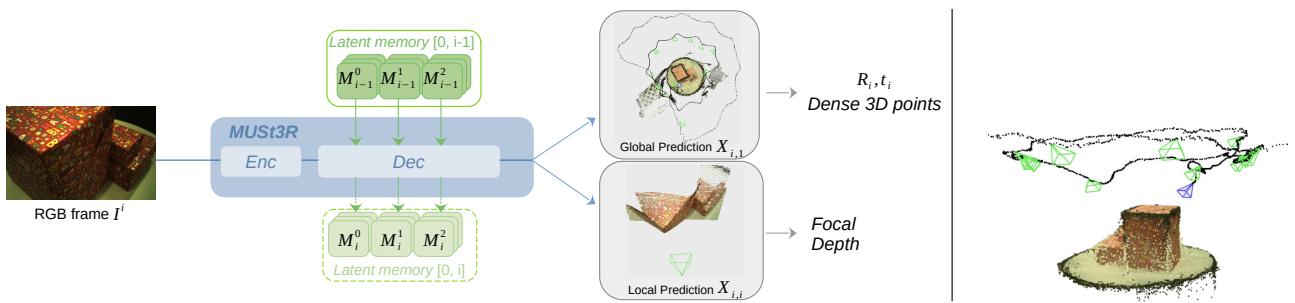
The implementation for this is surprisingly concise. The Python snippet below highlights how the complex logic of SLAM (Simultaneous Localization and Mapping) is abstracted away by the network’s ability to just “predict” the next state.
2. Offline Structure-from-Motion (SfM)
This is the “3D scan” scenario. You have a disorganized collection of 50 photos of a statue. MUSt3R sorts the images based on visual overlap and feeds them sequentially into the memory. Once the memory is populated with latent representations of the whole scene, it performs a final Rendering pass.
In the rendering pass, it asks the network: “Given what you now know about the entire sequence in your memory, re-predict the 3D points for all images.” This breaks causality (using future information to fix past predictions) and results in highly accurate, globally consistent models.
Experimental Results
The paper validates MUSt3R on several challenging benchmarks, comparing it against its predecessor (DUSt3R) and other state-of-the-art methods like Spann3R.
Visual Odometry Performance
On the TUM RGB-D benchmark, a standard test for camera tracking, MUSt3R demonstrates exceptional performance. In the table below, lower numbers (RMSE) are better. MUSt3R (bottom rows) consistently beats or matches methods that are designed specifically for SLAM, even though MUSt3R is uncalibrated (it doesn’t know the camera parameters beforehand!).
![Table 1: VO: ATE RMSE [cm] on TUM RGB.Sparse (S) versus dense (D) versus dense unconstrained (U) methods on TUM-RGB SLAM benchmark. \\(( ^ { * } )\\) model re-run without Loop Closure and global bundle adjustment.](/en/paper/2503.01661/images/012.jpg#center)
It is worth noting that MUSt3R runs at a respectable 15 FPS in its causal mode (MUSt3R-C), making it viable for near real-time applications.
3D Reconstruction Quality
Qualitatively, the results are stunning. Whether it’s large outdoor landmarks or cluttered indoor rooms, MUSt3R recovers fine details and correct geometry.
![Figure 5: Qualitative example of MUSt3R reconstructions of Cambridge Landmarks [27].](/en/paper/2503.01661/images/022.jpg#center)
The system is also robust enough to handle “Object-Centric” scenes, where the camera orbits a specific object, handling the drastic viewpoint changes smoothly.
![Figure 6: Qualitative example of MUSt3R reconstructions of MIP-360 [5].](/en/paper/2503.01661/images/023.jpg#center)
Intrinsics Estimation
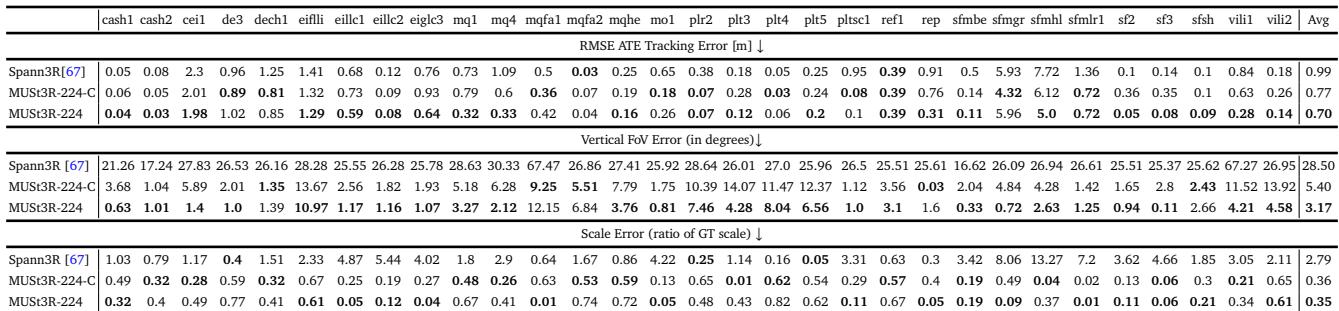
One of the wildest features of this lineage of models (DUSt3R/MUSt3R) is that they predict the camera’s focal length purely from the image content. The experiments show that MUSt3R estimates the Field of View (FoV) with an average error of only ~4 degrees, which is often better than the variation you might get from cheap, uncalibrated sensors.
Conclusion and Implications
MUSt3R represents a significant step forward in geometric deep learning. By moving from pairwise comparisons to a memory-augmented, multi-view architecture, it solves the scalability issues that plagued previous methods.
Here are the key takeaways:
- Scalability: The \(O(N)\) complexity allows processing large sequences that were previously intractable.
- Versatility: A single model handles both online SLAM-like tasks and offline 3D reconstruction.
- Simplicity: It removes the need for complex, handcrafted geometric pipelines (like bundle adjustment or loop closure) for many applications. The network simply learns the geometry.
For students and researchers in computer vision, MUSt3R suggests that the future of 3D reconstruction lies not in better hand-coded math, but in smarter neural architectures that can “remember” 3D space over time. As memory mechanisms improve, we may soon see end-to-end neural SLAM systems that rival the best engineered solutions on the market.