](https://deep-paper.org/en/paper/2503.01774/images/cover.png)
Introduction
We are currently witnessing a golden age of neural rendering. Technologies like Neural Radiance Fields (NeRF) and 3D Gaussian Splatting (3DGS) have allowed us to turn a handful of 2D photographs into immersive, navigable 3D scenes. The results are often breathtaking—until you stray too far from the original camera path.
As soon as you move the virtual camera to a “novel view”—an angle not seen during training—the illusion often breaks. You encounter “floaters” (spurious geometry hanging in the air), blurry textures, and ghostly artifacts. This happens because these regions are underconstrained; the 3D model simply doesn’t have enough data to know what should be there, so it guesses, often poorly.
Standard optimization methods assume perfect input data, but real-world captures have motion blur, lighting changes, and imperfect calibration. Previous attempts to fix this using generative AI (like diffusion models) have been slow, often requiring computationally expensive queries at every training step.
Enter DIFIX3D+. In a new paper from NVIDIA, researchers propose a pipeline that uses a blazing-fast, single-step diffusion model to “fix” these artifacts. It doesn’t just paint over the mistakes; it teaches the 3D model to correct itself.
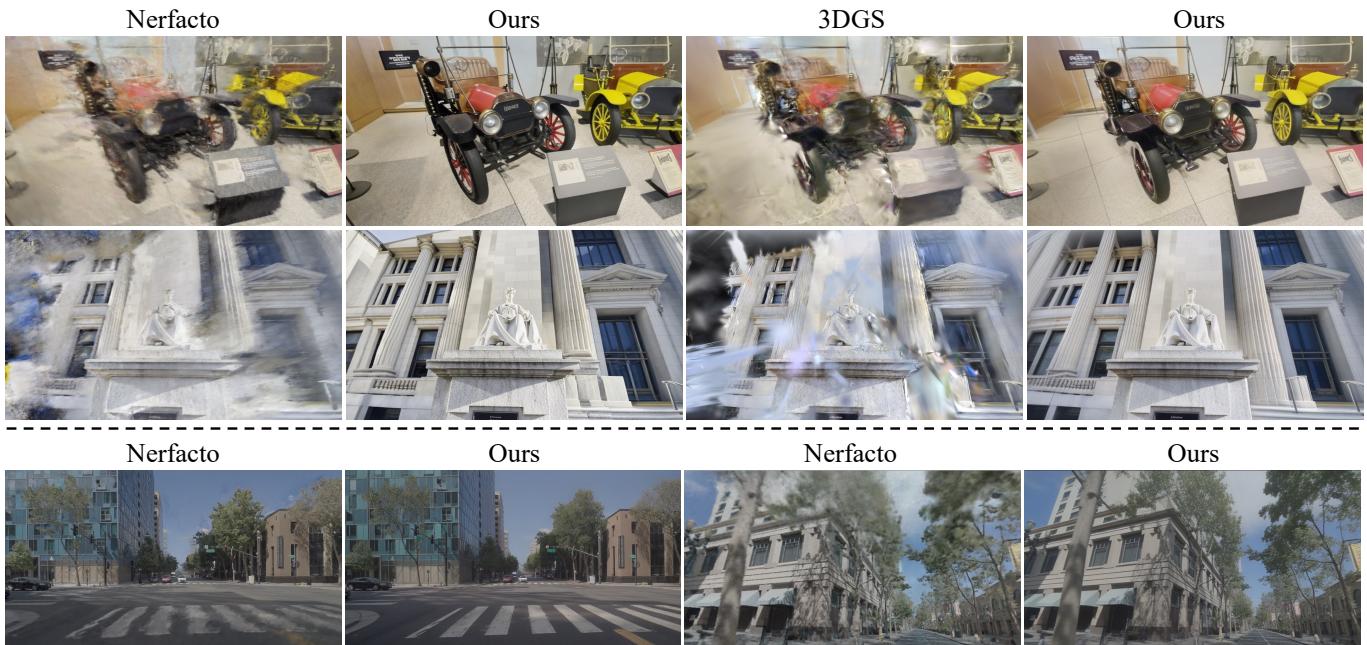
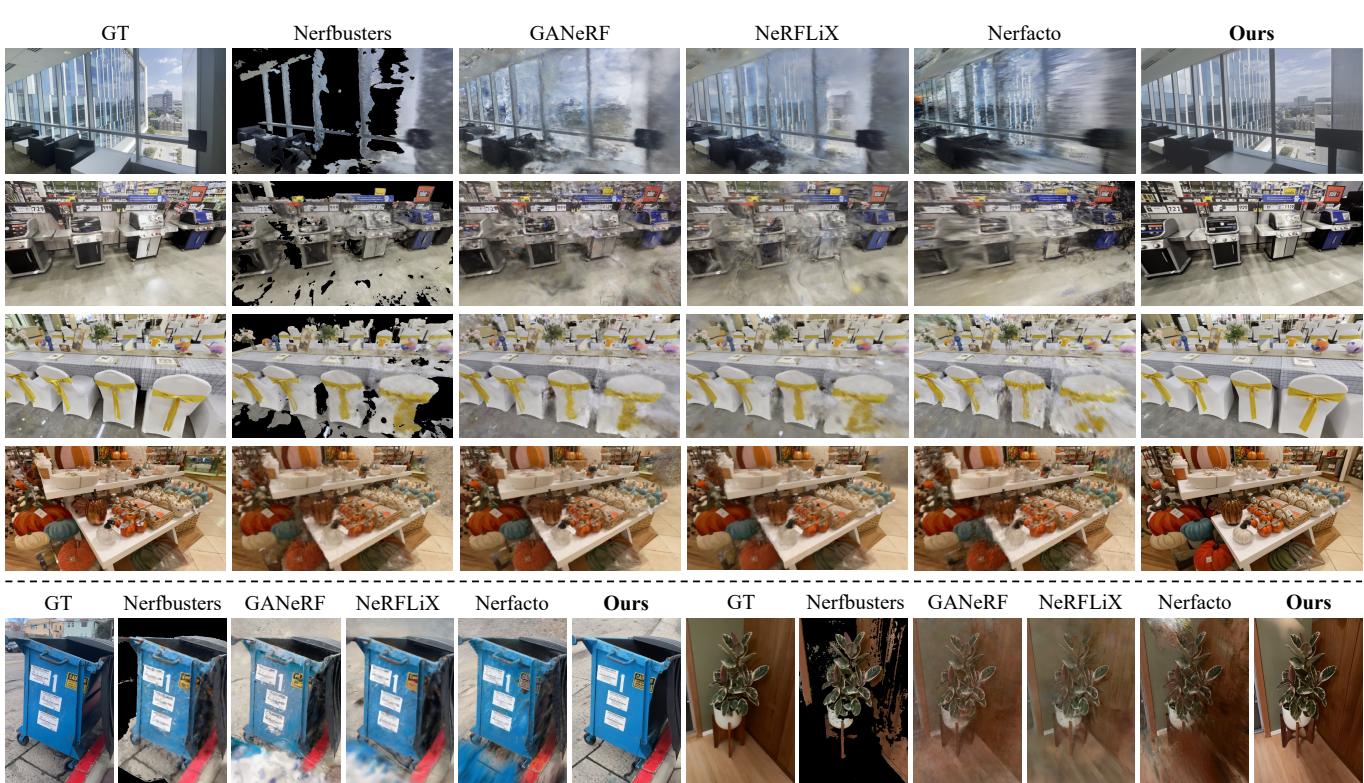
As shown in Figure 1 above, the difference is stark. Where standard methods (Nerfacto, 3DGS) produce blurry or distorted renderings, DIFIX3D+ generates crisp, photorealistic details in both indoor and outdoor environments.
In this post, we will tear down the architecture of DIFIX3D+, explain how it adapts 2D generative priors to 3D space, and analyze why “single-step” diffusion is the key to making this practical.
Background: The Artifact Problem
To understand the solution, we must first briefly revisit the problem.
Neural Rendering Basics
Whether we are talking about NeRFs or Gaussian Splatting, the goal is to synthesize a color \(C\) for a pixel by shooting a ray into the scene.
In NeRF, we sample points along a ray and accumulate color and density. The rendering equation looks like this:
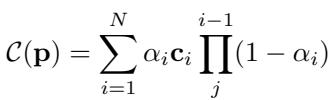
In 3D Gaussian Splatting, we project 3D Gaussian ellipsoids onto the 2D screen. The alpha blending formula is slightly different but follows the same logic of accumulation:

The fundamental issue is Shape-Radiance Ambiguity. If you only have a few images of a car from the front, the 3D model can “cheat” by placing the car’s texture on a flat wall behind it, or by creating a cloud of semi-transparent particles. From the training angles, it looks perfect. But rotate the camera 15 degrees, and the geometry falls apart.
The Diffusion Dilemma
Generative Diffusion Models (like Stable Diffusion) are excellent at hallucinating plausible details. They know what a car looks like from the side, even if your specific dataset doesn’t show it perfectly.
However, using them for 3D is tricky. Standard diffusion models are iterative. To generate or clean an image, they run a denoising loop 50 to 100 times. If you try to use this inside a 3D training loop that runs for thousands of iterations, your training time explodes from minutes to days.
The authors of DIFIX3D+ tackle this by leveraging Single-Step Diffusion Models (specifically, SD-Turbo). These models can map noise to a clean image in a single forward pass, making them orders of magnitude faster.
Core Method: DIFIX
The heart of this paper is DIFIX, a specialized image-to-image translation model designed to remove rendering artifacts.
1. The Insight: Artifacts are just “Noise”
The researchers made a clever observation: the visual artifacts produced by NeRFs and 3DGS (blur, noise, floaters) mathematically resemble the intermediate noisy states of a diffusion model.
Instead of training a diffusion model from scratch, they fine-tuned SD-Turbo. They trained it to take a “noisy” rendered image (containing artifacts) and output a “clean” ground-truth image.
However, simply denoising the image isn’t enough. If you ask a standard diffusion model to fix a blurry photo of a building, it might invent a totally different building. To prevent this, DIFIX is conditioned on a Reference View—a real image from the dataset that is closest to the current viewpoint.
2. Architecture
The architecture is a modified U-Net. As visualized in Figure 3 below, the model takes two inputs:
- The Input (the artifact-ridden render).
- The Reference View (ground truth context).
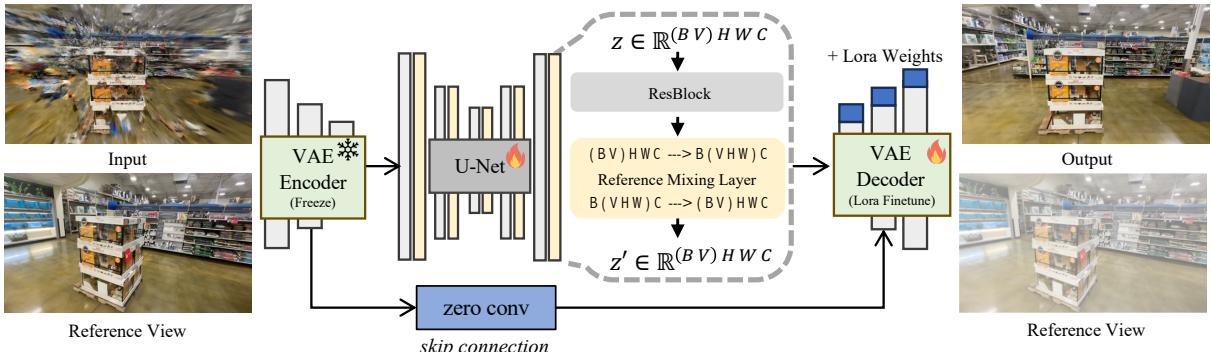
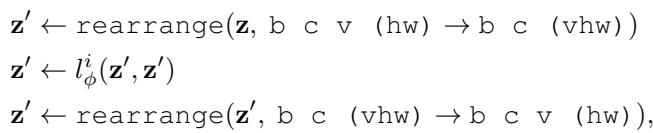
To make the model aware of the reference image, the authors replaced the standard self-attention layers with a Reference Mixing Layer. This layer concatenates the features of the input and reference views, allowing the model to “borrow” correct textures and colors from the reference view to fix the input.
The mathematical operation for mixing the views in the latent space looks like this:
3. The Goldilocks Noise Level
A critical hyperparameter in this process is \(\tau\), the noise level used during training.
- If \(\tau\) is too high (e.g., 1000), the model destroys the input image and hallucinates a new one that doesn’t match the scene geometry.
- If \(\tau\) is too low (e.g., 10), the model barely changes anything, leaving artifacts intact.
The authors found that \(\tau = 200\) is the “Goldilocks” zone. At this level, the model is aggressive enough to remove floaters and sharpen edges, but conservative enough to respect the underlying scene structure.

As shown in Figure 4, \(\tau=200\) achieves the highest Peak Signal-to-Noise Ratio (PSNR) and Structural Similarity (SSIM).
4. Data Curation: Teaching the Fixer
To train DIFIX, the authors needed a massive dataset of “Bad Render” vs. “Good Image” pairs. Since such a dataset didn’t exist, they manufactured one using three strategies:
- Cycle Reconstruction: Train a NeRF on a trajectory, render a shifted view, train another NeRF on that, and render back to the original. This accumulates errors naturally.
- Model Underfitting: Intentionally stopping training early (25-75% of epochs) to generate blurry, unfinished results.
- Cross Reference: Training on one camera from a multi-camera rig and trying to predict the view of a held-out camera.
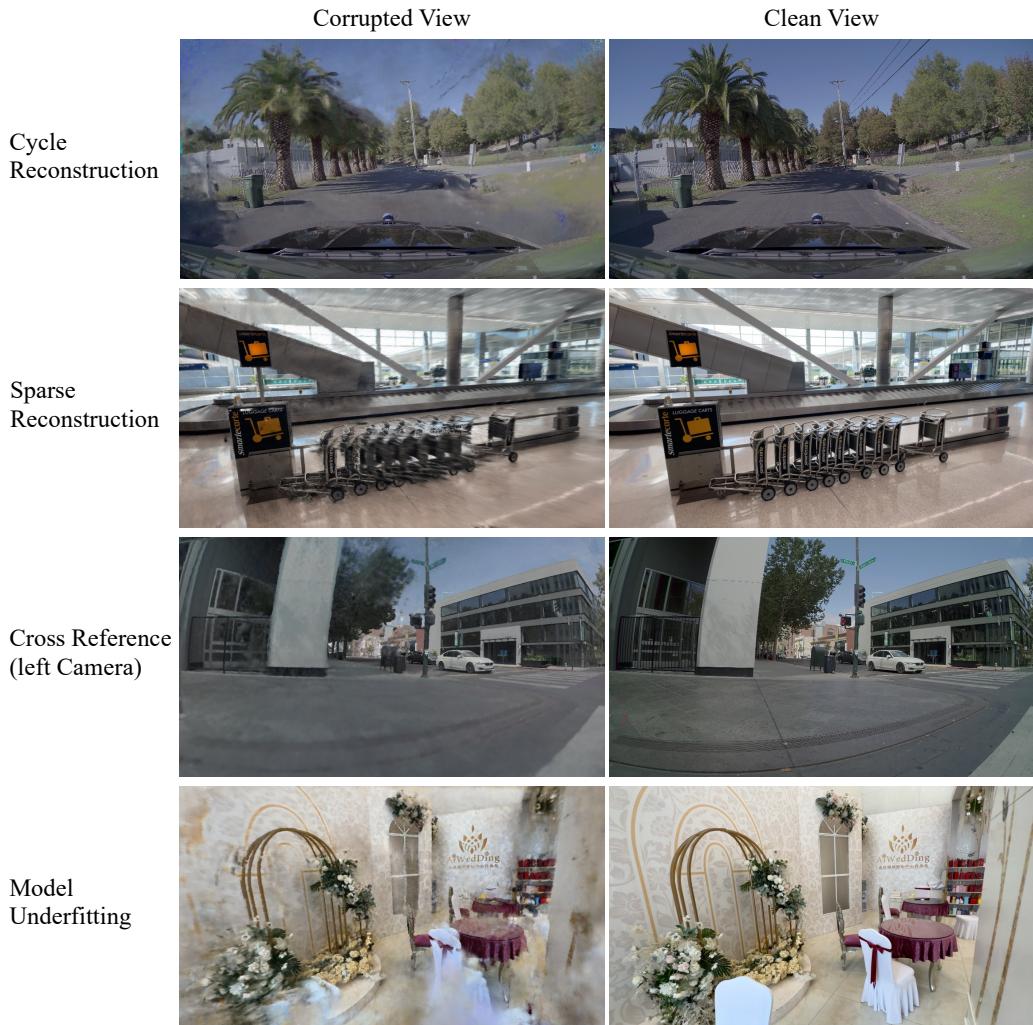
Figure S2 illustrates these degradation strategies. This curated dataset allows DIFIX to learn exactly what NeRF/3DGS artifacts look like and how to remove them.
The DIFIX3D+ Pipeline
Having a “Fixer” model is great, but applying it blindly to every frame can lead to temporal inconsistency (flickering). To solve this, the authors propose a pipeline that distills the fixed images back into the 3D representation.
The pipeline consists of three distinct steps, visualized in Figure 2:
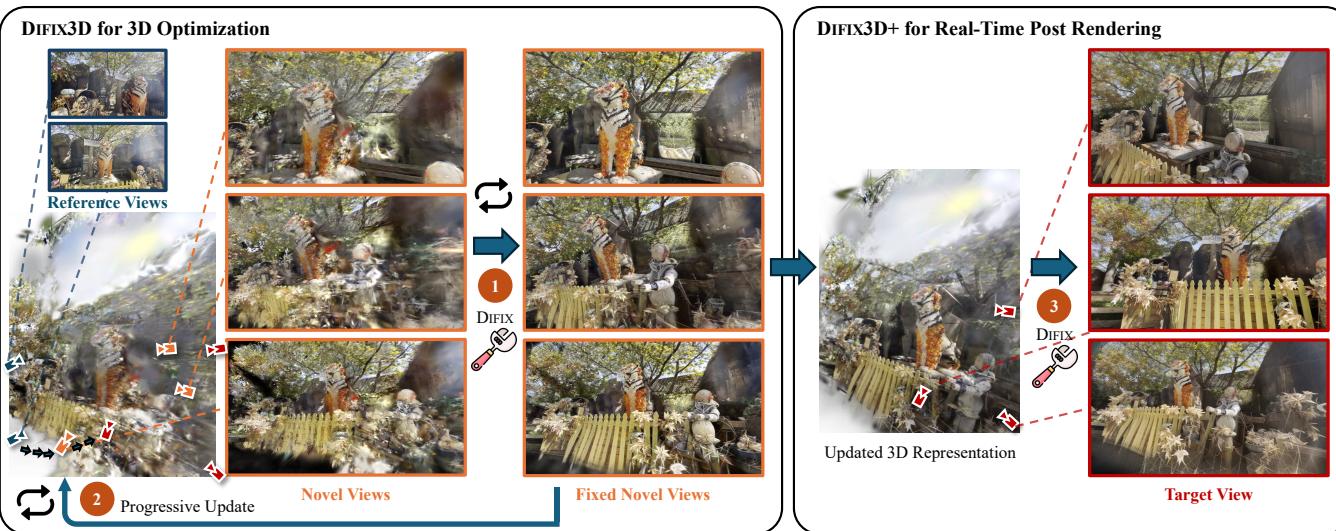
Step 1: Progressive 3D Update (The Distillation Loop)
This is the training phase. The goal is to improve the underlying NeRF or 3DGS model.
- Render: The system renders a novel view slightly away from the training cameras.
- Fix: DIFIX processes this render, removing artifacts using 2D priors.
- Update: This “fixed” image is treated as a pseudo-ground-truth. The 3D model is trained on this new image.
Crucially, this is done progressively. The system starts with views close to the training data and slowly pushes the camera further out. This allows the 3D model to “grow” its reliable region outward, with DIFIX acting as a guardrail to prevent artifacts from being baked in.
Step 2: Real-Time Post-Processing
Even after the progressive update, some minor artifacts might remain because 3D representations have limited capacity (they can’t store infinite detail).
Because DIFIX is a single-step model, it is incredibly fast (approx. 76ms per frame). This allows the authors to run DIFIX one last time during inference. This acts as a final polish, sharpening textures and removing any residual high-frequency noise that the 3D model couldn’t smooth out.
Loss Functions
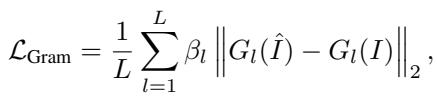
To supervise the training, the authors use a combination of standard reconstruction loss and perceptual losses. They specifically employ a Gram Matrix Loss to encourage sharp textures. The Gram matrix computes feature correlations, which captures “style” and texture information effectively.
Experiments and Results
The authors evaluated DIFIX3D+ on challenging datasets like DL3DV (in-the-wild scenes) and Nerfbusters.
Quantitative Analysis
The results, shown in Table 2, are impressive.
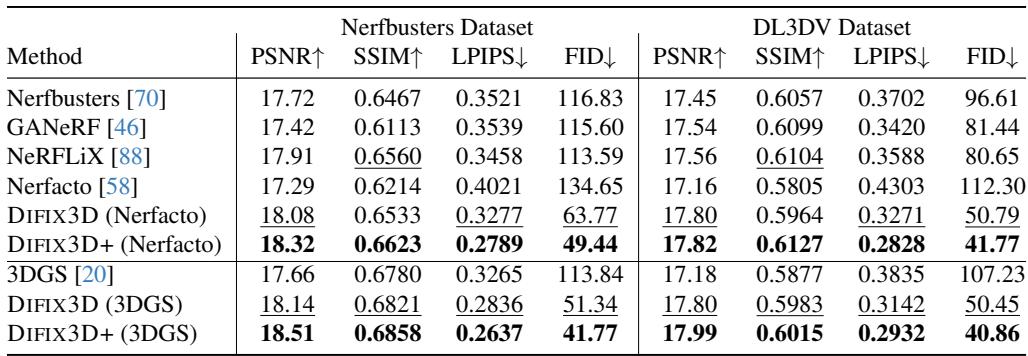
- FID (Fréchet Inception Distance): Lower is better. DIFIX3D+ achieves an FID of 41.77 on Nerfacto, compared to 112.30 for the baseline. This is a nearly \(3\times\) improvement in perceptual quality.
- PSNR: Higher is better. The method consistently improves PSNR by over 1dB, indicating better pixel-level accuracy.
Qualitative Analysis
The visual comparisons confirm the metrics. In Figure 5, we see DIFIX3D+ handling complex geometry like fences and foliage that usually turn into a blurry mess with other methods.
Ablation: Do we really need the Reference View?
The authors performed ablation studies to prove the necessity of their architecture choices. Figure S1 shows what happens if you remove the reference conditioning.
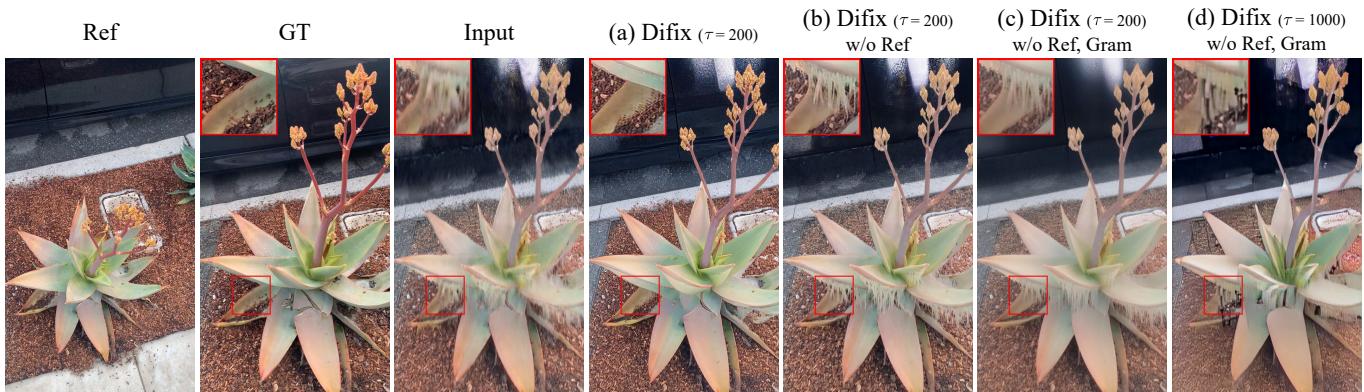
Without the reference view (Panel b), the model cleans the noise but hallucinates incorrect details (notice the distorted plant leaves). With the reference view (Panel a), the geometry is preserved faithfully.
The Impact of Post-Processing
Does the final real-time post-processing step (Step 2 of the pipeline) actually matter? Figure 7 suggests yes.
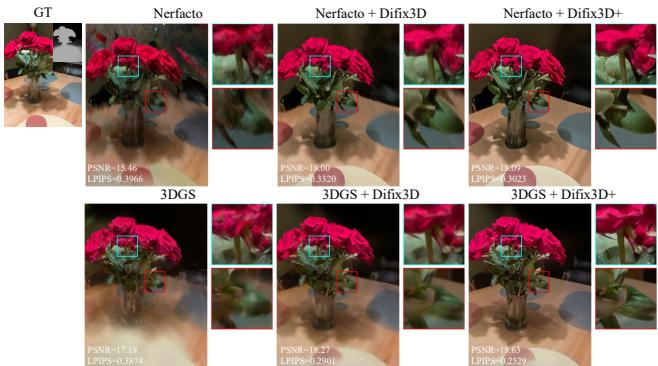
The difference between DIFIX3D (just the 3D update) and DIFIX3D+ (with post-processing) is visible in the fine textures of the flower petals. The post-processing acts as a final super-resolution and denoising pass.
Conclusion
DIFIX3D+ represents a significant step forward in making neural rendering robust for real-world applications. By treating 3D reconstruction artifacts as a specific type of “noise,” the authors successfully adapted powerful 2D diffusion priors to the 3D domain.
The key takeaways from this work are:
- Speed Matters: Moving from iterative diffusion to single-step models (SD-Turbo) makes generative feedback loops practical for 3D training.
- Reference is Key: Conditioning generative models on reference views is essential to prevent hallucination and maintain geometric consistency.
- Hybrid Approach: The best results come from combining optimization (baking knowledge into the 3D model) with inference-time enhancement (cleaning up the final render).
As generative models become faster and more consistent, pipelines like DIFIX3D+ will likely become the standard for creating photorealistic digital twins and immersive virtual environments.