](https://deep-paper.org/en/paper/2503.02261/images/cover.png)
Introduction
In the world of cell biology, seeing is understanding. 3D fluorescence confocal (FC) microscopy has become an indispensable tool for scientists, allowing them to peer inside living organisms and visualize the complex, volumetric dance of life at a cellular level. From studying how embryos develop to understanding neural connections, the ability to capture 3D data is revolutionary.
However, this technology comes with a frustrating trade-off. To keep cells alive during long-term observation, scientists must keep the laser power low. Low power means less signal, which inevitably leads to noisy, grainy images. Furthermore, the physics of microscopes creates a specific problem known as anisotropic resolution. While the image might look sharp in the lateral plane (XY), the resolution along the depth axis (Z) is often terrible—sometimes 4.5 times worse. This results in 3D volumes that look like stacks of pancakes rather than continuous, solid objects.
Traditionally, Deep Learning could solve this via Super-Resolution (SR), but that requires “Ground Truth”—perfect, high-resolution examples to learn from. In live-cell imaging, acquiring that ground truth requires high laser power that would kill the very cells you are trying to study. It is a catch-22.
In this post, we are diving into a paper titled “Volume Tells: Dual Cycle-Consistent Diffusion for 3D Fluorescence Microscopy De-noising and Super-Resolution.” The researchers propose a novel method called VTCD (Volume Tells Cycle-Consistent Diffusion). Their approach is fascinating because it is unsupervised: it doesn’t need perfect ground truth data. Instead, it listens to what the “Volume Tells” it, using the internal consistency of the 3D data itself to fix noise and blur.
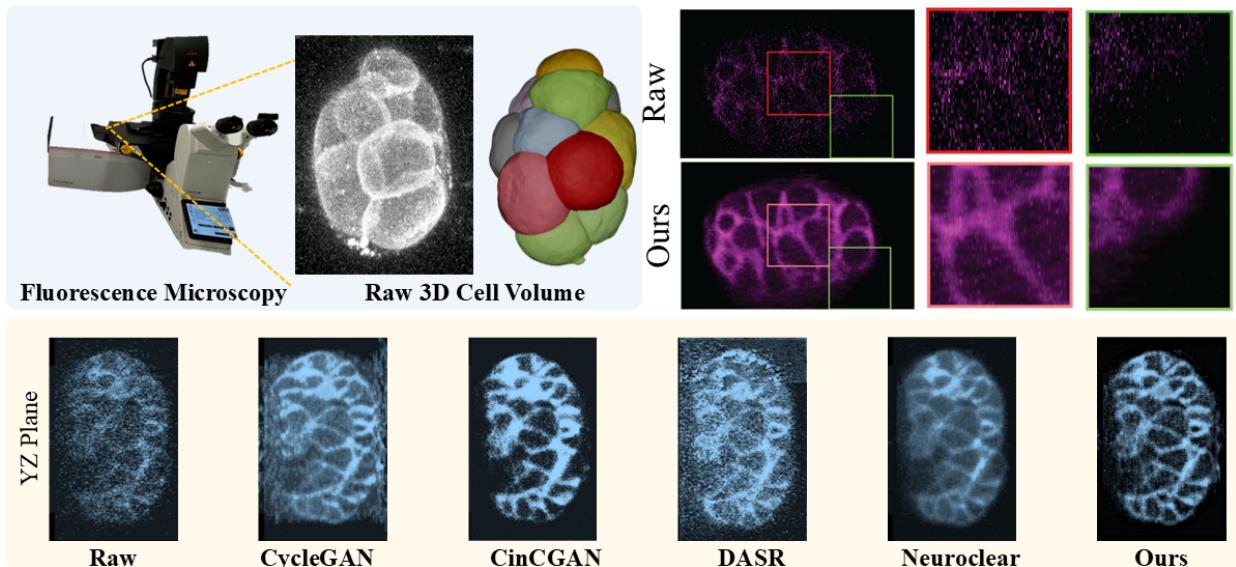
As shown in Figure 1, the difference is striking. The raw images (Top-Right) are noisy and indistinct. The VTCD results (Bottom) reveal clear cellular structures that were previously hidden in the noise.
Background: The Challenges of 3D Microscopy
To appreciate the solution, we must first understand the specific “degradations” that affect 3D fluorescence microscopy.
1. Spatially Varying Noise
Noise in these images isn’t random static like on an old TV. It varies based on depth. As light penetrates deeper into a biological sample, it scatters and absorbs. This means that slices deep inside the volume are much noisier than slices at the surface. Standard denoising algorithms often assume uniform noise, making them ineffective here.
2. Anisotropic Resolution
Microscopes have a “point spread function” (PSF) that is elongated along the Z-axis (shaped like a rugby ball standing on its tip). This physically limits how sharp the Z-axis can be. If you look at a cell from the top down (XY plane), it looks crisp. If you look at it from the side (XZ or YZ plane), it looks blurred and stretched.
3. The Lack of Ground Truth
Supervised learning models (like SRCNN or standard Diffusion Models) work by looking at pairs of “Bad Image” and “Good Image.” The model learns the mapping between them. In live-cell 3D microscopy, obtaining the “Good Image” (High-Resolution, Low-Noise) is physically impossible without damaging the sample. Therefore, researchers must rely on unsupervised learning—teaching the model to improve images without ever seeing a “perfect” answer key.
The Core Method: Volume Tells (VTCD)
The core insight of this paper is that the 3D volume already contains the information needed to fix itself. This is what the authors call “Intra-volume imaging priors.”
- For Denoising: Even though noise varies, adjacent slices in a volume usually have similar noise distributions. The model can use this consistency to separate signal from noise.
- For Super-Resolution: The high-resolution details exist in the XY plane. By understanding the 3D structure, the model can “propagate” this high-quality information into the blurry XZ and YZ planes.
To implement this, the authors utilize a Dual Cycle-Consistent Diffusion framework. This is a complex architecture, so let’s break it down using their schematic.
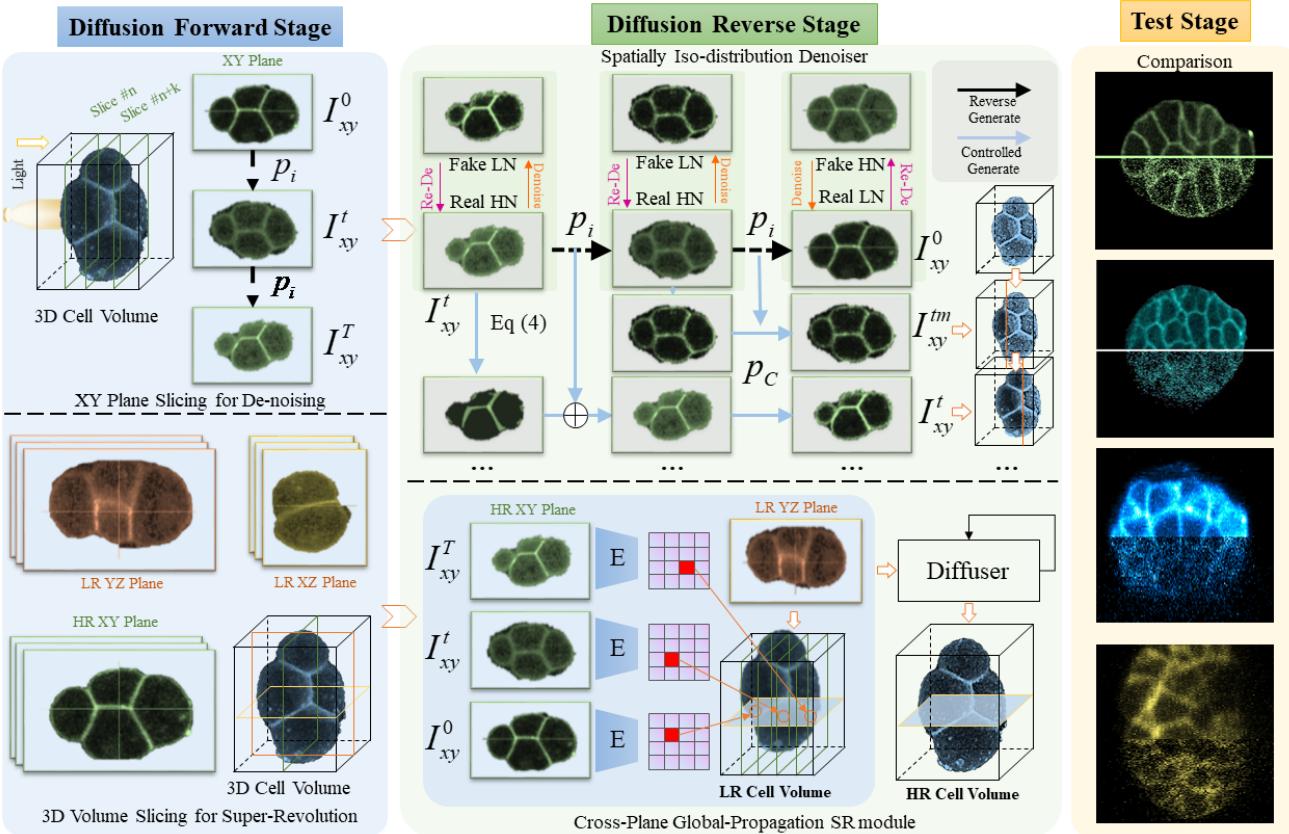
The framework (Figure 2) consists of two main cycles: one for De-noising (Top path) and one for Super-Resolution (Bottom path).
The Forward Stage: Modeling the Physics
In diffusion models, the “forward process” usually involves gradually adding Gaussian noise to an image until it is pure static. However, VTCD does something smarter. It models the forward process based on the actual physical degradation of the microscope.
For Denoising: The authors view the Z-axis stacking as a diffusion process. Since light degrades as it goes deeper, they model the progression of slices along the Z-axis as a gradual addition of noise. This is represented mathematically as:

For Super-Resolution: Similarly, they model the blurring effect. They treat the low-resolution XZ and YZ planes as degraded versions of the high-resolution XY plane information.

By defining the forward process this way, the model isn’t just learning to remove random noise; it is learning to reverse the specific optical flaws of the microscope.
The Reverse Stage 1: Spatially Iso-Distributed Denoiser
The first “generator” in this system is the Spatially Iso-Distributed (SID) Denoiser. Its job is to reverse the noise degradation.
In a standard diffusion model, the reverse step tries to predict the original clean image \(I_0\). However, because the noise varies spatially (it’s different at different depths), simply predicting one global “clean” state doesn’t work well.
The SID Denoiser uses the semantic content of the adjacent slices to guide the denoising. It looks at a noisy slice \(I_{xy}^t\) and uses the consistency of the surrounding volume to estimate the clean version. The reverse step is modified to include this guidance:

To ensure the denoising doesn’t hallucinate fake biology, the researchers enforce semantic consistency. They define a distance metric that ensures the “meaning” (semantic content) of the denoised image matches the input, even as the noise is stripped away.
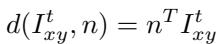
This results in a controlled generation trajectory (Equation 5 below), where the model progressively edits the latent encoding of the image to remove noise while preserving the cell shape.

The Reverse Stage 2: Cross-Plane Global-Propagation SR
This is perhaps the most innovative part of the paper. How do you fix the blurry Z-axis (XZ/YZ planes) when you don’t have a sharp reference?
The answer: Use the XY plane.
In fluorescence microscopy, the XY resolution is high. The model assumes that the structural details (textures, edges, shapes) found in the XY plane should logically exist in the other planes too. The Cross-Plane Global-Propagation SR Module (CPGP-SRM) takes features from the high-res XY plane and “propagates” them into the 3D volume.
Here is how it works:
- Feature Extraction: The model extracts 2D features from the sharp XY slices.
- 3D Projection: It projects these features into a 3D grid.
- Accumulation: An “Accumulator MLP” (a small neural network) aggregates these features, looking at neighboring grid elements to fill in the gaps in the Z-direction.
The accumulation process is described by this equation, where \(\theta\) represents the learned weights for combining spatial information:
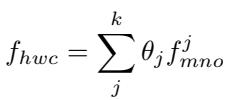
Finally, the model updates the blurry XZ and YZ slices by overlaying these propagated high-resolution details onto the original low-resolution data.

This process effectively “paints” the missing Z-axis details using the information present in the XY-axis.
The Training Objective
Because this is unsupervised, the model relies on a composite loss function \(\mathcal{L}_{\mathrm{VTDC}}\) that includes:
- Adversarial Loss (\(\mathcal{L}_{GAN}\)): Makes the images look realistic to a discriminator.
- Cycle Consistency Loss: Ensures that if you degrade the enhanced image, you get the original input back.
- Denoising & SR Specific Losses: To guide the diffusion process.

Specific components include Total Variation loss (\(\mathcal{L}_{TV}\)) to ensure smoothness (preventing pixelated artifacts) and Content Loss to preserve biological identity.


Experiments and Results
The researchers didn’t just test on toy datasets; they built a massive, comprehensive library of live-cell imaging data.
The Dataset
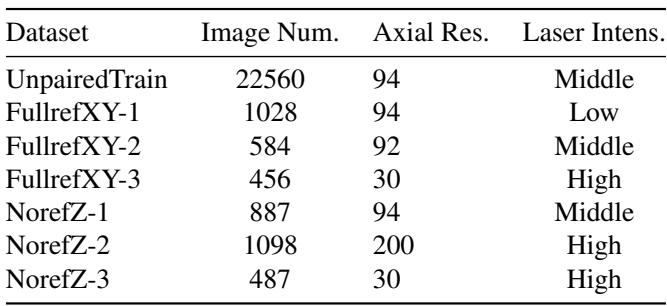
They collected over 22,000 images from live-cell embryos using Leica confocal systems. They created specific benchmarks: “Full Reference” (where they artificially downsampled images to have a ground truth for testing) and “No Reference” (real-world data where no ground truth exists).
Qualitative Results (Visuals)
The visual improvements are undeniable. When looking at the YZ plane (the side view, which is usually blurry), VTCD recovers membrane structures that are completely invisible in the raw data or other methods like CycleGAN.
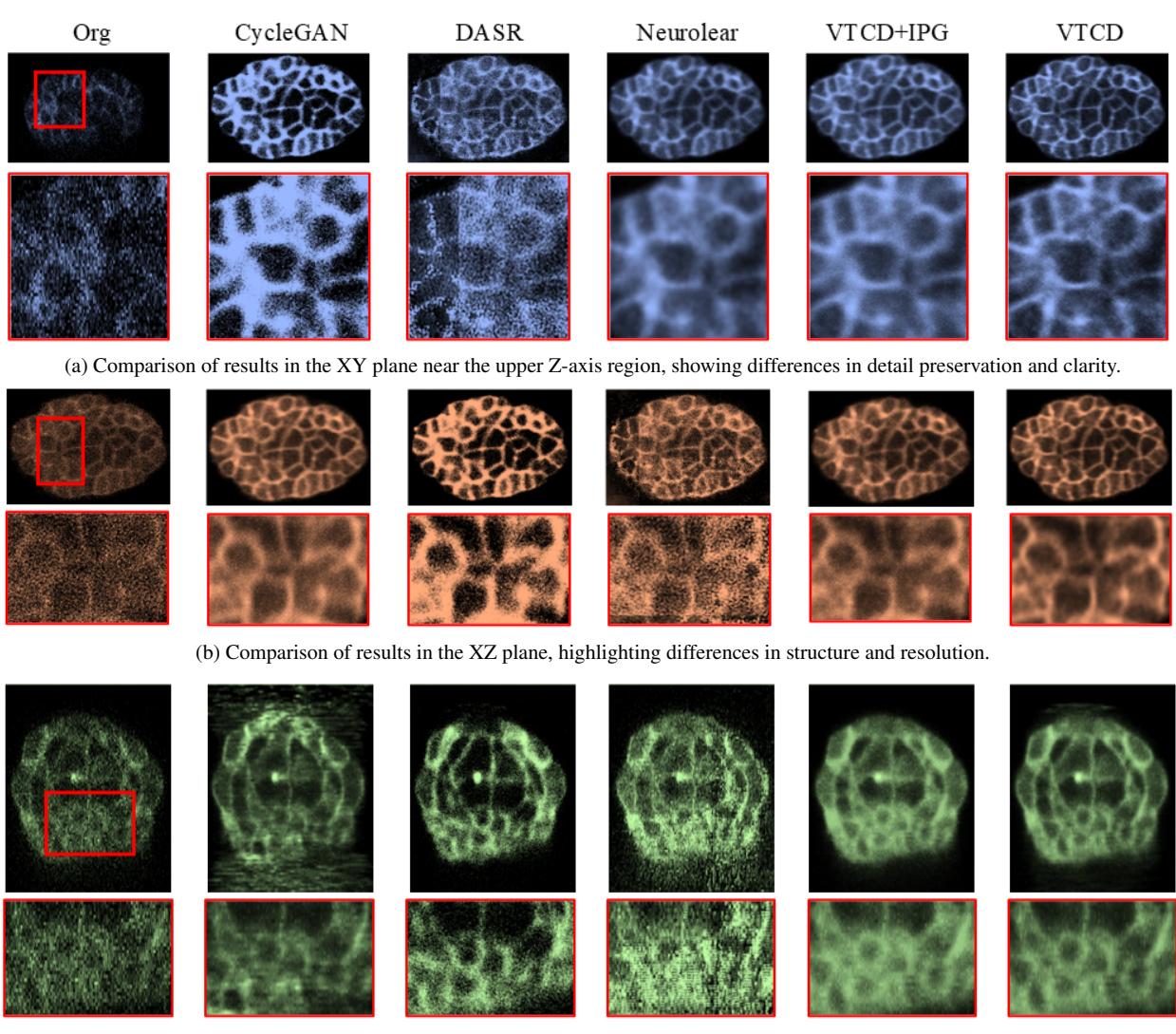
In Figure 3(c), look at the column labeled “VTCD.” Compared to “Raw” and “CycleGAN,” the cell boundaries are sharp and distinct. The blur is gone.
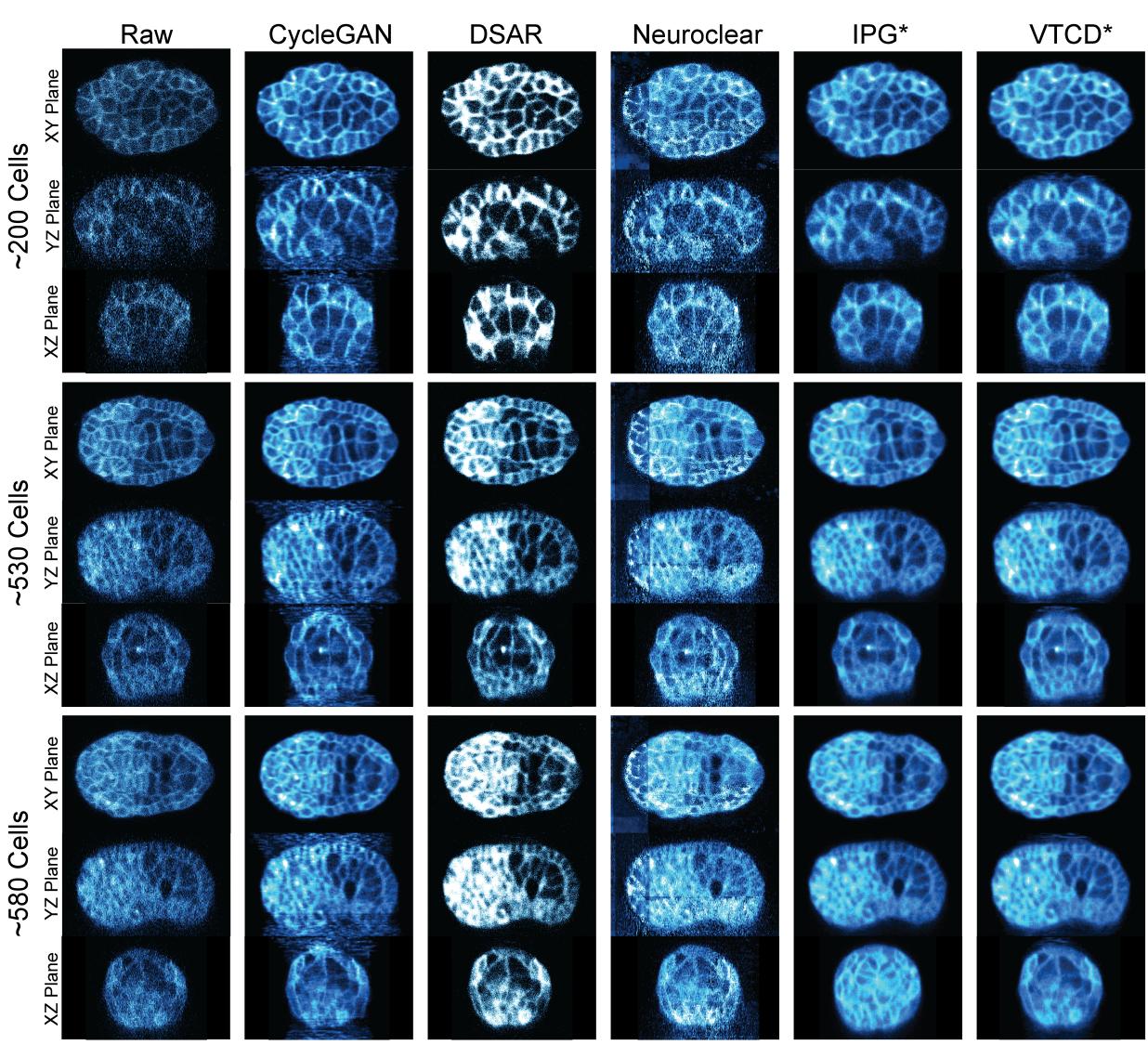
Further comparisons in the supplementary material reinforce this. In Figure S1 below, we see comparisons across different cell densities. The “Raw” column is grainy and dark. VTCD (far right) produces bright, crisp images with clear cell membranes.
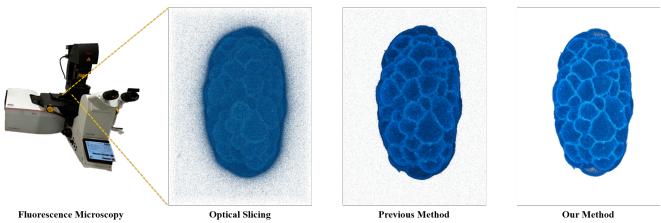
We can also see a 3D rendering comparison. The “Previous Method” leaves artifacts and disconnected structures, while “Our Method” creates a coherent, smooth 3D cell volume.
Quantitative Results (The Numbers)
Visually pleasing images are good, but do the numbers back them up? Yes.
The researchers used metrics like PSNR (Peak Signal-to-Noise Ratio) and SSIM (Structural Similarity Index). Higher is better. As shown in Figure 4, VTCD consistently scores higher than competing unsupervised methods like CycleGAN, CinCGAN, and Neuroclear across different datasets.
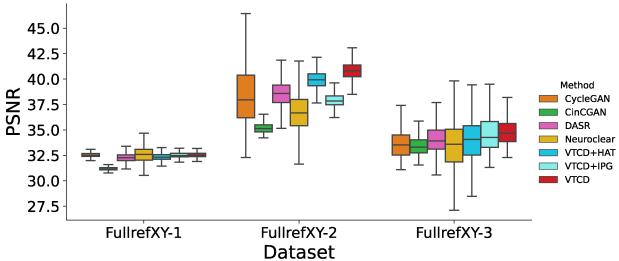
Crucially, they also tested on No Reference datasets (where no ground truth exists). Here, they used metrics like NIQE and PIQE (perception-based quality evaluators where lower is better).
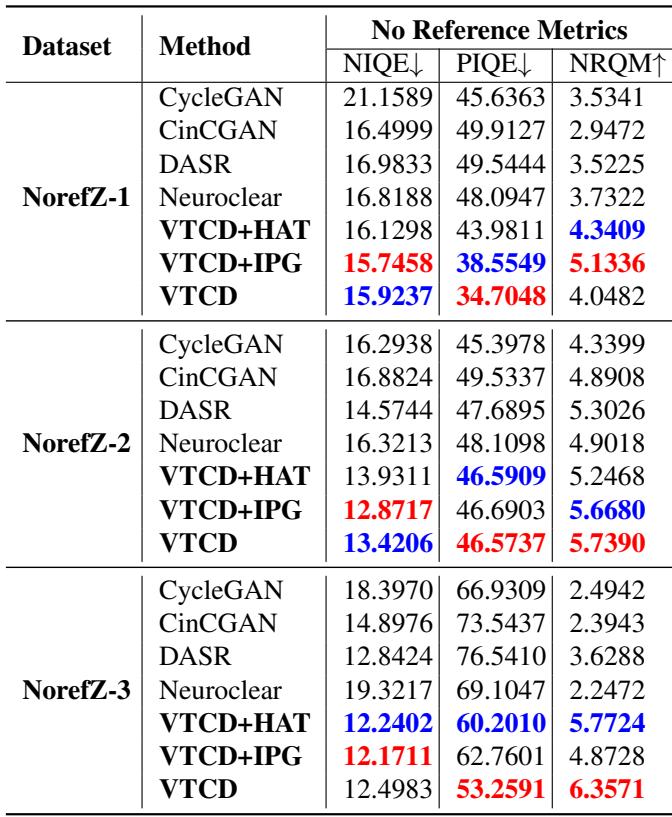
In Table 3, VTCD achieves significantly lower scores (better quality) in NIQE and PIQE compared to the baselines. For example, in the NorefZ-3 dataset, VTCD achieves a PIQE of 53.26, while the standard CycleGAN sits at 66.93.
Ablation Studies
To prove that every part of their “Dual Cycle” machine was necessary, they performed ablation studies—removing parts of the model to see what breaks.
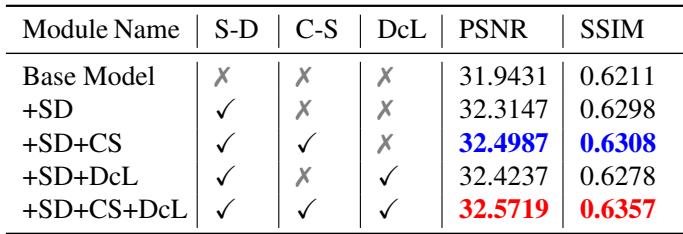
Table 4 shows that removing the SID-Denoiser or the CPGP-SRM leads to a drop in performance. The full model (bottom row) yields the highest PSNR and SSIM, confirming that both the denoising and super-resolution modules work synergistically.
Conclusion
The “Volume Tells” (VTCD) paper presents a significant leap forward for 3D fluorescence microscopy. By accepting that ground truth data is inaccessible and instead relying on intra-volume priors, the researchers have found a way to “hack” the physics of microscopy.
They treat the 3D volume not just as a stack of pictures, but as a coherent physical object where:
- Noise follows predictable patterns between slices.
- Structure in the high-res XY plane dictates the structure in the blurry Z-axis.
The resulting method allows biologists to image cells at low laser power (keeping them alive and healthy) while computationally restoring the high resolution and low noise required for precise analysis. This opens new doors for long-term observation of fundamental life processes, from cell division to embryonic development, in crystal-clear 3D.