](https://deep-paper.org/en/paper/2503.03081/images/cover.png)
Introduction
In the world of Artificial Intelligence, we have witnessed a massive explosion in capabilities driven by data. Large Language Models (LLMs) like GPT-4 thrive because they ingest trillions of tokens of text from the internet. However, robotics faces a stubborn bottleneck: the physical world. Unlike text or images, high-quality data for robotic manipulation—teaching a robot how to fold laundry, cook a steak, or assemble a toy—is incredibly scarce.
The gold standard for collecting this data is teleoperation. This involves a human expert controlling a physical robot arm to perform a task. While this produces perfect “robot-domain” data (exact joint angles and camera views), it is prohibitively expensive. You need the robot hardware, the safety infrastructure, and the time to operate it slowly. On the other end of the spectrum, we have in-the-wild demonstrations—videos of humans doing tasks with their own hands. This data is abundant and cheap, but it suffers from a massive “domain gap.” A human hand does not look or move like a two-finger robotic gripper.
How do we bridge this gap? How can we collect data as cheaply as recording a human, but with the precision and format of a robot?
The research paper “AirExo-2: Scaling up Generalizable Robotic Imitation Learning with Low-Cost Exoskeletons” proposes a comprehensive solution. The authors introduce a low-cost hardware system, a clever data adaptation pipeline, and a robust learning policy. Together, they allow researchers to collect data in the wild (outside the lab) and train robots that perform just as well as those trained with expensive teleoperation setups.
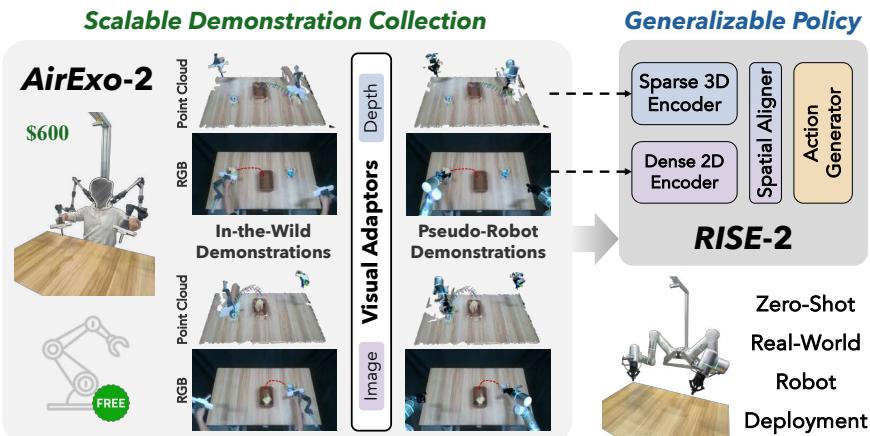
As shown in Figure 1, the system rests on two pillars: AirExo-2, a wearable exoskeleton that captures demonstration data, and RISE-2, a sophisticated neural network policy designed to learn from this data. In this post, we will dissect the hardware engineering, the computer vision magic used to adapt the data, and the neural architecture that makes zero-shot deployment possible.
Background: The Challenge of Imitation Learning
Imitation Learning (IL) is essentially “monkey see, monkey do” for robots. The robot observes a set of demonstrations and learns a policy that maps observations (camera images, depth maps) to actions (motor movements).
To scale IL, we need massive datasets. Current methods fall into two main buckets:
- Robot-Centric (Teleoperation): High quality, but requires expensive robots. It is hard to scale because you can’t easily take a heavy industrial arm into a kitchen or a living room.
- Human-Centric (Passive Video/Handheld): Using YouTube videos or handheld grippers. While scalable, these methods struggle with the Kinematic Gap (human arms move differently than robots) and the Visual Gap (the robot sees a human hand in the training data but sees its own gripper during testing).
The goal of AirExo-2 is to combine the best of both worlds: the portability and low cost of human-centric collection with the precision and visual consistency of robot-centric data.
Part 1: The AirExo-2 System
The first contribution of the paper is the hardware and the associated software pipeline for data collection. The researchers aimed to build a device that eliminates the need for a physical robot during the training phase.
Hardware Design
The AirExo-2 is a dual-arm exoskeleton mounted on a mobile base. It is designed to be kinematically isomorphic to the robot. In simple terms, this means the wearable arm has the same joint lengths and range of motion as the target robot arm.
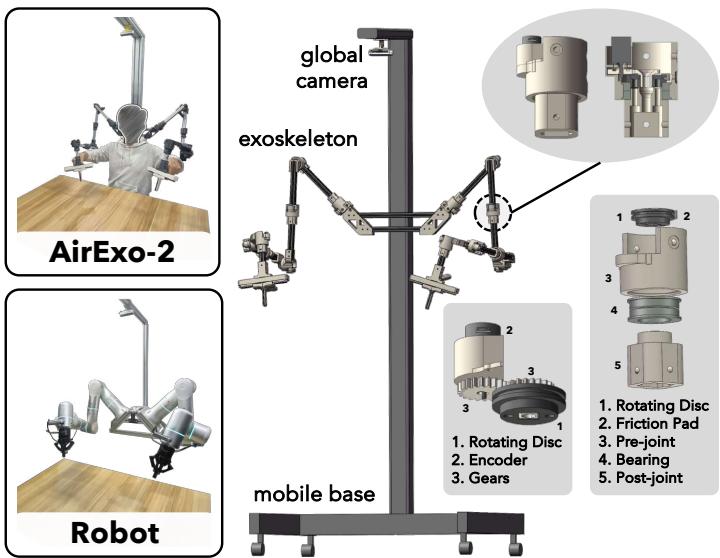
As detailed in Figure 8, the system costs approximately \(600—a fraction of the cost of a standard robotic arm (which can range from \)30k to $60k). Key design features include:
- 1:1 Scale: The exoskeleton matches the dimensions of the robot, ensuring that if a human can reach an object wearing the suit, the robot can reach it too.
- High Rigidity: Unlike previous iterations made of 3D-printed plastic, AirExo-2 uses aluminum profiles and carbon-fiber-reinforced parts. This rigidity is crucial for accuracy; if the frame bends, the sensor readings won’t match the actual hand position.
- Mobile Base: The system is on wheels, allowing for data collection in diverse environments (kitchens, offices, etc.), not just a fixed lab bench.
- Electronics: It uses high-precision encoders and a customized gripper trigger to record exactly how the human is moving and grasping.
The Calibration Challenge
Building the hardware is only half the battle. To use the data, the system must know exactly where the hand is in 3D space relative to the camera. This requires precise calibration.
The authors utilize a technique called Differentiable Rendering to solve this. Usually, calibration is done manually or with markers, but errors accumulate across the joints. Here, the system tries to “draw” (render) a 3D model of the exoskeleton based on its sensor readings. It then compares this drawing to the actual camera image.
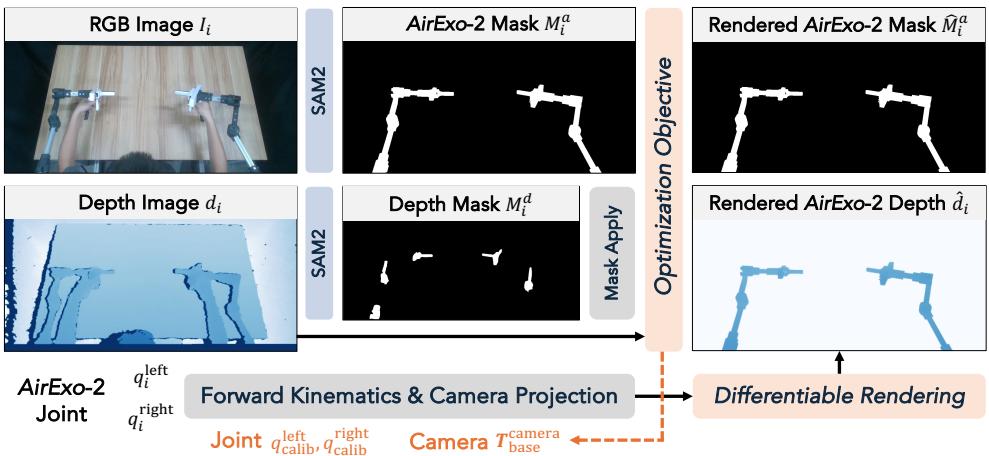
As shown in Figure 9, the system takes the joint angles (\(q\)) and camera parameters (\(T\)) to render a mask (\(\hat{M}\)) and depth map (\(\hat{d}\)). It compares these to the real observed mask and depth. By calculating the difference (loss), it can mathematically adjust the calibration parameters to minimize the error.
The optimization objective is formally defined as:

This automated process ensures that the “digital twin” of the exoskeleton aligns perfectly with reality, achieving sub-millimeter accuracy in depth alignment.
The Adaptation Pipeline: From Human to Pseudo-Robot
This is perhaps the most innovative part of the AirExo-2 system. Even with accurate joint data, if we train a robot on video frames containing a human wearing an exoskeleton, the robot will be confused when it is deployed and sees its own metallic arm.
To fix this, the authors created a pipeline to transform “In-the-Wild” demonstrations into “Pseudo-Robot” demonstrations.
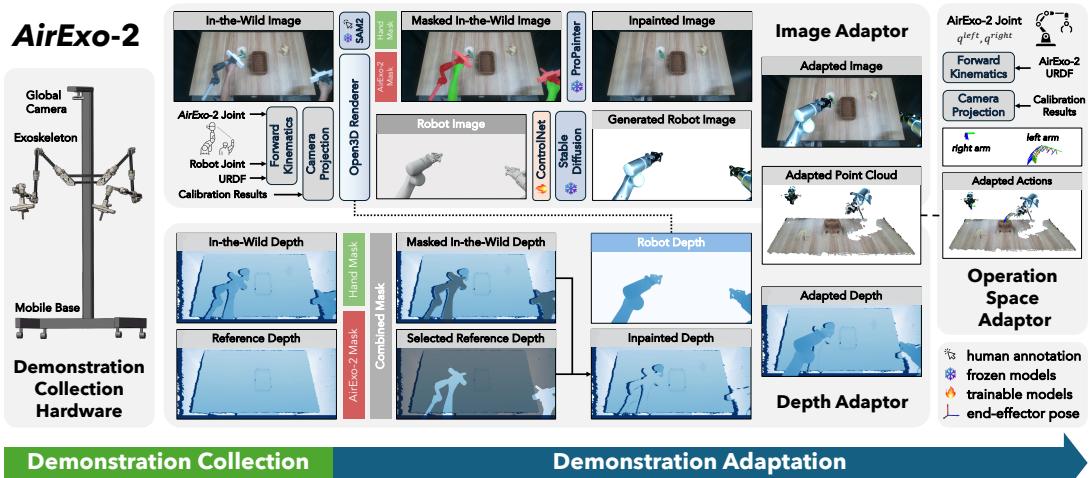
Referencing Figure 2, the pipeline involves three distinct adaptors:
- Image Adaptor (Bridging the Visual Gap):
- Segmentation: Using SAM-2 (Segment Anything Model 2), the system identifies and masks out the human operator and the exoskeleton.
- Inpainting: Using ProPainter, the masked area is filled in with the background, effectively “erasing” the human.
- Robot Rendering: Since the system knows the exact joint angles (thanks to the exoskeleton), it renders a photorealistic image of the actual robot arm in that exact pose.
- Composition: The rendered robot is overlaid onto the clean background. The result is a video that looks like the robot performed the task itself.
- Depth Adaptor:
- Similar to the image adaptor, the depth map is modified to remove the human geometry and insert the robot’s geometric shape. This provides clean 3D data for the policy.
- Operation Space Adaptor:
- This maps the physical movements recorded by the exoskeleton encoders directly into the robot’s coordinate system.
The output of this pipeline is a dataset that looks and feels like expensive teleoperation data, but was collected using a cheap, portable suit.
Part 2: The RISE-2 Policy
Now that we have high-quality, adapted data, we need a brain to learn from it. The authors introduce RISE-2 (Robust and Generalizable Imitation System 2).
Standard policies often struggle to balance geometric precision (understanding exactly where an object is in 3D) with semantic understanding (knowing what an object is, like distinguishing a red mug from a blue cup). RISE-2 addresses this by using a hybrid architecture.
Architecture Overview
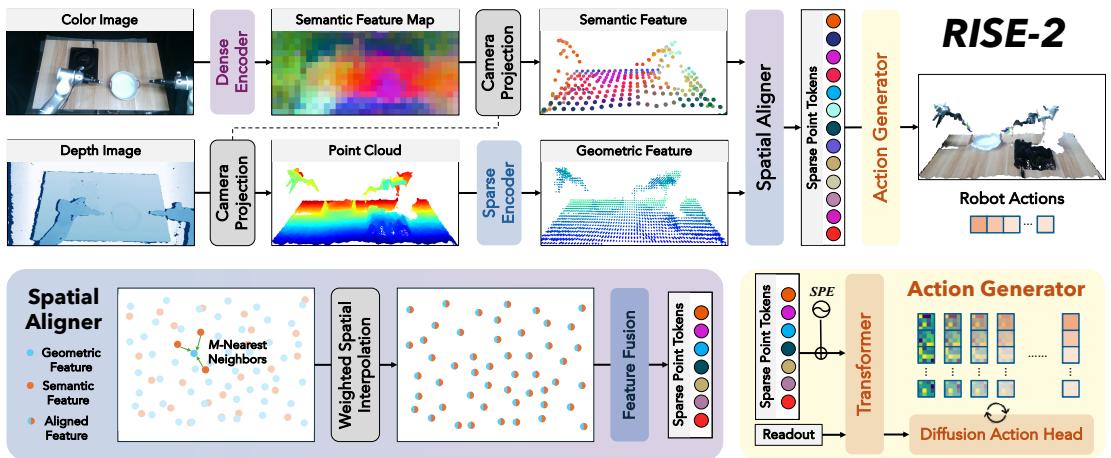
As illustrated in Figure 3, the RISE-2 architecture processes information in two parallel streams before fusing them:
- Sparse Encoder (3D Geometry):
- Takes a Point Cloud (derived from depth images) as input.
- It uses a sparse convolutional network (specifically MinkResNet).
- Purpose: To understand the precise shape and location of objects. It is “color-blind” to avoid overfitting to specific textures.
- Dense Encoder (2D Semantics):
- Takes the RGB Image as input.
- It utilizes a pre-trained Vision Foundation Model (specifically DINOv2).
- Purpose: To capture high-level semantic information and context. Because DINOv2 is trained on massive internet datasets, it is incredibly robust to lighting changes and visual distractions.
The Spatial Aligner
The challenge is combining these two very different types of data. 2D features exist in pixel coordinates \((u, v)\), while 3D features exist in spatial coordinates \((x, y, z)\).
RISE-2 solves this with a Spatial Aligner. It fuses the features based on their 3D coordinates. For every point in the 3D cloud, the model looks up the corresponding semantic features from the 2D map.
To make this precise, the authors use a weighted spatial interpolation. Instead of just grabbing the nearest pixel, it averages features from the nearest neighbors based on distance, ensuring smooth feature transitions.
The equation governing this fusion is:
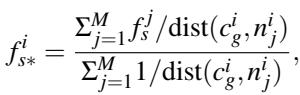
Here, \(f_{s*}^i\) is the aligned semantic feature. By fusing features this way, RISE-2 creates a representation that is both geometrically accurate and semantically rich.
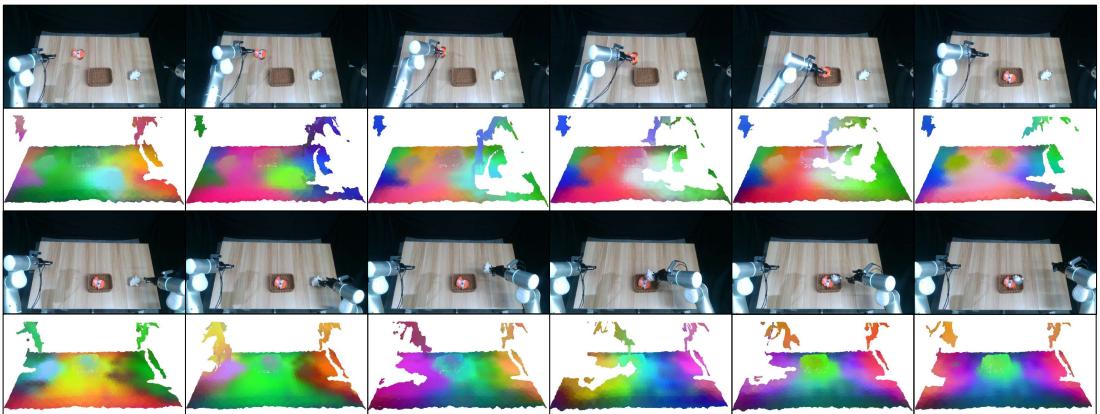
Figure 10 (bottom of the image above) visualizes these fused features. You can see how the model attends to relevant parts of the scene (like the robotic grippers and the target objects) with high precision, confirming that the spatial aligner effectively bridges the 2D-3D gap.
Action Generation
Finally, these fused features are passed to an Action Generator. This module uses a Transformer to process the features and a Diffusion Head to predict actions. Diffusion policies are currently state-of-the-art in robotics because they can represent complex, multi-modal distributions (e.g., if there are two valid ways to grab a cup, a diffusion policy can represent both, whereas a simple regression model might average them and grab nothing).
Experiments and Results
The researchers put AirExo-2 and RISE-2 to the test across several real-world tasks, such as collecting toys, lifting plates, and opening/closing lids.
Performance Comparison
How does RISE-2 compare to existing methods like ACT, Diffusion Policy, and standard RISE?
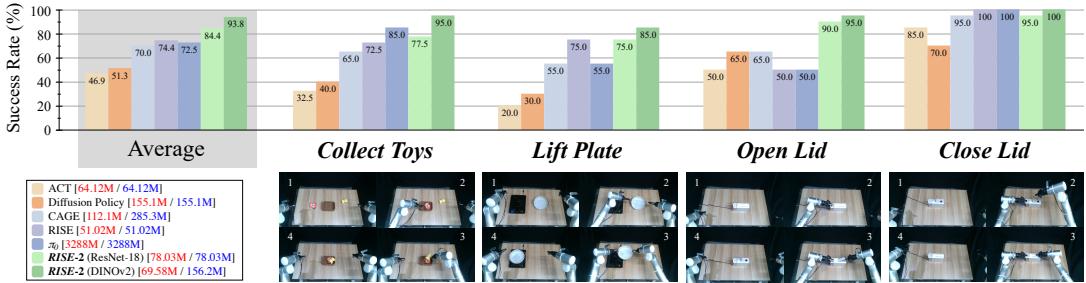
Figure 4 shows the success rates on in-domain tasks (tasks seen during training). RISE-2 (specifically the version using DINOv2) consistently outperforms the baselines. In tasks requiring fine motor skills, like “Lift Plate,” RISE-2 achieves significantly higher reliability.
Generalization Capabilities
A major claim of the paper is “generalizability.” Can the robot handle a new background tablecloth or a different toy that it wasn’t trained on?
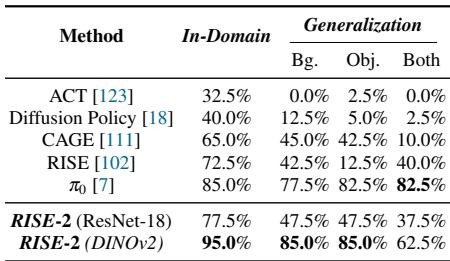
Table 1 presents the results of generalization experiments.
- Novel Backgrounds (Bg.): RISE-2 maintains a 95% success rate, whereas policies like ACT drop to 32.5%.
- Novel Objects (Obj.): RISE-2 achieves 85%, significantly higher than competitors.
- Both: Even when both the background and object are new, RISE-2 holds strong at 85%.
This robustness is largely attributed to the separation of concerns in the architecture: the 3D encoder handles the geometry (shape of the new object), while the 2D encoder (DINOv2) handles the semantic variation.
The Ultimate Test: Pseudo-Robot vs. Teleoperation
The most critical question for the AirExo-2 system is: Does the data actually work?
The researchers compared a policy trained on expensive Teleoperation Data vs. a policy trained on cheap AirExo-2 (Pseudo-Robot) Data.
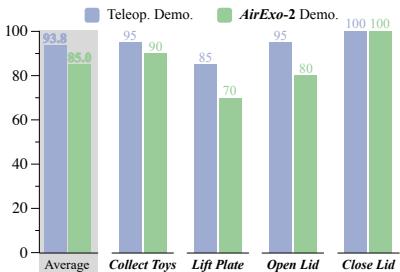
As seen in Figure 5, the results are striking. The policy trained on AirExo-2 data (green bars) achieves performance comparable to the teleoperation baseline (blue bars). In simple tasks like “Close Lid,” it matches the performance perfectly (100%). In more complex tasks, the drop-off is minimal.
This confirms that the “visual trickery” of the adaptation pipeline works—the robot successfully learns to control its own body by watching videos of a “fake” robot generated from human motion.
Scalability
Finally, why does this matter? Cost and speed.
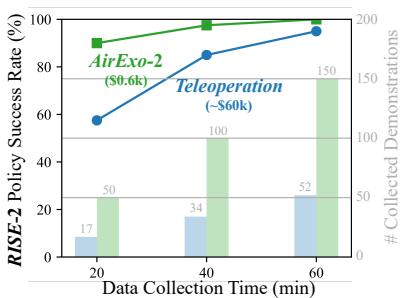
Figure 7 illustrates the scalability analysis.
- Cost: AirExo-2 costs \(0.6k vs \)60k for teleoperation.
- Throughput: In the same amount of time (x-axis), an operator using AirExo-2 can collect more demonstrations (bars) than a teleoperator.
- Success: Because data collection is faster, you get more data in the same time, leading to higher policy success rates (lines).
Conclusion and Implications
The AirExo-2 paper presents a compelling blueprint for the future of robot learning. By decoupling data collection from the physical robot, we can lower the barrier to entry for creating large-scale robotic datasets.
The synergy between the hardware and the software is key here:
- AirExo-2 provides the low-cost, accurate kinematic data.
- The Adaptation Pipeline translates that data into the robot’s visual domain.
- RISE-2 leverages a hybrid 2D/3D architecture to learn robust skills that generalize to new environments.
This approach suggests a future where we might see “image-net scale” datasets for robotics, collected not by expensive robots in labs, but by people wearing exoskeletons in their homes and workplaces. As the “pseudo-robot” data becomes indistinguishable from real data, the dream of a general-purpose robotic helper moves one step closer to reality.