](https://deep-paper.org/en/paper/2503.04119/images/cover.png)
Introduction
Neural Style Transfer (NST) has been one of the most visually captivating applications of Deep Learning. The ability to take a photo of your local park and render it in the swirling, impressionistic strokes of Van Gogh’s The Starry Night feels like magic. Over the years, the field has evolved from slow, optimization-based methods to “Arbitrary Style Transfer” (AST)—systems that can apply any style to any content image in real-time.
However, as impressive as AST models (like CNN-based, Transformer-based, or Diffusion-based approaches) have become, they often stumble on a specific, subtle hurdle: Semantic Consistency.
Imagine transferring a style where the sky is painted with smooth blue strokes and the ground with rough, earthy textures. Existing models often confuse these regions. They might apply the rough ground texture to the sky simply because the shapes match, disregarding the semantic reality of the scene.
This article explores a research paper that tackles this exact problem: “SCSA: A Plug-and-Play Semantic Continuous-Sparse Attention for Arbitrary Semantic Style Transfer.”
The authors introduce a novel attention mechanism that forces the neural network to respect semantic boundaries. It ensures that “sky” looks like “sky” and “grass” looks like “grass,” not just globally, but with the correct local textures. By the end of this post, you will understand the limitations of current “Universal Attention,” the mathematics behind the new SCSA modules, and how this method can be plugged into existing architectures without retraining them from scratch.
The Problem with Universal Attention
To understand the innovation of SCSA, we must first look at how modern Attention-based AST (Attn-AST) methods work.
In a typical Attn-AST framework (like SANet or StyTR²), the model calculates an attention map between the Content image features and the Style image features. This is often referred to as Universal Attention (UA). The goal is to find regions in the style image that are similar to the content image and “copy” that style over.
The formula for standard Universal Attention generally looks like this:

Here, \(Q\) (Query) comes from content features, while \(K\) (Key) and \(V\) (Value) come from style features. The attention map \(S\) is computed as:
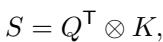
And the final stylized features \(F_{cs}\) are a weighted sum:

The Flaw: The issue with Universal Attention is that it is semantically blind. It calculates similarity based purely on feature vectors. If a cloud in the content image has a shape similar to a white rock in the style image, UA might transfer the rock’s texture to the cloud.
As shown in Figure 1 below, this leads to two main artifacts:
- Style Discontinuity: Adjacent regions that should look the same (like a continuous sky) end up looking patchy because they attended to different parts of the style image.
- Texture Loss: The “weighted average” nature of soft attention can wash out vivid, specific textures, leading to a blurry or blocky look.
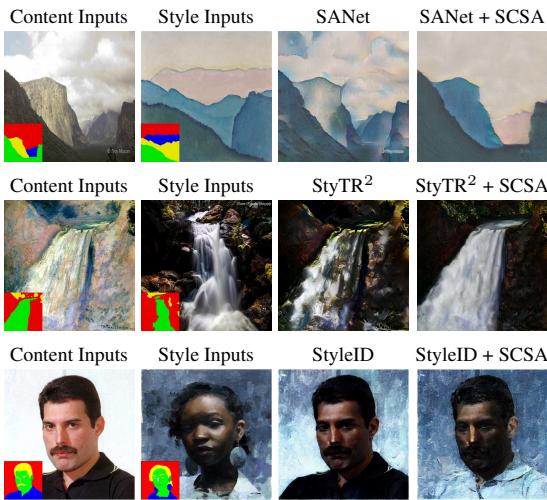
Notice the top row in Figure 1. The standard SANet output (third column) has a background that looks inconsistent and blended. The SCSA-enhanced version (fourth column) maintains a coherent, artistic style across the background.
The Solution: SCSA (Semantic Continuous-Sparse Attention)
The researchers propose replacing Universal Attention with SCSA. This isn’t just a single attention block; it is a dual-pathway mechanism designed to handle semantics intelligently.
SCSA relies on Semantic Maps—segmentation masks that label regions (sky, person, building, tree). It assumes we have these maps for both the content and style images.
SCSA is composed of two distinct attention modules that work in parallel to solve the artifacts mentioned above:
- Semantic Continuous Attention (SCA): Ensures global consistency (solving the “patchy” look).
- Semantic Sparse Attention (SSA): Preserves vivid details (solving the “washed out” texture).
The diagram below (Figure 2) perfectly illustrates the conceptual difference between the proposed method and the traditional Universal Attention.
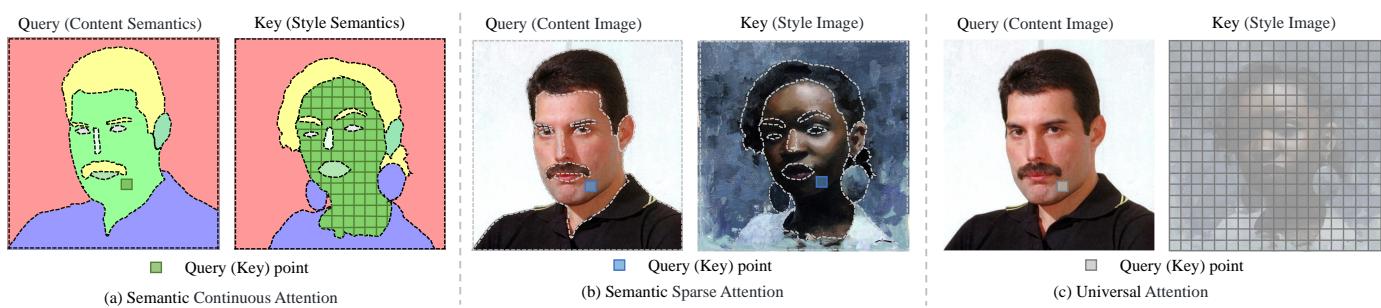
In (a) SCA, the model looks at the entire semantic region (e.g., all face points) to understand the general color and style. In (b) SSA, the model hunts for the single best match (sparse) within that semantic region to capture specific details like the eye shape. In (c) UA, the model looks everywhere, leading to confusion.
Let’s break down the mathematics and logic of each module.
1. Pre-processing: Semantic Adaptive Instance Normalization (S-AdaIN)
Before applying attention, the model needs “pure” features. Content features often carry their own style (lighting, color), which can interfere with the transfer.
The authors use Semantic AdaIN (S-AdaIN) to align the statistics (mean and variance) of the content features to match the style features per semantic region.
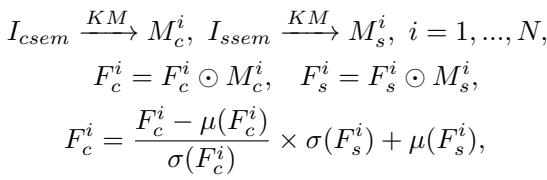
This equation shows that for every semantic category \(i\), the content features \(F_c\) are normalized and then scaled/shifted by the style features’ statistics. This initializes the content features with a rough approximation of the target style’s colors, making the subsequent attention mechanisms much more effective.
2. Semantic Continuous Attention (SCA)
Goal: Transfer the overall “atmosphere” and consistency of a semantic region.
SCA does not use the detailed image features for calculating the attention map. Instead, it uses the Semantic Map Features (\(F_{csem}\) and \(F_{ssem}\)). Since semantic maps are uniform within a region (e.g., the whole sky is labeled “1”), the attention weights will be naturally smooth and continuous.
The Math:
First, we generate Query and Key from the semantic maps, but the Value comes from the style image:

We compute the raw attention map \(\mathcal{A}\):
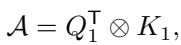
The Masking Operation (\(G_1\)): This is the critical step. We want to strictly enforce semantic matching. If a query point belongs to “sky,” it should only attend to “sky” key points. We set the attention scores for mismatched semantics to negative infinity:
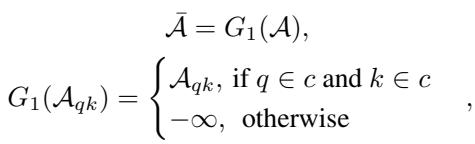
By applying Softmax to this masked map, the weights for different semantic regions become 0. The remaining weights are distributed evenly across the correct semantic region. This results in the stylized feature \(F_{sca}\):

Because \(F_{csem}\) and \(F_{ssem}\) lack texture details (they are just region labels), the resulting attention map treats all points in a semantic region equally. This effectively transfers the average global style of that region, ensuring continuity.
3. Semantic Sparse Attention (SSA)
Goal: Transfer vivid, specific textures (e.g., the brushstroke on a specific cloud).
While SCA provides smoothness, it sacrifices detail. SSA fixes this by looking at the Image Features (\(F_c\) and \(F_s\)) which contain structural details.
The Math:
We compute Query, Key, and Value from the image features (note that \(Q_2\) uses the normalized content features):

We calculate the raw attention map \(\mathcal{B}\):
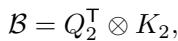
The Sparse Operation (\(G_2\)): Unlike SCA, we don’t want an average. We want the best match. If we average all “grass” textures, we get a green blur. If we pick the most similar “grass” patch, we get a blade of grass.
The function \(G_2\) retains only the maximum attention weight within the same semantic category and kills everything else:
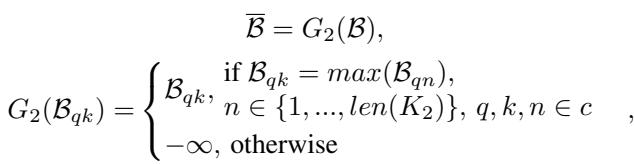
This makes the attention “sparse”—for each query point, only one key point (the best match) has a weight of 1, and all others are 0.

This “Hard Attention” mechanism copies specific texture patches, preserving the vividness of the style.
4. Feature Fusion
Finally, the outputs of the two attention modules are combined with the original content features. The authors introduce parameters \(\alpha_1\) and \(\alpha_2\) to control the balance between the smooth global style (SCA) and the sharp textures (SSA).

- \(\alpha_1\): Controls the overall style intensity (SCA).
- \(\alpha_2\): Controls the texture intensity (SSA).
Plug-and-Play Integration
One of the strongest contributions of this paper is that SCSA is framework-agnostic. It can be inserted into CNNs, Transformers, or Diffusion models.
Figure 4 below illustrates how SCSA replaces the standard Universal Attention (UA) module in three popular architectures: SANet (CNN), StyTR² (Transformer), and StyleID (Diffusion).
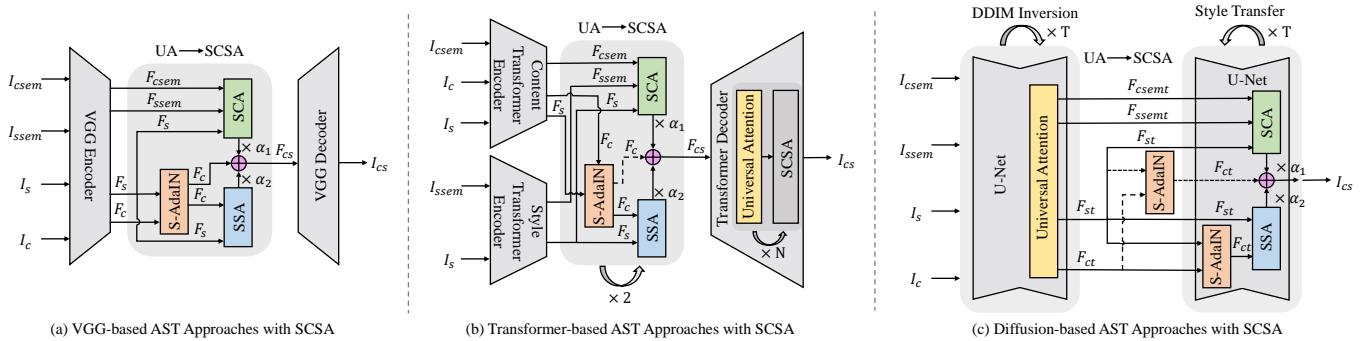
- CNN (a): SCSA sits between the encoder and decoder.
- Transformer (b): It replaces the cross-attention layers.
- Diffusion (c): It is injected into the U-Net during the denoising steps (specifically at the maximum time step \(T\) for S-AdaIN).
The integration process involves encoding the semantic maps alongside the images:

And then passing all four feature sets (Content, Style, Content-Map, Style-Map) into the SCSA module:

Experiments and Results
Does adding semantic awareness actually improve the art? The results suggest a resounding yes.
Qualitative Comparison
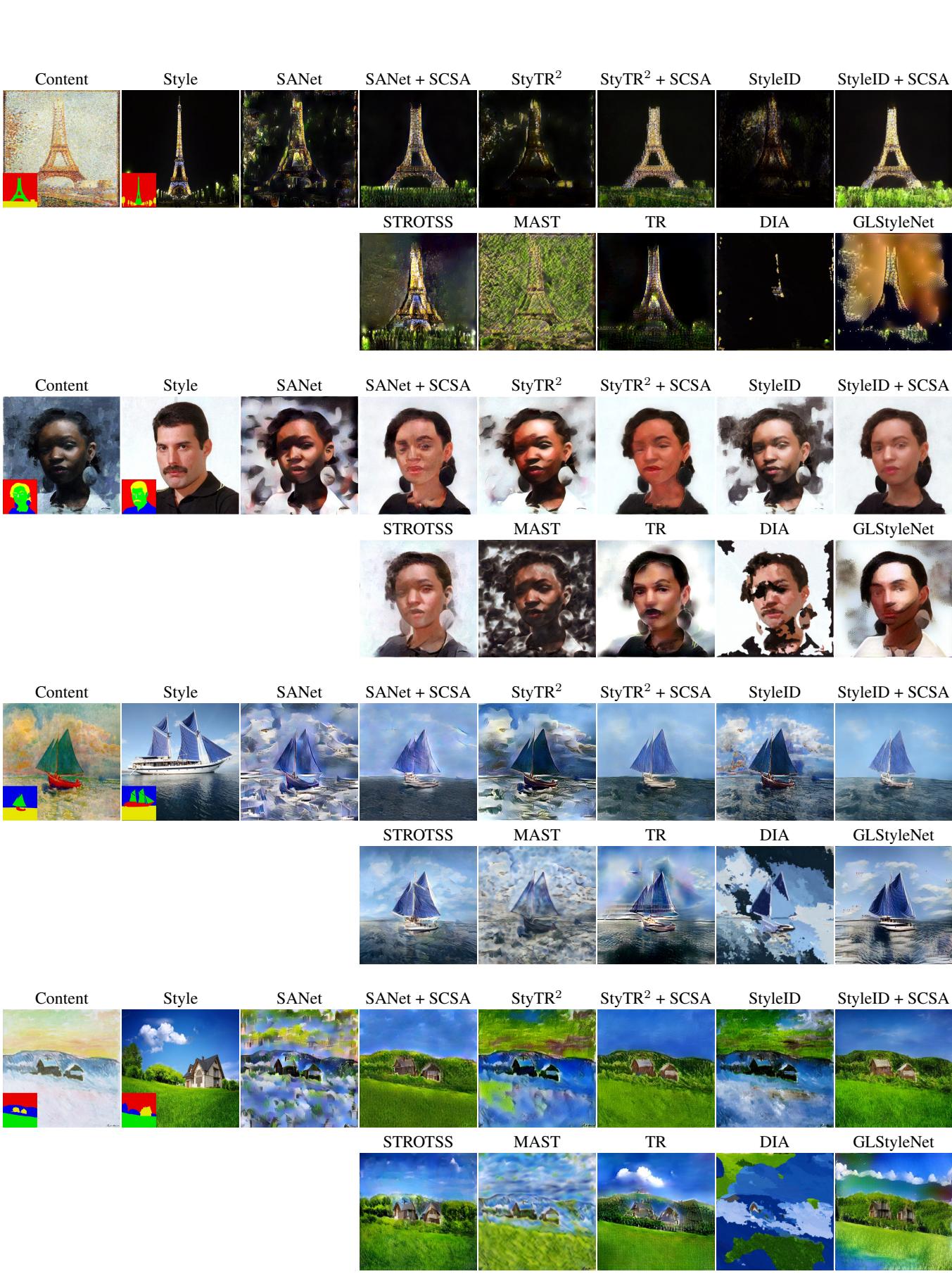
Figure 5 compares SCSA-enhanced models against state-of-the-art (SOTA) methods.

Look closely at the StyleID column vs. StyleID + SCSA. In the third row (mountain landscape), the standard StyleID struggles to separate the ground from the sky cleanly. The SCSA version creates a distinct, vivid separation that respects the semantic layout of the content image. Similarly, compared to patch-based methods like TR or GLStyleNet, SCSA preserves the content structure much better while achieving high stylization.
Additional comparisons (Figure 16) reinforce this. In row 2 (scissors), notice how SCSA ensures the background texture doesn’t bleed into the scissors themselves, maintaining a sharp boundary that standard SANet misses.
Ablation Studies: Do we need both SCA and SSA?
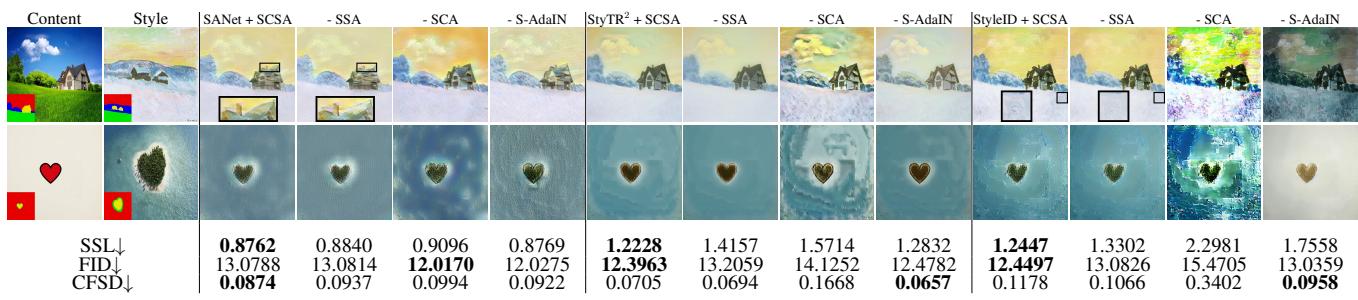
The authors performed ablation studies to prove that both modules are necessary.
- SCA Only: The images have good color consistency but look blurry and lack texture detail.
- SSA Only: The textures are sharp, but the colors can look disjointed or “wrong” across large regions.
- No S-AdaIN: The global color tone fails to match the style image.
Figure 6 visually demonstrates these trade-offs. The full SCSA combination (first column in each block) offers the best balance of structure, color, and texture.
Controlling the Style
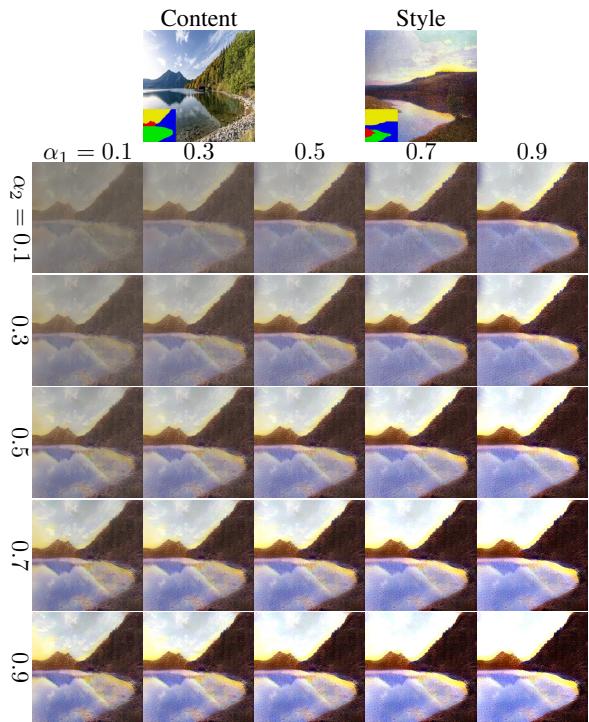
Remember the fusion parameters \(\alpha_1\) (SCA/Global) and \(\alpha_2\) (SSA/Texture)? The authors show that these allow for granular control over the output.
In Figure 7, we see the effect of tuning these parameters on SANet. Increasing \(\alpha_1\) (horizontal axis) strengthens the overall artistic feel and color saturation. Increasing \(\alpha_2\) (vertical axis) makes the brushstrokes and local patterns more distinct.
Conclusion
The SCSA paper addresses a fundamental limitation in arbitrary style transfer: the blindness of attention mechanisms to semantic meaning. By explicitly incorporating semantic maps and splitting the attention process into Continuous (for global consistency) and Sparse (for local texture) pathways, SCSA achieves a level of fidelity that previous methods struggled to reach.
For students and researchers in this field, SCSA offers two key takeaways:
- Interpretability Matters: Breaking attention into “What generally belongs here?” (SCA) and “What specifically matches this?” (SSA) is a powerful design pattern.
- Hybrid Approaches: Combining soft attention (weighted sum) and hard attention (max selection) allows models to capture both the macro and micro attributes of a style.
Whether applied to CNNs or the latest Diffusion models, SCSA proves that adding semantic understanding is the next logical step in the evolution of Neural Style Transfer.
All images and equations presented in this article are derived from the research paper “SCSA: A Plug-and-Play Semantic Continuous-Spare Attention for Arbitrary Semantic Style Transfer.”