](https://deep-paper.org/en/paper/2503.04459/images/cover.png)
Imagine you are watching a video of an orchestra. A friend asks, “Which instrument started playing first?” To answer this, your brain performs a complex feat. You don’t just look at a few random snapshots; you perceive the continuous flow of time. You don’t just listen to the audio as a whole; you isolate specific sounds and synchronize them with visual movements. Most importantly, you know exactly what to look and listen for before you even process the scene because the question guides your attention.
In the world of Artificial Intelligence, this task is known as Audio-Visual Question Answering (AVQA). While humans do this naturally, AI models have historically struggled. They often treat videos as slideshows of disconnected frames and only consider the actual question at the very end of the process.
Today, we are diving deep into a research paper that challenges these limitations: “Question-Aware Gaussian Experts for Audio-Visual Question Answering” (QA-TIGER). This proposed framework introduces a way to model time continuously and integrates the question into the very heart of the perception process.
The Problem: Discrete Sampling and Late Fusion
To understand why QA-TIGER is significant, we first need to look at how traditional AVQA models operate and where they fail.
Most existing methods rely on Uniform Sampling. They chop a video into equal intervals (e.g., every 2 seconds) and pick a frame. This is computationally efficient but dangerous. If the answer to “Which clarinet makes the sound last?” lies in a split-second action between those sampled frames, the model misses it entirely.
More advanced methods use Top-K Frame Selection. They try to pick the “best” frames based on similarity to the question. However, this is still a discrete approach. It picks isolated moments, shattering the temporal continuity required to understand duration, sequence, or gradual changes.
Furthermore, most models suffer from Late Fusion. They process the audio and video independently to extract features, and only combine them with the question text at the final classification stage. This means the visual encoder doesn’t know what it should be looking for until it’s too late.
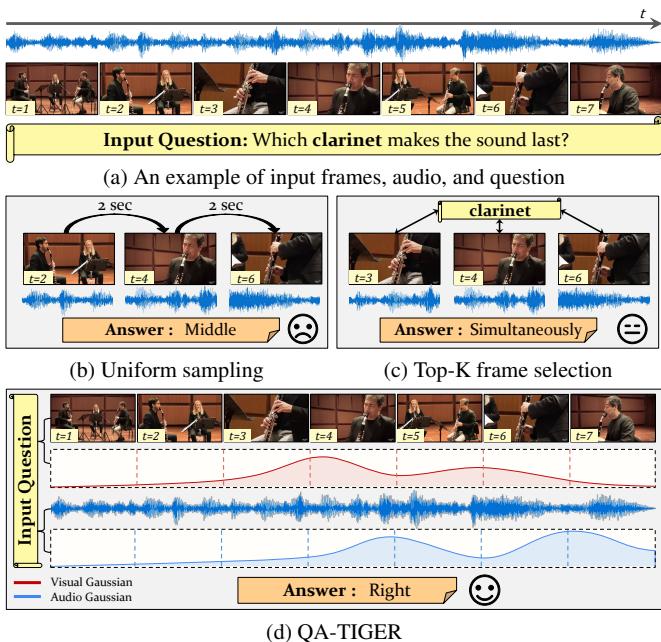
As shown in Figure 1 above, uniform sampling (b) and Top-K selection (c) both fail to identify the correct clarinet because they miss the critical temporal window. QA-TIGER (d), however, uses smooth curves (Gaussian distributions) to weight the importance of time segments continuously, allowing it to correctly identify the answer.
The QA-TIGER Architecture
QA-TIGER stands for Question-Aware Temporal Integration of Gaussian Experts for Reasoning. The architecture is designed to address the two main flaws mentioned above: it injects question awareness early, and it models time continuously using “experts.”
Let’s look at the high-level workflow:
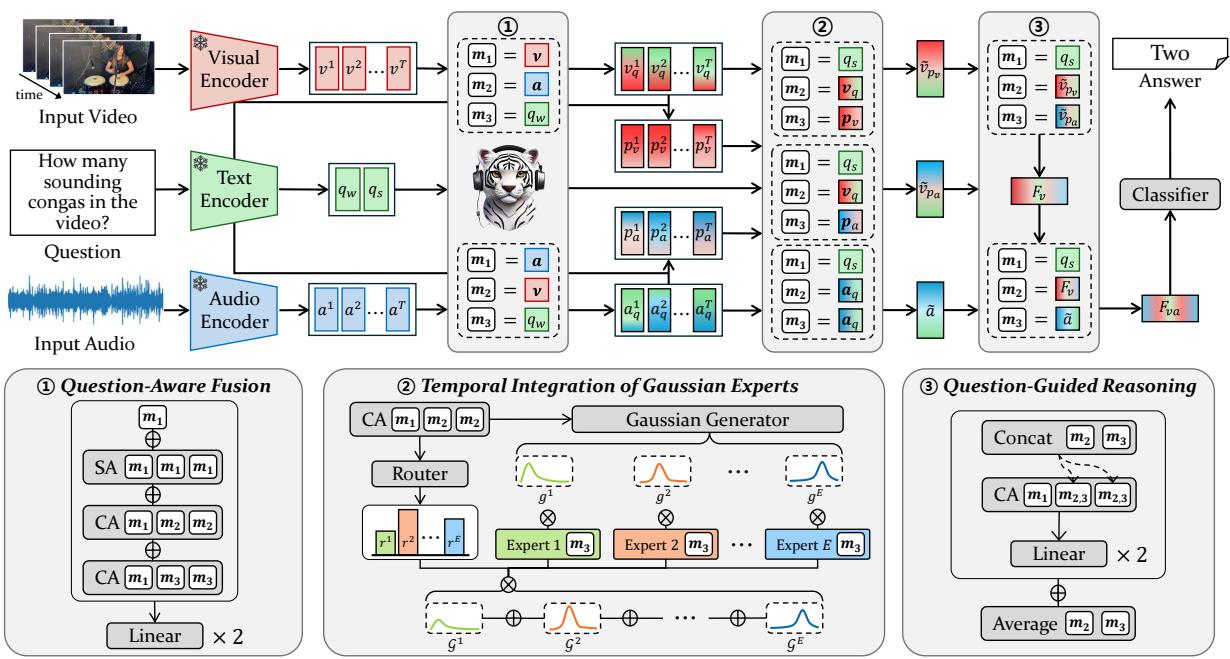
The pipeline consists of three major stages:
- Question-Aware Fusion: Embedding the question into audio and visual features immediately.
- Temporal Integration of Gaussian Experts: Using a Mixture of Experts (MoE) to create dynamic, continuous time windows.
- Question-Guided Reasoning: The final decision-making step.
Let’s break these down, step-by-step.
1. Question-Aware Fusion
The first innovation is how the model handles input. Instead of extracting generic visual features, QA-TIGER wants features that are already biased toward the question.
The model takes a video \(V\), audio \(A\), and a question \(Q\).
- Visuals: Processed by a CLIP encoder to get frame-level and patch-level features.
- Audio: Processed by VGGish to get audio features.
- Question: Processed by a text encoder to get word-level and sentence-level features.
The magic happens in the Fusion Module. The model forces the visual features to “pay attention” to the audio and the specific words in the question. Simultaneously, the audio features pay attention to the visuals and the question.
This is achieved through a stack of Self-Attention (SA) and Cross-Attention (CA) layers. The equations below describe how the visual features (\(v\)) and audio features (\(a\)) are updated to become “question-aware” (\(v_q\) and \(a_q\)):

In simple terms:
- SA(v, v, v): The visual frames look at each other to understand the video context.
- CA(v, a, a): The visuals look at the audio to synchronize sound and sight.
- CA(v, q_w, q_w): The visuals look at the specific words in the question (\(q_w\)) to highlight relevant objects (e.g., if the question is about a “saxophone,” saxophone regions in the image get a boost).
This process ensures that by the time we reach the next stage, our data is already rich with semantic meaning relevant to the user’s query. To capture even finer details, the researchers apply a similar refinement to the patch-level features (specific regions within a frame), as seen here:

2. Temporal Integration of Gaussian Experts
This is the core contribution of the paper. How do we move away from picking discrete frames? We use Gaussian Experts.
In probability theory, a Gaussian distribution (or Bell Curve) is defined by a center (\(\mu\)) and a width (\(\sigma\)). In QA-TIGER, these curves represent time windows.
- The center \(\mu\) tells the model when to look.
- The width \(\sigma\) tells the model how long to look.
The Mixture of Experts (MoE) Framework
The model employs a “Mixture of Experts” approach. Think of these experts as a team of observers. One expert might focus on the beginning of the video, another on the end, and another might scan for short bursts of activity.
First, the model generates a condensed query representation for both audio and video by attending to the sentence-level question feature (\(q_s\)):

Using these representations, the model generates the parameters for the Gaussian curves. Unlike previous works that might use a single mask, QA-TIGER generates \(E\) different Gaussian distributions (experts).

The Router
Crucially, not all experts are equally useful for every question. If the question asks, “What happens at the end?”, the experts focusing on the start of the video are irrelevant.
To handle this, a Router determines the importance of each expert. It calculates a routing weight (\(r\)) using a Softmax function. This weight decides how much influence each expert’s Gaussian curve should have on the final result.

Aggregating the Timeline
Finally, the model aggregates the temporal information. It doesn’t just sum up the frames; it computes a weighted sum where the weights come from the Gaussian curves multiplied by the router’s confidence.

This results in a set of features that represent continuous spans of time, dynamically adjusted to focus exactly where the question suggests the answer lies.
3. Question-Guided Reasoning
At this stage, we have highly refined, temporally integrated audio and visual features. The final step is to combine them to predict the answer.
The model fuses the audio and visual streams one last time, again using the question as a guide. It first refines the visual representation:

And then fuses the audio into the visual stream:

This final feature vector (\(F_{va}\)) is passed through a classifier to select the correct answer from the candidate list.
Why This Works: Qualitative Visualization
The math is elegant, but does it actually work like we think it does? The researchers provided visualizations of the “Attention” maps, which show us exactly what the model is looking at.
Question-Awareness in Action
Let’s look at how the Question-Aware Fusion module behaves. In the image below, we see the attention heatmaps for two different questions asked on the same video.
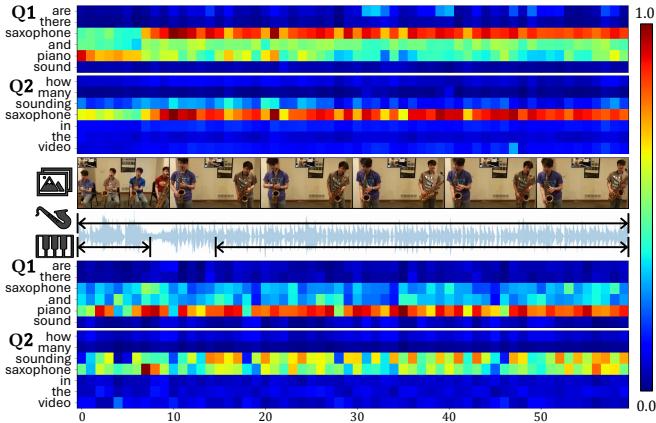
- Top Row (Question 1): “Are there saxophone and piano sound?” Notice how the audio attention (bottom half of the top block) lights up strongly for the piano sound, which is visually subtle but auditorily distinct.
- Bottom Row (Question 2): “How many sounding saxophone…?” The attention shifts. The visual attention locks onto the saxophones to count them, and the audio attention focuses on the saxophone’s timbre.
This proves the model isn’t just “seeing” a video; it’s actively searching for the concepts mentioned in the text.
Gaussian Experts in Action
We can also visualize the Gaussian weights. Do the experts actually focus on the right time segments?
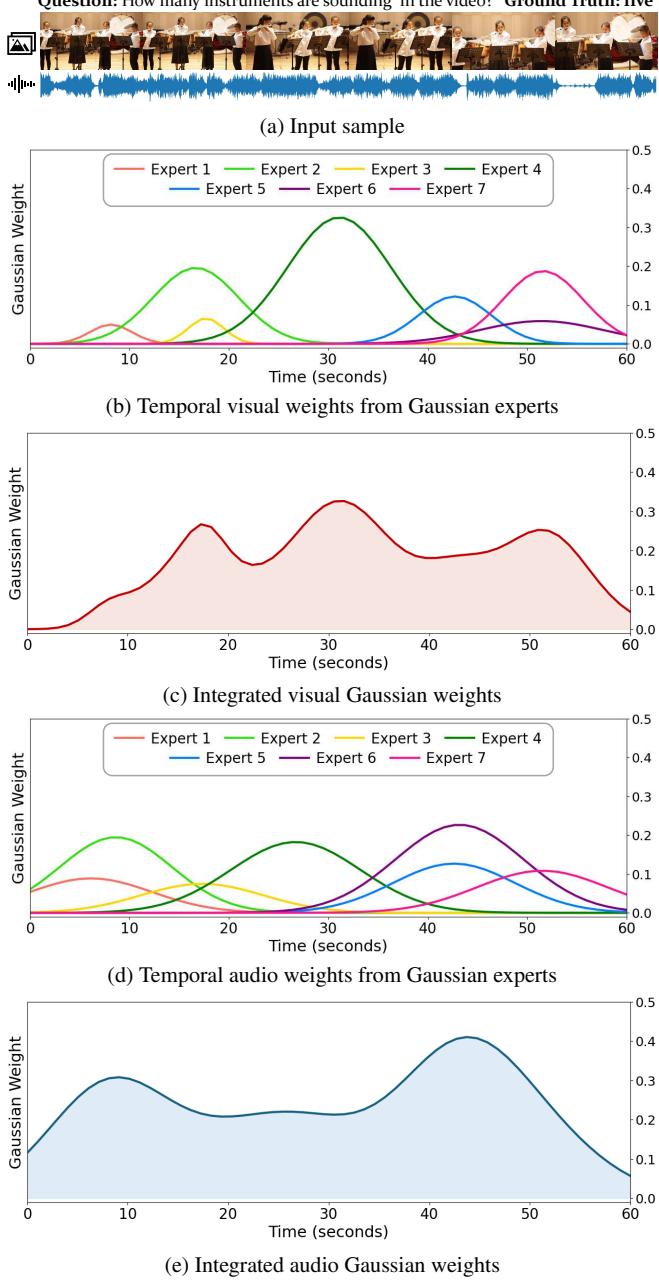
In Figure A, for a question about counting instruments, the experts distribute themselves across the timeline. You can see the distinct colored curves representing different experts. Their combined effort (the “Integrated” curve) creates a smooth attention mechanism that covers the moments where instruments are playing, ignoring silent or irrelevant sections.
Experimental Results
The researchers tested QA-TIGER on the MUSIC-AVQA benchmarks, which are standard datasets for this task involving musical instruments.
State-of-the-Art Performance
The quantitative results are impressive. QA-TIGER achieves a new state-of-the-art (SOTA) accuracy.
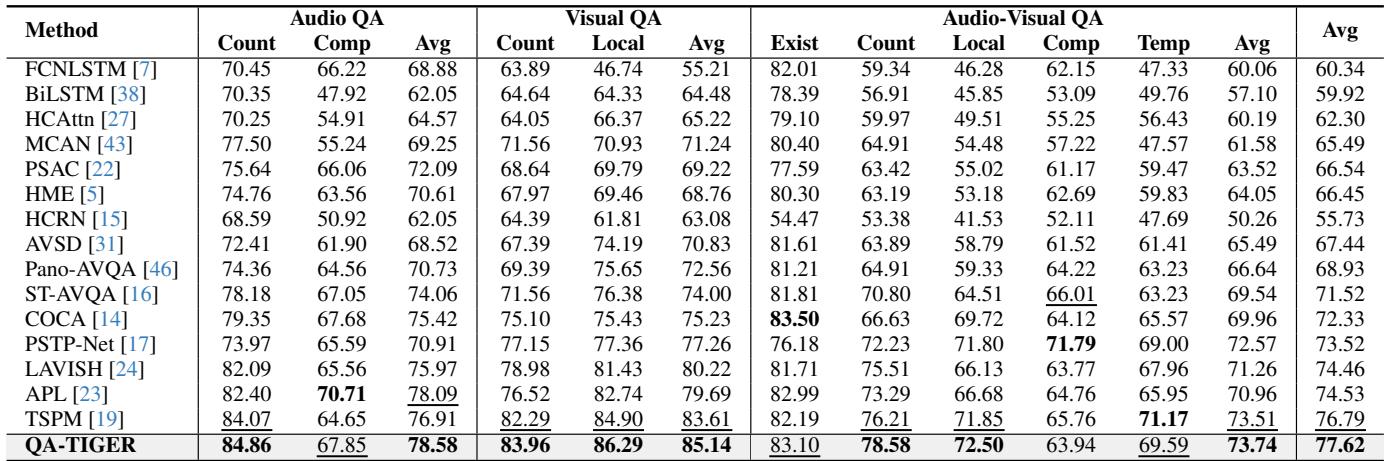
The model shines particularly in AV-Counting (counting instruments based on sight and sound) and AV-Temporal (understanding sequences) tasks. This validates the hypothesis that continuous temporal modeling is superior for reasoning about duration and order.
Comparing Sampling Strategies
To prove that Gaussian Experts are better than simple Uniform or Top-K sampling, the authors ran an ablation study comparing the methods directly.
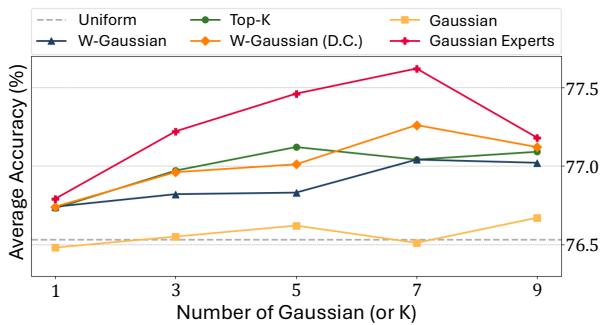
As seen in Figure 5, the “Gaussian Experts” approach (magenta line) consistently yields higher accuracy than Uniform or Top-K methods, regardless of the number of segments (\(K\)) used. Notably, the performance peaks around 7 experts, suggesting that a small team of specialized temporal experts is sufficient to cover complex videos.
Qualitative Comparison: Where Others Fail
It is often more instructive to look at failure cases of previous models to understand the advancement.

In Figure F(a), the question asks, “How many musical instruments were heard?”
- Uniform/Top-K: These methods effectively “guess” based on a few frames. They miss the moments where all instruments sound together or distinct solos occur, leading to incorrect counts.
- QA-TIGER (Audio/Visual Gaussian): By integrating the signal over time, TIGER captures the full auditory scene and correctly identifies the number of instruments.
Conclusion and Implications
QA-TIGER represents a significant step forward in multimodal AI. By moving away from discrete frame sampling and adopting continuous temporal modeling via Gaussian Experts, the model bridges the gap between static image processing and true video understanding.
Furthermore, the Question-Aware Fusion mechanism demonstrates the power of “Early Fusion.” By letting the language guide the vision and audio processing from the very first layers, the model becomes far more efficient at filtering out noise and focusing on relevant signals.
Key Takeaways:
- Time is Continuous: treating video as a sequence of isolated snapshots destroys critical information. Gaussian modeling restores this continuity.
- Context is King: The question should dictate feature extraction, not just final classification.
- Specialization Wins: Using a Mixture of Experts allows the model to adapt dynamically to different parts of a video, providing flexibility that rigid sampling cannot match.
For students and researchers in Computer Vision and Multimodal Learning, QA-TIGER offers a blueprint for how to handle the “fourth dimension” (time) more effectively. It suggests that the future of video understanding lies not just in bigger transformers, but in smarter, more adaptive ways of representing time and context.