](https://deep-paper.org/en/paper/2503.04475/images/cover.png)
Imagine you are hiking in a dense forest. You look around, and all you see are trees—trunks, branches, and leaves that look suspiciously similar to the trees you passed ten minutes ago. Now, imagine coming back to that same spot six months later. The leaves have fallen, the grass has grown, and the lighting is completely different. Could you recognize exactly where you are?
This scenario highlights one of the hardest problems in robotics: Place Recognition in natural environments.
While robots in urban environments can rely on buildings, street signs, and rigid geometric corners to figure out their location, robots in forests face “perceptual aliasing.” Everything looks the same, and the environment is constantly changing due to seasons and weather.
In this post, we are diving into ForestLPR, a research paper that proposes a novel way for robots to recognize places in forests using LiDAR. The key idea? Instead of looking at the forest as one big 3D blob, the researchers suggest slicing the world into layers and paying attention to how tree geometry changes at different heights.
The Problem: Why Forests Confuse Robots
To navigate, a robot needs to build a map and recognize when it has returned to a previously visited location. This is crucial for “Loop Closure”—correcting the drift in the robot’s internal compass by snapping the map together when a location is recognized.
Most current methods use LiDAR (Light Detection and Ranging) to create 3D point clouds. In cities, these methods work great by converting 3D data into 2D “Bird’s-Eye View” (BEV) images or using neural networks to process the points directly.
However, forests present unique challenges:
- Self-Similarity: One patch of forest looks very much like another.
- Unstructured Terrain: The ground is uneven and slopes vary wildy.
- Temporal Changes: Trees grow, leaves fall, and wind moves branches. A scan taken in summer looks very different from one taken in winter.
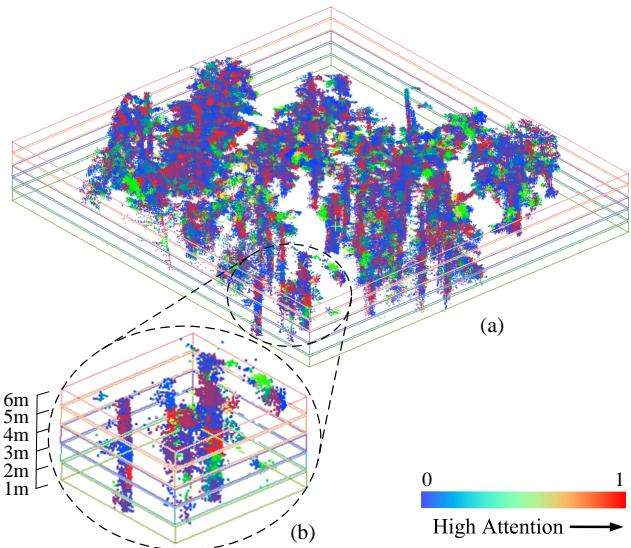
As shown in Figure 1, a raw point cloud of a forest is messy. The ground is noisy, and the canopy is chaotic. The researchers behind ForestLPR hypothesize that the unique spatial distribution of tree trunks and branches at specific heights contains the stable “fingerprint” needed for recognition.
The Solution: ForestLPR Overview
ForestLPR stands for Forest LiDAR Place Recognition. It is a deep learning framework designed to extract a global “signature” (descriptor) from a LiDAR scan that is robust to rotation (it doesn’t matter which way the robot is facing) and seasonal changes.
The core innovation lies in two areas:
- Clever Pre-processing: Filtering out the noise (ground and canopy) to focus on the stable parts of trees.
- Multi-BEV Architecture: Generating multiple 2D images at different height intervals and using a mechanism to decide which height layer contains the most useful information.
Let’s break down the architecture step-by-step.
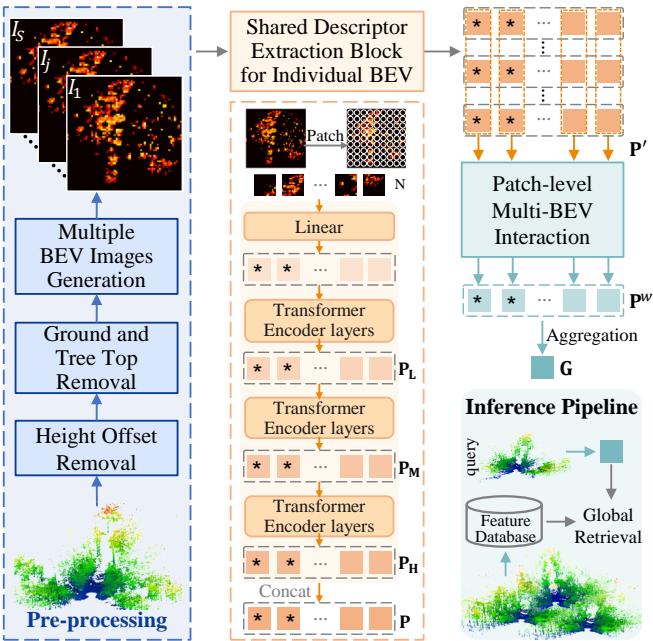
Step 1: Cleaning the Data (Pre-processing)
Raw LiDAR data includes the ground (which changes with slope) and the tree tops (which move in the wind and change with seasons). To find stable features, we need to normalize this data.
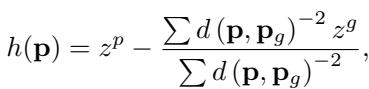
Ground Segmentation & Normalization First, the system separates the ground points from the non-ground points. But simply removing the ground isn’t enough. A tree standing on a hill appears “higher” than a tree in a valley. To fix this, the algorithm calculates the height of every point relative to the ground immediately beneath it.
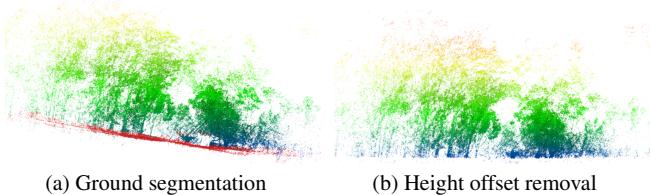
As seen in Figure 2, the algorithm essentially “flattens” the terrain.
- (a) Shows the original scan with elevation changes.
- (b) Shows the normalized scan where all trees start at
z=0.
Mathematically, the normalized height \(h(\mathbf{p})\) is calculated by subtracting the weighted average height of neighboring ground points:
Trimming the Noise After normalization, the researchers crop the data. They remove the bottom 1 meter (to ignore grass, snow, and fallen branches) and everything above 6 meters (to ignore the leafy canopy that changes seasonally). They focus exclusively on the 1m to 6m range, where the tree trunks and main branches are most stable.
Step 2: Slicing the Forest (Multi-BEV Representation)
Most BEV methods squash the entire 3D point cloud into a single 2D image. The authors argue this causes information loss. A branching pattern at 2 meters high is distinct from a pattern at 5 meters high. If you squash them together, you lose that distinction.
ForestLPR slices the normalized point cloud into \(S\) horizontal slices (e.g., 5 slices, each 1 meter thick). Each slice is projected into a 2D grid called a BEV Density Image.
To prevent dense areas (like a thick trunk) from overpowering sparse areas (like thin branches), they apply a logarithm to the density values:

Then, they normalize the pixel values to a 0-1 range to create an image suitable for a neural network:
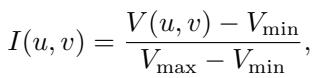
This results in a stack of images, where each image represents the forest geometry at a specific height.
Step 3: Feature Extraction with Transformers
Now that we have our stack of images, how do we understand them? ForestLPR uses a Visual Transformer (specifically DeiT) as its backbone.
Unlike Convolutional Neural Networks (CNNs) that look at local pixels, Transformers split an image into small patches (e.g., \(16 \times 16\) pixels) and process them as a sequence of “tokens.” This allows the network to understand global context—how a tree on the left relates to a tree on the right.
The network processes each of the \(S\) height slices independently but shares the same weights. It extracts features from three different levels of the Transformer (low, mid, and high levels) to capture both fine details and broad patterns.
Step 4: The Multi-BEV Interaction Module
This is the most critical part of the paper. We have features for every slice (layer) of the forest. But not all layers are equally important.
- In one spot, the unique feature might be a specific branching pattern at 3 meters.
- In another spot, the thick trunk at 1 meter might be the key.
The Multi-BEV Interaction Module allows the network to “talk” across the vertical layers and decide where to pay attention.
Generating Attention Weights For every patch location, the module looks at the features across all slices. It calculates the “relative feature value” by comparing each slice to the mean of all slices:

It then uses a SoftMax function to generate a weight vector \(\mathbf{w}_i\). This vector tells the network: “For this specific patch, pay 80% attention to slice #2 and only 5% to the others.”

Finally, these weights are applied to the original features to create a weighted, fused descriptor that emphasizes the most discriminative parts of the forest:

Step 5: Creating the Global Descriptor
The final step is to combine all these patch features into a single vector that represents the entire place. The system uses a specialized pooling layer (GeM) and concatenation to create a final global descriptor \(\mathbf{G}\).

This vector \(\mathbf{G}\) is what the robot stores in its map. When the robot sees a new place, it generates a new \(\mathbf{G}\) and compares it to its database using simple Cosine distance.
Experiments and Results
The researchers tested ForestLPR on three diverse datasets: Wild-Places (dense natural forest), ANYmal (collected by a quadruped robot), and Botanic Garden (managed parkland).
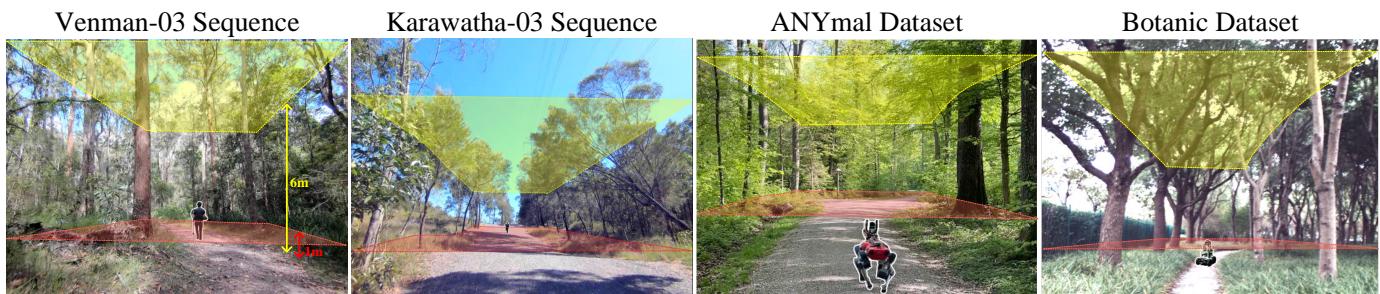
As shown in Figure 4, the environments vary significantly in vegetation density and structure. The yellow planes indicate the 6m cutoff, and red planes indicate the 1m ground cutoff.
Quantitative Performance
The primary metric used is Recall@1 (R@1), which asks: “When the robot searched for its current location in the database, was the #1 match correct?”
ForestLPR was compared against State-of-the-Art (SOTA) methods like PointNetVLAD, MinkLoc3D, and standard Scan Context.
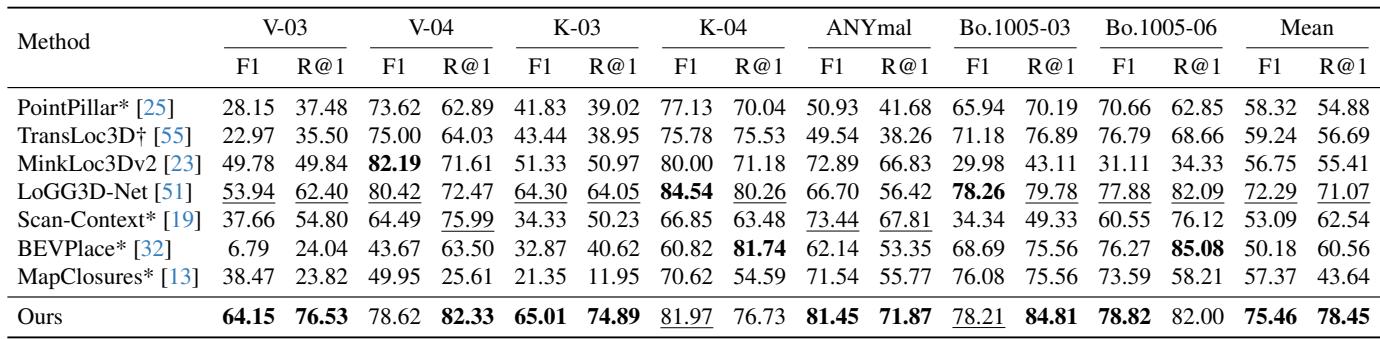
Table 1 shows the results for “Intra-sequence” detection (loop closures within the same run).
- ForestLPR (Ours) consistently outperforms other methods.
- On the Wild-Places (V-03) dataset, ForestLPR achieves an F1 score of 64.15, compared to just 53.94 for the next best method (LoGG3D-Net).
- On the ANYmal dataset, it achieves 81.45, significantly higher than others.
The method shines even brighter in Inter-sequence tests (Re-localization), where the robot visits a place months later.
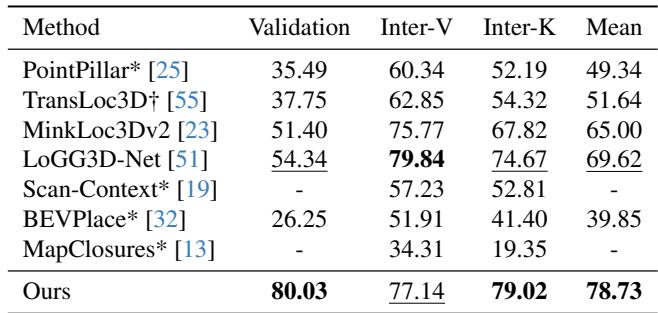
In Table 2, look at the “Inter-K” column (Karawatha forest sequences). ForestLPR achieves a recall of 79.02%, whereas the popular Scan-Context method only manages 52.81%. This proves the hypothesis: slicing the forest and selecting stable heights makes the system robust to seasonal changes.
Qualitative Analysis: Seeing What the Robot Sees
Does the attention mechanism actually work? The researchers visualized the attention weights projected back onto the point cloud.
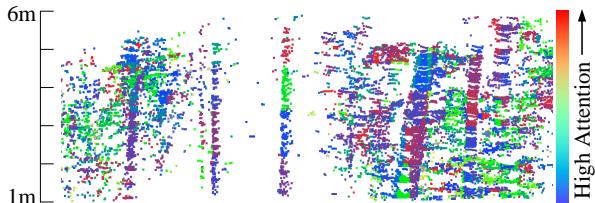
In Figure 6, the colors represent attention weights (Red = High, Blue = Low). Notice how the network doesn’t just look at everything equally. It focuses on specific trunk sections and branching points that are unique to those trees. It learns to ignore the parts of the vegetation that are confusing or generic.
Ablation Study: Do we really need multiple slices?
You might wonder, “Why not just stack the slices together without the fancy interaction module?” The authors tested this.
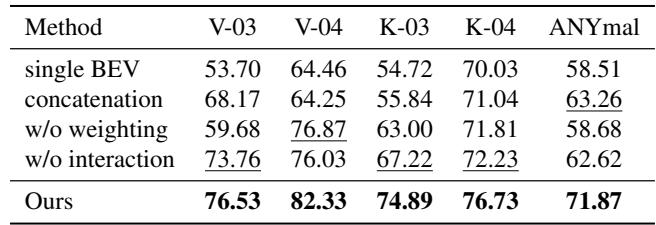
Table 4 reveals:
- Single BEV: If you only use one density image, performance drops significantly (e.g., 53.70 vs 76.53 on V-03).
- Concatenation: If you stack the images but don’t use the interaction module to weigh them, performance is still much lower.
- Ours: The full interaction module provides the best results, proving that the system needs to adaptively choose which height is important.
Conclusion
ForestLPR represents a significant step forward for robots operating in nature. By treating the forest as a multi-layered geometric puzzle rather than a chaotic cloud of points, the method finds stability in an unstructured world.
Key Takeaways:
- Height Matters: Geometric information varies at different elevations. Slicing the data captures this.
- Adaptive Attention: Not all parts of a tree are equally unique. Allowing the network to “choose” the best height slice per patch improves accuracy.
- Robustness: By filtering ground and canopy, and focusing on trunk geometry, robots can recognize places even as seasons change.
As we move toward autonomous search-and-rescue drones or forestry monitoring robots, techniques like ForestLPR will be essential to ensure these machines don’t get lost in the woods.