](https://deep-paper.org/en/paper/2503.04877/images/cover.png)
Introduction
Imagine teaching a robot to pick up a coffee cup. You show it thousands of examples, and eventually, it masters the task perfectly. But then, you move the camera two inches to the left, or you swap the robot arm for a slightly different model. Suddenly, the robot fails completely.
This “brittleness” is one of the most persistent challenges in robotic Imitation Learning (IL). While we have become very good at training specialists—agents that excel in a fixed environment—we struggle to train generalists that can adapt to changes in viewpoint or embodiment (the physical structure of the robot).
Standard approaches usually fall into two camps: 2D vision-based methods, which are rich in semantic understanding but struggle with spatial geometry, and 3D point-cloud methods, which understand geometry but often lack the semantic richness to distinguish objects in complex scenes.
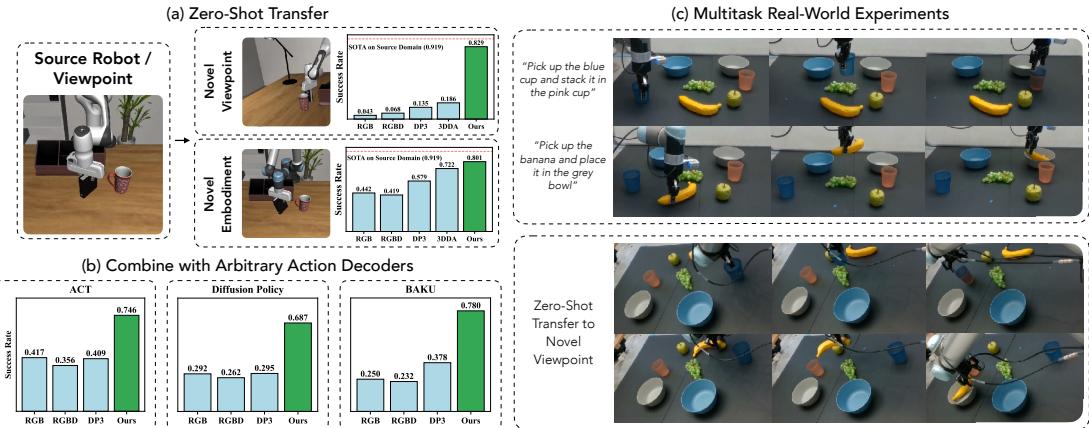
In this post, we will dive deep into Adapt3R, a new research paper that proposes a hybrid solution. Adapt3R is an observation encoder designed specifically for domain transfer. It combines the semantic power of pretrained 2D foundation models with the geometric precision of 3D point clouds. The result is a system that allows robots to learn tasks on one robot and execute them on another, or perform tasks correctly even when the camera moves significantly—situations where traditional methods fail catastrophicially.
The Context: Why is Generalization so Hard?
To understand why Adapt3R is significant, we first need to look at why current methods struggle with out-of-distribution (OOD) data.
The Limits of 2D Imitation Learning
Most modern robotic learning relies on standard RGB cameras. A Convolutional Neural Network (CNN) or a Transformer processes the image and outputs robot actions. These models are prone to overfitting the specific background, lighting, or camera angle of the training data. If the camera angle shifts, the pixel patterns change drastically, and the policy breaks.
The Pitfalls of Existing 3D Representations
To fix the spatial issues of 2D, researchers turned to 3D representations like voxels or point clouds. Ideally, a 3D point cloud is “viewpoint invariant”—a cup looks like a 3D cup regardless of where the camera is placed.
However, existing 3D methods have limitations:
- Lack of Semantics: Methods like DP3 (3D Diffusion Policy) use colorless point clouds. They rely purely on geometry. This makes it hard to distinguish between semantically different but geometrically similar objects (e.g., a red cup vs. a blue cup).
- Overfitting to Geometry: Methods that perform complex self-attention between all points in a scene (like 3D Diffuser Actor) tend to overfit the specific geometric layout of the training scene, making them brittle when that geometry shifts (e.g., changing the camera angle changes the density of points).
- Computational Cost: Processing high-resolution 3D data is computationally expensive, often slowing down inference to rates unusable for real-time control (e.g., < 5Hz).
The Core Method: Adapt3R
The researchers behind Adapt3R propose a clever architectural philosophy: Offload semantic reasoning to 2D backbones, and use 3D only for localization.
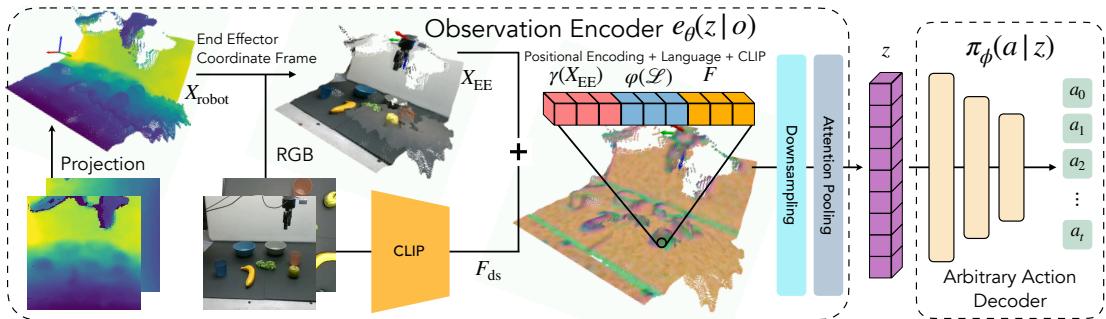
Instead of trying to learn what an object “is” from a sparse point cloud, Adapt3R uses a pretrained 2D vision model (CLIP) to extract features. It then lifts these features into 3D space to understand where they are relative to the robot.
Let’s break down the architecture step-by-step.
1. Constructing the 3D Scene
The process begins with RGBD (Color + Depth) images from one or more calibrated cameras.
- Feature Extraction: The system passes the RGB images through a frozen, pretrained CLIP ResNet backbone. This extracts a dense feature map containing rich semantic information (understanding “cup,” “handle,” “table”).
- Lifting to 3D: Using camera calibration matrices, pixels are projected into 3D space to form a point cloud. However, unlike a standard point cloud that just has \((x, y, z)\) coordinates and maybe RGB color, each point in this cloud is associated with a high-dimensional semantic feature vector from CLIP.
2. The End-Effector Coordinate Frame (Crucial Step)
Most systems represent point clouds in the “World Frame” (relative to the robot’s base or the room). Adapt3R transforms the point cloud into the End-Effector (EE) Frame.
Why does this matter? Imagine you are trying to insert a key into a lock. Does it matter where the lock is in the room? No. What matters is where the lock is relative to your hand. By transforming the world into the robot’s hand-centric view, the policy learns relative spatial relationships. This is critical for Cross-Embodiment Transfer. If you switch from a large robot arm to a small one, the “World Frame” coordinates of the hand change completely, but the “EE Frame” view of the object remains consistent as the gripper approaches it.
3. Smart Downsampling and Cropping
Raw point clouds are noisy and heavy. Adapt3R employs specific strategies to clean the data:
- Cropping: It crops the scene to focus on the workspace (the table) and removes points behind the end-effector (often the robot’s own arm), which prevents the robot from confusing its own body with the environment.
- Feature-Based Downsampling: Standard methods use Farthest Point Sampling (FPS) based on geometric distance (XYZ). This often selects many points on the empty table because they are far apart physically. Adapt3R uses FPS based on the feature distance. This ensures the downsampling preserves semantically distinct points (the objects) rather than just geometrically spread-out points (the table surface).
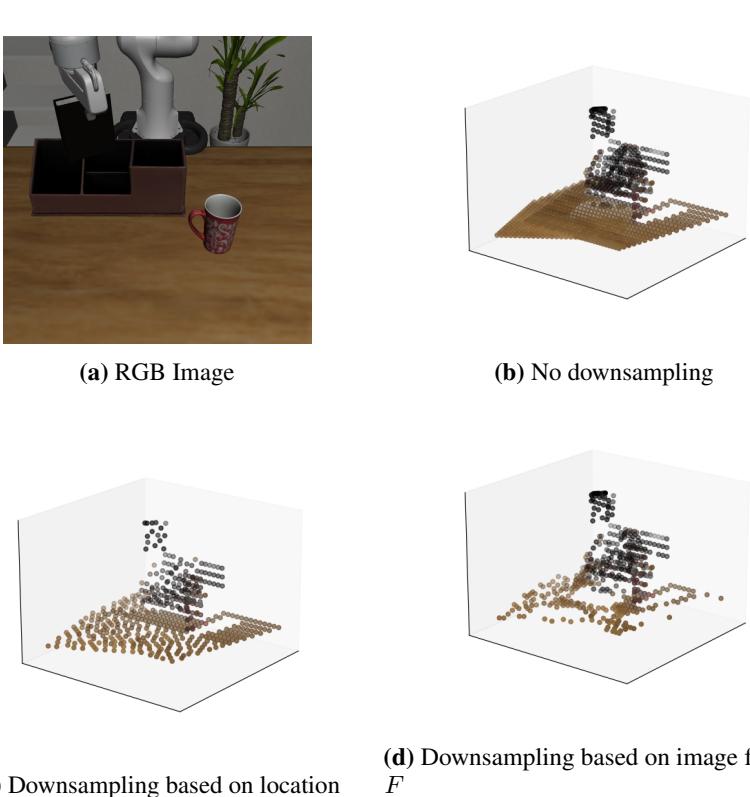
As shown in Figure 13 above, notice how Feature-Based FPS (d) concentrates points on the objects of interest compared to coordinate-based sampling (c).
4. Attention Pooling and Conditioning
Finally, the system needs to compress this cloud into a single vector \(z\) to feed into the imitation policy.
- Positional Encoding: Points are encoded with Fourier features to help the network perceive high-frequency spatial details (vital for high-precision tasks).
- Language Injection: Language instructions (e.g., “Pick up the blue cup”) are embedded via CLIP and concatenated to the point features.
- Attention Pooling: Instead of simple Max Pooling (which loses context) or heavy Self-Attention (which is slow), Adapt3R learns an attention map over the points. This allows the model to dynamically “decide” which points are relevant for the current task and aggregate them into the final vector \(z\).
This vector \(z\) is then passed to a downstream policy—such as ACT (Action Chunking Transformer) or Diffusion Policy—to generate motor commands.
![Figure 8: In this figure we compare Adapt3R to several recent methods which also use point clouds for imitation learning. (a) We provide a diagram of Adapt3R for reference. (b) DP3 [25] omits any semantic information, instead conditioning on colorless point clouds. (c) 3D Diffuser-Actor [27] cross attends between noisy action trajectories and scene tokens. (d) GenDP [29] hand selects important reference features in the training data…](/en/paper/2503.04877/images/011.jpg#center)
Experimental Results
The researchers evaluated Adapt3R on complex simulated benchmarks (LIBERO-90, MimicGen) and real-world robot setups. The goal was to test three capabilities: Multitask learning, Cross-Embodiment transfer, and Novel Viewpoint generalization.
1. In-Distribution Performance
First, can it learn the tasks at all? In the LIBERO-90 benchmark (90 distinct manipulation tasks), Adapt3R achieved a 90.0% success rate, matching or exceeding the best baselines (RGB ResNet achieved 90.9%, while 3D Diffuser Actor achieved 83.7%).
In high-precision tasks (MimicGen), Adapt3R significantly outperformed purely geometric methods like DP3. For example, in the “Threading” task (inserting a rod into a hole), Adapt3R achieved 44.0% success, while DP3 failed almost completely (0.2%), likely because DP3 lacked the semantic resolution to align the objects precisely.
2. Zero-Shot Camera Transfer
This is the “stress test.” The model is trained on one camera view. At test time, the camera is rotated around the scene.
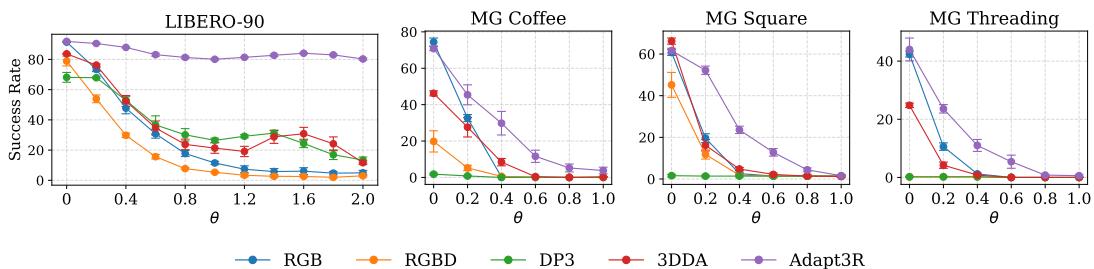
The results in Figure 4 are striking.
- Adapt3R (Purple line): Maintains high performance (near 80% on LIBERO) even as the camera rotates significantly (\(\theta = 2.0\) radians).
- Baselines: RGB (Blue) and RGBD (Orange) methods crash immediately. Even 3D Diffuser Actor (Red), which uses point clouds, degrades significantly.
Why does 3D Diffuser Actor fail? The authors hypothesize that its heavy self-attention mechanism overfits the specific geometric distribution of points in the training view. Adapt3R’s attention pooling is more robust, effectively ignoring “out-of-distribution” points that appear from new angles.
3. Cross-Embodiment Transfer
Can a policy trained on a Franka Panda arm work on a Kuka IIWA or a UR5e? The authors aligned the action spaces (using delta poses) and used Adapt3R’s End-Effector frame point clouds.

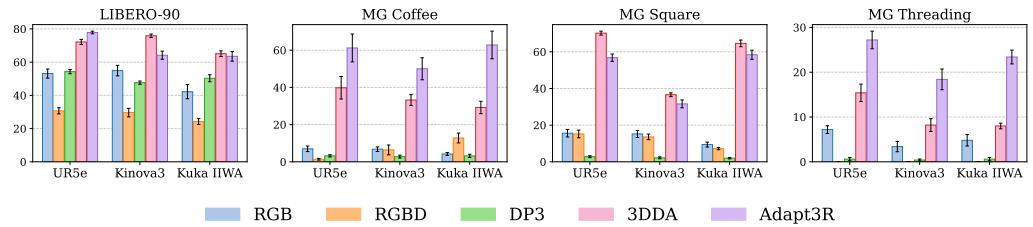
As shown in Figure 5, Adapt3R (Purple) consistently outperforms 2D methods (RGB) and geometry-only methods (DP3). Because Adapt3R perceives the world relative to the gripper, swapping the robot body (which is mostly cropped out or masked) has minimal impact on the policy’s understanding of the object interaction.
4. Real-World Validation
Simulations are useful, but the real world is messy. Depth cameras are noisy, and lighting varies. The team tested Adapt3R on a physical UR5 robot performing pick-and-place tasks.
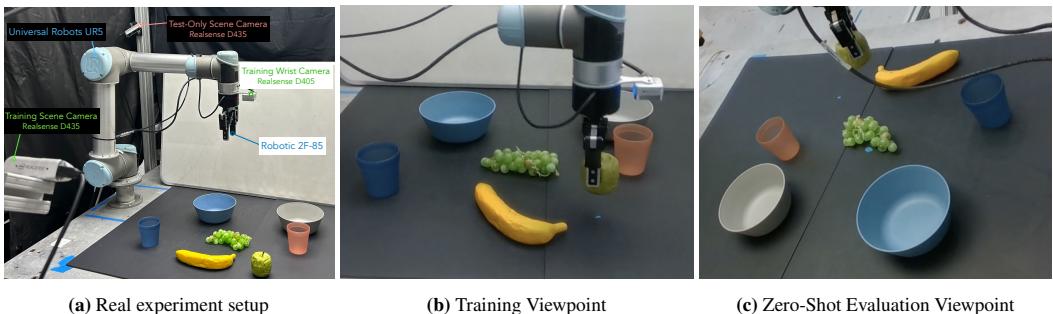
The real-world results mirrored the simulation. When the camera was moved to a completely new angle (Figure 6c):
- RGB Baseline: Performance dropped by 44.4%.
- 3D Diffuser Actor: Performance dropped by 55.6%.
- Adapt3R: Performance dropped by less than 6%.
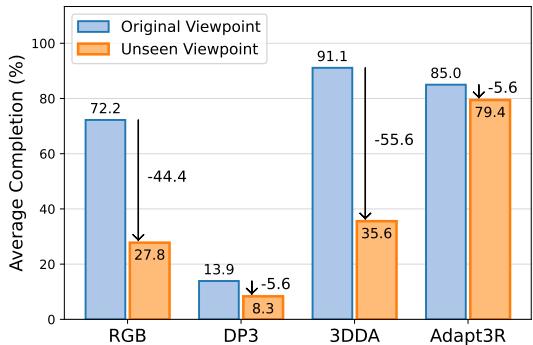
This confirms that the architecture isn’t just exploiting simulation artifacts—it genuinely learns a robust representation of the task.
Why It Works: The Ablation Studies
The authors stripped parts of the model away to see what matters most.
- Removing Image Features: If you replace CLIP features with just RGB colors, performance collapses (especially on camera transfer). This proves that the pretrained 2D semantics are doing the heavy lifting for understanding the scene.
- Removing EE Frame: Without transforming points to the End-Effector frame, generalization drops. The robot loses its “egocentric” reference.
- Removing Positional Encoding: Without Fourier features, precise manipulation tasks suffer because the network can’t resolve fine spatial differences.
Conclusion & Implications
Adapt3R represents a shift in how we think about 3D Robot Learning. Rather than trying to build “Point Cloud Nets” that learn everything from scratch, it leverages the massive progress in 2D Computer Vision (CLIP) and uses 3D geometry strictly for what it does best: spatial localization.
Key Takeaways:
- Hybrid is better: Combining 2D semantics with 3D geometry yields better generalization than either modality alone.
- Frame of Reference matters: Representing the world relative to the robot’s hand (End-Effector frame) is crucial for transferring skills between different robots.
- Speed: Adapt3R runs at ~44Hz, making it fast enough for real-time control, unlike heavier transformer-based 3D methods (like 3DDA running at 2.6Hz).
While limitations remain—specifically the reliance on high-quality depth cameras and calibration—Adapt3R paves the way for “Generalist Agents.” If we can train robots that don’t need to be retrained every time we bump the camera or upgrade the hardware, we are one step closer to deploying robots effectively in the chaotic, unstructured real world.