](https://deep-paper.org/en/paper/2503.04919/images/cover.png)
Introduction: The “Floating Book” Problem
Imagine asking an AI to “place a book on the shelf.” To a human, this is a trivial task. You identify the shelf, find an empty spot on the flat surface, and place the book there upright or stacked.
To a standard Multimodal Large Language Model (MLLM), however, this request is fraught with peril. The AI might understand the concept of a shelf and a book, but it lacks a fundamental understanding of 3D geometry. It might place the book floating six inches above the shelf, intersecting through the wood, or balancing precariously on the very edge. Why? Because most AI models treat objects as rough “bounding boxes”—cubes that encompass an object—rather than complex shapes with specific surfaces. If a shelf is treated as a solid box, you can’t put anything inside it.
This disconnect between high-level semantic understanding (“books go on shelves”) and low-level geometric reality (gravity, collision, surface normals) is a major bottleneck in 3D scene generation.
Enter FirePlace, a new framework presented by researchers from Stanford University and Google DeepMind. FirePlace bridges this gap by using MLLMs not to place objects directly, but to reason about geometric constraints. It combines the “common sense” of language models with rigorous 3D processing tools to create scenes that are both physically feasible and aesthetically plausible.
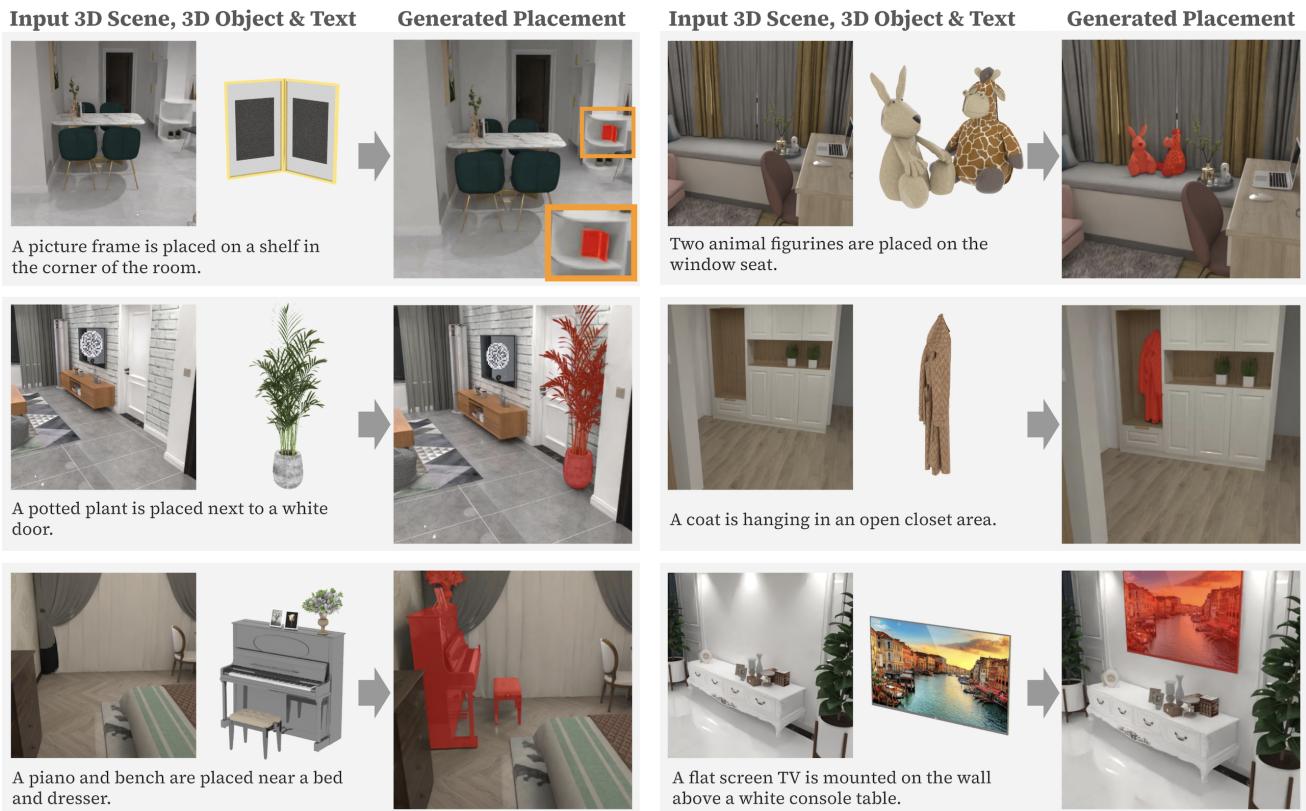
In this deep dive, we will explore how FirePlace moves beyond simple bounding boxes to understand the fine-grained geometry of the 3D world.
Background: Why Current Methods Struggle
Generating 3D scenes is critical for architecture, game development, and VR/AR. Recently, researchers have tried to leverage MLLMs (like GPT-4V or Gemini) for this task because these models have incredible world knowledge. They know that chairs go near tables and monitors go on desks.
However, existing methods typically fail in two specific ways when dealing with preexisting, complex scenes:
- The Bounding Box Limitation: Most systems simplify 3D objects into bounding boxes (rectangular prisms). This works for a closed box, but fails for a chair (which has a seat, a back, and empty space for legs) or an L-shaped desk. If you try to place an object “on” a chair using only its bounding box, the object ends up sitting on an invisible lid covering the chair, rather than on the seat itself.
- Instance Ambiguity: If you tell an AI to “hang a picture on the wall,” and the room has four walls, which one do you mean? Existing systems struggle to visually “look” at the scene and select the specific object instance that makes sense in context.
FirePlace addresses these issues by treating the MLLM as a reasoning engine rather than a coordinate generator. It asks the MLLM to define rules (constraints), which are then solved mathematically.
The FirePlace Method
The FirePlace framework operates as a pipeline, translating a vague text instruction into a precise 3D transformation matrix. The process is broken down into five distinct stages, visualized below.
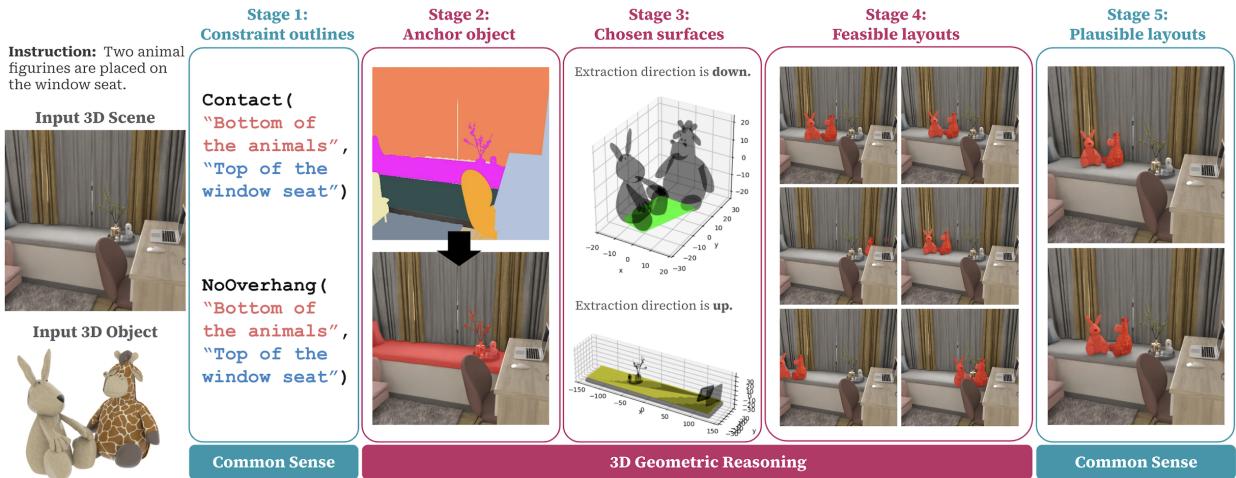
Let’s break down the architecture step-by-step.
Stage 1: Constraint Outline Generation
Everything begins with the input text (e.g., “Place the lamp next to the sofa”). FirePlace first prompts the MLLM to translate this natural language into a “Constraint Outline.”
Instead of guessing coordinates \((x, y, z)\), the model outputs a list of logical relationships. For example:
- Constraint:
Contact - Anchor Object: “The top surface of the side table.”
- Target Object: “The bottom base of the lamp.”
It might also add a CloseTo constraint regarding the wall or the sofa. This step leverages the MLLM’s semantic strength—it knows how objects usually interact physically without needing to know the math behind it yet.
Stage 2: Visual Selection of Anchor Objects
Here is where FirePlace begins to tackle the “Instance Ambiguity” problem. The constraint outline might refer to “the white cabinet.” In a room with multiple cabinets, the system needs to know which one.
FirePlace renders segmentation masks of the scene—essentially coloring each object differently—and asks the MLLM to pick the correct one by color.
The Innovation: Batched Visual Selection
A major challenge discovered by the authors is that MLLMs get overwhelmed when presented with too many options. If a scene has 100 objects, showing an image with 100 different colored masks results in poor selection accuracy.
To solve this, the researchers introduced Batched Visual Selection.
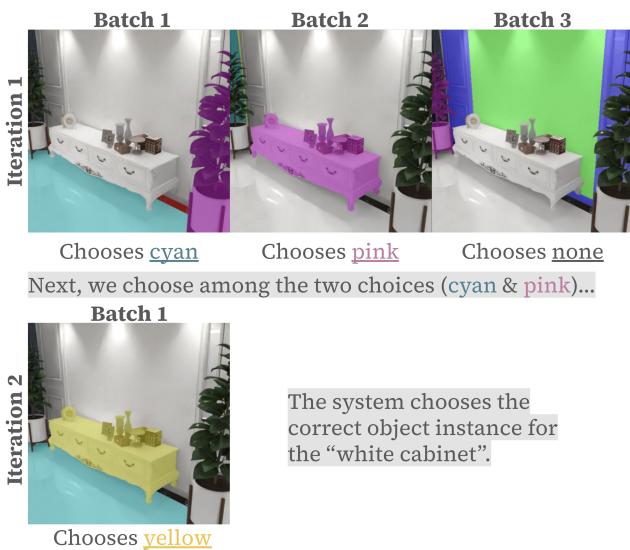
As shown above, the system uses a recursive tournament style approach:
- It groups objects into small batches (e.g., 3 at a time).
- It asks the MLLM to pick the best match in that small batch.
- It takes the winners from each batch and repeats the process until one object remains.
This “inference-compute scaling” significantly improves the reliability of the AI in identifying the correct furniture or architectural element to interact with.
Stage 3: Reasoning with Fine-Grained Geometry
Once the “Anchor Object” (e.g., a desk) is identified, FirePlace needs to find the correct surface. This is the move away from bounding boxes.
The system performs Surface Extraction:
- Directional Guessing: The MLLM predicts the normal direction of the relevant surface. If placing a laptop on a desk, the direction is “Up.”
- Geometric Clustering: The system analyzes the 3D mesh of the object. It groups faces of the mesh that point in that direction.
- Visual Confirmation: The system renders these candidate surfaces (e.g., the top of the desk, the top of the drawer handle, the top of the monitor stand) and asks the MLLM to visually select the correct one.
This capability is crucial for complex objects. Consider an L-shaped desk. A bounding box approach would treat the empty space in the “L” as solid, preventing a chair from sliding in. FirePlace extracts the actual desktop surface.
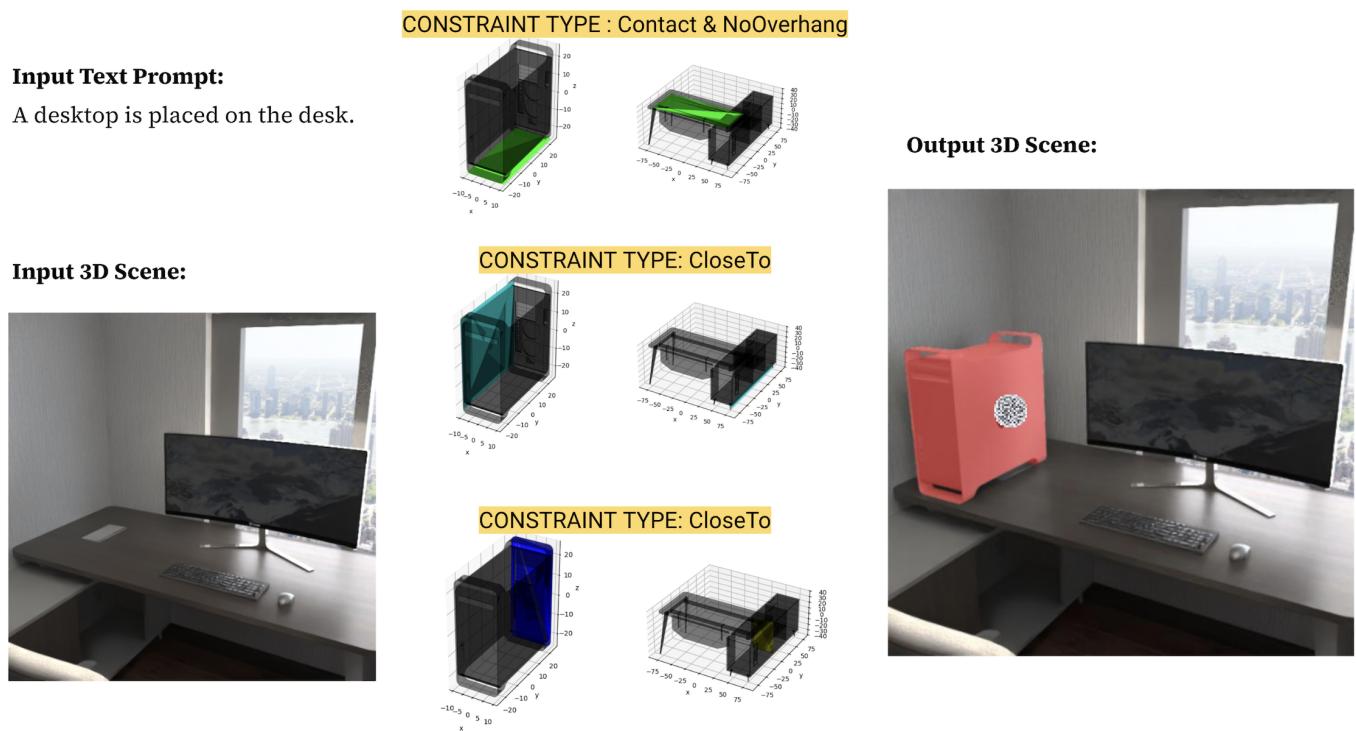
In the example above, notice how the Contact and NoOverhang constraints are applied to the specific geometry of the desk surface, not a box that encompasses the whole furniture piece.
Stage 4: Solving the Constraints
Now the system has a set of geometric rules. For example:
- Surface A (Lamp Base) must touch Surface B (Table Top).
- Surface A must be
FarFromSurface C (Edge of table).
FirePlace uses a mathematical solver (Simulated Annealing) to find a position and orientation (transformation matrix \(T\)) that minimizes the “energy” of these constraints.
The paper utilizes a library of binary constraint functions. While simple, these functions can describe complex behaviors when combined.
For example, the NoOverhang constraint ensures that one object is fully supported by another—vital for ensuring books don’t hang halfway off a shelf.
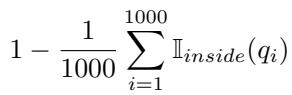
This equation essentially checks if the projection of the target object falls entirely within the boundaries of the anchor surface.
Stage 5: Plausibility Pruning
The solver might return several mathematically valid positions. For a “chair at a table,” there might be valid positions at the head of the table or the side. Some might technically satisfy the geometry but look “awkward” or block a doorway.
To ensure Common Sense, FirePlace renders the top candidates and feeds them back into the MLLM. The model acts as a critic, scoring the placements based on aesthetics, functionality, and accessibility.
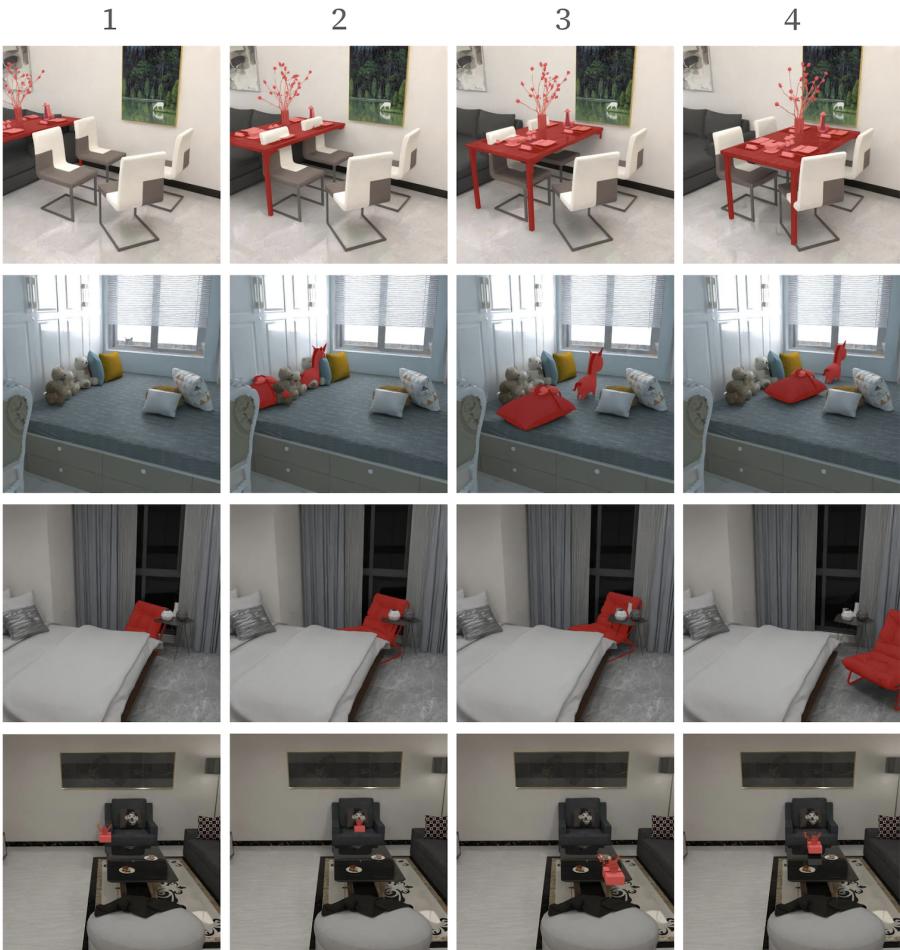
This final pruning step allows the system to filter out placements that are geometrically possible but semantically “weird.”
Experiments and Results
The researchers evaluated FirePlace on a dataset of 266 placement tasks across 50 photorealistic 3D scenes. They compared it against two state-of-the-art baselines: Holodeck and LayoutGPT.
Quantitative Success
FirePlace outperformed the baselines across every metric used.
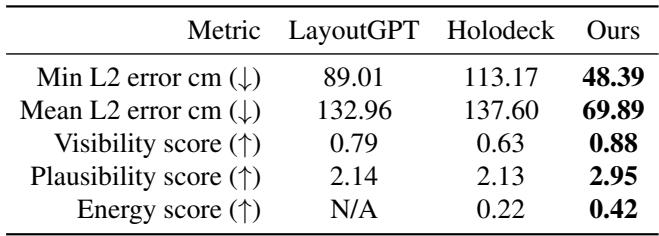
- L2 Error: FirePlace’s placement accuracy was nearly double that of the baselines (lower error is better).
- Plausibility Score: Rated significantly higher by AI judges.
- Visibility: Objects placed by FirePlace were less likely to be hidden inside walls or other objects.
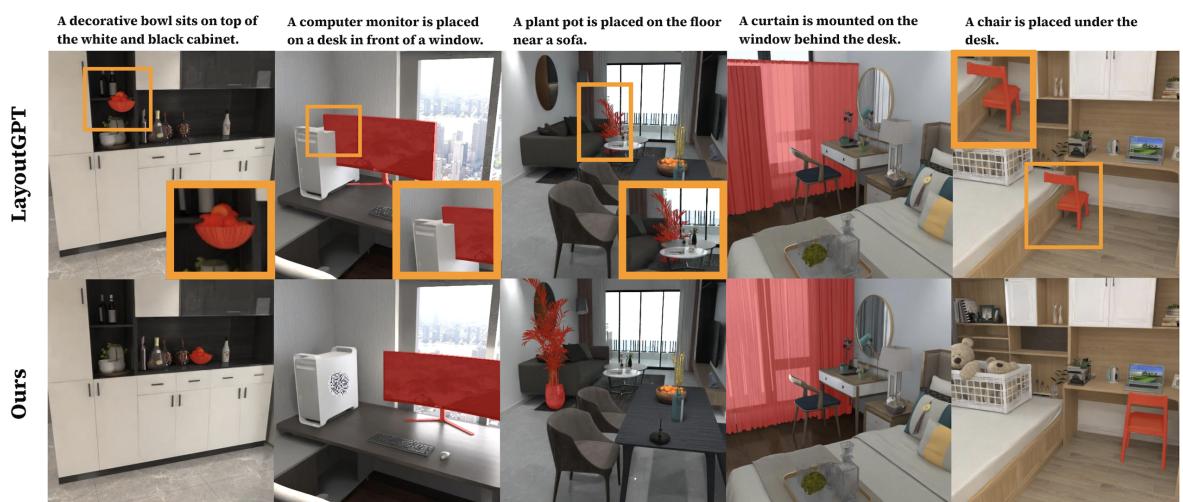
Qualitative Comparisons
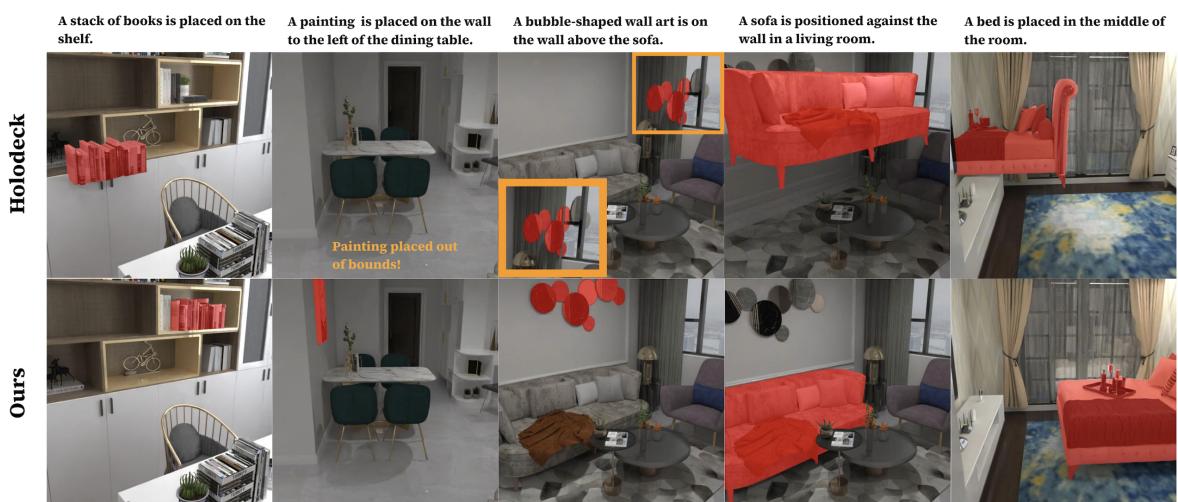
The visual results highlight the limitations of previous approaches.
Comparison with Holodeck
Holodeck relies on bounding boxes. When tasked with placing books on a shelf, Holodeck often fails because the bounding box of the shelf “fills” the empty space where the books should go. FirePlace, understanding the surface geometry, slides the books right in.
Comparison with LayoutGPT
LayoutGPT attempts to predict 3D positions directly. Without the rigorous constraint solver, it often hallucinates positions that result in physical intersections—placing objects inside one another.
Ablation Studies: What Matters Most?
The researchers performed ablation studies—removing specific parts of the system to see what broke.
- Removing Constraints: Asking the MLLM to just guess the spot resulted in objects floating in mid-air or clipping through furniture.
- Removing Visual Selection: Relying only on text descriptions (e.g., “the chair”) without looking at the image caused the system to pick the wrong chair or wall.
- Removing Geometry (using Bounding Boxes): This drastically reduced the ability to place objects on shelves or irregular surfaces.
The coat closet example below perfectly illustrates this. Only the full FirePlace pipeline (top left) managed to hang the coat inside the closet. The “Geometry” ablation (bottom left) distorted the object because it didn’t understand the open space of the closet.
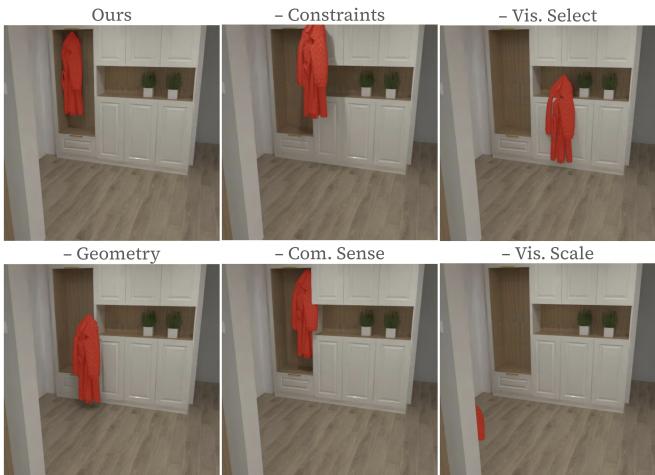
Image-Based Inputs
Interestingly, FirePlace isn’t limited to text instructions. Because it uses MLLMs, you can provide an image of a room setup and ask it to replicate that arrangement in a new 3D scene.
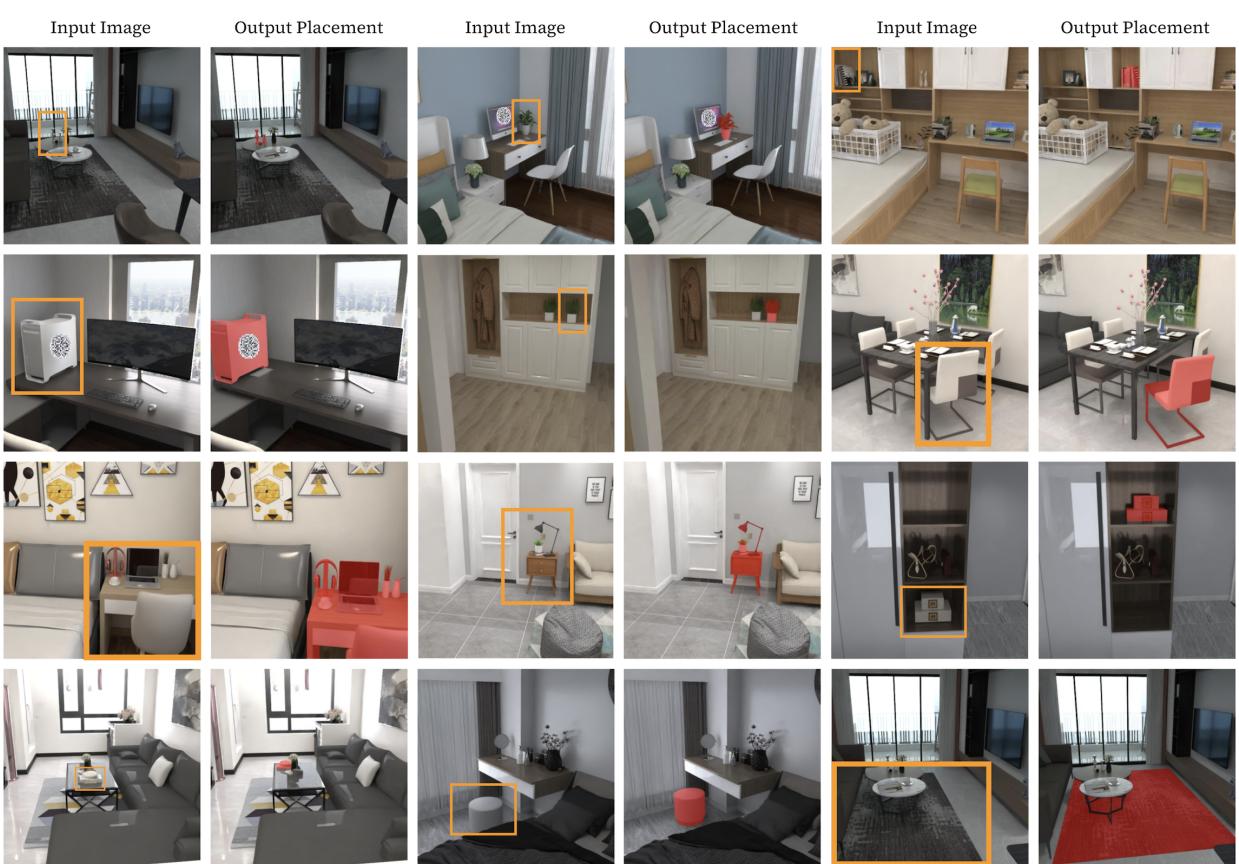
The system analyzes the image, deduces the constraints (e.g., “Oh, in this photo, the plant is to the left of the sofa”), and applies those rules to the new 3D environment.
Conclusion and Future Implications
FirePlace demonstrates a crucial lesson in the evolution of AI: Language models are excellent reasoners, but poor engineers.
By decoupling the semantic reasoning (“Where should this go?”) from the geometric execution (“What are the coordinates?”), FirePlace plays to the strengths of both MLLMs and traditional geometric algorithms.
The introduction of Batched Visual Selection is a takeaway that extends beyond just 3D placement—it offers a blueprint for how AI agents can handle complex selection tasks in cluttered environments without getting overwhelmed.
As we move toward more immersive virtual worlds and autonomous robotics, systems like FirePlace will be essential. They ensure that when we ask a robot to “clean up the room,” it doesn’t just throw everything into a pile, but understands the subtle, geometric nuance of where everything belongs.