](https://deep-paper.org/en/paper/2503.05652/images/cover.png)
Introduction
We often dream of the “Rosie the Robot” future—a general-purpose helper that can tidy the living room, clean the bathroom, and organize the pantry. While we have seen incredible advances in robotic manipulation in lab settings, bringing these capabilities into a real-world home remains a formidable challenge.
Why is this so hard? It turns out that a messy home requires more than just a good gripper. It requires a robot that can coordinate its entire body. To open a heavy door, a robot can’t just use its arm; it needs to lean in with its torso and drive its base simultaneously. To put a box on a high shelf, it needs to stretch up; to scrub a toilet, it needs to crouch down.
In this post, we are diving deep into the BEHAVIOR ROBOT SUITE (BRS), a new framework from researchers at Stanford University. This paper tackles the “whole-body” problem head-on by introducing two major innovations: a clever, low-cost teleoperation interface called JoyLo, and a novel learning algorithm called WB-VIMA that understands the hierarchy of robotic movement.
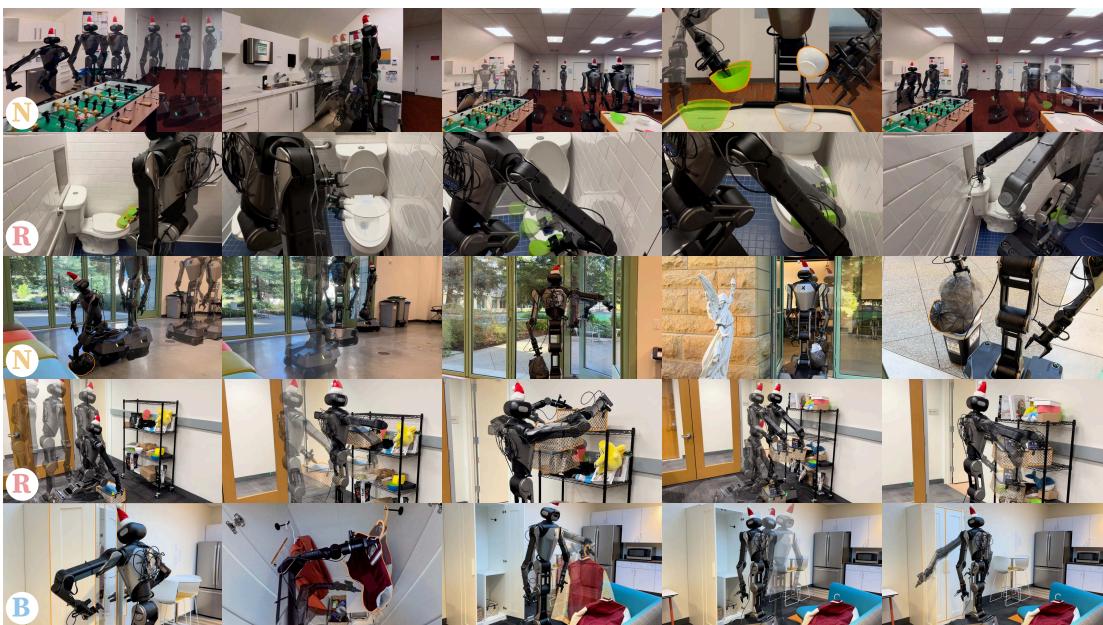
As shown in Figure 1 above, BRS enables robots to perform complex tasks like cleaning toilets, organizing shelves, and taking out the trash—tasks that require simultaneous coordination of arms, torso, and a mobile base.
The Three Pillars of Household Robotics
Before we get into the “how,” we need to understand the “what.” Through an analysis of the BEHAVIOR-1K benchmark (a dataset of everyday household activities), the researchers identified three critical capabilities a robot must possess to be useful in a home:
- Bimanual Coordination: Using two hands is non-negotiable for carrying large boxes or folding laundry.
- Stable and Accurate Navigation: The robot must move precisely through tight spaces without crashing.
- Extensive End-Effector Reachability: This is often overlooked. Homes are vertical spaces. Objects are on the floor, on counters, and on high shelves.
The researchers quantified this “reachability” problem by analyzing where objects are actually located in a home.
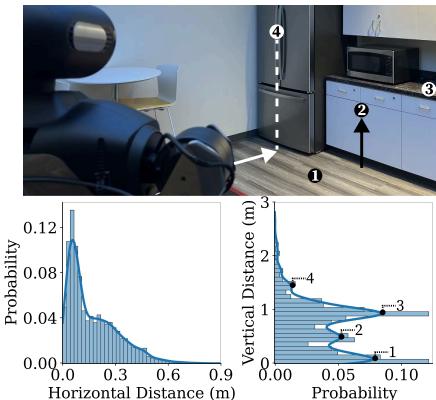
As you can see in Figure 2, the vertical distribution of objects is multi-modal. There are peaks at floor level (0.09m), low tables (0.49m), counters (0.94m), and shelves (1.43m). A robot with a fixed height is simply not going to cut it. It needs a flexible torso to cover this range.
The Hardware: Introducing JoyLo
To learn these tasks, we typically use Imitation Learning, where a human controls the robot to collect training data. However, controlling a robot that has two arms, a moving base, and a flexible torso is incredibly difficult.
Existing solutions usually fall into two traps:
- High Cost: Exoskeletons and professional motion capture rigs can cost thousands of dollars.
- Poor Usability: Trying to control a mobile base with a keyboard while moving robot arms with a VR controller is a cognitive nightmare for the operator.
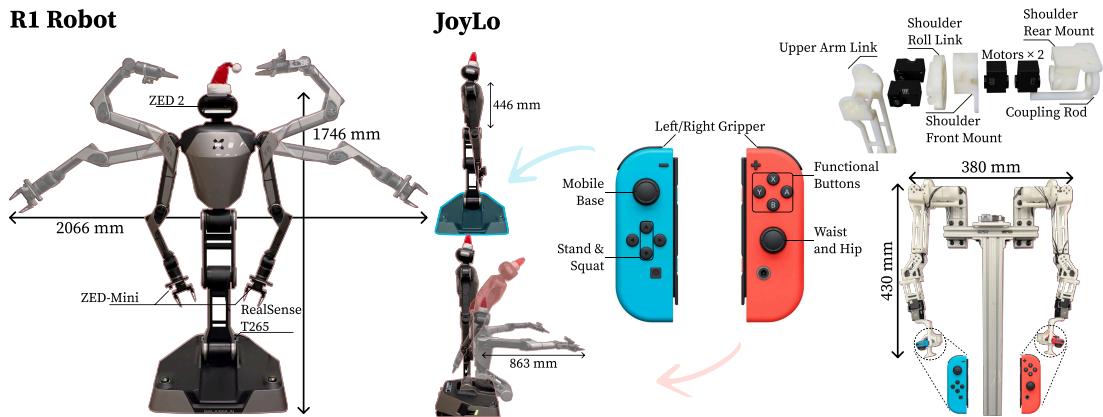
The BRS team introduced JoyLo, a “Joy-Con on Low-Cost Kinematic-Twin Arms” system.
How JoyLo Works
The system uses a “puppeteering” approach. The operator holds a physical rig (the “kinematic twin”) that matches the robot’s arm structure.
- Arms: As the operator moves the rig, the robot mimics the movement.
- Base & Torso: This is the clever part. The rig is tipped with standard Nintendo Joy-Cons. The operator uses the thumbsticks on the Joy-Cons to drive the mobile base and adjust the torso height while moving the arms.
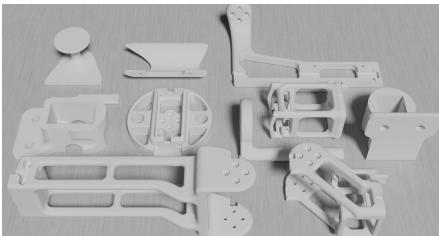
This setup costs under $500 to build (see the components below), making it accessible for widespread research. It also provides haptic feedback. The motors in the JoyLo rig provide resistance if the robot hits an obstacle, helping the operator “feel” the environment without expensive force sensors.
The Algorithm: WB-VIMA
Having a robot and a controller is step one. Step two is teaching the robot to act autonomously. This brings us to WB-VIMA (Whole-Body VIsuoMotor Attention).
Whole-body control is tricky because of the kinematic chain. If the mobile base moves 10cm to the left, the arms also move 10cm to the left. If the torso rotates, the arms rotate with it. Errors at the “root” (base/torso) amplify errors at the “leaves” (hands). Standard policies often treat all joints equally, predicting a flat vector of 21 actions (base + torso + arms) at once. This ignores the physical dependencies of the body.
WB-VIMA solves this by respecting the hierarchy of the robot’s body.
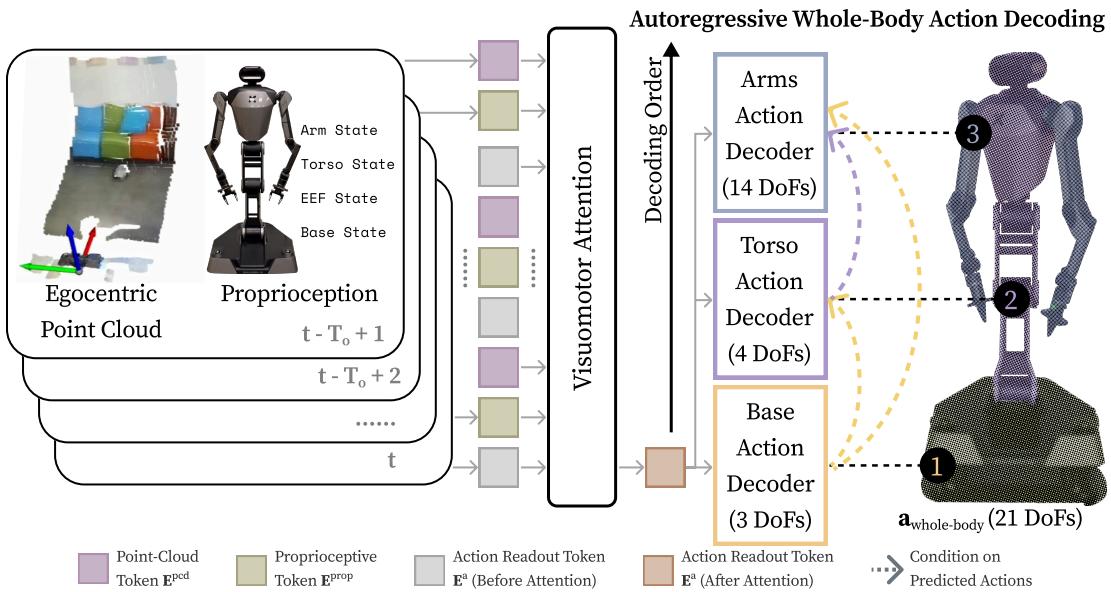
1. Multi-Modal Observation Attention
First, the model needs to see. WB-VIMA takes in two types of data:
- Egocentric Colored Point Clouds: 3D visual data from the robot’s cameras.
- Proprioception: The robot’s internal knowledge of its joint angles and velocity.
These inputs are encoded into tokens and processed by a transformer using causal self-attention. This allows the robot to fuse visual information with its body state to understand where it is and what is around it.
2. Autoregressive Whole-Body Action Decoding
This is the core innovation. Instead of predicting all movements at once, WB-VIMA predicts them in a specific order, using conditional diffusion models.
The process works like a cascade:
- Predict Base Action: The model first decides where the mobile base should move.
- Predict Torso Action: It uses the predicted base action to decide how the torso should move.
- Predict Arm Action: Finally, it uses both the base and torso predictions to decide exactly where the arms should go.
This creates a dependency chain where the “downstream” body parts (arms) are fully aware of what the “upstream” parts (base/torso) are doing, allowing them to compensate for movement and maintain precision.
The mathematical formulation for this iterative denoising process is shown below:
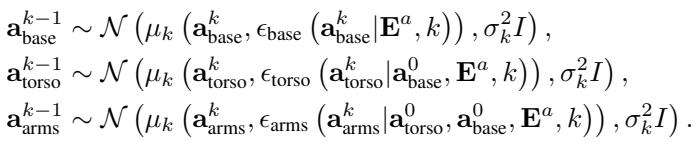
In this equation:
- \(\mathbf{a}_{\mathrm{base}}\) is the base action.
- \(\mathbf{a}_{\mathrm{torso}}\) is conditioned on the base.
- \(\mathbf{a}_{\mathrm{arms}}\) is conditioned on both base and torso.
- \(\epsilon\) represents the diffusion noise prediction network.
Experiments and Results
The researchers tested BRS on five challenging real-world tasks: cleaning a post-party mess, cleaning a toilet, taking out trash, stocking shelves, and doing laundry. These tasks were chosen specifically because they break standard robots—they require reaching high/low and coordinating movement with manipulation.
Performance vs. Baselines
WB-VIMA was compared against leading baselines like DP3, RGB-DP, and ACT.
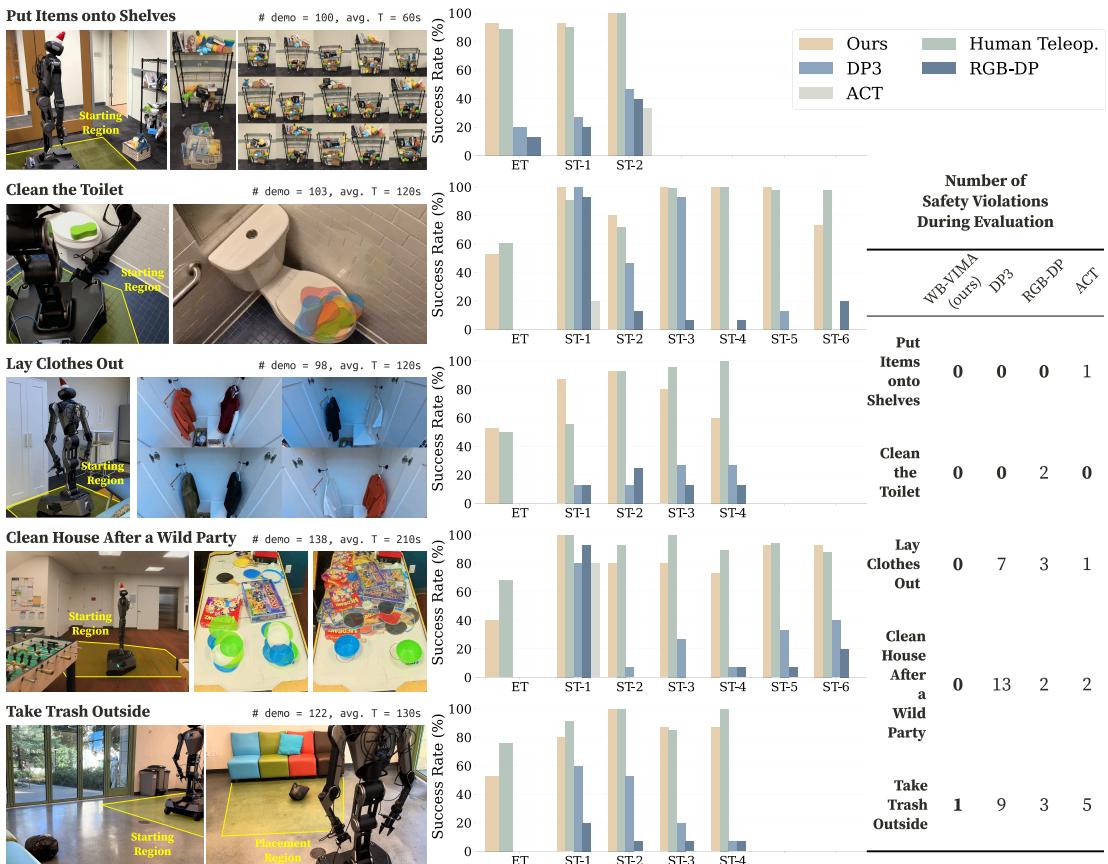
The results in Figure 5 are stark.
- ACT (Action Chunking with Transformers) failed to complete any full task. It struggled with the high-dimensional whole-body space.
- DP3 (3D Diffusion Policy) performed better but struggled with coordination, often colliding with furniture.
- WB-VIMA (Ours) achieved an average sub-task success rate of 88% and a peak full-task success rate of 93%.
Crucially, look at the Safety Violations table on the right of Figure 5. WB-VIMA had almost zero violations. Because the policy explicitly accounts for the base and torso movement, it doesn’t accidentally ram the robot into a doorframe or over-torque an arm while moving.
Why Hierarchy Matters: The Ablation Study
Is the autoregressive (hierarchical) decoding really necessary? The researchers tested a version of their model without it (treating all joints equally).
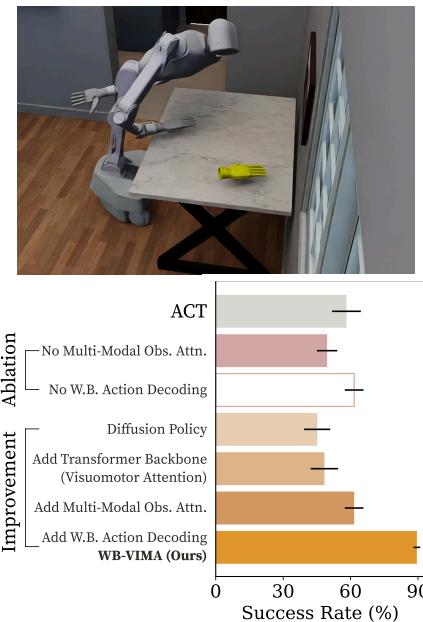
Figure 7 shows a simulated wiping task. The full WB-VIMA model (far right) achieves ~90% success. Removing the whole-body (W.B.) action decoding drops success to ~65%, similar to the baseline. This proves that telling the arms what the legs are doing is essential for precise control.
The Importance of Body Coordination
To illustrate why whole-body control is needed physically, look at the task of opening a heavy door or a dishwasher.
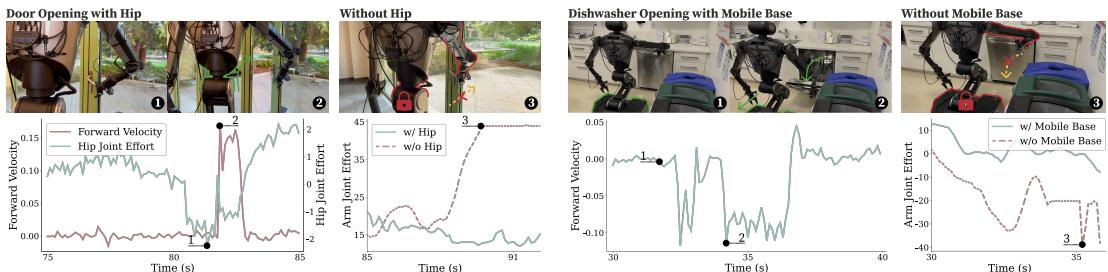
In Figure 9, we see two scenarios.
- With Mobile Base (Green Line): The robot reverses its base while pulling the handle. The velocity is smooth, and the arm effort (torque) is low.
- Without Mobile Base (Red Dashed): If the base is locked, the robot tries to open the door using only its arm. The arm runs out of workspace, the velocity jerks, and the joint effort spikes dangerously high.
WB-VIMA naturally learns this coordination: “If I pull the door, I must back up.”
User Study: Is JoyLo Actually Good?
You might think a DIY rig made of 3D-printed parts and Nintendo controllers would be clunky. To test this, the team ran a user study comparing JoyLo against VR controllers and the Apple Vision Pro (AVP) for data collection.
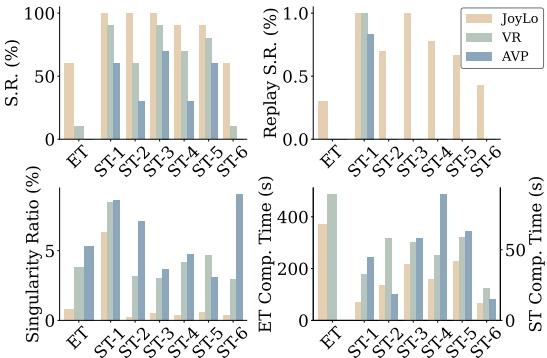
JoyLo (the orange bars in Figure 8) dominated.
- Success Rate (S.R.): Users completed the full task ~70% of the time with JoyLo, compared to <20% with VR and 0% with Apple Vision Pro.
- Speed: JoyLo was significantly faster for both navigation and manipulation sub-tasks.
Why? VR and Vision Pro typically use Inverse Kinematics (IK)—you move your hand, and the computer calculates the joint angles. This often leads to “singularities” (mathematical dead-ends where the robot gets stuck) or jerky motions. JoyLo controls the joints directly, resulting in smoother data.
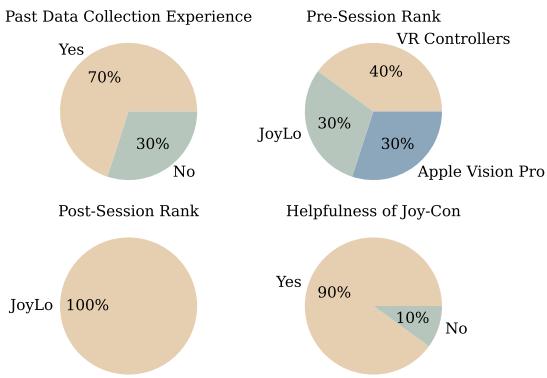
The qualitative feedback (Figure A.4) confirms this. While 40% of users thought they would prefer VR before the study, 100% preferred JoyLo after trying it.
Limitations and Failure Modes
No robotic system is perfect. The paper provides a transparent look at where BRS fails.
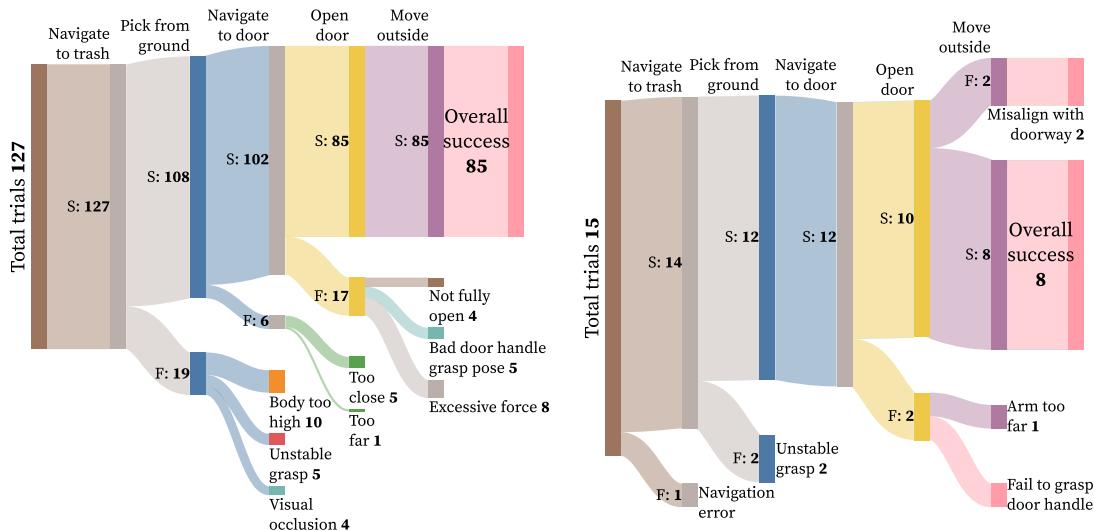
In the trash disposal task (Figure 10), failures occurred during complex interactions, such as grasping the door handle or misaligning with the doorway.
- Visual Occlusion: Sometimes the robot arm blocks its own camera view.
- Compounding Errors: In long tasks, a small error in step 1 (picking up the bag slightly wrong) can lead to a failure in step 5 (bag gets stuck in the bin).
The authors note that future work could involve active perception (moving the camera to see better) and training on data where humans correct the robot’s mistakes.
Conclusion
The BEHAVIOR ROBOT SUITE represents a significant step forward for household robotics. It acknowledges that a home robot is a whole-body system, not just a floating arm.
By creating JoyLo, the researchers democratized high-quality data collection. You don’t need a $50,000 motion capture studio; you need a 3D printer and some Joy-Cons. By developing WB-VIMA, they showed that respecting the physical hierarchy of the robot—legs, then torso, then arms—leads to policies that are more precise, robust, and safe.
As these technologies mature, we are inching closer to the day when a robot can truly handle the chaotic, vertical, and complex environment of a real human home.