](https://deep-paper.org/en/paper/2503.05936/images/cover.png)
Introduction
In the rapidly evolving world of Artificial Intelligence, Large Multimodal Models (LMMs) have emerged as the new titans. Models like LLaVA and GPT-4V can see, read, and reason, bridging the gap between visual and textual data. However, this capability comes at a steep price: computational resources.
To put this into perspective, running a 70-billion parameter model like LLaVA-Onevision at standard 16-bit precision requires roughly 140GB of GPU memory. This effectively walls off these powerful models from consumer hardware and efficient edge deployment. To solve this, researchers turn to model compression, specifically quantization—reducing the precision of the model’s weights (e.g., from 16-bit floating point to 4-bit or 2-bit integers).
While we have become quite good at compressing text-only Large Language Models (LLMs), LMMs present a unique challenge. Existing techniques often hit a wall at extreme compression rates, such as 2-bit quantization. At this level, the model’s reasoning capabilities typically collapse, leading to gibberish outputs or hallucinations.
Enter CASP (Compression based on Attention SParsity), a new method proposed by researchers at Huawei Technologies Canada. CASP leverages a fundamental property of how multimodal models “look” at images to achieve state-of-the-art performance in extreme compression regimes.
In this deep dive, we will explore the mechanics of CASP, the theory of attention sparsity, and how we can shrink massive models to a fraction of their size without losing their ability to see.
The Core Problem: The 2-Bit Barrier
Before understanding the solution, we must understand the bottleneck. Post-Training Quantization (PTQ) is the standard for compressing models without the massive cost of retraining them. Techniques like GPTQ, AQLM, and QuIP# work by mapping the high-precision weights of a neural network to a smaller set of discrete values.
- 4-bit quantization is generally considered “safe”—models retain most of their performance.
- 3-bit quantization is the current frontier, showing minor degradation.
- 2-bit quantization is the “danger zone.” Here, the model is stripped of so much information that accuracy typically plummets.
However, the authors of CASP noticed something interesting. While LMMs are built on top of LLMs, they process data differently. When an LMM processes an image, it converts visual data into hundreds or thousands of “visual tokens.” Unlike text, where every word is usually significant, visual data is highly redundant.
The Insight: Attention Sparsity
The core hypothesis of CASP is that multimodal inputs result in highly sparse attention matrices.
In a Transformer model, the “Attention” mechanism calculates how much focus every token should put on every other token. In text-only models, tokens often attend to many other words to understand context. However, in LMMs, visual tokens (patches of an image) often receive very little attention compared to text tokens.
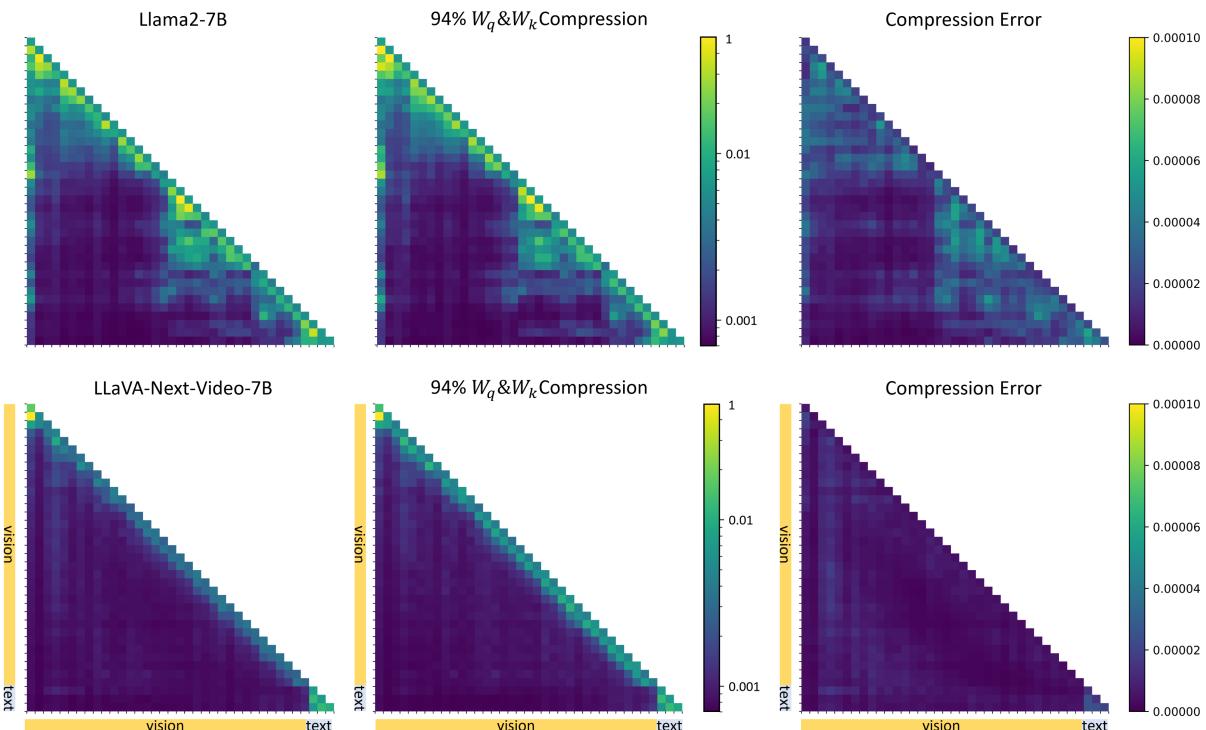
As shown in Figure 2 above, look at the difference between the attention maps:
- Left (Original): The LLaVA-Next-Video model (an LMM) shows a highly sparse map (lots of dark purple/black space). This indicates that for many operations, the model is effectively ignoring large swaths of the visual input.
- Comparison: The Llama-2 model (text-only) generally has a denser attention pattern.
This observation raises a critical question: If the model barely uses these connections, why are we spending precious bits storing the weights that calculate them?
The Theoretical Foundation
The researchers formalized this intuition mathematically. They focused on the Query (\(W_q\)) and Key (\(W_k\)) weight matrices, which are responsible for generating the attention scores.
The attention map \(\mathbf{S}\) is calculated as:

Where \(X\) is the input, and \(W_q\) and \(W_k\) are the weight matrices we want to compress. The resulting matrix \(\mathbf{S}\) tells us the “importance” scores.
The researchers propose that if \(\mathbf{S}\) is sparse (mostly zeros), we can compress \(W_q\) and \(W_k\) aggressively with minimal error. They define the compression error \(E\) as the difference between the original attention map and the approximated map derived from compressed weights.
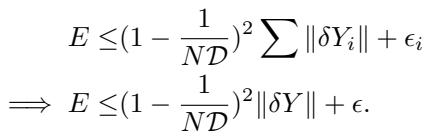
This inequality is the theoretical backbone of CASP. Here is what it tells us in plain English:
- \(D\) represents density (the opposite of sparsity).
- The upper bound of the error \(E\) is proportional to \((1 - \frac{1}{ND})^2\).
- Therefore, as the density \(D\) decreases (meaning sparsity increases), the potential error \(E\) decreases.
This confirms that LMMs, which naturally have high sparsity due to redundant visual tokens, are mathematically more forgiving to compression in their Query and Key matrices than standard LLMs.
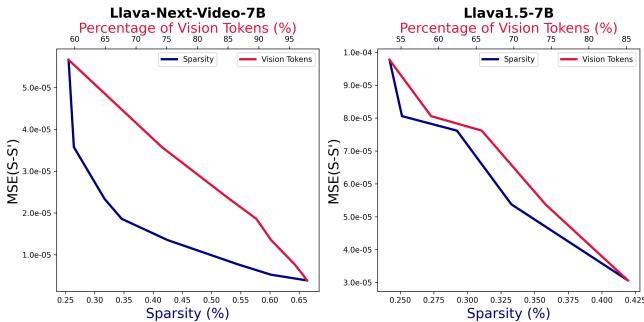
Figure 3 validates this experimentally. The red line represents the percentage of visual tokens. As the number of visual tokens increases (moving to the right), the sparsity increases, and the Mean Squared Error (MSE) of the compression drops to near zero.
The CASP Method
CASP (Compression based on Attention SParsity) is a two-step post-training compression framework designed to exploit the findings above.
Phase 1: Data-Aware Low-Rank Decomposition
Since the attention matrices are sparse and the weights \(W_q\) and \(W_k\) exhibit a low-rank structure, CASP doesn’t just quantize them—it decomposes them.
The method uses Low-Rank Decomposition. Imagine a massive matrix \(W\). We can approximate it by multiplying two much smaller matrices, \(A\) and \(B\). If \(W\) is \(N \times N\), \(A\) might be \(N \times r\) and \(B\) might be \(r \times N\), where \(r\) (the rank) is a very small number.
CASP performs this decomposition specifically on the Query and Key matrices. By doing so, they compress these specific weights to roughly 6% of their original size, which is equivalent to compressing them to 1 bit, yet the sparse nature of the attention map ensures the model performance remains stable.
Phase 2: Quantization with Optimal Bit Allocation
After decomposing the attention weights, the rest of the model still needs to be quantized. However, applying a blanket “2-bit” policy to every layer is inefficient. Some layers are critical for reasoning (“sensitivity”), while others are redundant.
CASP introduces an Optimal Bit Allocation strategy. The goal is to assign more bits to sensitive layers and fewer bits to robust layers, ensuring the average bit rate hits the target (e.g., 2 bits).
The researchers determine layer sensitivity using a “Block Influence” score, \(s_l\). They then solve an optimization problem to calculate the ideal bit-width (\(b_l\)) for each layer:

In this equation:
- \(b_l\) is the number of bits for layer \(l\).
- \(B_{avg}\) is the target average bit rate.
- \(s_l\) is the sensitivity of the layer.
- \(p_l\) is the number of parameters in that layer.
Essentially, this formula acts as a budget manager, spending “bit budget” where it buys the most accuracy.
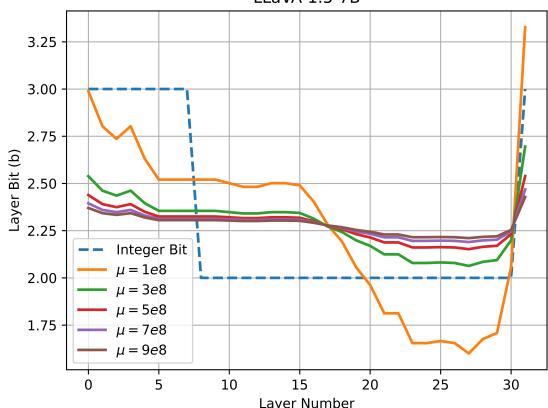
Figure 4 visualizes this allocation. You can see that not all layers are treated equally. The early layers (0-5) and the very last layers receive higher bit allocations (sometimes exceeding 3 or 4 bits), while the middle layers are compressed more aggressively. This nonuniform distribution is key to surviving the 2-bit regime.
Experiments and Results
Does this theory hold up in practice? The researchers tested CASP against state-of-the-art quantization methods: GPTQ, AQLM, and QuIP#.
Image-Language Benchmarks
The first test was on standard image-understanding benchmarks using the LLaVA family of models. The metric used is Perplexity (PPL), where lower is better.

Figure 1 shows a stark contrast. Look at the red bars (CASP) versus the blue bars (Baseline methods at 2-bit):
- In GPTQ (2.2 Bit), the baseline perplexity explodes to 26.15. CASP pulls it back down to 10.13.
- In AQLM (2 Bit), the baseline is 31.7. CASP rescues it to 13.78.
This is a massive recovery of information. Standard 2-bit quantization breaks the model; CASP makes it functional.
Video-Language Benchmarks
The results become even more interesting when applied to video. Video models process multiple frames, generating thousands of visual tokens. According to the theory of sparsity, CASP should perform even better here because the attention maps are sparser.
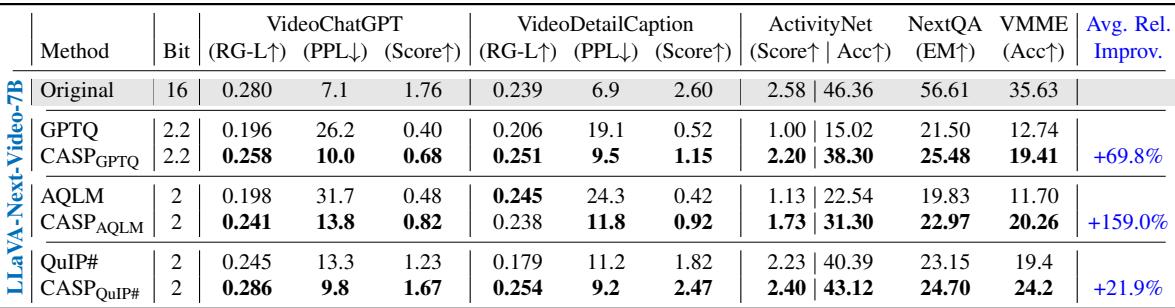
Table 2 confirms this. On the LLaVA-Next-Video-7B model:
- CASP-AQLM achieves a relative improvement of 159% over standard AQLM.
- On the VideoChatGPT benchmark (Score), standard GPTQ drops the score from 1.76 (Original) to 0.40. CASP-GPTQ recovers it to 0.68, nearly doubling the performance of the baseline quantization.
Qualitative Analysis: Seeing the Difference
Numbers are great, but can the model actually “see”? Let’s look at a meme explanation task, which requires both visual recognition and cultural reasoning.
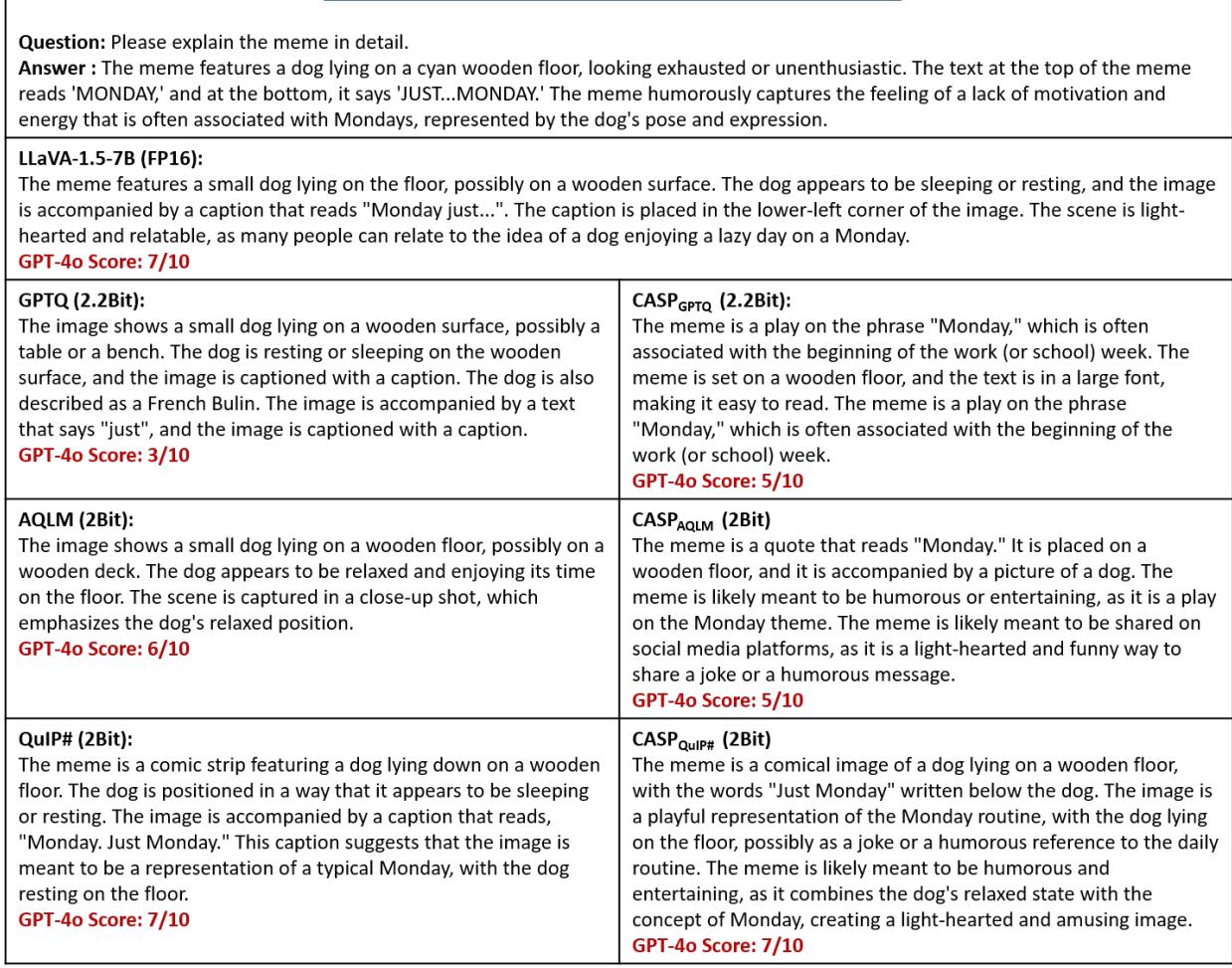
In Figure 10, the model is asked to explain a “Monday dog” meme.
- GPTQ (2.2 Bit) struggles significantly (Score 3/10). It hallucinates, saying the dog is on a table or bench, and gives a generic description.
- CASP-GPTQ (Score 5/10) correctly identifies the context, explaining the play on the “Monday” theme and the beginning of the work week.
- CASP-QuIP# (Score 7/10) gives the best response, accurately capturing the humor (“comical image,” “playful representation of the Monday routine”).
This qualitative difference is crucial. In a benchmark, a slightly higher perplexity might look like a small number. In deployment, it is the difference between a chatbot that understands a joke and one that hallucinates a table that doesn’t exist.
Conclusion and Implications
The “CASP” paper provides a significant step forward in the democratization of Large Multimodal Models. By identifying that attention sparsity is the Achilles’ heel of LMM redundancy, the authors unlocked a method to compress these massive models into 2-bit representations without the catastrophic failure usually seen at that level.
Key Takeaways:
- Visual Redundancy is Key: LMMs spend a lot of compute on visual tokens that don’t matter much. This creates sparse attention maps.
- Sparsity Allows Compression: Theoretical bounds prove that highly sparse attention maps allow for aggressive low-rank decomposition of Query and Key matrices.
- Smart Allocation: Treating every layer the same is inefficient. CASP’s data-aware bit allocation ensures bits are spent where they matter.
- 2-Bit is Viable: CASP demonstrates that 2-bit LMMs are no longer a theoretical curiosity but a practical possibility, outperforming current state-of-the-art methods by wide margins.
For students and practitioners, CASP highlights an important lesson: simply applying techniques designed for one domain (text LLMs) to another (LMMs) is often suboptimal. Understanding the unique data properties of your model—in this case, the sparsity of visual attention—can reveal optimization opportunities that generic methods miss.