](https://deep-paper.org/en/paper/2503.06012/images/cover.png)
In the rapidly evolving world of Computer Vision, reconstructing 3D humans from 2D images is a well-studied problem. But humans rarely exist in a vacuum. We hold phones, sit on chairs, ride bikes, and carry boxes. When you add objects to the equation, the complexity explodes.
This field, known as Human-Object Interaction (HOI) reconstruction, faces a fundamental conflict. To reconstruct a 3D scene, you need to understand the global structure (where the person is relative to the object) and the local details (how the fingers wrap around a handle). Most existing methods struggle to balance these two, often prioritizing one at the expense of the other.
In this post, we will dive deep into a paper titled “End-to-End HOI Reconstruction Transformer with Graph-based Encoding” (or HOI-TG). This research proposes a novel architecture that combines the global context-awareness of Transformers with the local topological strengths of Graph Convolutional Networks (GCNs).
The Core Problem: Explicit vs. Implicit Modeling
Before understanding the solution, we must define the problem. Previous state-of-the-art methods typically rely on explicit contact constraints.
Imagine you are trying to reconstruct a person sitting on a chair. An explicit method might try to force the geometry of the hips to perfectly touch the chair surface by calculating offset vectors or contact maps. While this sounds logical, it creates a “natural conflict.”
- Global Reconstruction: Wants to minimize the overall shape error of the human and object.
- Local Constraints: Wants to force specific vertices to touch, often distorting the overall shape or requiring expensive, slow post-optimization steps to fix the mesh.
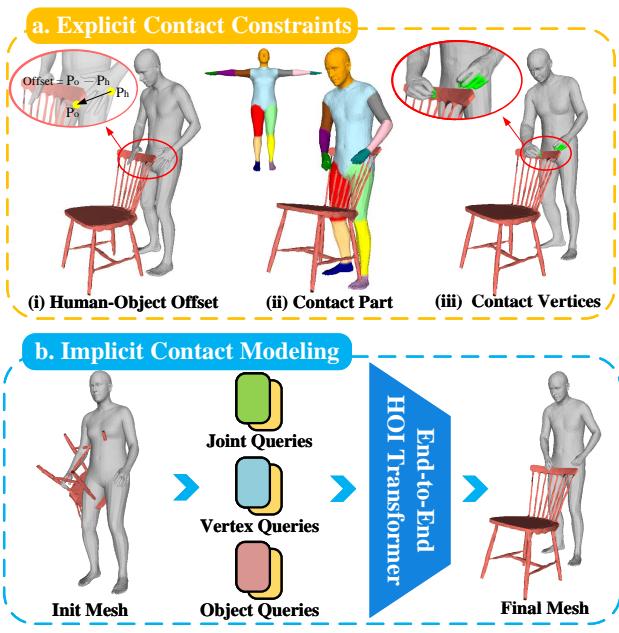
As shown in Figure 1, traditional methods (a) rely on offsets and contact part matching. The proposed HOI-TG method (b) takes a different approach: Implicit Modeling. Instead of hard-coding the contact rules, it uses an attention mechanism to learn the interaction naturally.
The HOI-TG Architecture
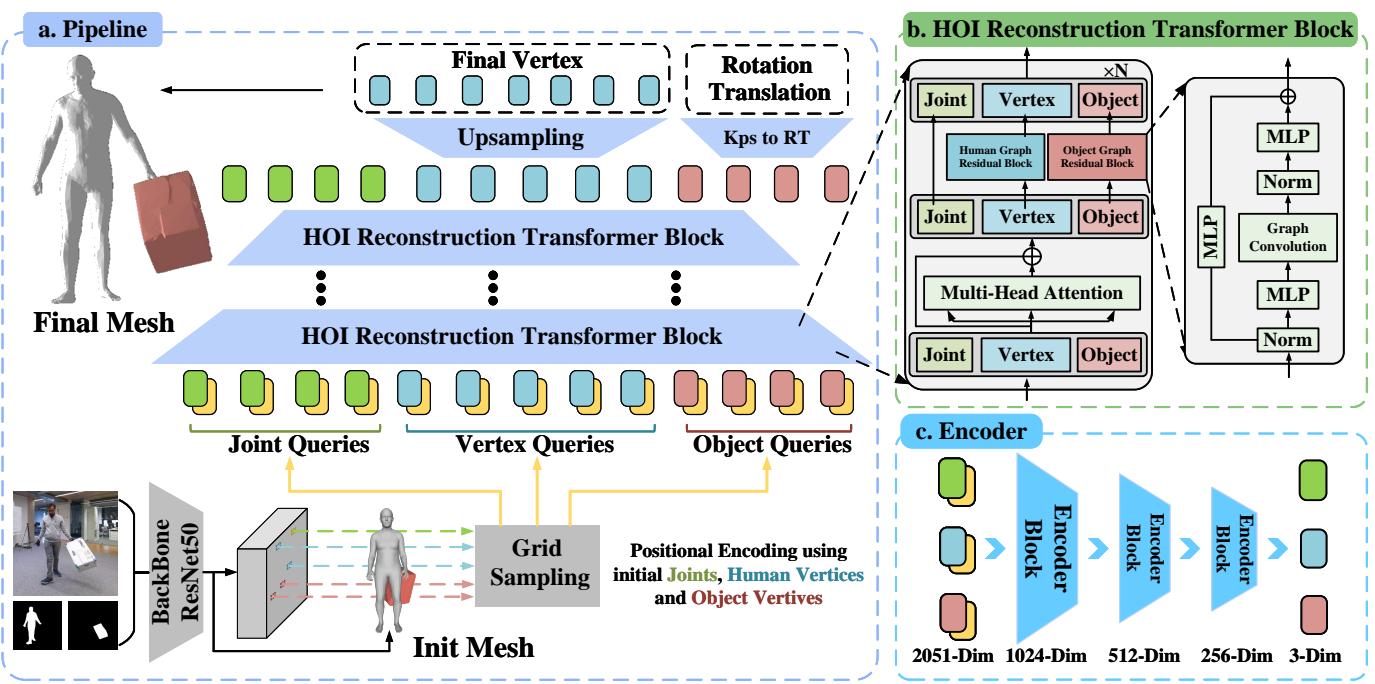
The researchers propose a framework that reconstructs the human mesh, object mesh, and their relative positions in an end-to-end manner. The architecture is sophisticated, so let’s break it down into three distinct stages: Initialization, Transformer Encoding, and Graph-based Refinement.
1. Preparation of Queries (Initialization)
Standard Transformer-based reconstruction methods (like METRO) often fail at HOI tasks because they use static queries—essentially asking the model to learn complex interactions from a “blank slate” or generic templates.
HOI-TG uses a smarter initialization strategy (see Figure 2a):
- Backbone Extraction: A ResNet50 extracts 2D image features.
- Initial Prediction: It predicts a rough “Init Mesh” for the human and a rough pose for the object using standard regression.
- Grid Sampling: This is the crucial step. Instead of using generic feature vectors, the model projects the 3D vertices of this initial mesh back onto the 2D image features. It samples the features at those specific points and concatenates them with the 3D coordinates.
This creates Joint Queries, Vertex Queries, and Object Queries that are already “3D-aware” before they even enter the Transformer.
Why does this matter? The researchers tested this hypothesis. As shown in Table 2 below, using this initialization strategy (Initial) significantly lowers the error (Chamfer Distance) compared to using static templates (Static).

2. The Transformer Encoder
Once the queries are prepared, they are fed into the HOI Reconstruction Transformer. This is a multi-layer encoder designed to capture global dependencies.
Because of the Self-Attention mechanism, every part of the input can “talk” to every other part. The hand vertex can pay attention to the cup vertex; the foot vertex can pay attention to the floor. This is excellent for solving the Global positioning problem. The model learns implicitly that if a person is holding a box, the arms must be positioned a certain way relative to the object.
However, Transformers have a weakness: they treat inputs as a bag of points. They don’t inherently respect the physical connections (topology) of a 3D mesh. This leads to “blurring,” where the boundary between the hand and the object becomes fuzzy.
3. Graph-based Encoding (The “TG” in HOI-TG)
To fix the local blurring caused by the Transformer, the researchers introduce Graph Residual Blocks inside the Transformer layers (see Figure 2b).
While the Multi-Head Attention mechanism looks at the whole picture, the Graph Block forces the model to respect the local neighborhood of vertices.
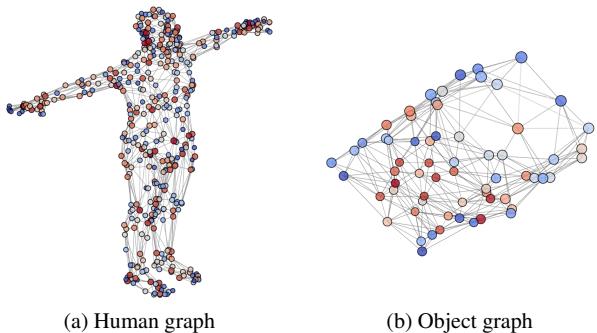
The Human Graph: For the human mesh, the topology is fixed (a standard human body layout). The model uses a predefined adjacency matrix (visualized in Figure 3a) to perform Graph Convolution.
The equation for the Graph Convolution is:

Here, \(\bar{\mathbf{A}}\) is the adjacency matrix, and \(\mathbf{W}_G\) are the learnable weights. This operation smooths features based on the actual physical connections of the body.
The Object Graph: This is tricker. Objects vary wildly—a chair has a different topology than a skateboard. You cannot use a fixed graph.
The solution is the K-Nearest Neighbors (KNN) approach. For any given object template, the model dynamically constructs a graph by connecting every vertex to its \(K\) closest neighbors (see Figure 3b).
The adjacency matrix for the object is calculated based on distance:


This allows the model to handle arbitrary objects while still enforcing local consistency.
Finding the right K: How many neighbors should an object vertex look at? The researchers performed an ablation study (shown in Figure 6).
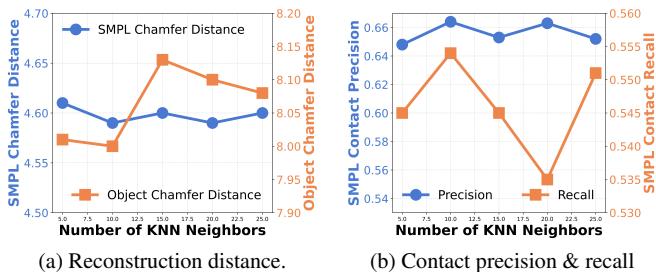
They found that \(K=10\) is the sweet spot. Too few neighbors (left side of the chart), and the graph is too sparse to learn structure. Too many neighbors (right side), and the local information gets drowned out by noise, increasing the reconstruction error (Chamfer Distance).
Training the Model
The model is trained end-to-end using a composite loss function. The goal is to minimize errors for the human, the object, and their interaction simultaneously.

Human Loss (\(\mathcal{L}_{\text{human}}\)): This includes terms for vertex positions at multiple scales (coarse to fine), joint positions, and parameters for the SMPL body model. It also enforces “edge length consistency” to prevent spiky, unnatural meshes.


Object Loss (\(\mathcal{L}_{\text{object}}\)): This ensures the object’s vertices are in the correct place and that its rotation/translation parameters are accurate.

Experimental Results
The researchers evaluated HOI-TG on two challenging datasets: BEHAVE and InterCap. They compared their method against leading baselines like METRO, Graphormer, PHOSA, CHORE, and CONTHO.
Quantitative Performance
The primary metric used is Chamfer Distance (CD), which measures the geometric error between the reconstructed 3D mesh and the ground truth (lower is better). They also measured Contact Precision and Recall (higher is better).
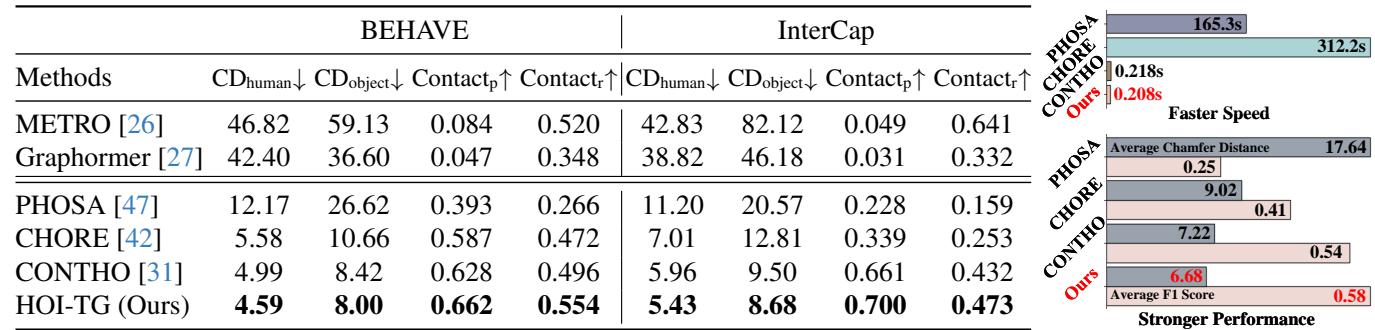
As shown in Table 1, HOI-TG achieves state-of-the-art results.
- On BEHAVE, it reduces Human error (CD) from 4.99 (CONTHO) to 4.59.
- On InterCap, it improves Human error from 5.96 to 5.43.
- Crucially, Contact Precision jumps significantly (e.g., from 0.628 to 0.662 on BEHAVE).
This proves that adding the Graph Residual Blocks didn’t just fix the local geometry; it helped the global interaction prediction as well.
Ablation: Do we need the Graphs?
You might wonder if the Transformer alone is enough. Table 3 confirms the necessity of the Graph-based encoding.
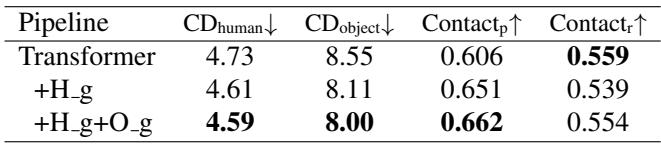
- Transformer only: 4.73 Human CD.
- + Human Graph: 4.61 Human CD.
- + Human & Object Graph: 4.59 Human CD.
Every time a graph block is added, the error drops and contact precision rises.
Qualitative Visualization
The numbers are good, but visual inspection reveals why they are good.
In Figure 9 below, look at the “CONTHO” column versus the “HOI-TG (Ours)” column. In the second row (carrying the box), the baseline method struggles to position the box correctly relative to the hands. HOI-TG places it accurately. In the bottom row (sitting), the baseline allows the human mesh to penetrate the chair. HOI-TG respects the boundary much better.
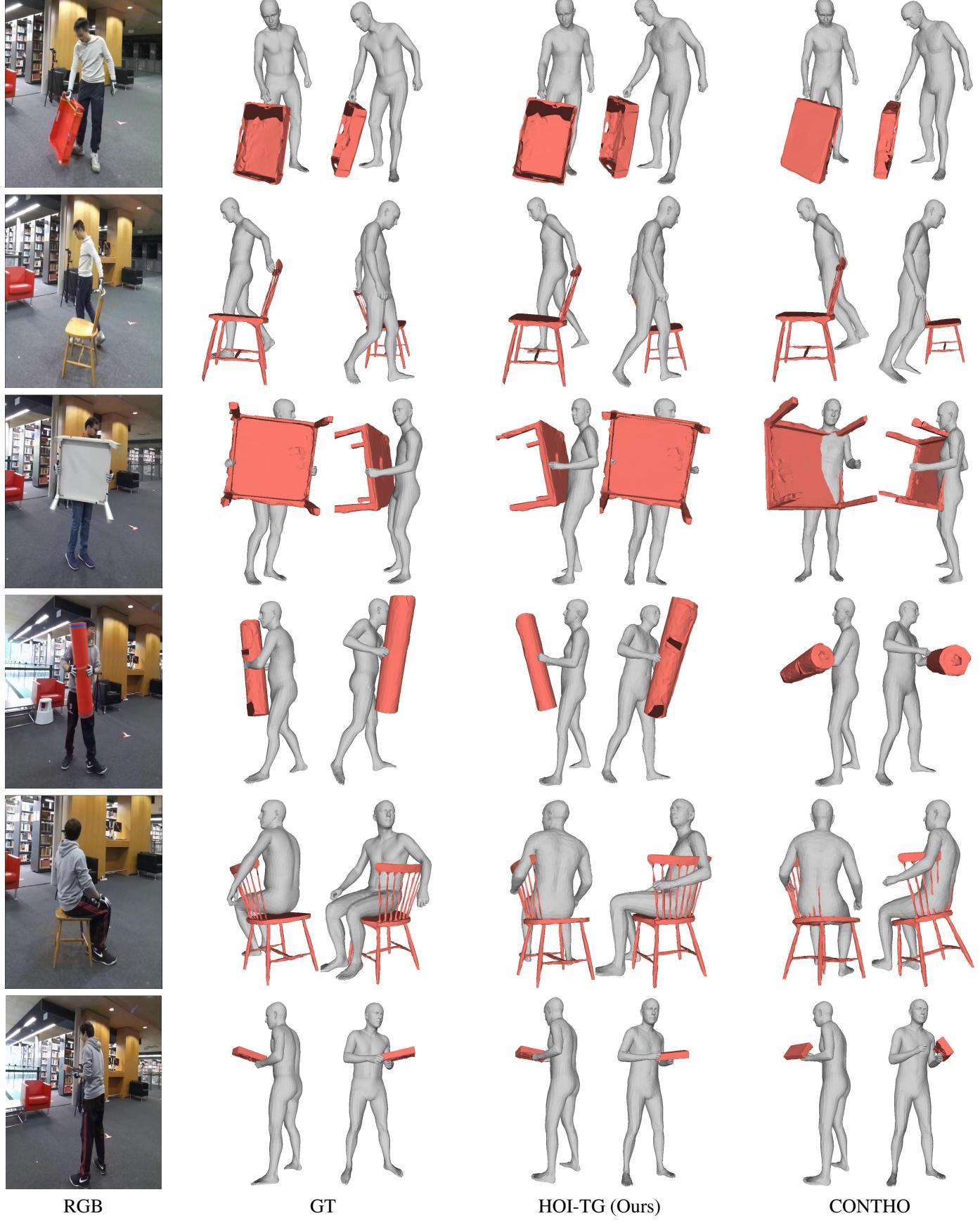
Furthermore, we can visualize the Attention Maps to see what the model is “thinking.”
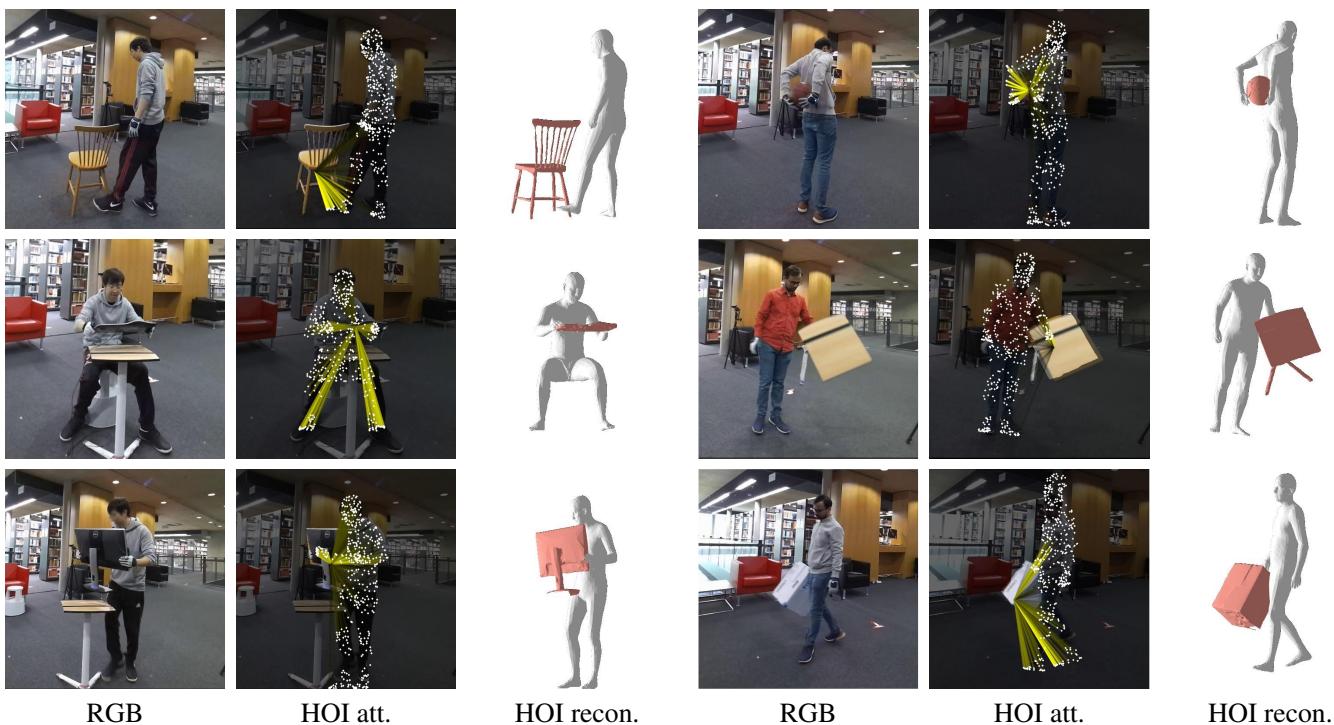
In Figure 5, the bright areas represent high attention. Notice that when the model is reconstructing the human (e.g., the person sitting on the chair), it pays intense attention to the specific object vertices that are interacting with the body. This confirms that the implicit interaction learning is working as intended.
Limitations and Future Work
No method is perfect. The authors frankly discuss failure cases, particularly with lying poses and highly symmetric objects.
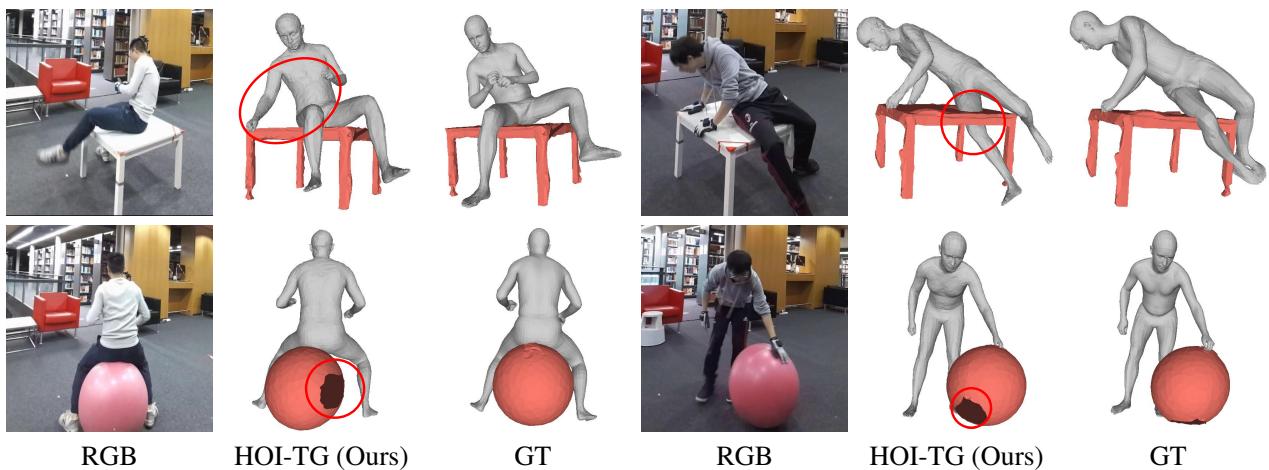
- Lying Poses (Row 1): When a person lies down, self-occlusion is extreme. The backbone struggles to find the initial mesh, and the Transformer cannot recover.
- Symmetric Objects (Row 2): For objects like a yoga ball, it is geometrically difficult to determine the exact rotation (a rotated sphere looks the same). The model sometimes predicts incorrect rotations for these objects.
Conclusion
The HOI-TG paper presents a compelling argument for hybrid architectures in 3D reconstruction. By combining Transformers (for global, implicit interaction understanding) with Graph Neural Networks (for local, topological refinement), the researchers solved the conflict between global structure and fine-grained contact.
The result is a fast, end-to-end system that doesn’t require slow post-optimization steps, pushing the boundary of what is possible in digitizing human-object interactions. This work paves the way for more realistic interactions in Augmented Reality and more capable robots that can understand how we interact with the world around us.