](https://deep-paper.org/en/paper/2503.06287/images/cover.png)
Introduction
In the rapidly evolving landscape of Artificial Intelligence, Large Vision-Language Models (LVLMs) like LLaVA, GPT-4V, and DeepSeek-VL have become the superstars of multimodal understanding. These models possess an uncanny ability to describe complex scenes, answer questions about images, and even engage in reasoning tasks that were previously thought impossible.
However, there has been a persistent gap in their capabilities. While an LVLM can eloquently describe a “red car parked next to a fire hydrant,” asking it to pinpoint the exact pixel coordinates of that car often results in failure or requires significant modifications to the model. This task—identifying the specific region in an image that corresponds to a text description—is known as Visual Grounding.
To bridge this gap, researchers have typically resorted to fine-tuning, a process where the model is retrained on specialized datasets containing bounding boxes and segmentation masks. This is computationally expensive and alters the original model weights.
But what if the model already knows where the object is? What if the information is hiding in plain sight, buried deep within the neural network’s architecture, waiting to be found?
In the paper “Your Large Vision-Language Model Only Needs A Few Attention Heads For Visual Grounding,” researchers from Yonsei University make a startling discovery. They find that within the thousands of attention heads in a frozen LVLM, a tiny subset—sometimes as few as three—act as built-in “localization heads.” By simply tapping into these heads, we can achieve state-of-the-art visual grounding without a single step of training.
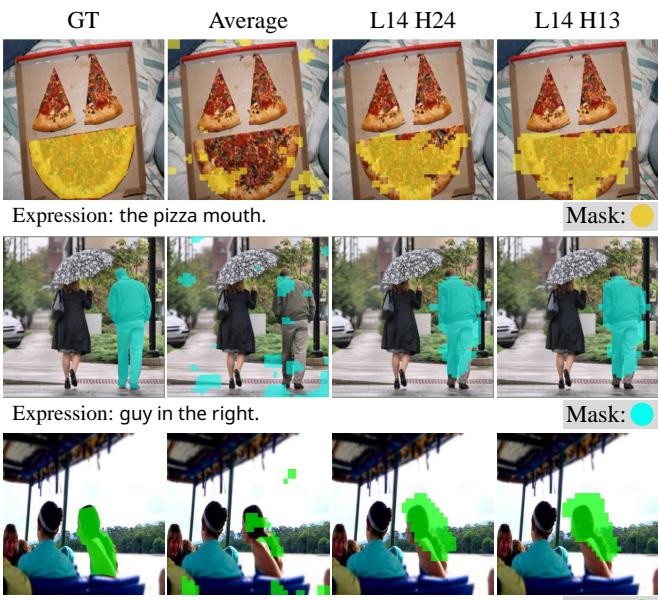
As shown in Figure 1, the average attention map of a model is often a noisy blur (Column 2). However, specific heads (Columns 3 and 4) sharpen their focus intensely on the object described in the text, such as the pizza or the person on the right. This blog post will take you through how these heads were discovered, how they are selected, and how they change the game for training-free computer vision.
Background: The Challenge of Visual Grounding
Before diving into the solution, let’s establish the problem. Visual grounding usually comes in two flavors:
- Referring Expression Comprehension (REC): Drawing a bounding box around an object described by text.
- Referring Expression Segmentation (RES): creating a pixel-perfect mask of the object.
The Status Quo
Currently, there are two main ways to force an LVLM to do this:
- Fine-tuning Based Methods: You take a pre-trained model (like LLaVA) and continue training it on grounding data. You might add special tokens (like
[SEG]) to the vocabulary that trigger a segmentation mask. While effective, this breaks the “frozen” nature of the model and requires massive resources. - Training-Free Methods: These usually rely on older models like CLIP or combine gradients from diffusion models. While they don’t require retraining, their performance has historically lagged behind fine-tuned specialists, often struggling with complex spatial instructions (e.g., “the cup to the left of the laptop”).
The researchers of this paper propose a third path: using the internal attention mechanisms of the LVLM itself.
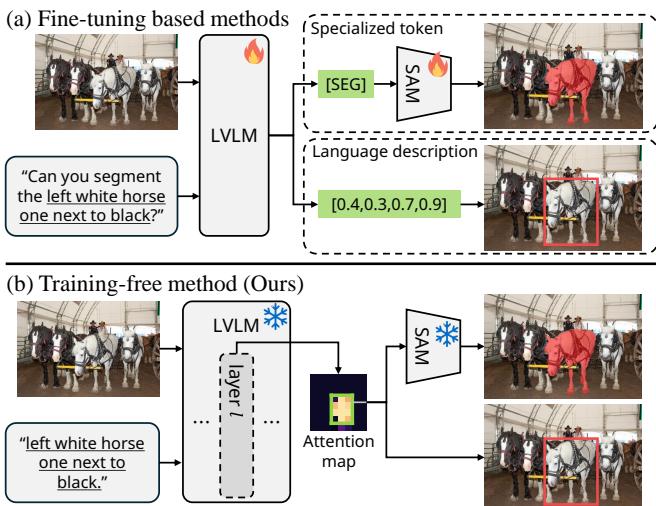
Figure 2 illustrates this paradigm shift. Part (a) shows the traditional heavy-lifting approach of fine-tuning. Part (b) shows the proposed method: simply extracting the “right” attention maps from the frozen model to guide a segmentation tool (like SAM - Segment Anything Model).
Understanding Self-Attention in LVLMs
To understand how they achieve this, we need a quick refresher on the Transformer architecture. LVLMs process data in layers. Each layer has multiple “Attention Heads.”
Mathematically, attention allows the model to relate different parts of the input to each other. When an LVLM processes the text “the white dog,” it computes an attention score between the text tokens and the image tokens (patches of the image).
The attention mechanism is governed by this equation:

Here, \(Q\) is the Query (from the text), and \(K\) is the Key (from the image). The output determines where the model looks in the image when processing that specific word.
The researchers specifically look at the attention weights relative to the last token of the text query. They hypothesize that because LVLMs generate text autoregressively, the final token of a sentence summarizes the semantic meaning of the whole phrase. Therefore, the attention map of the last text token should theoretically “look” at the object being described.

The Core Discovery: Finding the “Localization Heads”
If you average the attention of all heads in a model, you get noise. The signal is diluted. The core contribution of this paper is a systematic way to filter out the noise and find the specific heads that act as spotlight operators.
The researchers proposed two strict criteria to identify these “Localization Heads.”
Criterion 1: Attention Sum (Is the head looking at the image?)
An LVLM attends to both text and images. Many attention heads focus solely on text-to-text relationships (understanding grammar or context) and ignore the image entirely. These are useless for visual grounding.
To filter these out, the researchers calculate the Attention Sum (\(S_{img}\)). This metric sums up the attention weights assigned to the image tokens. If the sum is high, the head is actively looking at the image.
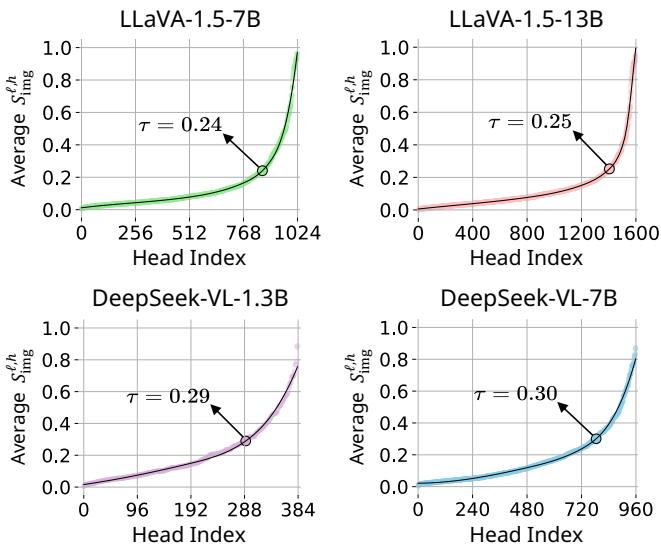
Figure 3 plots the attention sum for all heads in various models. You can see a sharp curve. The heads on the far right (above the threshold \(\tau\)) are the ones heavily engaged with the visual data. We discard the rest.
Criterion 2: Spatial Entropy (Is the focus sharp?)
Just looking at the image isn’t enough. A head might look at the entire image (background, sky, floor) rather than a specific object. We need heads that focus on compact, distinct regions.
To measure this, the authors utilize Spatial Entropy.
- High Entropy: Attention is scattered all over the map (bad for localization).
- Low Entropy: Attention is concentrated in tight clusters (good for localization).
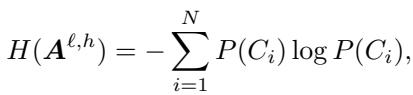
The process involves binarizing the attention map (turning it black and white based on intensity), identifying connected components (blobs), and calculating the entropy based on the size of these blobs.
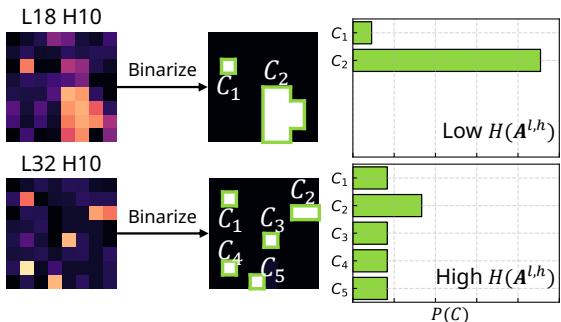
As visualized in Figure 4, the top row shows a head with low entropy—it creates distinct, clean clusters. The bottom row shows high entropy—scattered noise.
The mathematical formulation for this entropy is:
The Selection Process
By combining these two criteria, the researchers devised a filtering pipeline:
- Keep heads with high Attention Sum.
- Among those, rank them by Spatial Entropy (lowest is best).
- Repeat this for 1,000 random samples to find heads that are consistently good, not just lucky on one image.
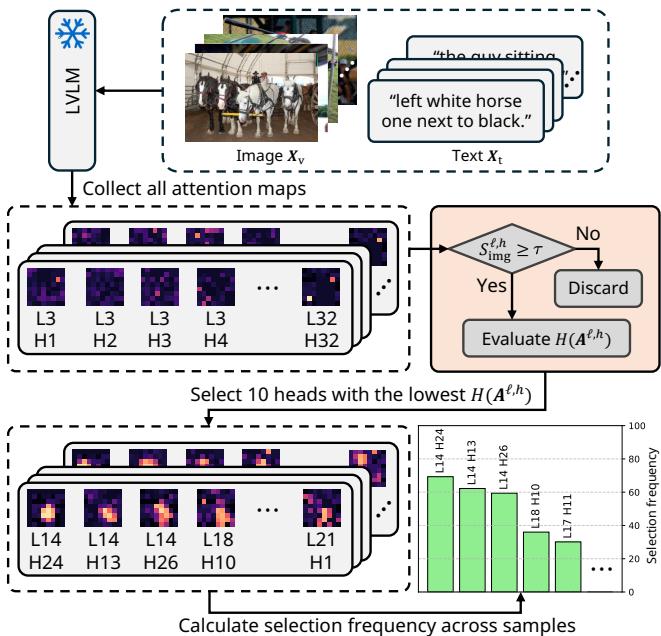
The result is a frequency chart (Figure 5, right). A tiny number of heads (like Layer 14, Head 24 in LLaVA-7B) appear at the top of the list almost every time. These are the Localization Heads.
Does this selection actually correlate with performance? Yes.
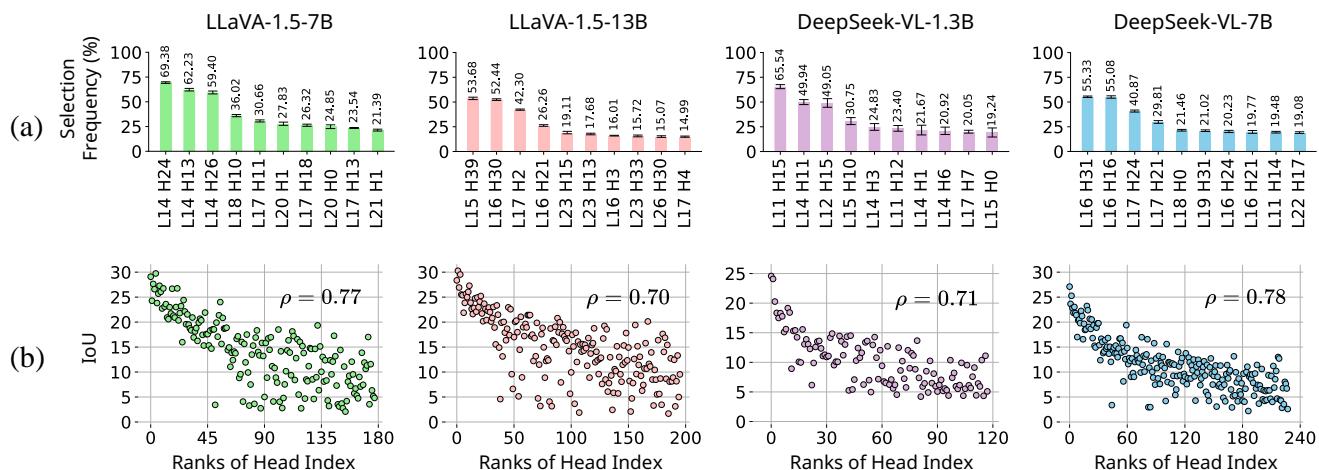
Figure 6(b) shows a scatter plot comparing the selection rank (x-axis) with the actual Intersection over Union (IoU) performance (y-axis). There is a strong positive correlation. The heads identified by this algorithm are indeed the ones that know where the objects are.
The Framework: Training-Free Visual Grounding
Once the localization heads are identified (a one-time process for each model), performing visual grounding becomes a straightforward pipeline.
- Input: An image and a text prompt (e.g., “the white horse”).
- Forward Pass: Run the inputs through the frozen LVLM.
- Extraction: Extract the attention maps only from the top-k localization heads (e.g., the top 3 heads).
- Assembly: Sum these maps together and apply Gaussian smoothing to reduce pixel noise.
- Post-Processing:
- For Bounding Boxes: Use a convex hull algorithm to draw a box around the highlighted area.
- For Segmentation: Use the bounding box as a prompt for the Segment Anything Model (SAM) to get a precise mask.
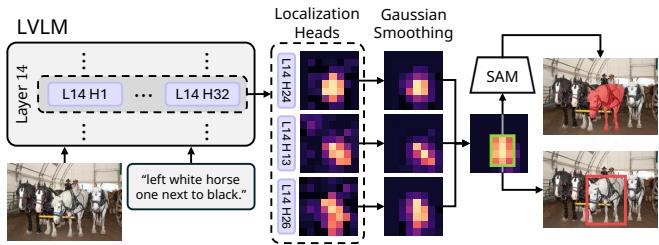
Figure 7 visualizes this elegant flow. Notice how the attention maps from heads L14H1, L14H3, and L14H6 combine to highlight the horse, which is then refined into a clean mask.
Experiments and Results
The researchers tested this framework across 10 different LVLMs (ranging from 1.3B to 13B parameters) on standard benchmarks like RefCOCO.
Quantitative Success
The results were impressive. The proposed method significantly outperformed existing training-free methods and, surprisingly, performed on par with methods that utilize heavy fine-tuning.
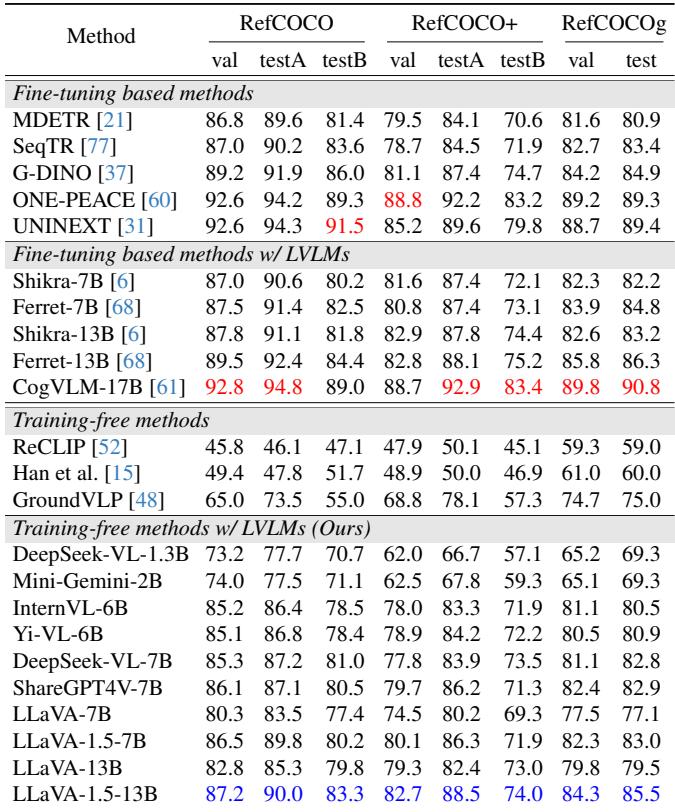
Table 1 highlights the performance on Referring Expression Comprehension (REC). Look at the “Training-free methods” section. The proposed method (Ours) achieves scores (like 83.5 on RefCOCO val) that dwarf previous CLIP-based methods (often in the 40s-60s) and rival fine-tuned models like Shikra (87.0).
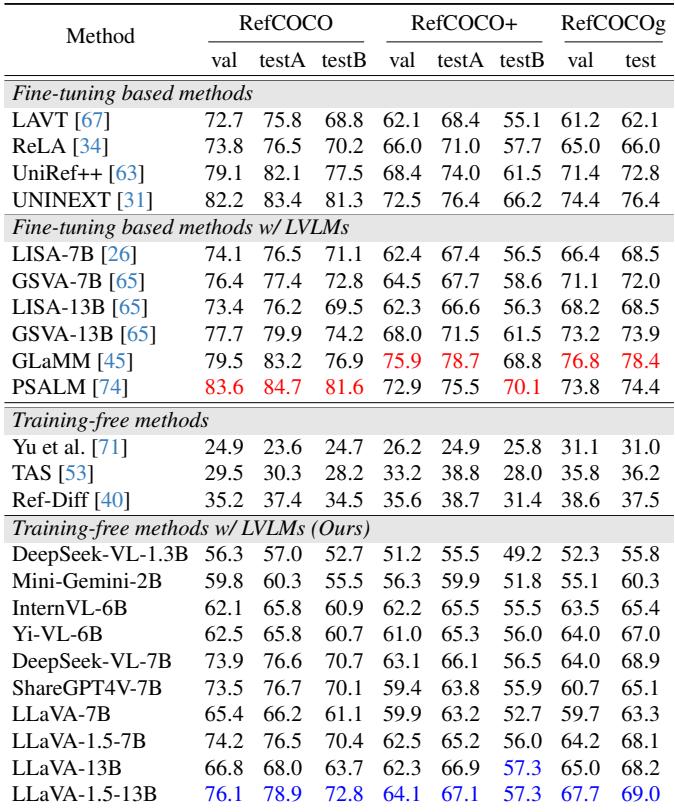
Table 2 shows similar dominance in Segmentation (RES). The method consistently achieves high accuracy, proving that the localization signal inside the frozen model is robust.
Qualitative Analysis
Numbers are great, but seeing is believing. The method handles complex scenarios involving multiple similar objects, which is a notorious failure point for CLIP-based approaches.
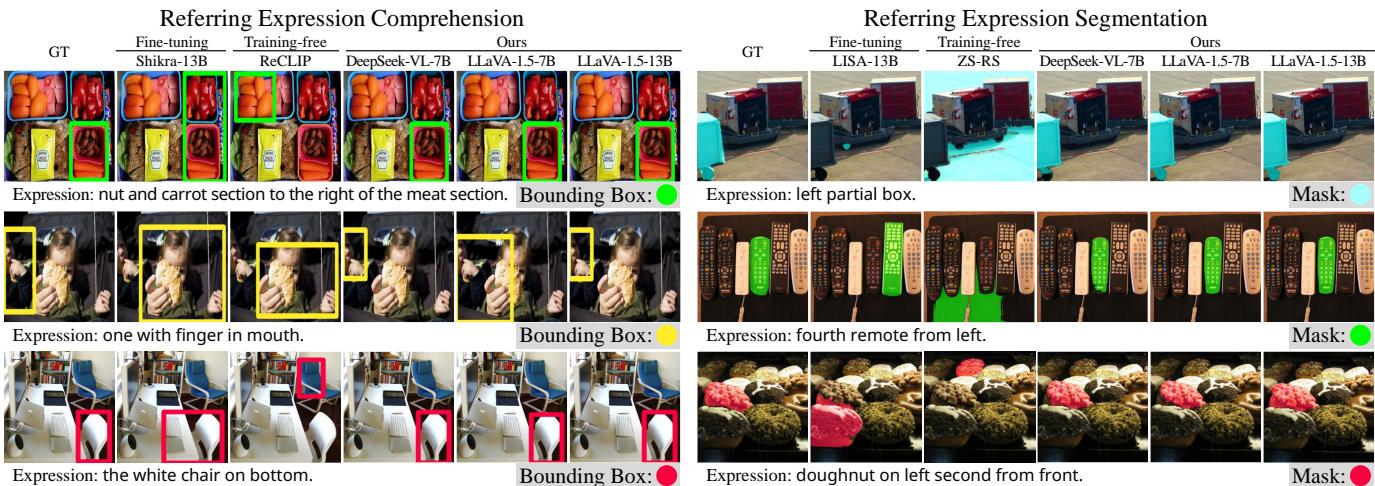
In Figure 8, look at the example of “nut and carrot section to the right of the meat section.” The model correctly identifies the specific tray compartment. Similarly, it distinguishes specific individuals in a crowd based on descriptions like “one with finger in mouth.”
Reasoning Capabilities
Because this method relies on the LVLM’s deep text understanding, it inherits the model’s reasoning abilities. It can solve “Reasoning Segmentation” tasks where the object isn’t named directly but implied.
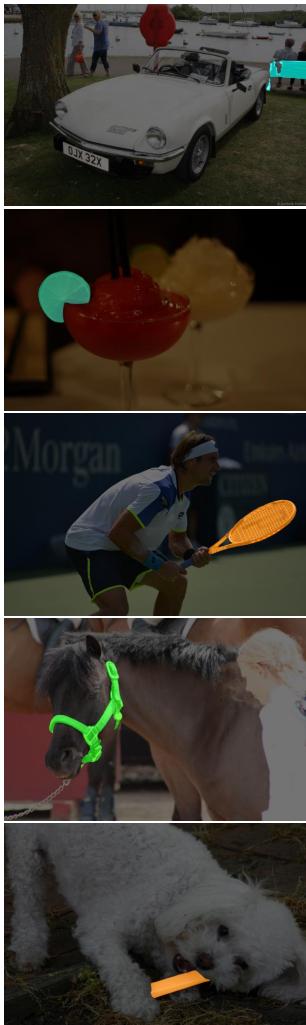
In Figure 17, the model is asked: “What item in the picture could be utilized as the accessory that people typically wear around their neck…?” The model correctly reasons that this refers to the bow tie on the dog and segments it perfectly. This level of semantic understanding is difficult for traditional object detectors.
When Does It Fail? (And What It Tells Us)
No model is perfect. However, one advantage of this approach is interpretability. When the model fails, we can look at the attention map to see why.
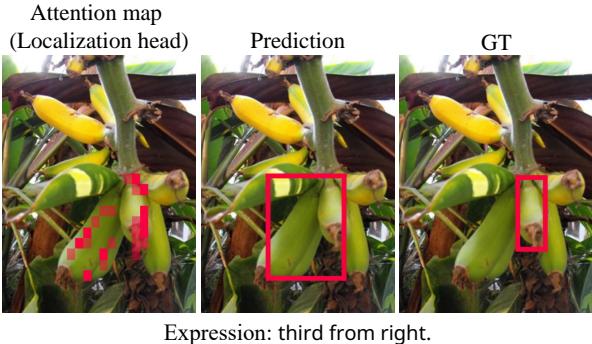
In Figure 9, the prompt asks for the “third banana from right.” The prediction includes both the third and fourth bananas. The attention map reveals that the LVLM itself was “looking” at both, indicating a failure in the model’s counting logic rather than the grounding framework itself. This transparency is invaluable for debugging LVLMs.
Implications and Conclusion
The findings of this paper suggest a fundamental shift in how we view Large Vision-Language Models. They are not just text generators that look at images; they possess an innate, spatial understanding of the visual world that is localized in specific neural pathways.
Key Takeaways:
- Efficiency: We can unlock visual grounding capabilities without the massive carbon footprint and time cost of fine-tuning.
- Simplicity: The framework is essentially a “filter” for attention maps, requiring minimal code to implement on top of existing models.
- Versatility: This works across different model architectures (LLaVA, DeepSeek, InternVL) and sizes.
Future Applications
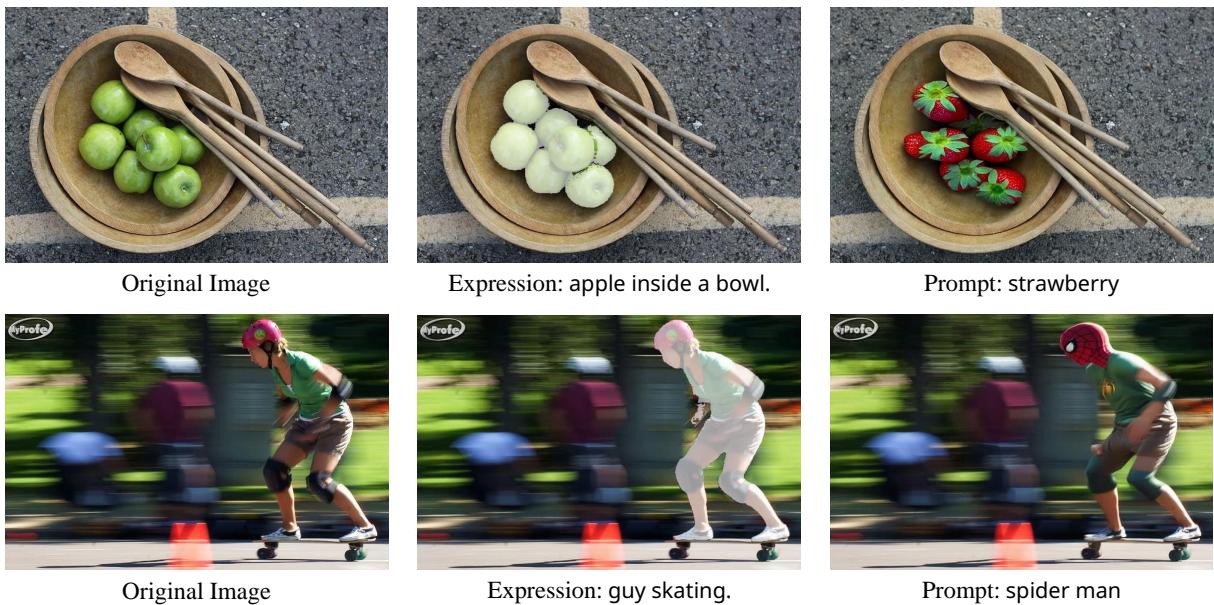
The potential extends beyond just drawing boxes. As shown in Figure 19, these localization heads can drive Image Editing. By using the attention mask to guide a diffusion model, users can perform text-based inpainting (e.g., turning a skater’s outfit into a Spider-Man costume) with high precision.
By realizing that your Large Vision-Language Model “only needs a few attention heads,” we open the door to more interpretable, efficient, and powerful multimodal AI applications. The eyes of the AI are already open; we just learned how to see what they see.