](https://deep-paper.org/en/paper/2503.06467/images/cover.png)
Introduction: The High Cost of Perception
If you have ever played around with computer vision, you know the drill: models are hungry. They have an insatiable appetite for data, specifically labeled data. In the world of 2D images, drawing a box around a cat is relatively easy. But in the realm of autonomous driving, where perception relies on 3D point clouds generated by LiDAR, the game changes.
Labeling a 3D scene is notoriously difficult. Annotators must navigate a complex, sparse 3D space, rotating views to draw precise 3D bounding boxes around cars, pedestrians, and cyclists. It is slow, expensive, and prone to human error.
This bottleneck has led researchers to explore sparsely-supervised 3D object detection. The idea is simple: what if we only label a tiny fraction of the data (say, 1% or 2%) and let the model figure out the rest? While this sounds promising, in practice, performance usually falls off a cliff when annotations become that scarce. The models just don’t have enough “ground truth” to learn what distinguishes a car from a bush or a wall.
But what if we could cheat? What if we could borrow the knowledge from a model that already knows what everything in the world looks like?
This is the premise of SP3D, a new research paper that proposes a boosting strategy for 3D detectors. By leveraging Large Multimodal Models (LMMs)—foundation models trained on billions of image-text pairs—SP3D transfers rich semantic knowledge from 2D images into the 3D domain. The result is a system that can train high-performance 3D detectors using a fraction of the usual human effort.
In this post, we will tear down the SP3D architecture, explain how it bridges the gap between 2D and 3D, and look at the clever engineering tricks (like “mask shrinking” and “dynamic clustering”) that make it work.
The Problem with Scarcity
Before diving into the solution, let’s visualize the problem. Current state-of-the-art methods for sparsely-supervised detection, such as a method called CoIn, rely on contrastive learning to make the most of limited data. They work reasonably well when you have a moderate amount of labels (like 10-20%).
However, as you drop the annotation rate down to 1% or 0.1%, the model’s ability to recognize objects collapses.
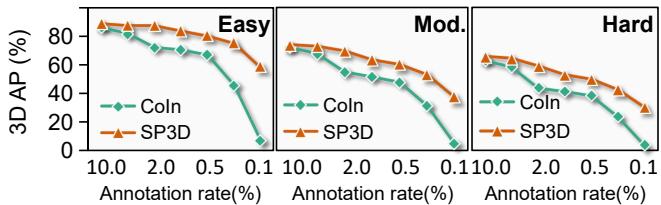
In Figure 1 above, look at the green dashed line (CoIn). As the annotation rate (x-axis) drops to the left, the performance (3D Average Precision) plummets. Now, look at the orange line (SP3D). It maintains robust performance even in “data deserts” where hardly any labels exist.
How does SP3D achieve this stability? It doesn’t rely solely on the sparse 3D labels. Instead, it generates its own pseudo-labels by looking at the camera images that accompany the LiDAR scans.
The Challenge of Cross-Modal Transfer
The core idea seems intuitive: run a powerful 2D segmentation model (like the Segment Anything Model, or SAM) on the camera image to find the cars, then project those pixels into 3D space to find the corresponding LiDAR points.
However, transferring 2D semantics to 3D points is fraught with peril. There are two main issues:
- Occlusion and Depth: An image is a flat projection. A pixel belonging to a car might geometrically line up with a wall behind the car in 3D space if the calibration isn’t perfect or if the LiDAR beam passes through a window.
- Edge Noise: The boundaries of objects in 2D segmentation masks are often fuzzy or slightly inaccurate.
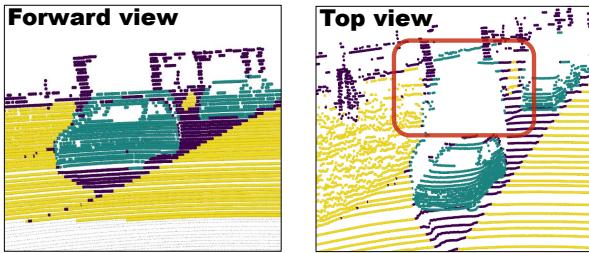
Figure 2 illustrates this “semantic bleeding.” In the top view (right), you can see points inside the red box (the car) are correctly identified. However, notice the noise around the edges? If we blindly project the 2D mask into 3D, we capture background points (yellow lines) and clutter. If we train a detector on these noisy points, the model learns to draw loose, inaccurate bounding boxes.
SP3D was designed specifically to clean up this mess.
The SP3D Architecture
The SP3D framework acts as a “booster.” It is a two-stage training strategy:
- Stage 1: Generate high-quality pseudo-labels using LMMs and train a detector from scratch using only these computer-generated labels.
- Stage 2: Fine-tune that detector using the small amount of real human annotations available.
The magic happens in Stage 1. To get from a raw image to a precise 3D bounding box, the authors introduce three key modules:
- CPST: Confident Points Semantic Transfer.
- DCPG: Dynamic Cluster Pseudo-label Generation.
- DS Score: Distribution Shape Score.
Let’s visualize the pipeline:
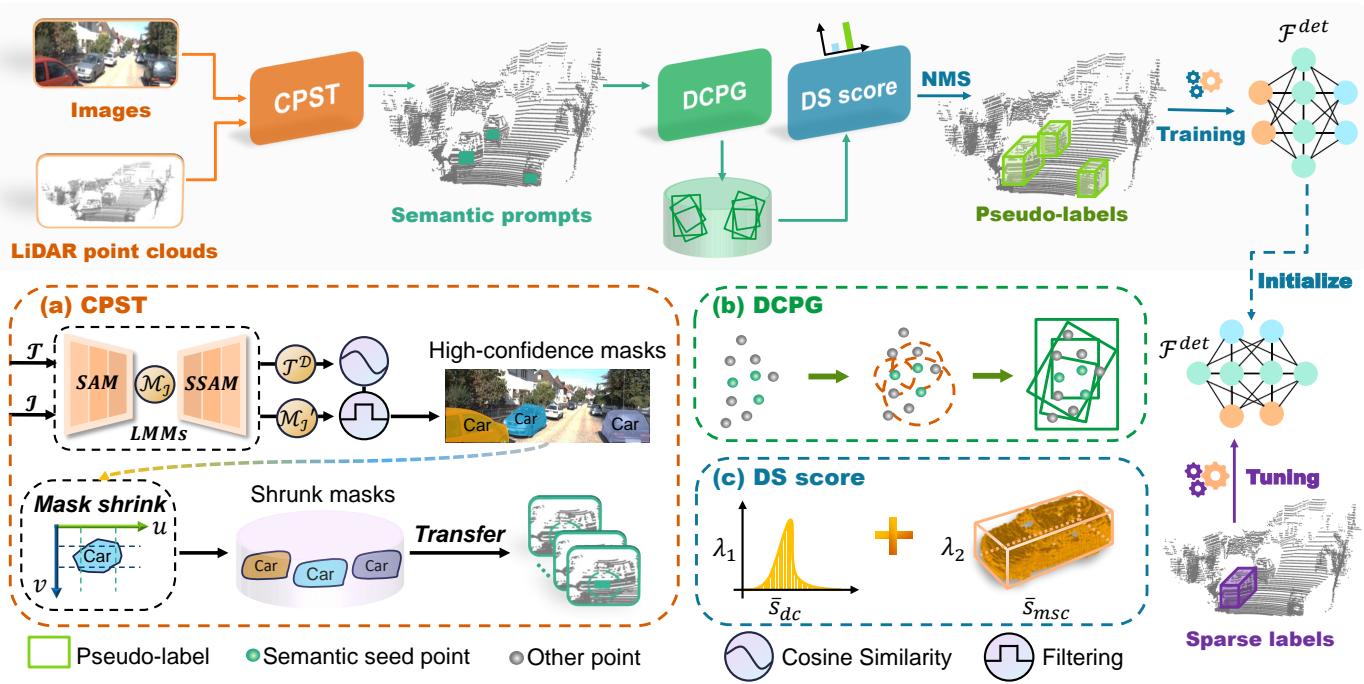
As shown in Figure 3, the process flows from the image input (left) through mask generation, point filtering, clustering, and finally scoring, to output a pseudo-label (bounding box). Let’s break down each step.
1. Confident Points Semantic Transfer (CPST)
The first step is extracting semantics. The authors use two powerful off-the-shelf models:
- FastSAM: To generate segmentation masks for everything in the image.
- SemanticSAM: To label those masks with text descriptions.
Mathematically, they generate class-agnostic masks \(\mathcal{M}_{\mathcal{I}}\):

And then generate descriptions \(\mathcal{T}^{\mathcal{D}}\) for those masks:

By comparing the text descriptions to the categories they care about (e.g., “Car”), they filter out the background.
The “Mask Shrink” Trick: Remember the noise problem in Figure 2? To solve this, the authors don’t use the full segmentation mask. Instead, they strictly constrain the mask to its center, effectively cutting off the edges where ambiguity lives.
They define a mask shrink operation. If a mask spans from pixel \(u_{min}\) to \(u_{max}\), they shrink it by a factor \(\gamma\) (gamma):
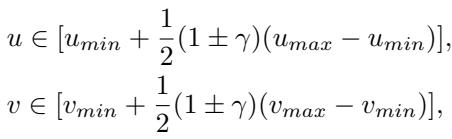
This ensures that the pixels they project to 3D are definitely part of the object (the “confident points”). These points become the seed points for the next step.
2. Dynamic Cluster Pseudo-label Generation (DCPG)
Now we have a cluster of “seed points” in 3D space that we are 99% sure belong to a car. But because we shrank the mask, we are missing the edges of the car. We need to recover the full geometry to draw a proper bounding box.
Standard unsupervised methods use clustering algorithms like DBSCAN with a fixed radius to group nearby points. However, LiDAR data is non-uniform; points are dense near the sensor and sparse far away. A fixed radius doesn’t work well for both close and distant objects.
The authors propose a Dynamic Radius. They adjust the clustering search radius \(r\) based on the index of the point (which often correlates with distance/density in LiDAR scanning patterns):

Here, \(r_{init}\) is a base radius, and it grows linearly as the function iterates through points \(t\) out of \(N\) total points. This allows the algorithm to capture the full geometry of the object, expanding outward from the seed points to include the edges that were originally trimmed off, without accidentally grabbing background noise.
3. Distribution Shape Score (DS Score)
At this point, the system has generated thousands of potential bounding boxes (proposals) based on clustering. Many of them will be garbage—too flat, too long, or containing empty space.
Usually, we would use Non-Maximum Suppression (NMS) based on an “IoU” (Intersection over Union) score with Ground Truth to filter these. But remember: we don’t have Ground Truth.
How do we filter bad boxes without knowing the answer? The authors designed a scoring system based on unsupervised priors—essentially, common sense rules about what a 3D object should look like.
Rule A: The Distribution Constraint In a valid object detection box, the LiDAR points shouldn’t be clustered on the very edge of the box; they should generally follow a Gaussian distribution relative to the center. The Distribution Constraint Score (\(s_{dc}\)) measures how well the points inside a proposed box fit a normal distribution \(\mathcal{N}\):

Rule B: The Meta-Shape Constraint Cars generally look like cars. They have a specific length-to-width ratio. The authors define a “Meta Instance”—a prototype shape for each class (e.g., average car dimensions). The Meta-Shape Constraint Score (\(s_{msc}\)) measures the KL-divergence (difference) between the proposed box shape \(\hat{B}_{\hat{b}}\) and the prototype shape \(\mathcal{B}_c\):

The Final Score These two scores are combined to create the final DS Score. This score replaces the traditional confidence score in the NMS process, allowing the system to filter out “unrealistic” boxes automatically.

Experiments and Results
Does this complex pipeline of shrinking masks and dynamic clustering actually translate to better object detection? The authors tested SP3D on two major autonomous driving datasets: KITTI and Waymo Open Dataset (WOD).
Performance on KITTI
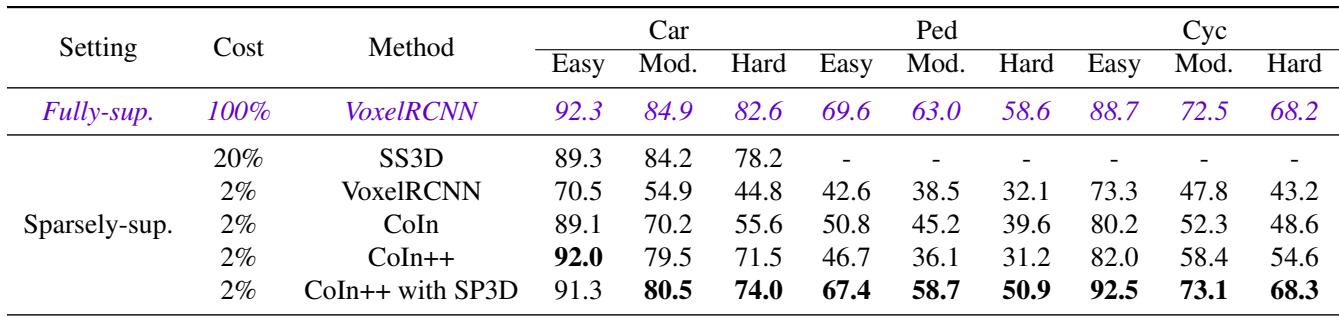
The results on the KITTI dataset are particularly striking when looking at the “Sparse” settings. In Table 1 below, compare the methods under the “2%” cost setting (meaning only 2% of the data was labeled).
- VoxelRCNN (a standard fully supervised method) drops to 54.9% AP (Moderate difficulty) when trained on 2% data.
- CoIn (the previous state-of-the-art) achieves 70.2%.
- CoIn++ with SP3D jumps to 80.5%.
That is a massive 10-point gain, bringing the sparsely supervised model dangerously close to the fully supervised performance (84.9%) despite using 50x less data.
Performance on Waymo (WOD)
The Waymo dataset is larger and more diverse. Here, the authors tested at a 1% annotation cost.
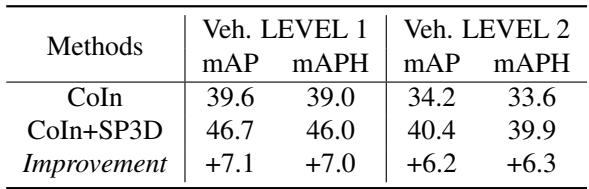
As shown in Table 3, SP3D improves the Vehicle Level 1 mAP from 39.6% (CoIn) to 46.7%. While this might seem numerically smaller than the KITTI gains, in the context of the challenging Waymo dataset, a 7.1% improvement is significant.
Zero-Shot Capabilities
Perhaps the most exciting result is in the Zero-Shot setting. This means training the detector using 0% of the 3D labels—relying entirely on the pseudo-labels generated by the LMMs and the SP3D pipeline.
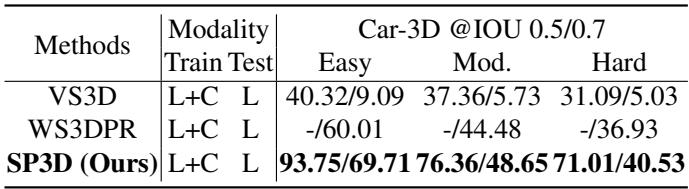
In Table 5, SP3D is compared against other zero-shot methods like VS3D.
- VS3D achieves 9.09% AP on Easy Cars.
- SP3D achieves 69.71% AP.
This suggests that the pseudo-labels generated by SP3D are of such high quality that a detector can learn to recognize cars effectively without ever seeing a human-drawn 3D box.
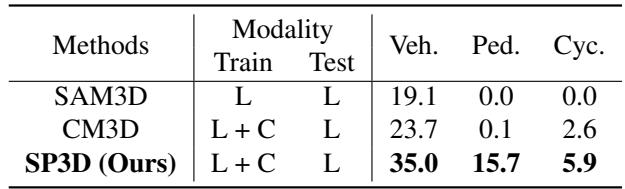
This trend holds on the Waymo dataset as well (Table 6 below), where SP3D significantly outperforms methods like SAM3D (which applies SAM directly without the sophisticated 3D refinement steps of SP3D).
Why does it work? (Ablation Study)
You might wonder if all these components (Mask Shrink, DCPG, DS Score) are necessary. The authors performed an ablation study to find out.
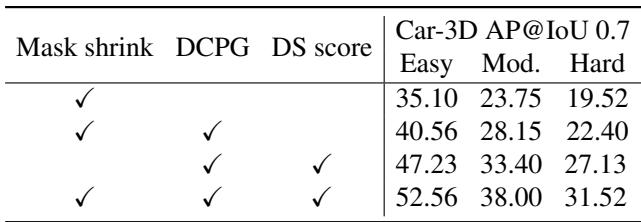
Table 8 tells the story:
- Row 1: Using basic mask transfer (without the special clustering or scoring) gives a moderate result (35.10 AP).
- Row 2: Adding DCPG (Dynamic Clustering) bumps it to 40.56 AP. Better clustering captures better geometry.
- Row 3: Adding DS Score instead of DCPG jumps to 47.23 AP. Filtering bad boxes is crucial.
- Row 4: Combining Mask Shrink + DCPG + DS Score yields the highest result (52.56 AP).
This confirms that the components are complementary. The mask shrink ensures the seeds are pure; DCPG ensures the geometry is complete; and DS Score ensures the final output makes physical sense.
Conclusion
The SP3D paper presents a compelling narrative for the future of computer vision: Multimodality is the key to efficiency.
By treating 2D images not just as a separate data stream, but as a source of “semantic prompts” for 3D data, the researchers effectively transferred the intelligence of massive foundation models (like SAM) into the specialized domain of LiDAR detection.
The technical takeaways for students and practitioners are:
- Don’t trust raw cross-modal projection: Calibration errors and edge noise require careful handling (like the Mask Shrink technique).
- Geometry matters: Simple radius clustering fails on variable-density data like LiDAR; dynamic approaches are necessary.
- Unsupervised Priors are powerful: When you lack labels, you can still filter data by enforcing rules about what “good” data should look like (Gaussian distribution, prototype shapes).
As Large Multimodal Models continue to improve, strategies like SP3D will likely become standard, allowing us to deploy robust 3D perception systems without the crushing cost of manual annotation.