](https://deep-paper.org/en/paper/2503.07457/images/cover.png)
Have you ever noticed that after hanging out with a specific friend for a while, you start talking like them? You might pick up their slang, match their speaking speed, or even start structuring your sentences the way they do. In linguistics and psychology, this is known as alignment. It is a fundamental part of human communication—we subconsciously adapt our language to our conversational partners to build rapport and ensure we are understood.
We know humans do this. But what about Large Language Models (LLMs)?
We know LLMs can be explicitly told to adopt a persona (e.g., “speak like a pirate” or “be a helpful coding assistant”). However, a recent paper titled “LLMs syntactically adapt their language use to their conversational partner” investigates a more subtle question: Do LLMs naturally adapt their grammar (syntax) to match their interlocutor during a conversation, without being told to do so?
This blog post explores this fascinating research, breaking down how the authors measured this “chameleon effect” in AI and what it tells us about the nature of machine conversation.
The Human Context: Why We Align
Before diving into the machines, we need to understand the human benchmark. When humans talk, we align on multiple levels:
- Low-level: Speech rate, posture, and gestures.
- High-level: Semantics (word choice) and syntax (sentence structure).
The paper focuses specifically on syntactic adaptation. This isn’t about repeating the same words; it’s about repeating the same structure.
For example, if you say, “The book was given to the teacher by the student” (Passive Voice), I am statistically more likely to respond with a passive construction later, like “The ball was thrown by the pitcher,” rather than the active “The pitcher threw the ball.”
Psycholinguists debate whether this is a conscious cooperative decision or a subconscious “priming” mechanism. Regardless of the why, the what is clear: human dialogue involves a convergence of syntactic styles over time. The researchers set out to see if GPT-4o and Llama-3-8B exhibit this same behavior.
The Core Method: Investigating Machine Syntax
To study this in LLMs, the researchers had to overcome two main hurdles:
- Defining Syntax: How do we turn text into measurable structural data?
- Measuring Adaptation: How do we prove the model is adapting to its partner and not just repeating itself?
1. From Sentences to Rules
To analyze syntax, the researchers didn’t look at raw text. Instead, they parsed conversations into Phrase Structure Trees.
A phrase structure tree breaks a sentence down into its constituent grammatical parts. This allows us to extract Context-Free Grammar (CFG) rules.

As shown in Figure 1 above, the sentence “we gave the policeman a toy” isn’t treated as a string of words. It is broken down into a hierarchy:
- S (Sentence) splits into NP (Noun Phrase) and VP (Verb Phrase).
- The VP splits into a Verb and two Noun Phrases.
From this tree, the researchers extract specific rules, such as VP -> V NP NP. This notation represents the abstract structure of the sentence, stripping away the specific words. By analyzing the frequency of these rules, the researchers can track the model’s “syntactic style” without getting distracted by the topic of conversation.
2. The Dataset: Creating Artificial Personalities
You cannot measure adaptation if two speakers already talk exactly the same way. To see if LLMs adapt, there must be an initial difference in their styles.
The researchers created a dataset of conversations between instances of LLMs (GPT-4o and Llama-3-8B). However, they didn’t just use the default models. They engineered 17 different “Language Personas” using system prompts. These included instructions like:
- “Your language is poetic and evocative.”
- “Your language is hesitant and unsure.”
- “Your language is precise and unambiguous.”
They then paired these agents up and had them discuss the topic: “What makes a day a good day?” This resulted in a rich corpus of conversations where two distinct “personalities” interacted over many turns.
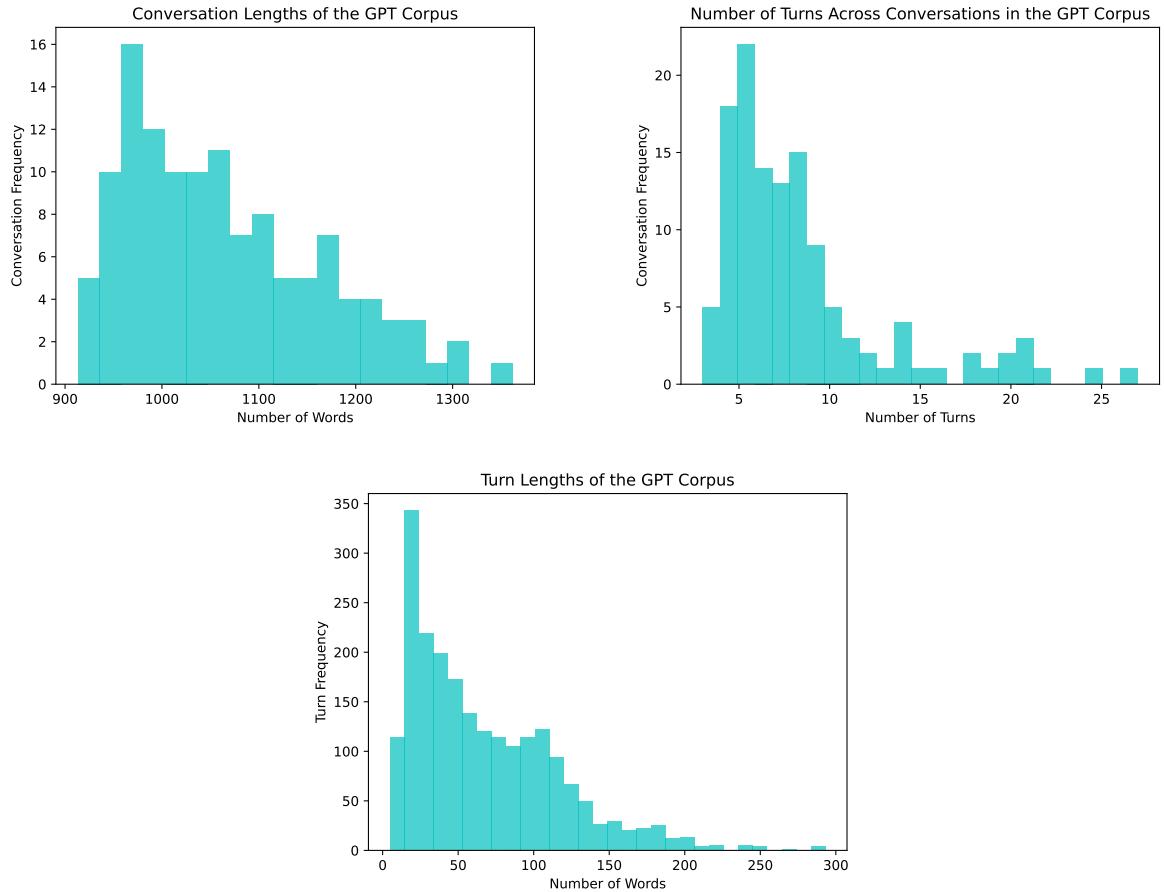
Figure 5 shows the statistics of the generated GPT-4o conversations. You can see in the top-left that the conversations were substantial, mostly hovering around 1,000 words. This length is crucial because syntactic adaptation is a gradual process; short Q&A interactions wouldn’t provide enough data to detect a trend.
3. Measuring Adaptation: The Reitter & Moore Method
This is the most technically innovative part of the paper. The authors adapted a statistical method originally developed by Reitter and Moore (2014) for human-human dialogue.
The goal is to determine if hearing a syntactic rule in the first half of a conversation (the PRIME) makes a speaker more likely to use that same rule in the second half (the TARGET).
Here is the step-by-step logic:
- Split the Conversation: Divide every conversation into two halves: the PRIME (first 49%) and the TARGET (last 49%).
- Identify Rules: Look at the syntactic rules used in the TARGET.
- Check for Priming: For a specific rule found in the TARGET, look back at the PRIME. Did the other speaker use this rule?
- The Control Group (Randomization): This is the key. It’s not enough to just see if the rule appeared. We need to know if it appeared because of the conversation.
To solve this, the researchers compare two scenarios, as illustrated below:
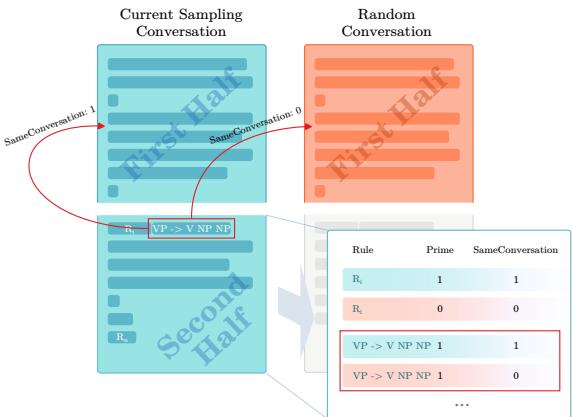
In Figure 2, we see the sampling process:
- SameConversation (1): We check if rule \(R_1\) appeared in the PRIME of the current conversation.
- Different Conversation (0): We check if rule \(R_1\) appeared in the PRIME of a randomly selected conversation between different speakers.
If the models are adapting, there should be a strong statistical link between a rule appearing in the PRIME and the TARGET of the Same Conversation, but no link (or a much weaker one) for random conversations.
Experiments and Results
The researchers applied this method to both the human “Switchboard” corpus (as a baseline to ensure the method works) and their new LLM corpora.
They used a Generalized Linear Mixed Model (GLMM), a type of regression analysis, to quantify the effect. They looked specifically for the coefficient of the SameConv variable. A positive, significant number means adaptation is happening.
The Regression Results

Table 1 presents the results across three datasets:
- Switchboard (Humans): The
SameConvvalue is 0.228. This confirms what we already knew—humans adapt. - GPT Corpus: The
SameConvvalue is 0.198. - Llama Corpus: The
SameConvvalue is 0.505.
The Conclusion: Both GPT-4o and Llama-3-8B show statistically significant syntactic adaptation. The positive values indicate that if Agent A uses a specific grammatical structure, Agent B is significantly more likely to use that same structure later in the conversation than chance would predict.
Interestingly, Llama-3 showed an even stronger adaptation effect coefficient than GPT-4o, though both were clearly adapting.
Is Adaptation Continuous?
The regression tells us adaptation happened, but it doesn’t tell us how. Did the models adapt instantly, or was it a gradual process?
To answer this, the researchers performed a fine-grained analysis. They tracked the Jensen-Shannon Divergence (JSD) between the two speakers’ syntactic distributions over the course of the conversation. JSD is a way of measuring the “distance” between two probability distributions. A lower JSD means the speakers are using more similar syntax.
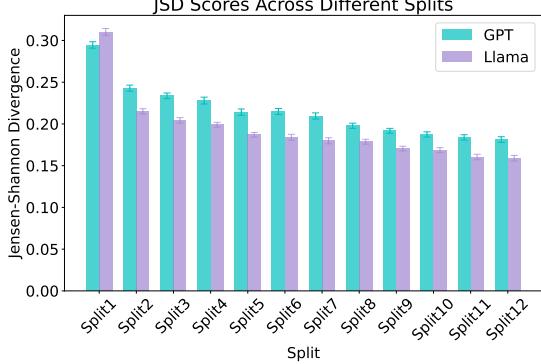
Figure 3 tracks this divergence across 12 splits of the conversation (from start to finish).
- The Trend: For both GPT (cyan) and Llama (purple), the distance generally decreases or stabilizes at a lower level as the conversation progresses.
- Interpretation: This suggests that adaptation is a continuous process. The models don’t just “set” their style at the beginning; they are constantly updating their probability distributions based on the context of the conversation.
Discussion: Is This “Human” Alignment?
The results are clear: LLMs syntactically adapt to their partners. But the authors offer an important caveat regarding mechanism.
In humans, alignment is often theorized to be a result of “conceptual pacts” (cooperating to be understood) or cognitive priming (neurons associated with a structure being activated).
LLMs, obviously, do not have neurons or social intentions. The authors propose that this behavior in LLMs is likely a result of long-context conditioning. Modern LLMs have massive context windows (memories). When the model generates a response, it is statistically conditioning its output on the entire history of the conversation.
If the history contains a lot of Passive Voice, the probability of the tokens required to form a Passive Voice sentence increases. While the mechanism is mathematical rather than cognitive, the observable behavior is remarkably similar to human adaptation.
Conclusion and Implications
This paper provides robust empirical evidence that Large Language Models are not static in their linguistic style. Even without explicit instructions, they drift toward the syntactic patterns of their conversational partners.
Key Takeaways:
- Rudimentary Alignment: LLMs exhibit “human-like” syntactic alignment, confirmed by the same statistical methods used to measure human dialogue.
- Continuous Process: This adaptation happens gradually over the course of a long conversation.
- Implicit Behavior: This occurs naturally as a byproduct of how these models process context, distinct from “persona” prompting.
Why does this matter? For the design of dialogue systems, this is excellent news. A good conversational assistant shouldn’t force the user to adapt to its way of speaking; it should meet the user where they are. This research suggests that modern LLMs are already capable of this implicit coordination, likely leading to more natural, fluid, and effective user interactions.
However, the authors also raise an ethical point: this adaptation leaves a “fingerprint.” If an LLM adapts too perfectly or in a specific, predictable way, it might create recognizable patterns that could be used to detect AI-generated text or identify specific models, potentially serving as a subtle, unintentional watermark.
As we continue to integrate LLMs into our daily lives, understanding these subtle behavioral dynamics becomes crucial. We aren’t just prompting machines; we are conversing with them, and it turns out, they are listening closer than we thought.