](https://deep-paper.org/en/paper/2503.07978/images/cover.png)
Introduction
Federated Learning (FL) has revolutionized how we train machine learning models. By allowing devices to train locally and share only model updates rather than raw data, FL promises a sweet spot between data utility and user privacy. It is currently powering applications in healthcare, finance, and the predictive text on your smartphone.
However, this decentralized architecture introduces a significant security flaw: the central server cannot see the training data. This blindness makes FL susceptible to backdoor attacks (also known as poisoning attacks). In a backdoor attack, a malicious client injects a “Trojan horse” into the global model. The model behaves normally on standard data, but when presented with a specific trigger (like a pixel pattern or a specific phrase), it misclassifies the input exactly how the attacker wants.
The challenge is stealth. Modern attacks are designed to be statistically similar to benign updates, making them incredibly hard to detect using traditional methods that look at the “magnitude” (size) of the update. Furthermore, in non-IID (Independent and Identically Distributed) settings—where data varies wildly between clients—distinguishing a malicious update from a simply “unique” benign update is a difficult statistical hurdle.
In this post, we dive deep into a research paper that proposes AlignIns (Direction Alignment Inspection). This novel defense mechanism moves beyond simple magnitude checks and looks at the direction of model updates at both a general and fine-grained level. We will explore how AlignIns uses “Principal Signs” and “Temporal Alignment” to filter out attackers, even in highly heterogeneous data environments.
Background: The Backdoor Problem
To understand the solution, we must first understand the nuance of the threat. In a standard Federated Learning setup (using an algorithm like FedAvg), the server distributes a global model to clients. Clients train this model on their local data and send back the “update” (the difference between the new local model and the old global model). The server averages these updates to create the next global version.
The Attack Surface
A backdoor attacker manipulates their local training process. They might stamp a yellow square on a stop sign and label it “speed limit.” If the global model learns this, an attacker can later cause accidents just by placing a yellow sticker on a sign.
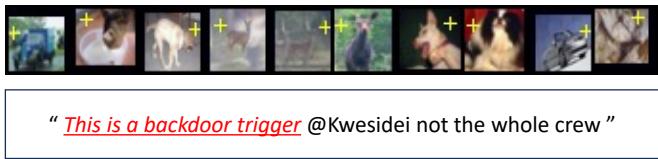 Figure 1: Examples of backdoor triggers. In image classification (left), a pixel pattern is added. In text classification (right), a trigger phrase like “This is a backdoor trigger” flips the sentiment analysis.
Why Existing Defenses Fail
Defenders typically try to filter out “anomalous” updates before aggregating them.
- Magnitude-based defenses: These measure Euclidean or Manhattan distances. If an update is “too large” compared to others, it is rejected. Failure mode: Attackers can scale their updates down or use penalties during training to ensure their malicious updates look just as small as benign ones.
- Cosine Similarity: This measures if an update is pointing in a different direction than the others. Failure mode: It captures only general direction. It misses fine-grained details (like specific parameter sign flips) and struggles when benign data is non-IID (meaning benign clients are naturally pointing in slightly different directions).
The authors of AlignIns argue that we need to look closer—specifically at the direction alignment of the updates.
The Core Method: AlignIns
The core hypothesis of AlignIns is that while malicious updates mimic the magnitude of benign updates, their optimization direction must deviate to implant the backdoor. This deviation might be subtle, but it exists.
AlignIns runs on the server side and filters updates in a four-step process:
- TDA: Temporal Direction Alignment inspection.
- MPSA: Masked Principal Sign Alignment inspection.
- MZ_score: Filtering based on robust statistics.
- Clipping: Post-filtering safety.
Let’s break down the mathematics and logic of each step.
1. Temporal Direction Alignment (TDA)
The first check is macroscopic. The system compares the direction of a client’s update (\(\Delta_i^t\)) with the direction of the global model from the previous round (\(\theta^t\)). The logic is that benign clients generally move the model in a direction consistent with the global learning trajectory, while attackers need to steer it elsewhere (towards the backdoor objective).
The TDA score (\(\omega_i\)) is calculated using Cosine similarity:

Here, the numerator is the dot product (measuring alignment), and the denominator normalizes for magnitude. A value close to 1 means they are aligned; -1 means they are opposite. Malicious clients often exhibit TDA values that cluster together but differ from the benign distribution.
2. Masked Principal Sign Alignment (MPSA)
This is the most innovative contribution of the paper. TDA provides a general view, but it can be fooled if the vector dimensions are large and the manipulation is subtle. MPSA zooms in on the signs (positive or negative) of the parameters.
As models converge, the magnitude of updates shrinks, making magnitude checks useless. However, the direction (the sign of the gradient) remains a strong signal.
The Principal Sign (\(p\)): First, the server calculates the “Principal Sign” vector. For every single parameter in the neural network, the server looks at all client updates and takes a “majority vote” on the sign. If most clients think parameter \(j\) should be positive, the principal sign for \(j\) is \(+1\).
The Top-\(k\) Mask: Not all parameters matter. In deep learning, many parameters are noise. AlignIns uses a Top-\(k\) Indicator. For a specific client, it identifies the top \(k\) parameters with the largest absolute values (the most important features for that client).
Calculating MPSA: The system checks: For the important parameters in this client’s update, how often does the sign match the Principal Sign?

- \(\text{sgn}(\Delta_i^t) - p\): Checks the difference between the client’s signs and the majority vote.
- \(\odot \text{Top}_k\): Masks out the unimportant parameters.
- \(||\cdot||_0\): Counts the number of non-matching important signs.
The result \(\rho_i\) is a ratio between 0 and 1. A higher \(\rho\) means the client’s important updates are well-aligned with the majority direction. Malicious updates, which try to inject specific backdoor features, often require flipping signs on specific important parameters, causing their MPSA score to deviate.
3. Anomaly Detection with MZ_score
Now the server has two scores for every client: a TDA score (general direction) and an MPSA score (fine-grained sign alignment). How does it decide who is malicious?
It uses the Median-based Z-score (MZ_score). Unlike a standard Z-score which uses the mean (easily skewed by outliers), the MZ_score uses the median, which is robust against extreme values.

The server calculates the MZ_score for both the TDA values and MPSA values. If a client’s score exceeds a predefined threshold (radius \(\lambda\)), it is flagged as an outlier and removed from the aggregation pool. This method adapts dynamically to the training process without needing manual tuning for every round.
Theoretical Analysis
The paper goes beyond heuristics and provides a theoretical framework proving the robustness of AlignIns.
\(\kappa\)-Robustness
The authors define a property called \(\kappa\)-robust filtering. Ideally, a defense should result in an aggregated update that is identical to the average of only the benign clients. \(\kappa\) represents the upper bound of the difference between the defense’s output and the ideal benign average.
The paper proves that AlignIns is \(\kappa\)-robust, with the bound defined as:

In simple terms, this equation states that the error is bounded by a constant that depends on the ratio of malicious clients (\(m\)) to benign clients (\(n-2m\)), the variance of the data (\(\nu\)), and the heterogeneity (\(\zeta\)). Crucially, as long as the number of attackers is less than a certain fraction of the total (roughly 1/3), the defense holds.
Propagation Error
One of the biggest risks in FL is that a small amount of poison leaks through in round \(t\), which shifts the starting point for round \(t+1\), leading to a snowball effect. The authors analyzed the propagation error—the cumulative deviation of the trained model from a purely benign model after \(T\) rounds.

This inequality shows that the error after \(T\) rounds does not explode to infinity. It is bounded by the cumulative learning rate \(\phi(T)\) and the robustness coefficient \(\kappa\). This theoretical guarantee suggests that even if AlignIns isn’t perfect in every single round, the model will not catastrophically diverge from the clean solution.
Experimental Results
The researchers tested AlignIns against state-of-the-art attacks (BadNet, DBA, Scaling, PGD, Neurotoxin) using standard datasets (CIFAR-10, CIFAR-100). They compared it against leading defenses like RLR, RFA, Multi-Krum, and Foolsgold.
Main Performance (IID Data)
In the table below, we look at three metrics:
- MA (Main Accuracy): Accuracy on clean data (higher is better).
- BA (Backdoor Accuracy): Success rate of the attack (lower is better).
- RA (Robust Accuracy): Accuracy on triggered data (higher is better).
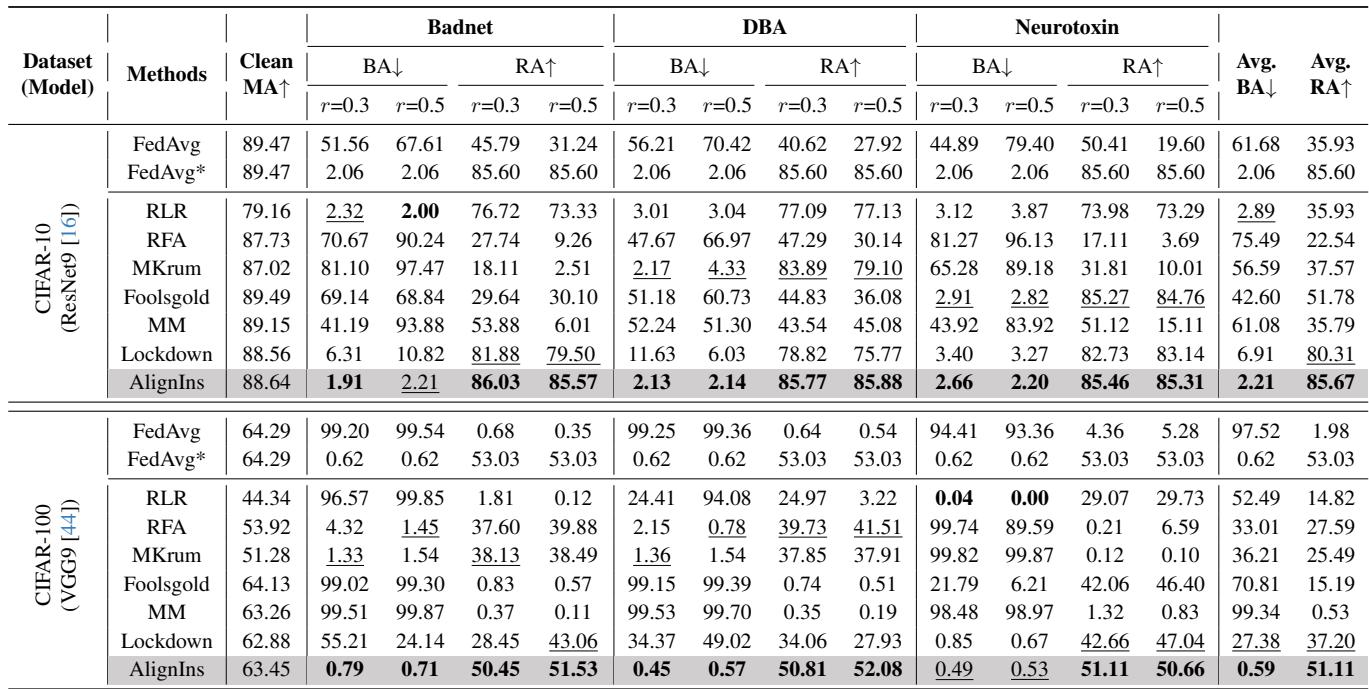
Key Takeaway: Look at the CIFAR-10 results (top half). Under “Avg. BA” (Average Backdoor Accuracy), standard FedAvg has a massive 56.21% attack success rate. AlignIns drops this to 2.66%, essentially neutralizing the attack. It does this while maintaining a Main Accuracy (88.64%) that is almost identical to the clean baseline. Other defenses like RLR reduce the attack but suffer a massive drop in accuracy (down to 79.16%).
Resilience in Non-IID Settings
The hardest challenge in FL is non-IID data. When every client has different data distributions, benign updates look very different from each other, making it easy for attackers to hide.
The graph below shows Robust Accuracy (RA) as the data becomes more non-IID (moving left on the x-axis, where smaller \(\beta\) means more non-IID).
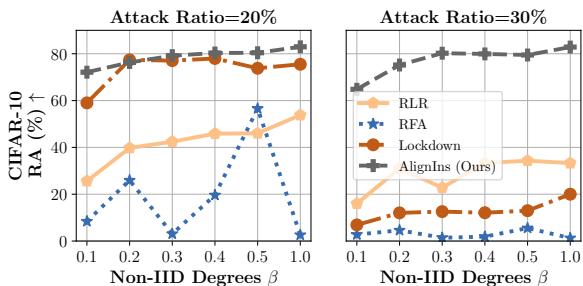
Key Takeaway: The gray line with squares (AlignIns) remains consistently high, even at \(\beta=0.1\) (extreme heterogeneity). Competitors like RFA (blue stars) and Lockdown (brown circles) see their performance collapse as the data becomes more heterogeneous or the attack ratio increases (right chart). This proves that MPSA’s focus on “important parameters” is highly effective at ignoring the noise caused by data distribution shifts.
Why do we need both metrics? (Ablation Study)
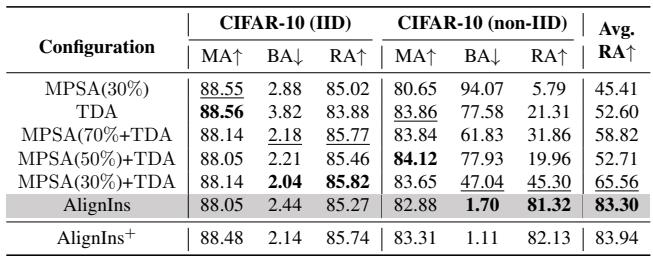
Is MPSA enough? Is TDA enough? The authors conducted an ablation study to see the contribution of each component.
Key Takeaway:
- TDA alone: Performs poorly in non-IID settings (RA 21.31%). General direction isn’t enough when everyone is moving differently.
- MPSA alone: Better, but still struggles (RA 5.79%).
- Combined (AlignIns): The combination jumps to 85.27% RA (IID) and 81.32% RA (Non-IID). The two metrics complement each other: TDA catches general deviations, while MPSA catches fine-grained sign manipulations masked by high variance.
Handling High Attack Ratios
Finally, the researchers tested the defense when the number of malicious clients increases from 5% up to 30%.
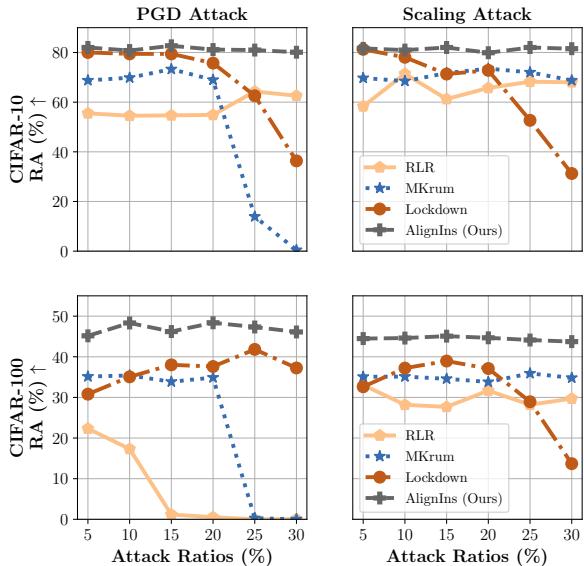
Key Takeaway: As the attack ratio (x-axis) increases, defenses like MKrum (blue triangles) and RLR (orange inverted triangles) fail catastrophically, dropping to near 0% robustness. AlignIns (red circles) maintains a flat, stable performance line even when nearly a third of the network is compromised.
Conclusion
Federated Learning is the future of privacy-preserving AI, but it cannot succeed without robust security. The paper “Detecting Backdoor Attacks in Federated Learning via Direction Alignment Inspection” introduces AlignIns, a sophisticated defense that sets a new standard for backdoor detection.
By inspecting the alignment of model updates at both a temporal level (TDA) and a fine-grained coordinate level (MPSA), AlignIns effectively distinguishes between the natural variance of benign clients and the calculated manipulations of attackers. Its ability to maintain high accuracy and low attack success rates, particularly in challenging non-IID environments, makes it a significant step forward.
For students and practitioners in FL, the takeaway is clear: magnitude is not enough. To catch a stealthy attacker, you have to look at where they are trying to steer the model, down to the very signs of the parameters.
Note: The images and equations used in this post are derived directly from the source research paper provided.