](https://deep-paper.org/en/paper/2503.09491/images/cover.png)
Introduction
In the fight against cancer, Nanoparticles (NPs) represent a futuristic and highly promising weapon. These microscopic carriers can be designed to deliver drugs directly to tumor sites, leveraging the “leaky” blood vessels of tumors to accumulate exactly where they are needed—a phenomenon known as the Enhanced Permeability and Retention (EPR) effect.
However, simply injecting nanoparticles isn’t enough. To maximize therapeutic outcomes, doctors need to know exactly how these particles will distribute within a tumor. Will they reach the core? Will they stay on the periphery? This distribution is heavily influenced by the Tumor Microenvironment (TME), specifically the layout of blood vessels and cell nuclei.
For years, researchers have used AI to predict this distribution. The logic has always been: “The more information, the better.” If we feed the AI data on both blood vessels (uni-modal) and cell nuclei (multi-modal), the prediction should be better, right?
Not always.
A fascinating research paper, “DAMM-Diffusion: Learning Divergence-Aware Multi-Modal Diffusion Model for Nanoparticles Distribution Prediction,” challenges this assumption. The researchers discovered that “divergence”—or inconsistency—between different data modalities can actually confuse the model, making a simple uni-modal model superior in certain cases.
In this post, we will explore how they solved this paradox using a novel architecture called DAMM-Diffusion, which intelligently decides when to trust complex multi-modal data and when to stick to the basics.
Background: The Challenge of Heterogeneity
To understand the solution, we first need to visualize the problem. Tumors are heterogeneous; they are chaotic structures with irregular blood vessel networks and varying cell densities.
Existing methods for predicting nanoparticle distribution generally fall into two camps:
- Uni-modal methods: These look primarily at tumor vessels (stained with a CD31 marker) to predict drug distribution.
- Multi-modal methods: These combine vessel data with cell nuclei information (stained with DAPI).
Common sense suggests that Method 2 should win. However, if the spatial relationship between the nuclei and the vessels is complex or inconsistent (divergent), the extra data acts as noise rather than a signal.
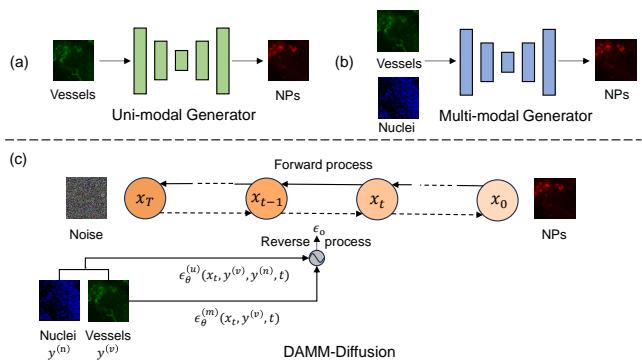
As shown in Figure 1 above, the researchers propose a third way. Instead of blindly choosing uni-modal or multi-modal, their model (DAMM-Diffusion) runs both simultaneously and dynamically selects the best output based on the “divergence” between the inputs.
The Core Method: DAMM-Diffusion
The researchers built their solution on top of Diffusion Models. If you are familiar with tools like Stable Diffusion or DALL-E, you know the basic premise: the model learns to destroy an image by adding noise (Forward Process) and then learns to reverse that process to generate a clean image (Reverse Process).
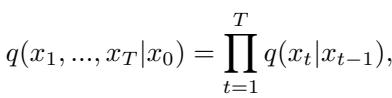
Mathematically, the forward process is a Markovian chain that adds Gaussian noise over \(T\) steps:
However, standard diffusion models don’t account for the “conflicting signal” problem in multi-modal data. The DAMM-Diffusion architecture changes the game by using a Unified Network with two distinct branches.
1. The Architecture Overview
The model doesn’t just train one network; it trains a unified system that contains:
- A Uni-modal Branch: Processes only vessel data.
- A Multi-modal Branch: Processes both vessel and nuclei data.
- A Divergence-Aware Multi-Modal Predictor (DAMMP): The “judge” that decides which branch offers the better prediction.
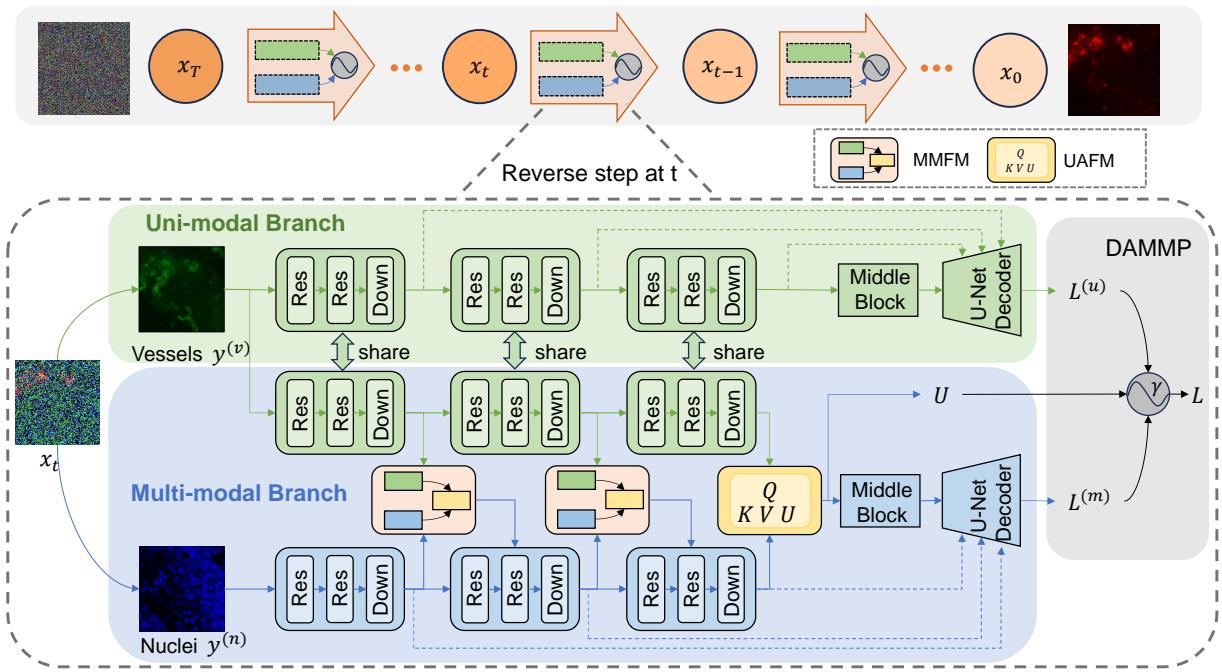
As illustrated in Figure 2, both branches utilize a U-Net architecture (a standard in medical image segmentation and generation). They share the time step \(t\), but they process different inputs. The magic happens in how the Multi-modal branch fuses information and how the DAMMP makes its final decision.
2. Smart Fusion: MMFM and UAFM
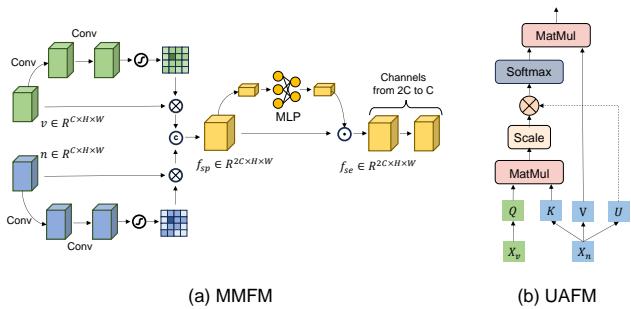
The Multi-modal branch isn’t just concatenating images. It uses two specialized modules to handle the data complexity, as detailed in Figure 3.
Multi-Modal Fusion Module (MMFM)
Visible in Figure 3(a), the MMFM is designed to extract and merge features effectively. It doesn’t just stack the vessel (\(v\)) and nuclei (\(n\)) features. It applies:
- Spatial Attention: Identifies where the important features are in the image space.
- Channel Attention: Identifies which feature channels carry the most relevant information. This ensures that the model focuses on the most informative parts of both modalities before merging them.
Uncertainty-Aware Fusion Module (UAFM)
This is a critical innovation, shown in Figure 3(b). In standard Transformers, “Cross-Attention” is used to relate two different inputs (like text and images, or in this case, vessels and nuclei). Standard cross-attention assumes that every part of the input is reliable.
The UAFM calculates an Uncertainty Map (\(U\)) using a learnable weight matrix (\(W_n\)) on the nuclei features (\(X_n\)):
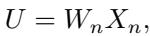
It then modifies the standard cross-attention mechanism. Instead of treating all correlations as equal, it scales the attention scores based on this uncertainty. If the model is uncertain about a specific node (region) in the nuclei data, it reduces the influence of that region on the final fusion.

This prevents “bad” or ambiguous data in the nuclei channel from polluting the clear signals in the vessel channel.
3. The Judge: Divergence-Aware Multi-Modal Predictor (DAMMP)
Even with smart fusion, sometimes the multi-modal data is just too divergent to be useful. This is where the DAMMP steps in.
The DAMMP calculates a divergence value \(d\), which is essentially the mean of the Uncertainty Map \(U\).
- High \(d\): Indicates low confidence in the fusion. The nuclei data conflicts with the vessel data.
- Low \(d\): Indicates high confidence. The modalities are consistent and helpful.
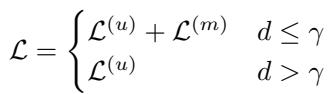
The model uses a switching mechanism for its loss function during training. If divergence is low (below a threshold \(\gamma\)), it optimizes both branches. If divergence is high, it focuses on the uni-modal branch.
The Feedback Loop
How does the model learn to set the correct divergence value? It uses a Divergence Feedback Loss (DFL). It compares the actual prediction error (\(L_1\)) of the uni-modal branch against the multi-modal branch.
- If the Multi-modal branch has a lower error, the model is encouraged to lower the divergence value \(d\).
- If the Uni-modal branch is better, the model is pushed to increase \(d\).
This creates a self-correcting loop:

The Final Output
During the actual prediction (inference), the model makes a hard choice based on the learned divergence:
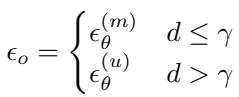
If \(d \leq \gamma\), the user gets the sophisticated multi-modal prediction. If \(d > \gamma\), the system reverts to the robust uni-modal prediction.
Experiments and Results
The team validated DAMM-Diffusion on a dataset of breast cancer tumor models in mice, using 20-nm quantum dots as the nanoparticles. They compared their model against state-of-the-art Generative Adversarial Networks (GANs) like CycleGAN and GANDA, as well as other Diffusion models like BBDM and CoLa-Diff.
Quantitative Performance
The results were impressive. Using metrics like SSIM (Structural Similarity Index, where higher is better) and PSNR (Peak Signal-to-Noise Ratio), DAMM-Diffusion outperformed the competition.
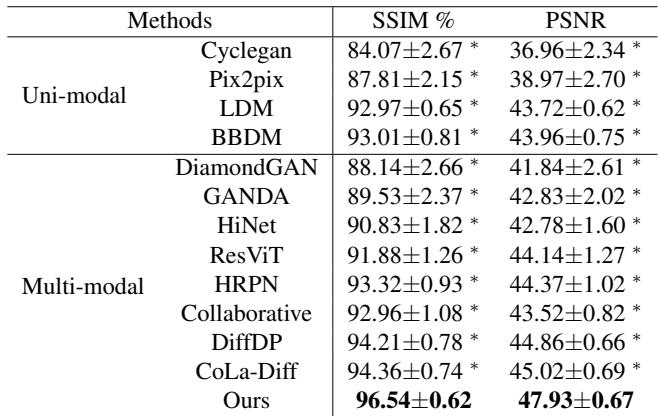
In Table 1, notice how DAMM-Diffusion achieves an SSIM of 96.54%. This is a significant jump over the uni-modal baselines (around 84-93%) and notably better than other advanced multi-modal diffusion models like CoLa-Diff (94.36%).
The team also tested the model on an “external validation set”—data from a completely different tumor model (B16) to see if the AI simply memorized the training data or actually learned the physics of NP distribution.
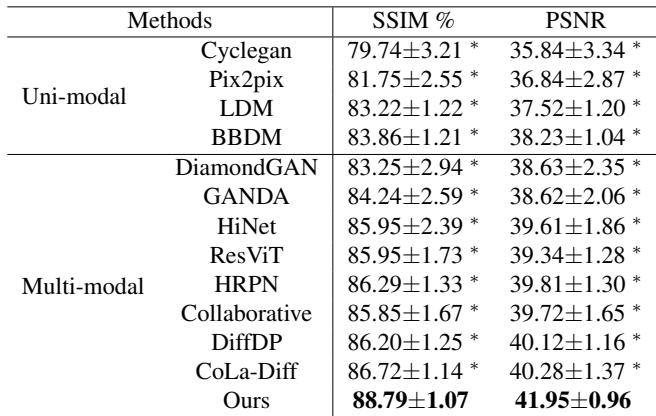
As shown in Table 2, the model maintained its lead, proving its strong generalization capabilities.
Qualitative Analysis: Seeing is Believing
Numbers are great, but in medical imaging, visual quality is paramount.
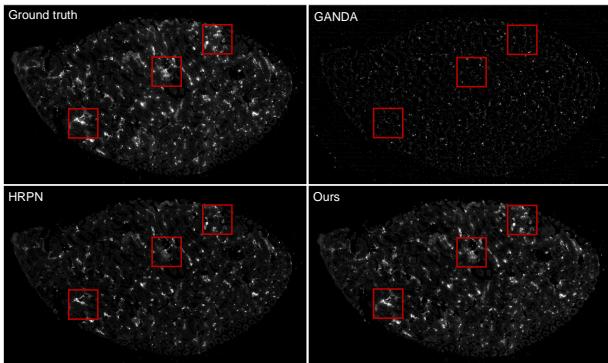
Figure 4 below shows the whole-slide level prediction. The “Ground Truth” is the actual distribution of nanoparticles.
- GANDA (Top Right): Misses details; looks blurry.
- HRPN (Bottom Left): Better texture, but creates artifacts.
- Ours (Bottom Right): The DAMM-Diffusion output is strikingly close to the Ground Truth, capturing the density and structural patterns accurately.
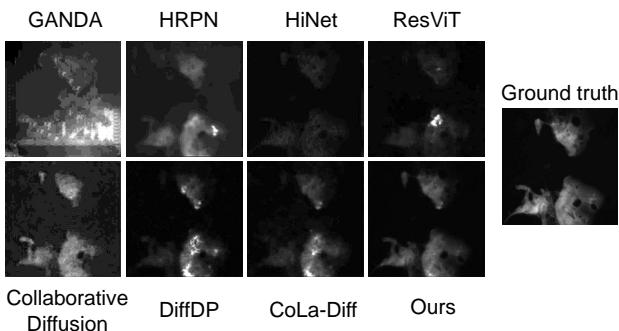
Zooming in to the patch level in Figure 5, the difference becomes even clearer. DAMM-Diffusion preserves the smooth boundaries of nanoparticle accumulation and maintains the correct intensity distribution, whereas other methods often introduce noise or fail to capture the high-concentration areas.
Component Analysis (Ablation Study)
Does every part of the complex architecture actually help? The researchers broke it down in Table 5.
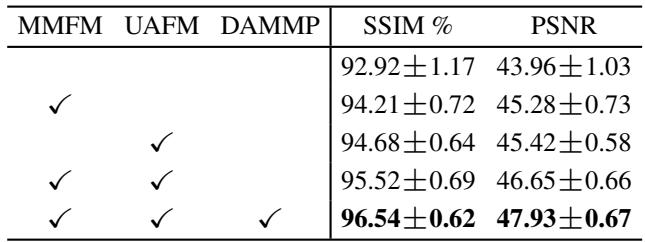
- Row 1: Using just MMFM gives a baseline.
- Row 2: Adding UAFM (Uncertainty-Aware Fusion) jumps performance significantly.
- Row 3: Adding the DAMMP (The Judge) provides the final boost to reach state-of-the-art performance.
This proves that the “Divergence-Aware” strategy is not just a gimmick; it is the primary driver of the model’s accuracy.
Beyond Nanoparticles: Brain MRI Synthesis
To prove this method isn’t limited to just nanoparticles, the authors applied DAMM-Diffusion to the BRATS dataset, a benchmark for brain tumor segmentation. The task was to generate a missing MRI modality (e.g., FLAIR) given other modalities (e.g., T1 and T2).
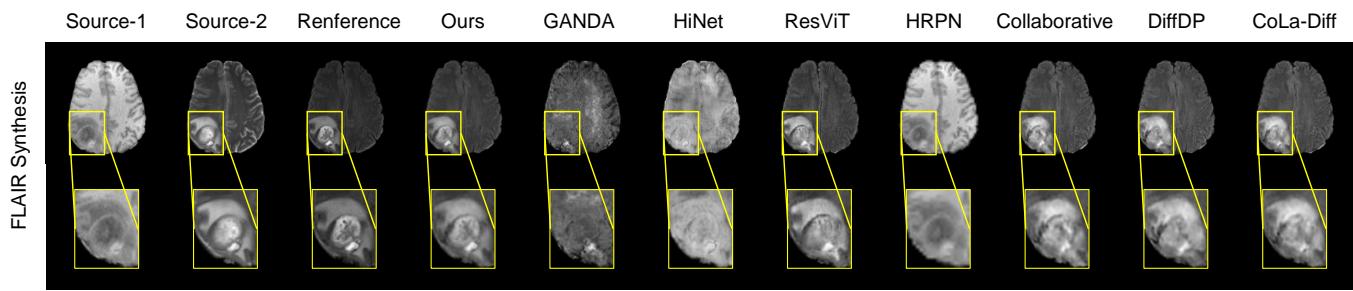
In Figure 8, looking at the T1, T2 \(\rightarrow\) FLAIR task, DAMM-Diffusion (labeled “Ours”) generates brain images with fewer artifacts and clearer lesion definitions compared to competitors like GANDA or ResViT. This suggests that the concept of “divergence-aware fusion” is a fundamental improvement applicable to many multi-modal medical imaging tasks.
Conclusion
The DAMM-Diffusion model teaches us a valuable lesson in AI: complexity needs control. By acknowledging that multi-modal data can sometimes be divergent or contradictory, the researchers built a system that is robust, accurate, and self-correcting.
For the field of nanomedicine, this is a significant step forward. Accurate prediction of nanoparticle distribution means doctors can better plan dosages, select patients who will respond best to treatment, and ultimately improve the efficacy of cancer therapies. By letting the AI decide when to “keep it simple” and when to “fuse the data,” we get the best of both worlds.