](https://deep-paper.org/en/paper/2503.09594/images/cover.png)
Introduction
For decades, the “holy grail” of autonomous driving has been a vehicle that doesn’t just navigate from point A to point B, but one that truly understands the world and can communicate with its passengers. We’ve seen incredible progress in Large Language Models (LLMs) that can reason about complex topics, and separate progress in autonomous driving systems that can navigate city streets. However, merging these two worlds has proven difficult.
Most current attempts at combining vision and language in cars result in a “backseat driver” scenario: the model can answer questions about the scene (Visual Question Answering, or VQA), but its answers are often completely disconnected from its actual driving decisions. A model might correctly answer, “I see a red light,” while simultaneously outputting a command to accelerate. This disconnect is a failure of language-action alignment.
Enter SimLingo, a new Vision-Language-Action (VLA) model presented by researchers from Wayve and the University of Tübingen. SimLingo isn’t just a driving model with a chatbot glued to the side. It is a unified system designed to handle closed-loop driving, vision-language understanding, and—crucially—language-action alignment.
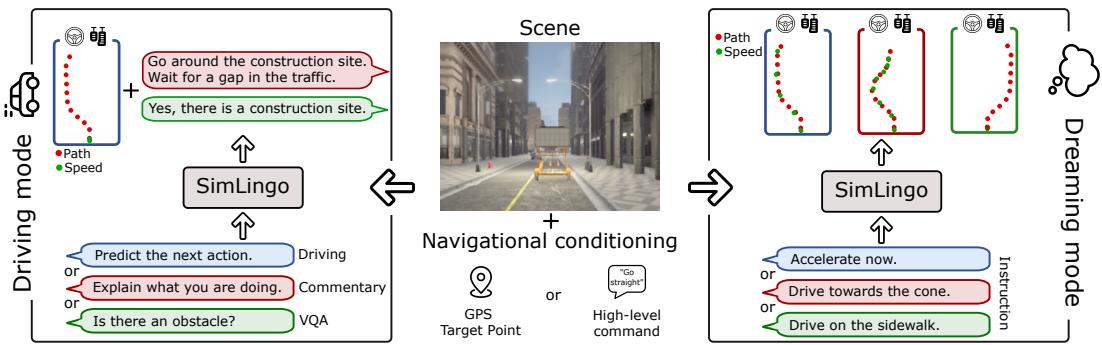
As illustrated in Figure 1, SimLingo operates in multiple modes, including a novel “Dreaming Mode” where the car simulates responses to instructions—even dangerous ones—to ensure it truly understands the relationship between words and physical actions. In this post, we will dive deep into how SimLingo achieves state-of-the-art performance using only cameras, bypassing expensive LiDAR sensors, and how it introduces the concept of “Action Dreaming” to solve the alignment problem.
Background: The Gap Between Talk and Action
To appreciate SimLingo, we first need to understand the landscape of End-to-End (E2E) autonomous driving.
The Dominance of Imitation Learning
State-of-the-art driving models typically use Imitation Learning (IL). They take sensor inputs (cameras, LiDAR) and try to mimic the trajectory of a human expert or a rule-based expert algorithm. While successful, these models are often “black boxes.” You feed them pixels, and they output steering and throttle commands. They cannot explain why they stopped, nor can they take complex natural language instructions like “follow that silver SUV.”
The Rise of Vision-Language Models (VLMs)
Recently, researchers have begun integrating VLMs (like GPT-4V or LLaVA) into robotics. In driving, this usually takes the form of visual question answering (VQA). You might ask the car, “Is it safe to change lanes?” and the model analyzes the image to give a text response.
The Alignment Problem
The critical flaw in existing methods is that the “talking” part of the brain and the “driving” part of the brain are often loosely coupled. The model might be trained to say “stop for the pedestrian” because it saw that in a text caption, but its motion planning head—trained on different signals—might not actually register the pedestrian as an obstacle.
SimLingo addresses this by proposing that true language understanding in robotics requires the actions to change in response to language. To prove a car understands “stop,” it shouldn’t just say “I will stop”; it must generate a stopping trajectory.
The SimLingo Method
The researchers propose a unified architecture that handles three distinct tasks simultaneously:
- Closed-loop driving: Navigating routes autonomously.
- Vision-Language Understanding: Answering questions and explaining decisions.
- Language-Action Alignment: Executing specific instructions via a new task called “Action Dreaming.”
Let’s break down the architecture and the innovations that make this possible.
Architecture Overview
SimLingo is built upon the InternVL-2 architecture, a powerful open-source Vision-Language Model. It utilizes a 1-billion parameter model (InternVL2-1B) which strikes a balance between performance and the inference speed required for driving.
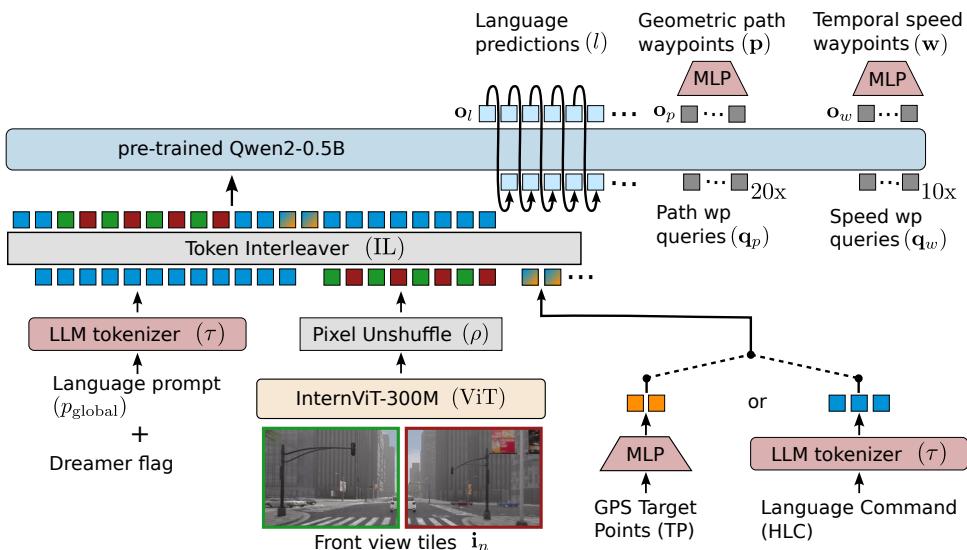
As shown in Figure 2, the architecture consists of three main stages: Encoding, Fusion (Interleaving), and Decoding (LLM processing).
1. High-Resolution Image Encoding
One of the subtle challenges in autonomous driving is resolution. A traffic light at a large intersection might occupy only a few pixels in a standard image. Most pre-trained VLMs resize images to \(224 \times 224\) or \(336 \times 336\), which blurs out these critical details.
To solve this, SimLingo splits the input image \(I\) into tiles. Specifically, it splits the high-resolution camera image into \(N_I\) tiles of size \(448 \times 448\). Each tile is encoded independently using the Vision Transformer (ViT).
The mathematical representation for extracting visual features \(e_I\) is:

Here, \(\rho\) represents a “pixel unshuffle” operation that downsamples features to keep the token count manageable for the LLM, ensuring the model sees fine details without exploding computational costs.
2. Multimodal Token Interleaving
Once the images are encoded, they must be combined with other inputs:
- Navigational Conditioning: Either GPS target points (where to go) or high-level language commands (e.g., “turn left”).
- System Prompts: Instructions telling the model what task to perform (e.g., “Predict the waypoints” or “Explain what you are doing”).
These inputs are processed into embeddings (\(e_{nav}\), \(e_L\)) and interleaved into a single sequence that the Large Language Model can digest:

3. Disentangled Action Output
This is a crucial innovation for driving stability. Standard driving models often output a sequence of waypoints that represent the car’s future location at specific timestamps. However, mixing “where to be” (geometry) and “when to be there” (speed) can lead to sloppy steering, especially when the car needs to slow down or swerve.
SimLingo decouples these predictions. The LLM predicts two distinct sets of outputs in a single forward pass:
- Geometric Path Waypoints (\(p\)): A series of points spaced every 1 meter. This tells the car strictly where to steer, independent of time.
- Temporal Speed Waypoints (\(w\)): Coordinates predicted every 0.25 seconds. This tells the car how fast to move along that path.
The final output generation is modeled as:

By using separate query tokens (\(q_p\) and \(q_w\)) and distinct PID controllers for steering and acceleration, the model achieves much smoother control.
The Core Innovation: Action Dreaming
Perhaps the most fascinating contribution of this paper is the concept of Action Dreaming.
Training a car to follow language instructions is hard because real driving data is boring. You rarely find expert driving data where a human is instructed to “drive onto the sidewalk” or “crash into that construction cone.” Yet, to test if a model truly understands language, it needs to be able to map any instruction to a corresponding physical action.
If you only train on “safe” instructions (like “drive straight”), the model might ignore the text and just drive straight because that’s what the visual features (the road) suggest. This is called “causal confusion.”
How “Dreaming” Works
The researchers created a synthetic dataset using a “world-on-rails” simulation. They take a recorded driving scene and mathematically simulate different futures:
- What if the car accelerated right now?
- What if it changed lanes into oncoming traffic?
- What if it swerved to hit that object?
They then pair these simulated trajectories with language instructions (e.g., “Accelerate now” or “Crash into the object”). During training, the model is fed the image and the instruction and must predict the corresponding trajectory—even if it’s dangerous.
Note: This mode is only for training or testing understanding. In the real world, the “Dreamer flag” is deactivated, and the model is tasked with rejecting unsafe instructions.
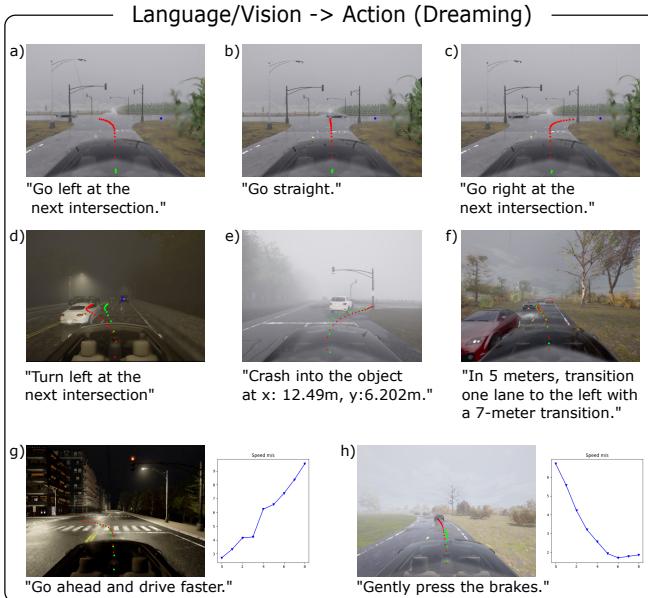
Figure 4 demonstrates this capability. In scene (e), the model is instructed to “Crash into the object,” and it correctly plots a trajectory toward the obstacle. In scene (g), instructed to “drive faster,” the blue speed graph spikes. This proves the model isn’t just looking at the road; it’s listening to the user.
Experiments and Results
The researchers evaluated SimLingo on two major benchmarks: the official CARLA Leaderboard 2.0 and the Bench2Drive benchmark.
Driving Performance
The results on the CARLA Leaderboard 2.0 are impressive. This benchmark is notoriously difficult, testing vehicles in diverse weather, lighting, and traffic scenarios.
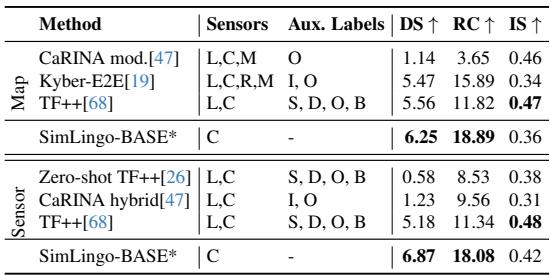
As shown in Table 1, the base version of the model (SimLingo-BASE) achieves a Driving Score (DS) of 6.25 to 6.87. This might look like a small number, but in the context of Leaderboard 2.0, it is a massive leap. It outperforms the previous state-of-the-art (CaRINA hybrid) by a factor of roughly 4x, and importantly, it does this using only cameras. Most top competitors require LiDAR and Radar maps.
The results on the local Bench2Drive benchmark further confirm this dominance:
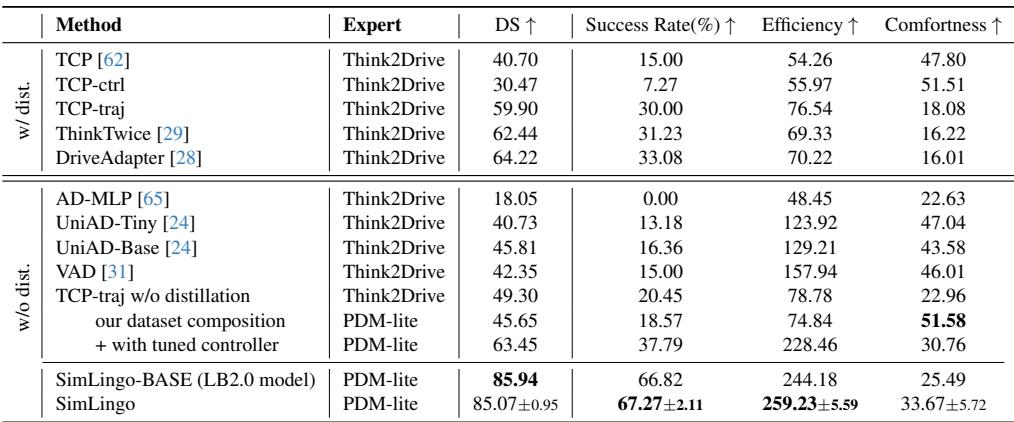
Here, SimLingo achieves a Driving Score of 85.07, significantly outperforming previous methods like TCP (40.70) and UniAD (45.81). This table highlights that adding language capabilities (the VQA and Dreaming tasks) does not degrade the pure driving performance—a “best of both worlds” outcome.
Language Capabilities
Does the model actually understand the scene, or is it just a good driver?
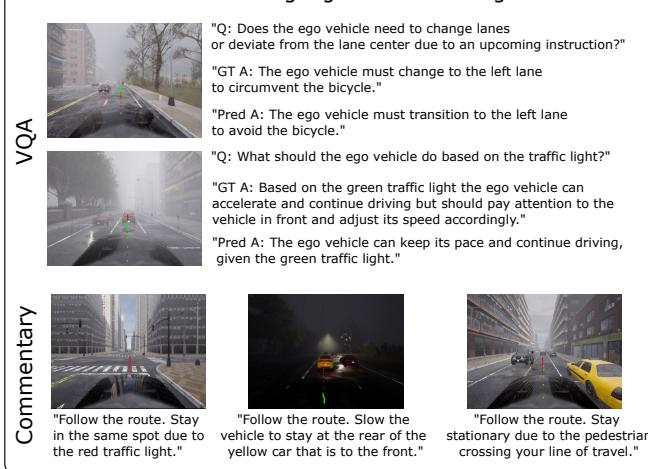
Figure 3 shows the model’s ability to answer Visual Question Answering (VQA) prompts. In the top example, the model correctly identifies that it needs to move left to avoid a bicycle. In the bottom, it correctly analyzes a traffic light scenario.
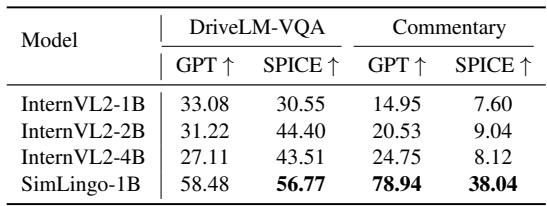
Table 3 quantifies this. SimLingo achieves a GPT-Score (a metric where GPT-4 grades the answer) of 58.48 on the DriveLM-VQA benchmark, nearly double the score of the base InternVL2-1B model. This shows that fine-tuning on driving-specific data turns a generalist VLM into a domain expert.
Does “Dreaming” Work?
To verify the “Action Dreaming” alignment, the researchers tested the model’s ability to follow instructions that deviate from normal driving behavior.

Table 5 reveals the impact of the Dreaming dataset. Without it (w/o Dreamdata), the model fails to follow instructions like “Slower” (22% success) or “Lane Change” (21% success) because it simply defaults to standard driving behavior. With the Dreaming training, success rates skyrocket to 80%+.
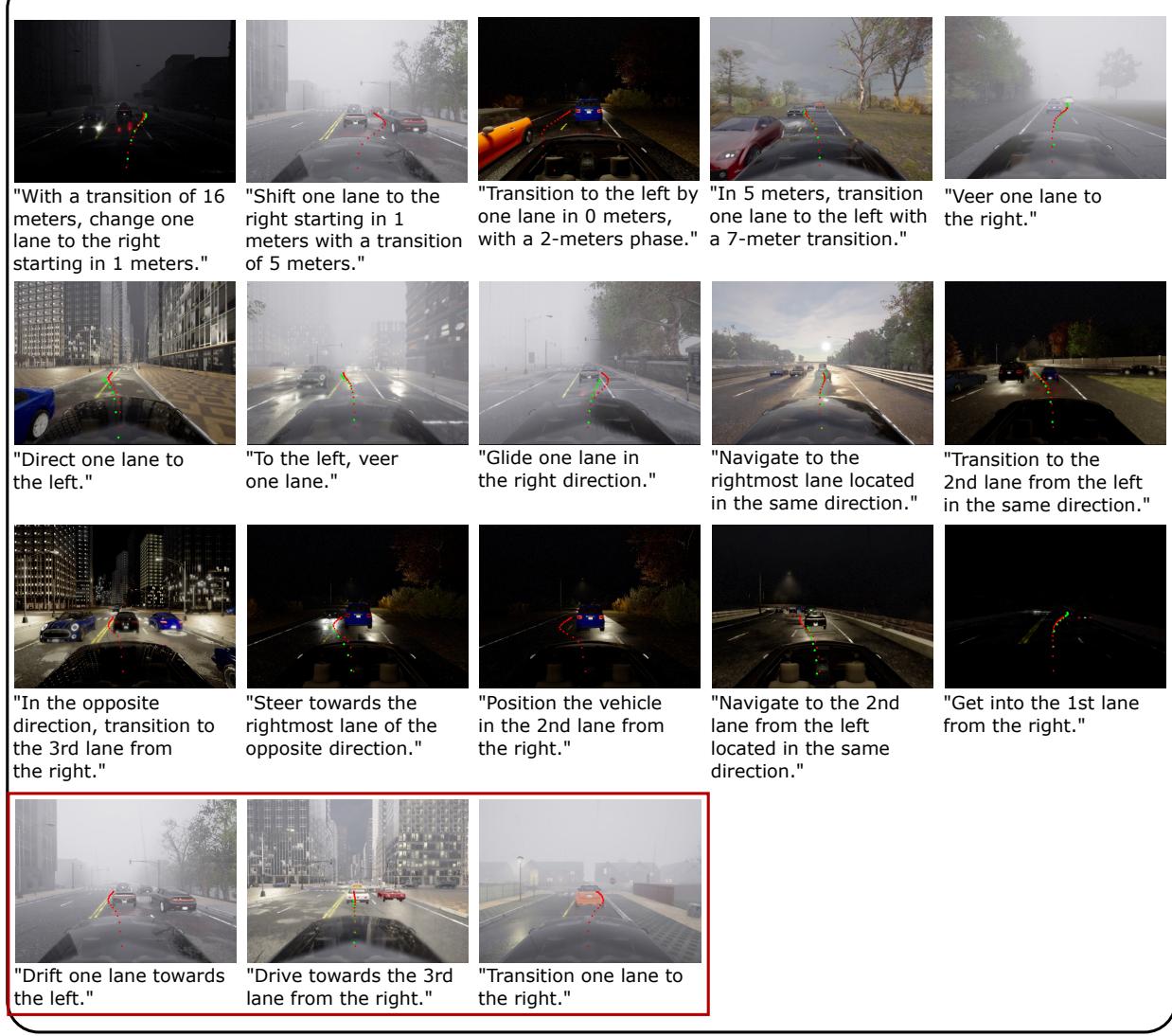
We can see this visually in Figure 11. The model can interpret complex instructions like “Transition one lane to the right starting in 1 meter” and generate precise path waypoints (red dots) that execute that maneuver.
Ablation Studies: What Matters?
The researchers performed ablation studies to see which components contributed most to the success.
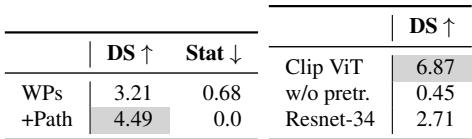
Table 9 highlights two key findings:
- Output Representation (Column a): Using the disentangled “Waypoints + Path” representation (separating speed and steering) drastically reduces collisions with static layout objects compared to using just waypoints. The collision rate drops from 0.68 to 0.0.
- Vision Encoder (Column b): Pre-training matters. Training the vision encoder from scratch results in a fail (0.45 DS), while using the CLIP-pretrained encoder yields state-of-the-art results (6.87 DS).
Navigation vs. Language Commands
An interesting side-experiment was comparing standard GPS navigation points against natural language commands (e.g., simply telling the car “Turn right”).
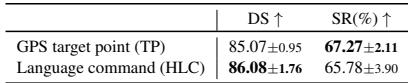
Table 4 shows that SimLingo performs almost identically whether it is guided by precise GPS points (85.07 DS) or high-level language commands (86.08 DS). This suggests that we are moving closer to a future where we can simply talk to our cars to give directions, rather than inputting coordinates.
Conclusion
SimLingo represents a significant step forward in the convergence of Large Language Models and Autonomous Driving. By introducing Action Dreaming, the researchers have found a way to bridge the gap between “seeing” and “doing,” ensuring that the model’s language understanding is grounded in physical actions.
Key Takeaways:
- Camera-Only SOTA: SimLingo sets a new standard on the CARLA Leaderboard 2.0 without needing expensive LiDAR.
- Alignment via Dreaming: Simulating alternate futures allows the model to learn instruction-following beyond just mimicking safe expert driving.
- Unified Model: A single architecture can drive, explain its actions, and answer questions without trading off performance.
While the current work is simulation-based, the implications for real-world robotics are profound. If robots can learn to “dream” actions based on language, they become safer, more interpretable, and easier for humans to control. Future work will likely focus on deploying these lightweight VLMs onto real vehicles, bringing us one step closer to the intelligent co-pilots science fiction promised us.