](https://deep-paper.org/en/paper/2503.09958/images/cover.png)
Imagine teaching a child to ride a bicycle. At first, you use training wheels. These provide stability and guidance, ensuring the child understands the mechanics of balancing and pedaling. But eventually, once the child gains momentum and confidence, the training wheels become unnecessary—perhaps even a hindrance to speed and maneuverability. You take them off, and the child continues to ride effectively.
In the world of Large Language Models (LLMs), In-Context Learning (ICL) acts a lot like those training wheels. By providing a model with a few examples (demonstrations) of how to solve a task, we guide it to produce the desired output. This is particularly useful for alignment—getting an LLM to follow instructions, be helpful, and remain safe without expensive fine-tuning.
However, standard ICL has a problem: it keeps the training wheels on forever. It forces the model to process those examples for every single token it generates, which is computationally expensive and slow.
In this post, we are diving into a fascinating paper titled “Take Off the Training Wheels! Progressive In-Context Learning for Effective Alignment.” The researchers propose a method called PICA (Progressive In-Context Alignment) that allows LLMs to use demonstrations to get started and then discard them to accelerate generation—without losing accuracy.
The Problem: The Cost of Alignment
Before we get to the solution, let’s establish the context. Aligning LLMs with human preferences is usually done through training-heavy methods like Supervised Fine-Tuning (SFT) and Reinforcement Learning from Human Feedback (RLHF). While effective, these methods require massive datasets and significant computational resources to update the model’s weights.
In-Context Learning (ICL) offers a “training-free” alternative. You simply prompt the model with a few examples of good behavior (e.g., “User: Be polite. Model: Certainly! How can I help?”), and the model aligns itself for the current session.
The downside? Inference cost. If your input prompt contains 1,000 tokens of examples, the model has to process those 1,000 tokens continuously. For complex generation tasks, this overhead is massive.
The researchers behind PICA asked a critical question: Are demonstrations actually necessary for the entire generation process?
The Investigation: How Demonstrations Impact Tokens
To answer that question, the authors conducted a series of experiments analyzing the probability distributions of tokens generated by the Llama-2 and Mistral models. They used KL-Divergence, a statistical metric that measures how different two probability distributions are.
They compared two scenarios:
- Zero-shot: No examples provided.
- Few-shot: Examples provided (Standard ICL).
They visualized where the model’s behavior shifted the most.
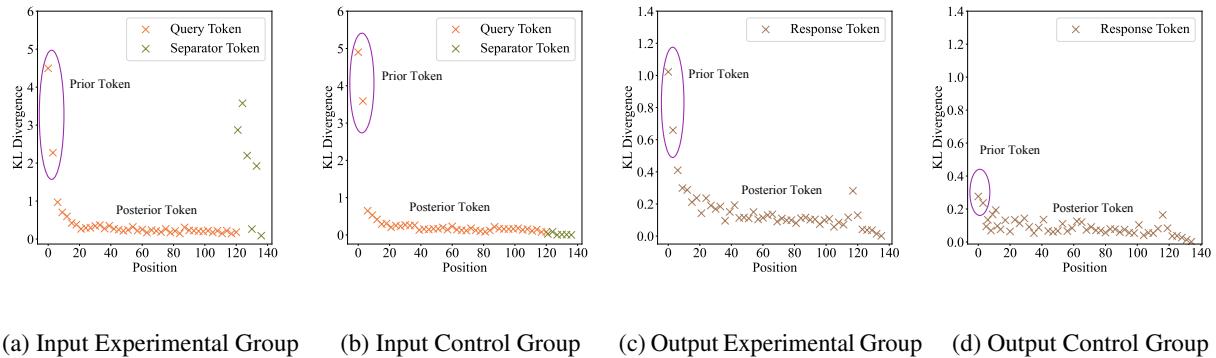
As shown in Figure 1 above, the results were revealing. Let’s break down the four graphs:
- Input Analysis (Top Row):
- Look at the “Separator Token” (marked with green ‘x’s). In the Experimental Group (comparing Zero-shot to Few-shot), the KL-divergence for separator tokens is massive.
- Interpretation: The model is encoding the “task function” (what it’s supposed to do) into the representation of the separator token—the delimiter between the query and the answer.
- Output Analysis (Bottom Row):
- Look at the purple circles in the bottom-left graph. The divergence is high for the Prior Response Tokens (the first few words of the answer) but drops significantly for the Posterior Response Tokens (the rest of the answer).
- Interpretation: Demonstrations are crucial for starting the response correctly. However, once the first few tokens are generated, the model enters a “flow state” where the demonstrations become redundant. The model already knows the trajectory.
This leads to the core hypothesis of the paper: The transformer embeds the task function into the separator token, and demonstrations are only needed to generate the first few tokens.
The Solution: Progressive In-Context Alignment (PICA)
Based on these findings, the authors developed PICA. The method is designed to “take off the training wheels” by splitting the generation process into two distinct stages.
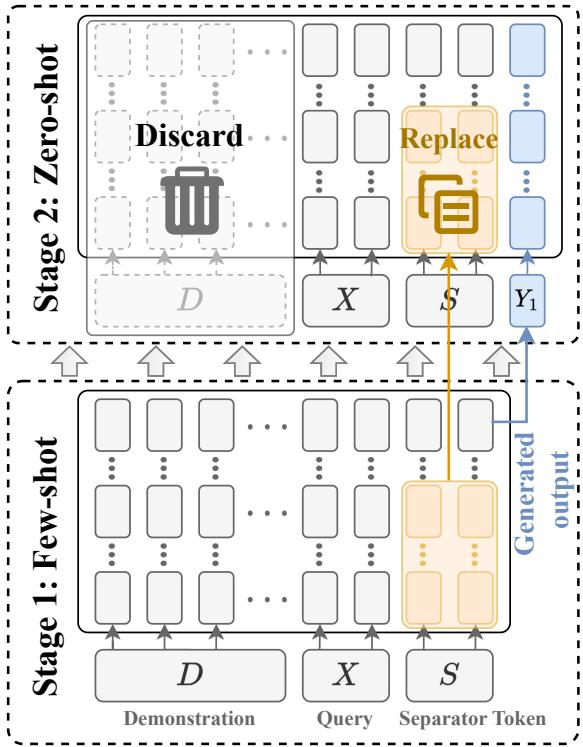
As illustrated in Figure 2, PICA operates in two stages: the Few-shot Stage and the Zero-shot Stage.
Stage 1: The Few-Shot Stage (Gaining Momentum)
In the first stage, the model behaves like a standard In-Context Learner. It takes the Demonstrations (\(D\)), the Query (\(Q\)), and the Separator (\(S\)) to generate the first few tokens of the answer.
The mathematical formulation for this stage is standard ICL:

Here, the model generates the prior tokens (\(Y_{1:i-1}^{few}\)). Crucially, during this pass, the authors extract the ICL Vector.
Remember the observation that the task information is stored in the separator token? PICA captures the hidden states of the separator token from the first \(L\) layers of the transformer. This “ICL Vector” contains the condensed essence of the task instructions found in the demonstrations.
Stage 2: The Zero-Shot Stage (Taking Off the Wheels)
Once a small number of tokens (e.g., 10 tokens) have been generated, PICA switches gears.
- Discard Demonstrations: The bulky examples (\(D\)) are removed from the input context.
- Inject Context: The prior tokens generated in Stage 1 are appended to the input.
- Inject Guidance: The extracted ICL Vector is used to intervene in the model’s forward pass.
The model now generates the rest of the response without the computational burden of the demonstrations:

To ensure the model doesn’t forget the task instructions (which were in the discarded demonstrations), PICA performs an intervention. It replaces the hidden states of the separator token in the zero-shot pass with the ICL Vector extracted earlier:
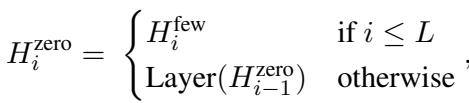
This implies that we are surgically implanting the “memory” of the instructions into the model’s processing stream, allowing it to continue as if the demonstrations were still there, but with the speed of a zero-shot model.
Experimental Results
Does PICA actually work? The researchers tested it against Vanilla ICL, Zero-shot, and even fully trained models (SFT and RLHF) using benchmarks like Alpaca-eval and Just-eval.
Effectiveness and Efficiency
The results, summarized in the table below, are impressive.
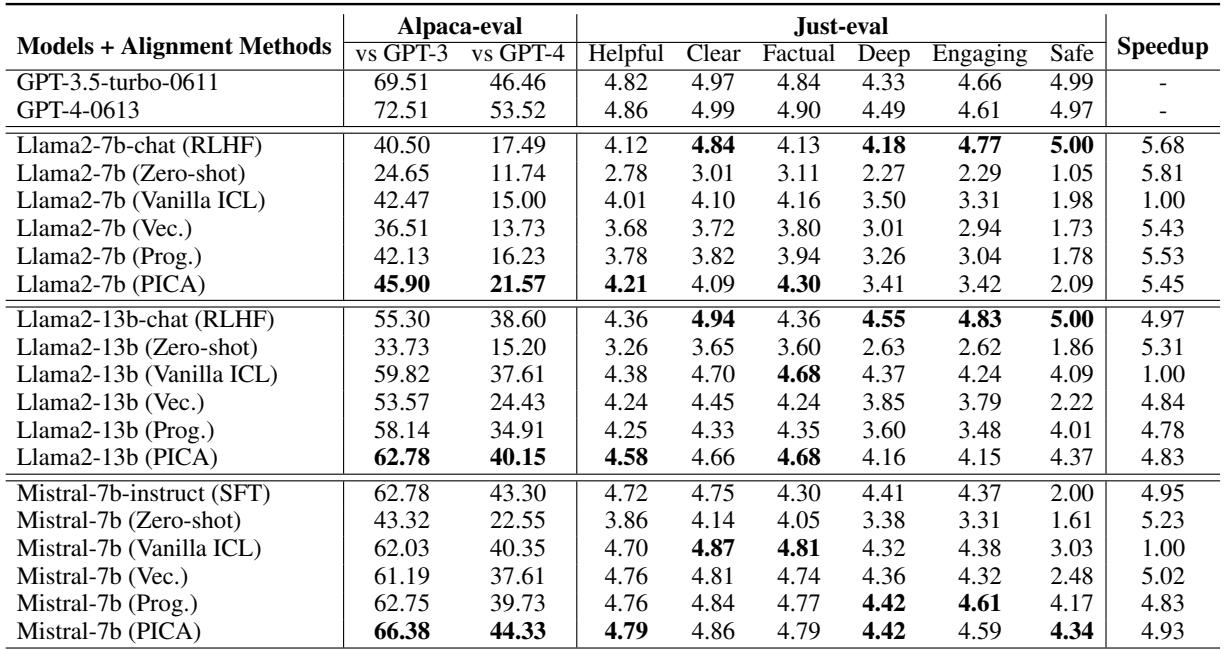
Key Takeaways from the Data:
- PICA vs. Vanilla ICL: PICA consistently achieves higher win rates against GPT-4. For example, on the Llama2-13b model, PICA achieves a 40.15% win rate against GPT-4, compared to Vanilla ICL’s 37.61%.
- Comparison to SFT/RLHF: PICA is comparable to, and sometimes better than, models that underwent expensive fine-tuning. On Llama2-7b, PICA significantly outperforms the RLHF version (21.57% vs 17.49% win rate against GPT-4).
- Speedup: Look at the “Speedup” column. PICA provides roughly a 5.45x speedup compared to Vanilla ICL. This is a game-changer for deploying LLMs, as it brings the inference speed almost to the level of zero-shot models.
Ablation Studies: Why the Components Matter
The authors didn’t just stop at the main results; they dissected PICA to understand why it works.
1. Layer Selection
They investigated which layers are most important for extracting the ICL Vector.
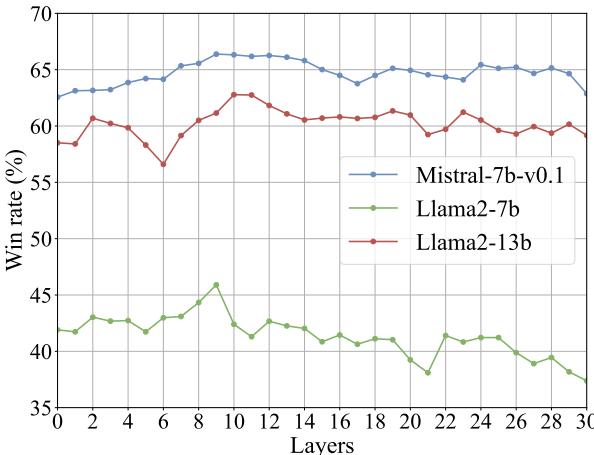
Figure 3 shows that the performance improves as you include more layers up to a certain point (around layer 10-15), and then plateaus. This supports the theory that the Transformer “builds” the task function in the earlier layers. Including deeper layers introduces noise because those layers are focused on predicting the specific next token rather than encoding the general task.
2. How Many Tokens are “Enough”?
How long do the “training wheels” need to stay on?
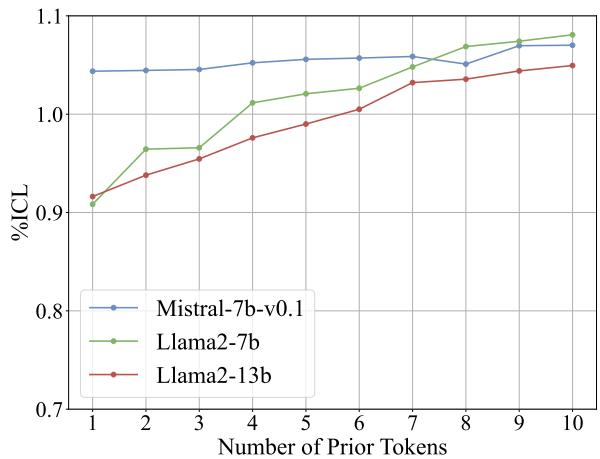
As shown in Figure 4, the performance gain rises sharply with the first few tokens. By the time the model has generated 10 prior tokens, PICA surpasses the performance of Vanilla ICL (represented by the 1.0 line). This confirms that the demonstrations are redundant after the very beginning of the response.
3. Robustness
Standard ICL is known to be brittle—if you pick “bad” examples, the model performs poorly. PICA appears to be much more robust.
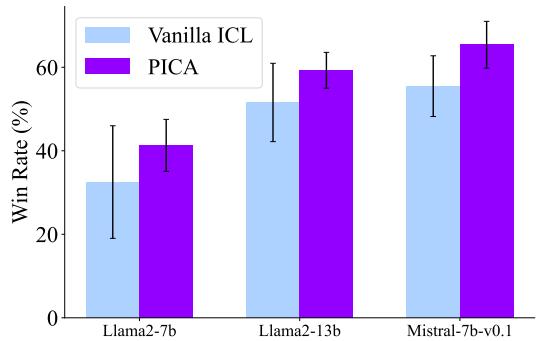
Figure 5 illustrates that PICA (purple bars) not only has a higher average win rate but also lower variance compared to Vanilla ICL (blue bars). Because PICA relies on the implicit representation of the task (the vector) and the generated prior tokens, it is less sensitive to the specific quirks of the input examples once the generation gets going.
Human Evaluation
To ensure these metrics weren’t just artifacts of automated testing, the researchers conducted human evaluations.
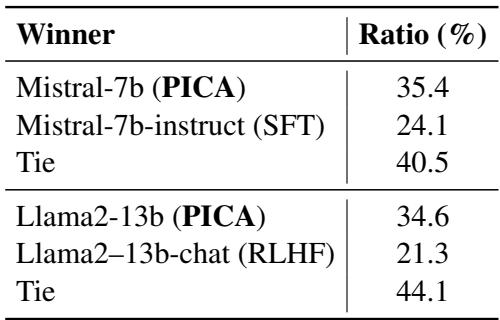
The human evaluation (Table 2) mirrors the automated benchmarks. For Mistral-7b, PICA beat the SFT model 35.4% of the time and tied 40.5% of the time. This is a strong validation that training-free methods can compete with fine-tuning.
Limitations and Future Work
While PICA is promising, it isn’t perfect. The authors note a specific weakness in enumeration tasks (e.g., “List 10 famous musicians”).
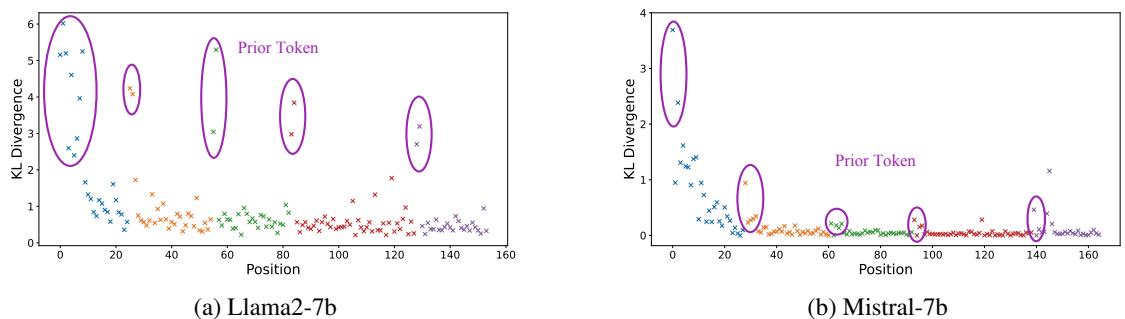
In Figure 7, we see that for list-based answers, the KL-divergence spikes again at the beginning of each new item in the list. This suggests that for tasks requiring independent, sequential items, the “training wheels” might need to be put back on momentarily for each new bullet point. The current version of PICA doesn’t handle this “re-initialization” well, leading to lower quality in long lists.
Conclusion
The “Take Off the Training Wheels!” paper presents a compelling argument for rethinking how we use In-Context Learning. It challenges the assumption that the full context is needed throughout the entire generation process.
By identifying that (1) task functions are stored in separator tokens and (2) demonstrations are only critical for the initial tokens, the researchers built PICA. This method offers a “best of both worlds” solution: the high quality of few-shot learning with the speed and efficiency of zero-shot inference.
For students and researchers in NLP, PICA highlights the importance of looking “under the hood” of Transformers. It’s not just about what the model outputs, but how and where it represents information internally. As we move toward more efficient AI, methods that intelligently manage context—rather than blindly processing it—will be essential.