](https://deep-paper.org/en/paper/2503.09968/images/cover.png)
Imagine you are training a self-driving car. You live in a sunny coastal city, so you gather thousands of hours of driving footage—all under bright blue skies and clear visibility. You train your object detection model until it detects pedestrians and other cars perfectly.
Now, you ship that car to London on a foggy, rainy night. Suddenly, the model fails. The pedestrians are obscured by mist; the cars are just blurs of red taillights reflecting on wet pavement.
This is the classic problem of Domain Generalization. In the specific sub-field known as Single-Domain Generalization (SDG), the challenge is even steeper: how do we train a model on only one domain (Source: Sunny Day) so that it performs well on any unknown domain (Target: Rainy, Night, Foggy, Sketch, etc.)?
In this post, we are diving into a fascinating paper titled “Style Evolving along Chain-of-Thought for Unknown-Domain Object Detection.” The researchers propose a novel method to prepare models for the unknown by simulating complex style evolutions—mimicking a “chain of thought”—during training.
The Problem: One-Step Prompts Aren’t Enough
To solve the lack of target domain data (e.g., we don’t have the rainy night photos yet), modern approaches often use Vision-Language Models (like CLIP). They use text prompts to “hallucinate” or simulate what other domains might look like.
Previous methods used one-step prompts. They would take a source image and apply a style transfer based on a simple prompt like “driving on a rainy night.”
However, real-world scenes are complex. A “rainy night” isn’t just a filter. It involves darkness, wet roads, reflections, windshield wipers, and pedestrians holding umbrellas. The authors of this paper argue that simple, one-step prompts fail to capture this complexity. They result in simplistic style transfers that don’t prepare the model for the gritty reality of unknown domains.
The Solution: Style Evolving along Chain-of-Thought
The core innovation here is borrowing a concept from Large Language Models (LLMs): the Chain-of-Thought (CoT). Instead of a single command, the method breaks down the style description into a progressive sequence: Word \(\rightarrow\) Phrase \(\rightarrow\) Sentence.
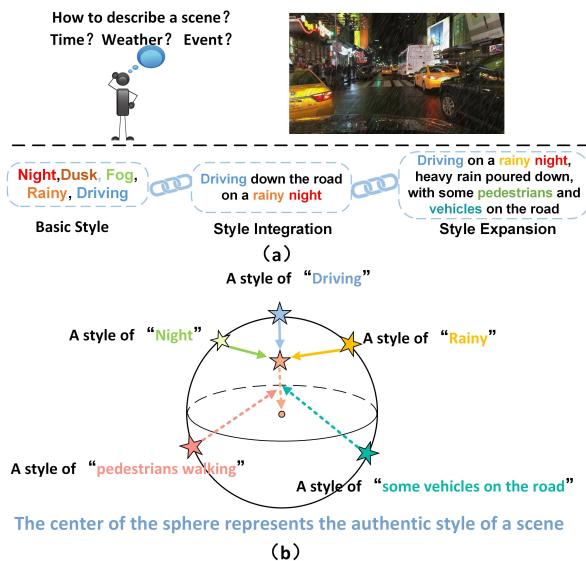
As shown in Figure 1 above, rather than jumping straight to a complex style, the model builds it up:
- Basic: “Rainy”
- Integrated: “Driving down the road on a rainy night.”
- Expanded: “Driving on a rainy night, heavy rain poured down, with some pedestrians and vehicles on the road.”
This progressive evolution exposes the object detector to a continuous spectrum of styles, from simple to complex, allowing it to learn robust features that survive severe domain shifts.
The Architecture: How It Works
The proposed framework integrates this Chain-of-Thought strategy into a standard object detection pipeline (like Faster R-CNN). Let’s break down the architecture shown below.
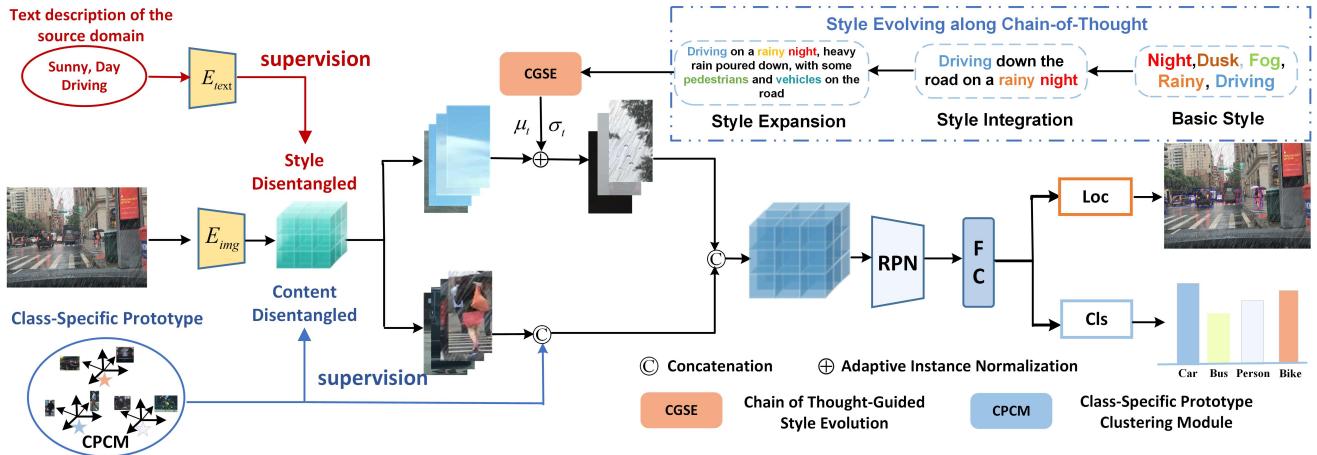
The architecture is designed to do two main things:
- Disentangle the image into Content (the objects) and Style (the weather/lighting).
- Evolve the Style using the Chain-of-Thought to create new training samples.
Let’s look at the specific mathematical steps that make this happen.
1. Constructing the Chain of Thought
First, the system needs to generate the text descriptions. It doesn’t just guess; it uses an image captioning model to look at the source image (sunny day) and pick relevant keywords (e.g., “driving,” “road”). Then, it uses a Large Language Model (like ChatGPT) to hallucinate variations.
It builds the text features in three stages.
Stage 1: Words. It starts with single words selected from vocabularies (Weather, Time, Style).

Stage 2: Phrases. It combines these words into short phrases to create a specific atmosphere.

Stage 3: Sentences. Finally, it expands the description with details about the environment and objects.

By summing these features (\(F_t^1\), \(F_t^2\), \(F_t^3\)), the model creates a rich, layered textual representation of the target style.
2. Evolving the Visual Style
Now that we have the text representation of the style, we need to force the image to match it. This is done using Adaptive Instance Normalization (AdaIN).
The idea is to normalize the source image features (\(F_s\)) and then scale and shift them using parameters (\(\mu_t, \sigma_t\)) derived from the text.

First, the source features are normalized:
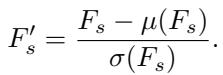
Then, the style is injected:

Crucially, the model calculates a Consistency Loss (\(\mathcal{L}_{tc}\)). This forces the newly styled image features (\(F_i\)) to be semantically similar to the complex text description (\(F_t^3\)).

3. Disentangling Content and Style
One major risk in style transfer is destroying the content. If you make an image look too much like a “Van Gogh painting,” a car might start looking like a swirling cypress tree. To prevent this, the authors employ a Disentanglement Module.
They extract two distinct sets of features from the backbone:

They use a Contrastive Loss to ensure these two feature sets are as different as possible (pushing style and content apart).

They also use a consistency loss to ensure the extracted style matches the source domain’s text description.

4. Class-Specific Prototypes
Finally, to ensure the object detector doesn’t lose track of what a “car” or “person” looks like amidst all this style changing, they introduce Class-Specific Prototypes.
Think of a prototype as the “ideal” mathematical representation of a class. The model clusters features to find the center of the “car” cluster.

These prototypes are used to enhance the content features, ensuring that even if the image looks like a rainy night, the underlying features of the car remain distinct and detectable.

Experiments and Results
Does this complexity pay off? The researchers tested the model on two distinct benchmarks: Diverse Weather Driving and Real-to-Art.
1. Diverse Weather Scenarios
They trained the model on a clear, sunny dataset and tested it on Night/Sunny, Dusk/Rainy, Night/Rainy, and Day/Foggy datasets.
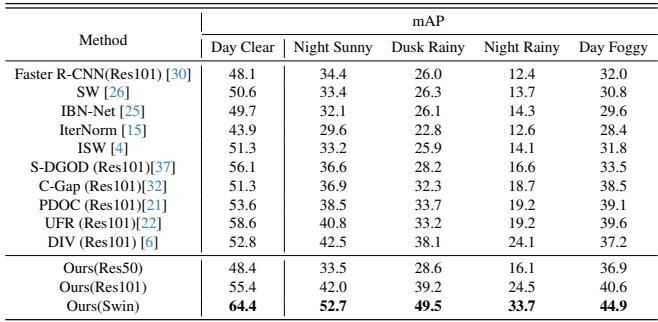
As seen in Table 1, the proposed method (Ours) consistently outperforms state-of-the-art competitors like C-Gap and S-DGOD. Specifically, look at the Night Rainy column—one of the hardest scenarios. The ResNet-101 version of this method achieves 24.5% mAP, a significant jump over the baseline Faster R-CNN (12.4%) and previous bests.
2. Real-to-Art Generalization
Generalization isn’t just about weather; it’s about domain shifts. The authors trained on real photos (Pascal VOC) and tested on artistic datasets (Comics, Watercolors, Clipart).
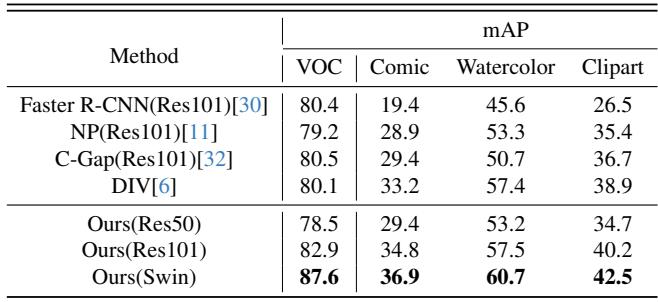
The results in Table 2 are striking. For Comic images, the method achieves 34.8% mAP (with ResNet-101), beating the C-Gap method by over 5%. This proves the Chain-of-Thought style evolution helps the model understand fundamental object structures regardless of the artistic rendering.
Qualitative Analysis: Seeing the Difference
Numbers are great, but detection boxes tell the story better. In Figure 4 below, we see a comparison between C-GAP (a leading competitor) and the proposed method.
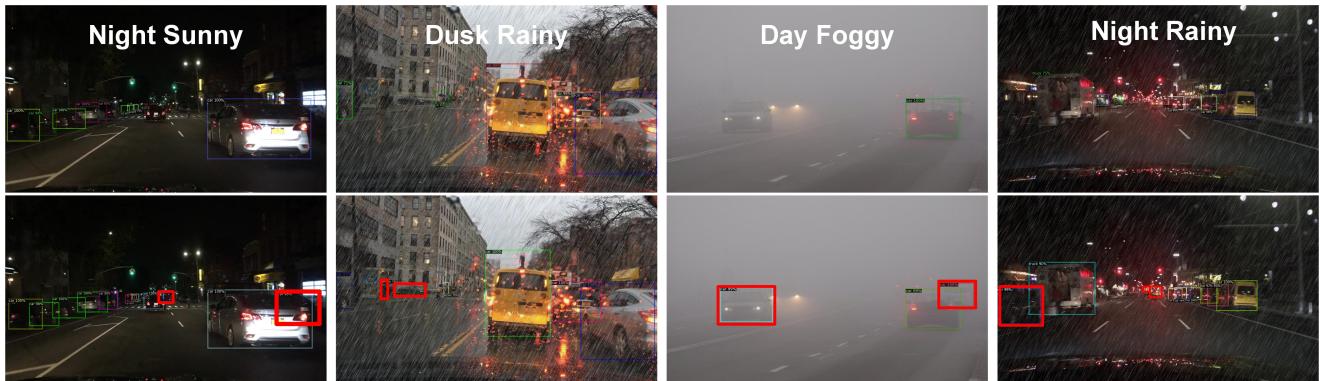
Pay attention to the Red Boxes. These are objects that C-GAP missed but the proposed Chain-of-Thought method detected. In the dark, rainy scenes, the proposed method successfully picks up vehicles that are barely visible to the human eye.
Why does it work? (Visualization)
The authors visualized the feature heatmaps to see where the model was looking.

- Column 2 (One-step): The activation is scattered. The model is distracted by the background.
- Column 4 (Three-level Chain-of-Thought): The activation is tight and focused on the objects (cars).
This confirms that progressively refining the style description helps the model learn to ignore the “style” (rain, fog) and focus on the “content” (objects).
Does the Hierarchy Level Matter?
Is the three-step process (Word-Phrase-Sentence) actually necessary? The authors performed an ablation study to find out.
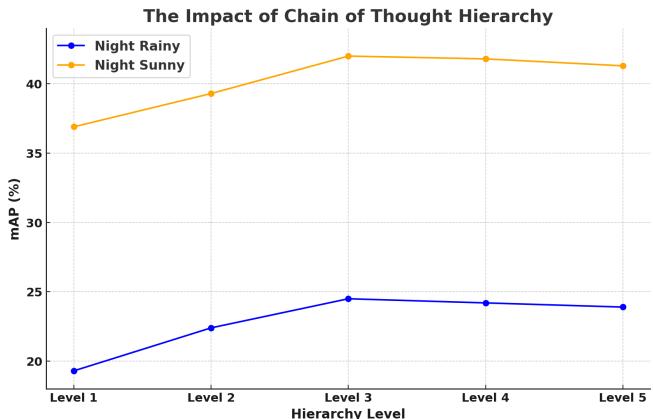
Figure 6 shows that performance peaks at Level 3.
- Level 1 (One-step): Too simple.
- Level 5: Too complex. If the prompts become too long or abstract, they might introduce noise that confuses the style transfer. The “Goldilocks” zone is the three-level chain: Word, Phrase, Sentence.
Conclusion
The paper “Style Evolving along Chain-of-Thought for Unknown-Domain Object Detection” presents a clever intersection of Vision and Language. By treating “style” not as a static filter but as an evolving concept—much like a thought process—the researchers allowed their model to experience a vast gradient of potential environments during training.
Key Takeaways:
- Complexity Matters: Simple prompts cannot capture the nuance of real-world domain shifts (like rainy nights).
- Chain-of-Thought: Progressively building style descriptions (Word \(\rightarrow\) Phrase \(\rightarrow\) Sentence) creates better training data.
- Disentanglement is Key: You must separate what an object is from where it is to maintain detection accuracy.
This approach sets a new standard for Single-Domain Generalization, promising safer autonomous systems that can handle the unexpected, even if they’ve only ever seen a sunny day.