](https://deep-paper.org/en/paper/2503.10078/images/cover.png)
Have you ever compressed an image so much that it looked blocky and pixelated, yet your phone still recognized the face in it perfectly? Conversely, have you ever taken a photo that looked fine to you, but your smart camera refused to focus or detect the object?
For decades, the field of image processing has been obsessed with one question: “Does this look good to a human?”
We built compression algorithms (like JPEG), cameras, and restoration filters designed to please the Human Visual System (HVS). But the world has changed. According to recent data, Machine-to-Machine (M2M) connections have surpassed Human-to-Machine connections. Today, the primary consumer of visual data isn’t you or me—it’s Artificial Intelligence.
This shift creates a massive problem. What looks “good” to a human eye might be indecipherable garbage to a machine’s neural network. And what a machine finds perfectly readable might look like static noise to us.
In this post, we are diving deep into a groundbreaking paper titled “Image Quality Assessment: From Human to Machine Preference.” The researchers argue that we need to stop optimizing solely for human eyes and start understanding Machine Preference. They introduce the first-ever large-scale database designed to teach us what machines actually want to see.
The Great Divide: Human vs. Machine Vision
To understand why this research is necessary, we first have to accept that biological eyes and digital sensors do not “see” the same way.
Humans prioritize aesthetics. We care about texture, natural colors, and structural integrity. If a sky looks slightly pixelated, we notice immediately. Machines, however, care about utility. A self-driving car doesn’t care if the stop sign is “beautifully rendered”; it cares if the edges are sharp enough to be classified as a stop sign.
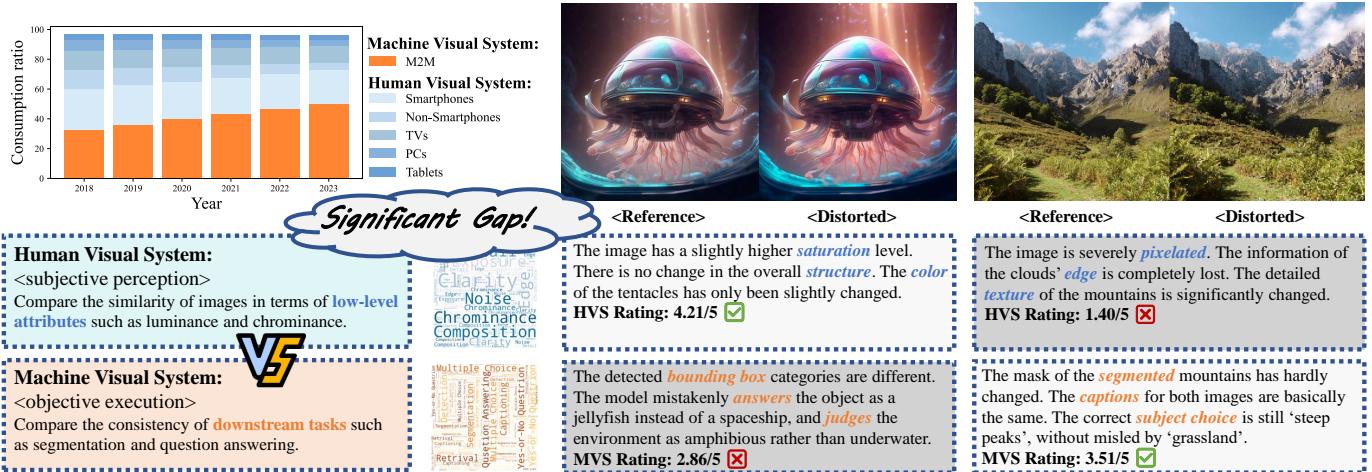
As shown in Figure 1 above, there is a significant gap between the Human Visual System (HVS) and the Machine Visual System (MVS).
- Top Center: Look at the spaceship images. The left image looks sharp to us (Human Rating: 4.21/5), while the right one looks pixelated (Human Rating: 2.86/5). However, a machine might fail to process the “sharp” one due to high saturation or specific noise patterns, while it perfectly understands the pixelated one.
- Bottom Right: The mountain landscape shows a clear segmentation error. The machine sees the mountain (MVS Rating: 3.51/5), but a human rates the distorted version poorly (1.40/5) because it looks unnatural.
This discrepancy has real-world consequences. If we compress images to look good for humans, we might accidentally destroy the features an AI needs to detect cancer in an X-ray or a pedestrian on the road.
The Landscape of Image Quality Assessment (IQA)
Before this paper, Image Quality Assessment (IQA) databases were entirely human-centric. Researchers would gather thousands of images, distort them, and ask thousands of humans to rate them. The resulting datasets (like LIVE or TID2013) became the gold standard for training algorithms.
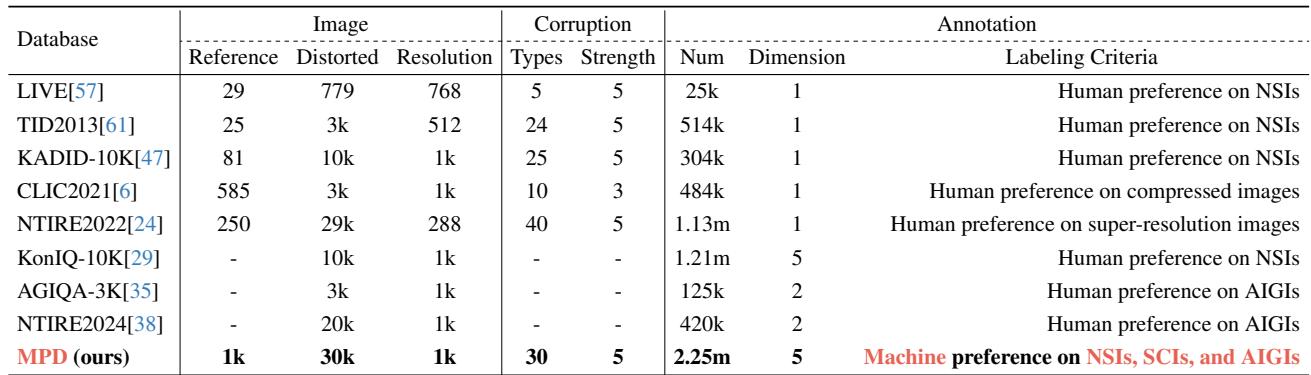
Table 1 illustrates the limitations of these legacy databases. Notice the “Annotation Labeling Criteria” column for the previous datasets: they are all based on “Human preference.”
The researchers behind this paper realized that to serve the modern internet of things (IoT) and AI ecosystems, they needed a new standard. They created the Machine Preference Database (MPD). It is the first database of its kind, boasting:
- 30,000 reference/distorted image pairs.
- 2.25 million fine-grained annotations.
- Evaluations from 30 different AI models.
Building the Machine Preference Database (MPD)
How do you ask a machine if it “likes” an image? You can’t just ask for a star rating. You have to test its performance. If an AI performs well on an image, the image quality is considered “high” for that machine. If the AI fails, the quality is “low.”
The construction of the MPD was a massive undertaking involving four distinct stages.
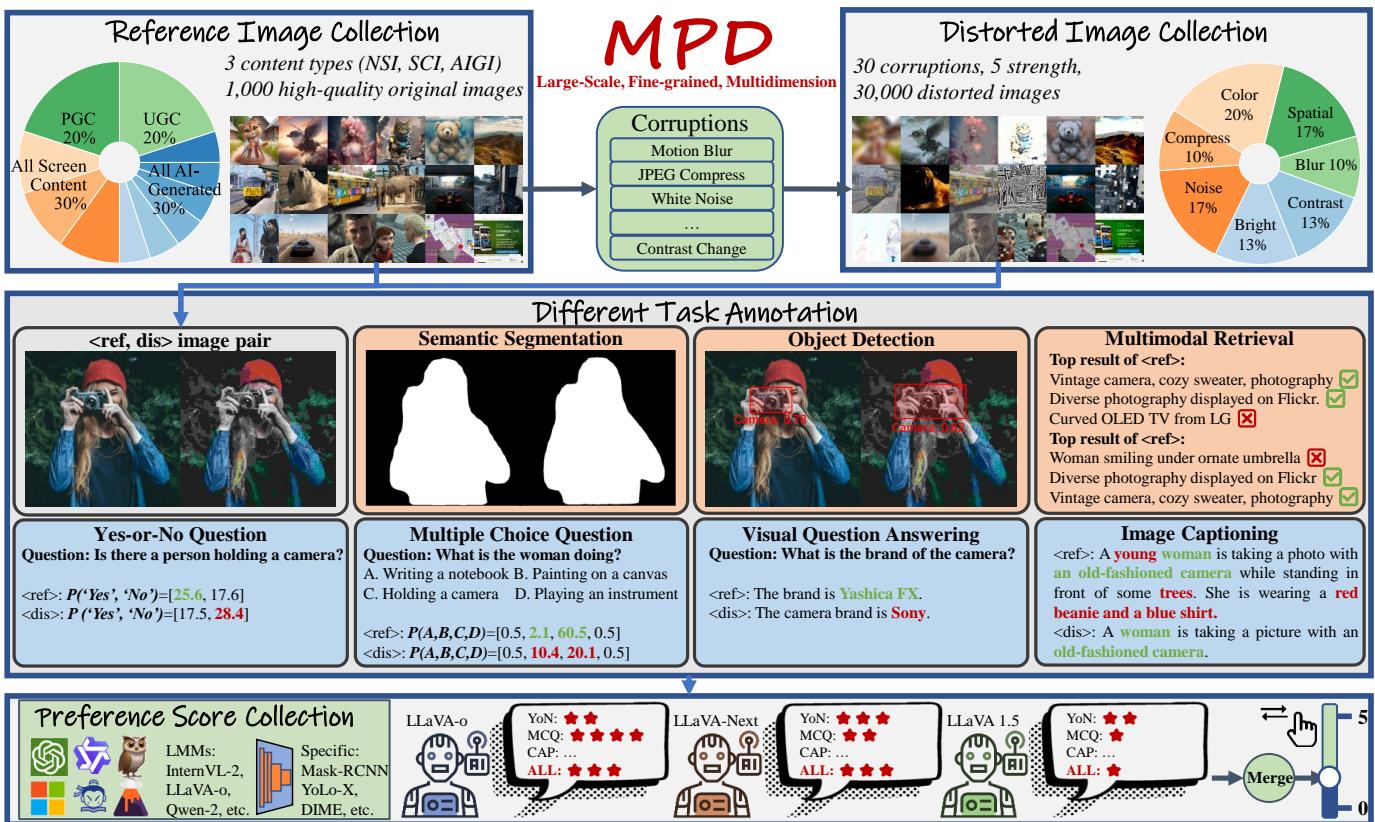
1. Image Collection
The team didn’t just stick to standard photos. To represent the modern internet, they collected 1,000 high-quality reference images across three categories:
- Natural Scene Images (NSIs): Standard photography.
- Screen Content Images (SCIs): Screenshots of websites, games, and documents.
- AI-Generated Images (AIGIs): Images created by models like Midjourney or DALL-E.
2. The Torture Chamber: Distorting the Images
To measure quality, you have to break things. The researchers applied 30 different types of corruption to these images. These weren’t just random noise; they modeled real-world problems like motion blur, JPEG compression artifacts, contrast changes, and transmission errors.
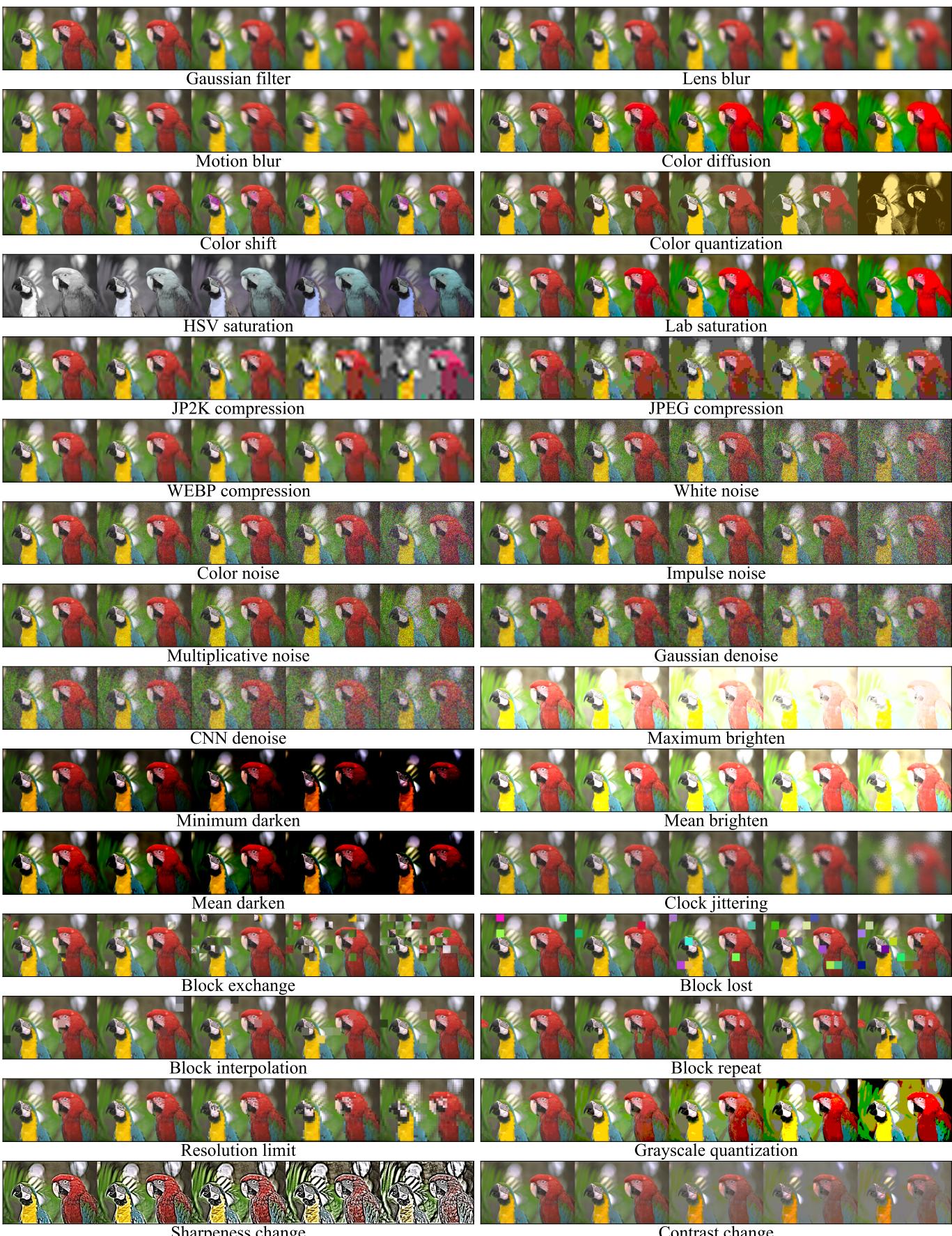
Take a look at Figure 12 above. It shows the sheer variety of distortions applied, from simple blurring (Row 1) to “Block exchange” (Row 4, where parts of the image are swapped) and “Pixelation” (Row 5). They applied these at 5 different strength levels.
3. Defining “Quality” for Machines
This is the core innovation of the paper. The researchers defined machine quality based on success in downstream tasks. They employed 15 Large Multimodal Models (LMMs) and 15 specialized Computer Vision (CV) models to perform 7 specific tasks on the distorted images.
If the model’s output on the distorted image matched its output on the clean reference image, the quality score was high.
The LMM Tasks (Thinking Models):
- YoN (Yes or No): Asking the model binary questions about the image.
- MCQ (Multiple Choice): Presenting a question with confusing options.
- VQA (Visual Question Answering): Asking open-ended questions.
- CAP (Captioning): Asking the model to describe the image.
The CV Tasks (Seeing Models):
- SEG (Segmentation): Can the model outline objects?
- DET (Detection): Can the model find bounding boxes around objects?
- RET (Retrieval): Can the model find this image in a database?
4. The Math Behind the Scores
To convert these tasks into numbers, the researchers used mathematical comparisons between the Reference result (\(ref\)) and the Distorted result (\(dis\)).
For Yes/No (YoN) tasks, they measured the difference in confidence probability:

For Multiple Choice (MCQ), they looked at the cosine similarity between the probability vectors of the options:

For Visual Question Answering (VQA), they compared the semantic meaning of the text answers using CLIP (a text-embedding model):

For Segmentation (SEG), they used the standard Intersection-over-Union (IoU) metric, which measures how much the predicted shape overlaps with the correct shape:

And for Object Detection (DET), they combined classification accuracy (\(Acc\)) with the bounding box overlap (\(IoU\)):

By aggregating these scores across 30 different models, the researchers established a “Mean Opinion Score” (MOS) for every single distorted image—not based on how it looked, but on how useful it was to the machines.
What Do Machines Actually Prefer?
The results from the MPD reveal fascinating insights into the “mind” of machine vision.
1. Machines and Humans Disagree
The most critical finding is that machine preference does not align with human preference.

Figure 6 shows the correlation between different models. The top-left matrix shows the correlation between human subjects (0.76), while the machines (other matrices) show lower internal consistency (around 0.62). This means that different AI models have different “tastes.” A distortion that breaks a Segmentation model might not bother a Captioning model at all.
2. Sensitivity to Corruption
Machines are surprisingly sensitive to specific types of errors that humans might ignore, and resilient to others that we find annoying.
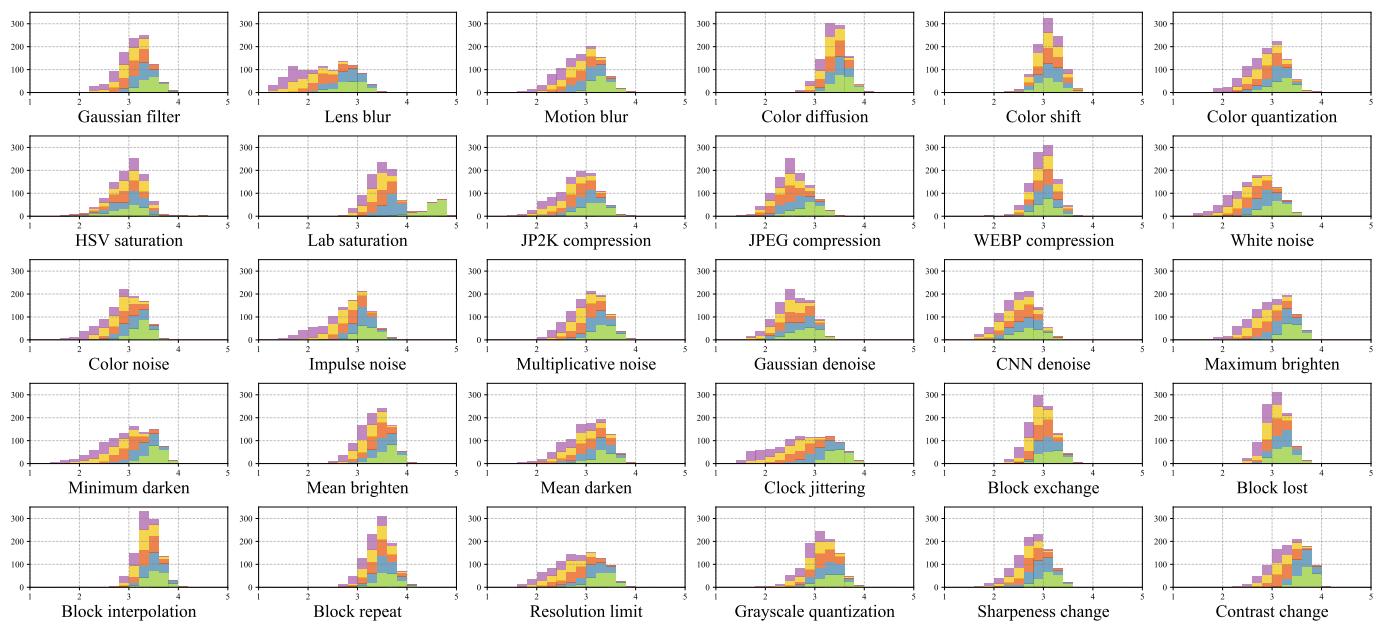
In Figure 4, look at the distribution of scores across different corruptions. Machines are highly sensitive to Lens Blur (second column, top row)—the scores drop drastically. However, they are relatively robust to Mean Brighten (fourth row, middle). Humans might hate a photo that is way too bright, but a machine can often still detect the edges and objects within it.
3. Task Independence
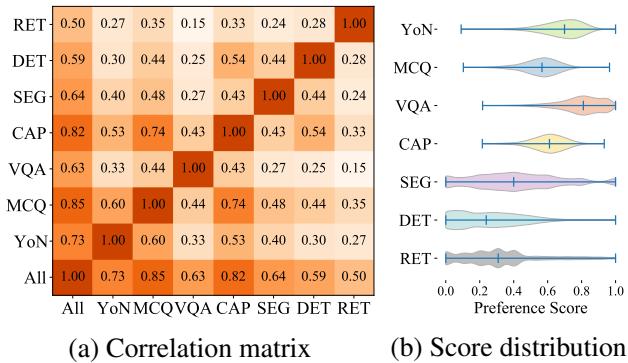
Figure 3 illustrates that success in one task (like Captioning, CAP) doesn’t guarantee success in another (like Detection, DET). The correlation heatmap (left) shows that while LMM tasks (MCQ, YoN) are somewhat correlated, specialized tasks like Segmentation (SEG) are quite distinct. This implies that “Image Quality” for machines is not a single number; it depends heavily on what the machine is trying to do.
The Failure of Traditional Metrics
The most damning result of the paper is the performance of existing Image Quality Assessment metrics. For years, we have relied on metrics like PSNR (Peak Signal-to-Noise Ratio) or SSIM (Structural Similarity Index) to judge image compression.
The researchers trained and tested these standard metrics on the MPD to see if they could predict machine preference.
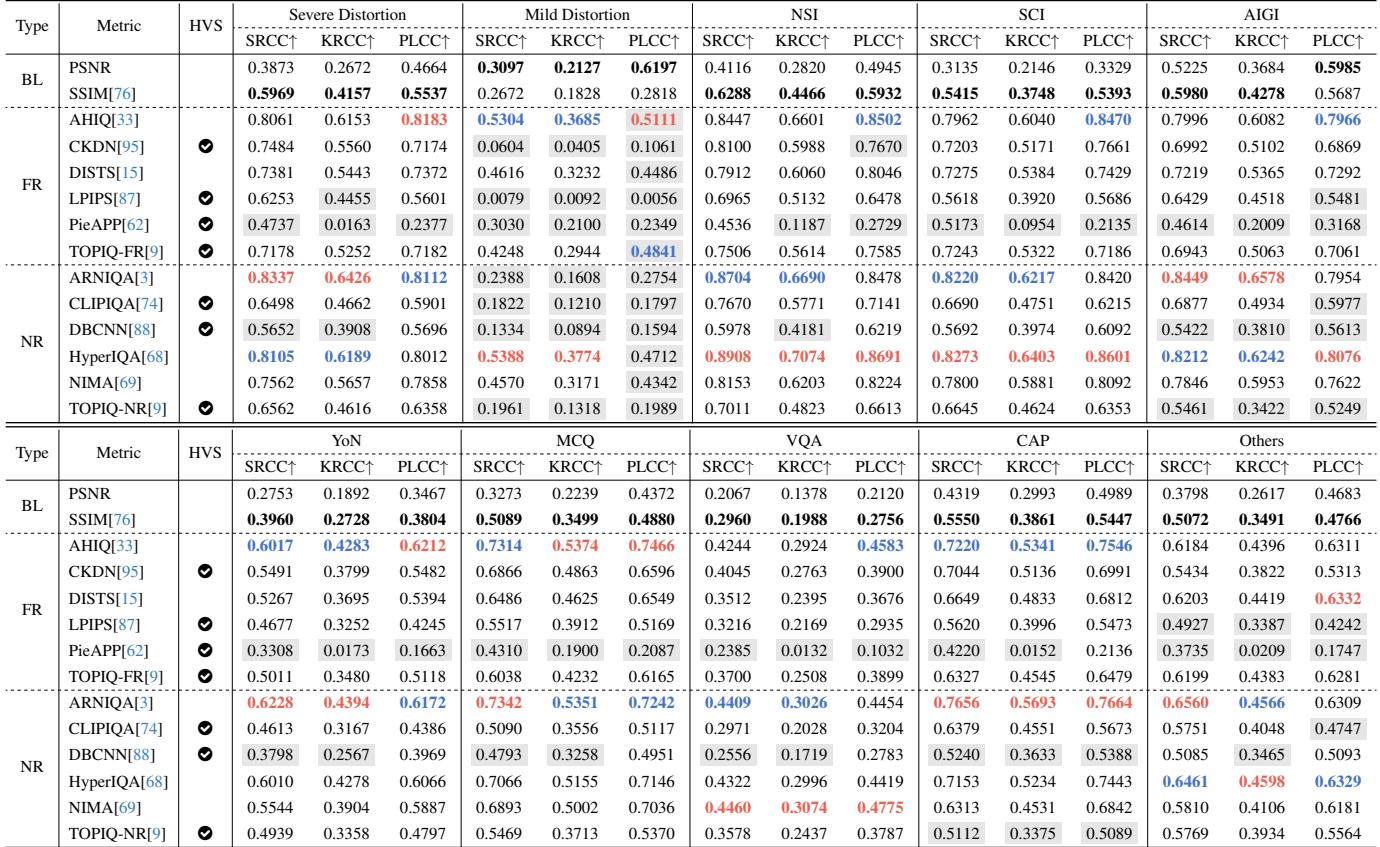
Table 2 paints a bleak picture. The SRCC (a correlation score where 1.0 is perfect) for standard metrics is shockingly low, especially for “Mild Distortion” (the kind of subtle compression used in real-world apps).
- PSNR achieves an SRCC of only 0.3097 on mild distortions.
- Even advanced deep-learning metrics designed for humans (like HyperIQA) struggle to accurately model machine perception compared to their performance on human datasets.
This proves that we cannot use human-centric tools to optimize images for machines. If we do, we are flying blind.
Visualizing the Difference
To make this concrete, let’s look at what the MPD considers “Low Quality” versus “High Quality.”
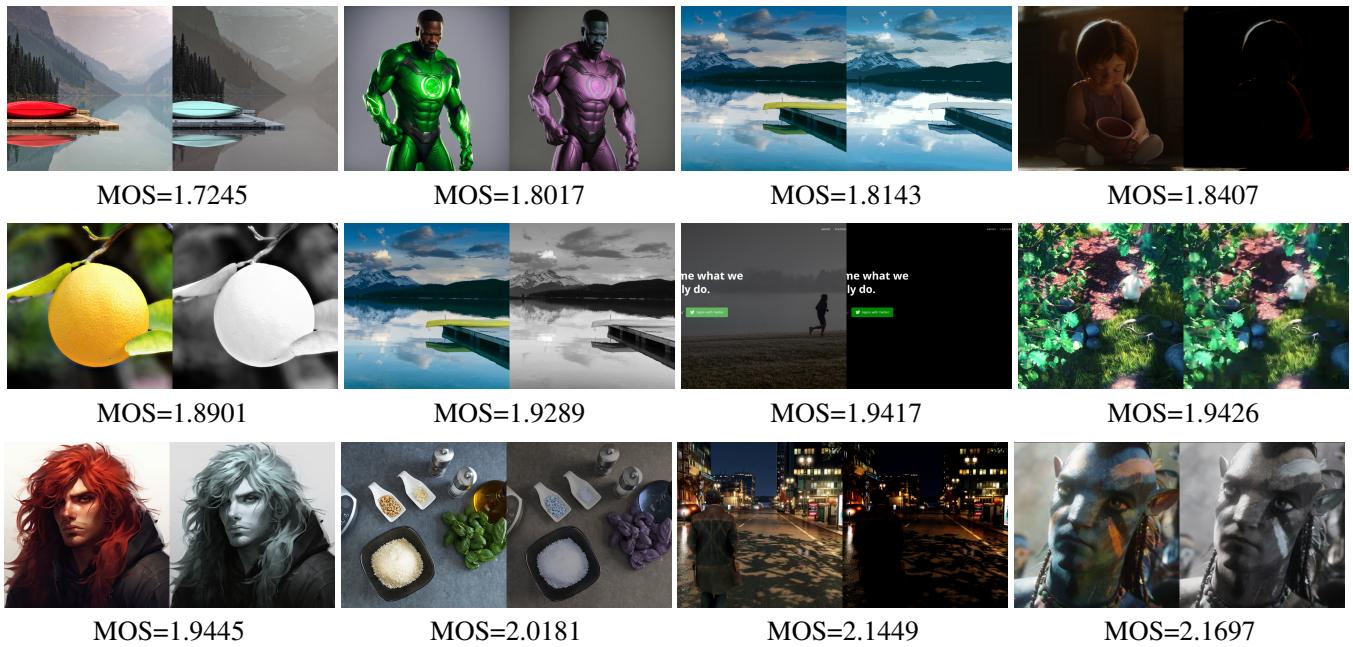
In Figure 10 (Low Quality), we see images that have been subjected to distortions that severely hamper machine performance. Notice that some of these might still be recognizable to a human (like the blurred city lights), but the loss of edge detail makes them useless for object detection algorithms.
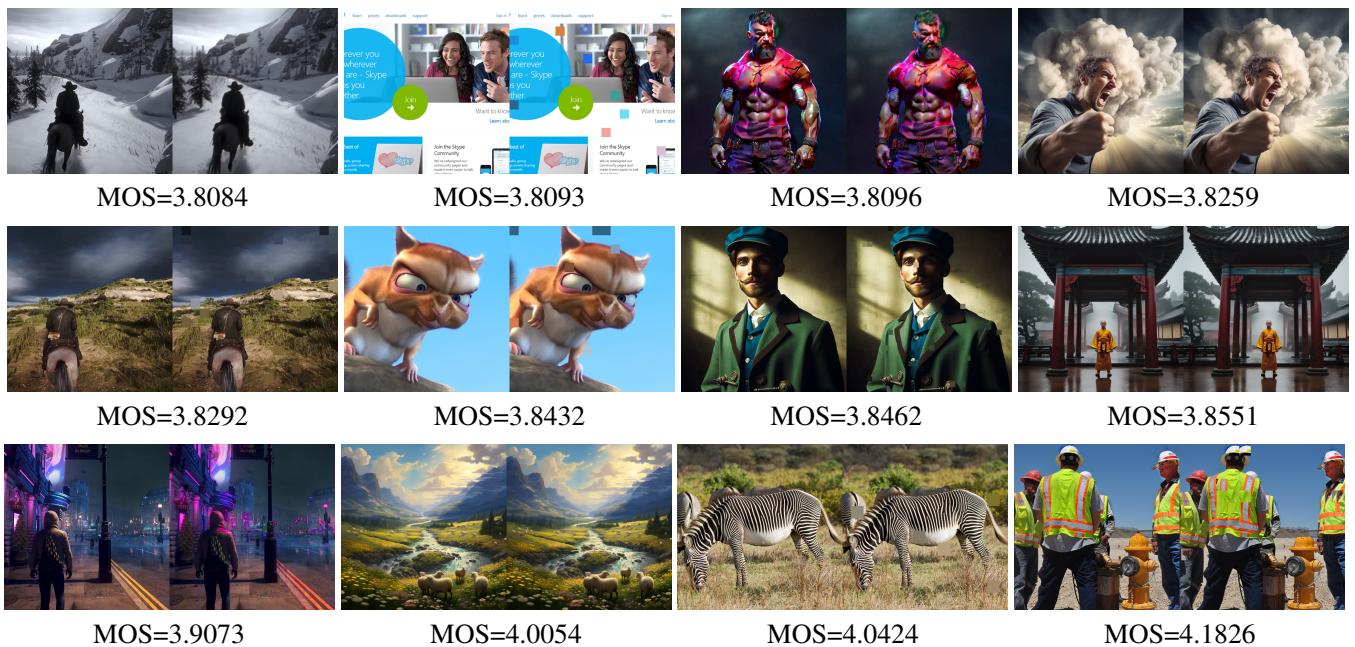
In contrast, Figure 11 (High Quality) shows images that machines scored highly. These images retain the structural information required for tasks like segmentation and classification, even if they aren’t “perfect” photography.
Why This Matters: The Future of Machine Vision
The publication of the Machine Preference Database marks a turning point in computer vision. As we move toward smart cities, autonomous driving, and automated medical diagnostics, the volume of images consumed by machines will continue to skyrocket.
We are currently wasting bandwidth transmitting visual data that humans like (colors, textures) but machines don’t need. Conversely, we are compressing data in ways that look fine to us but confuse our AI systems.
Key Takeaways:
- Stop Assuming: We cannot assume an image is “good” just because a human says so.
- New Metrics Needed: We need new compression standards (like a “JPEG for AI”) that prioritize machine utility over human aesthetics.
- Task-Specific Optimization: Image processing pipelines should be aware of the downstream task. An image destined for a segmentation bot should be processed differently than one destined for a captioning bot.
The MPD provides the data needed to build these next-generation tools. It challenges us to rethink the very definition of “image quality” in an age where the most common pair of eyes is a camera lens connected to a GPU.