](https://deep-paper.org/en/paper/2503.10149/images/cover.png)
In the rapidly evolving world of autonomous driving and robotics, sensors are the eyes of the machine. LiDAR (Light Detection and Ranging) stands out as a critical sensor, providing precise 3D maps of the environment. However, raw 3D points are just the starting point. To make sense of the world, a vehicle must “register” these point clouds—stitching together scans taken at different times or from different locations to calculate its own movement and map its surroundings.
For years, researchers have chased higher accuracy in point cloud registration using complex deep learning models. Specifically, Transformers with Cross-Attention mechanisms became the gold standard. The logic seemed sound: to align two scans, the network should constantly compare them back and forth (cross-attend) to find matching features.
But a recent paper, “Unlocking Generalization Power in LiDAR Point Cloud Registration,” challenges this status quo. The authors argue that for real-world generalization, cross-attention is actually the bottleneck. By removing it and introducing a smarter “Progressive Self-Attention” mechanism, they achieved state-of-the-art results.
In this post, we will dive deep into this research to understand why “less is more” when it comes to generalizing across different distances and datasets.
The Generalization Problem
Before dissecting the solution, we must understand the problem. In a controlled lab setting or when testing on the same dataset used for training, modern registration methods perform exceptionally well. They can align two point clouds with sub-centimeter accuracy.
However, the real world is messy. An autonomous vehicle trained on city streets in Boston (dense, urban) might be deployed on a highway in Arizona (sparse, open). Furthermore, the distance between LiDAR scans changes based on the vehicle’s speed.
The core challenges are:
- Cross-Distance Variations: As an object moves further away from a LiDAR sensor, the point density drops drastically. A car 10 meters away looks like a dense cluster of points. At 40 meters, it might be just a few sparse dots.
- Cross-Dataset Variations: Different LiDAR sensors (e.g., 64-line vs. 32-line) produce data with completely different characteristics.
The authors of the paper noticed a disturbing trend: leading methods like CoFiNet and GeoTrans perform great at 10 meters but fail catastrophically when tested at 40 meters or on new datasets.
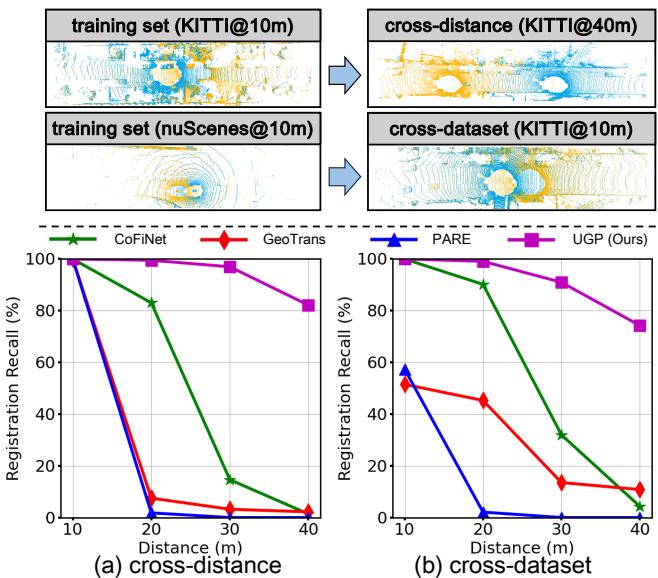
As shown in Figure 1 above, look at the sharp decline in performance (the red and blue lines) for existing state-of-the-art methods as the distance increases from 10m to 40m. The proposed method, UGP (purple line), maintains high recall rates where others collapse.
Why Do Current Methods Fail?
The failure of existing methods lies in their reliance on Cross-Attention.
In the context of Transformers, cross-attention mixes features from the “Source” point cloud and the “Target” point cloud. It tries to find geometric consistency between them. This works if the geometry looks roughly the same in both scans.
However, in LiDAR data, the geometry does not look the same. Due to the inverse-square law and sensor mechanics, the density of a point cloud is inconsistent.
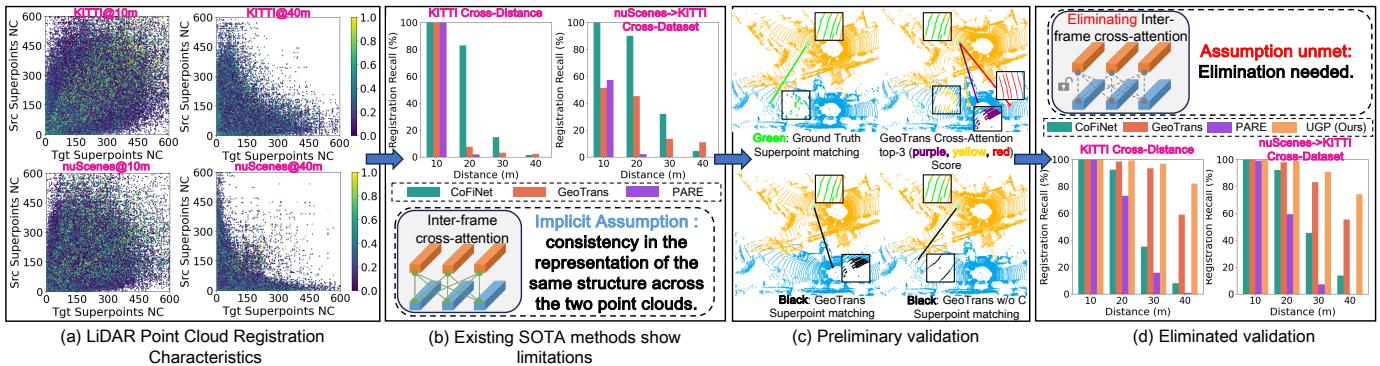
Figure 2 above illustrates this “Motivation.”
- Panel (a): Notice the scatter plots. At 10m (top left), the density (Neighborhood Count) of matching points is roughly equal. But at 40m (bottom left), the density is all over the place.
- The Implicit Assumption: Cross-attention models implicitly assume that the structure of an object is consistent across scans. When you train on dense data (10m) and test on sparse data (40m), the cross-attention module gets confused because it’s looking for dense patterns that no longer exist.
- Panel (c): This visualization shows a method (GeoTrans) failing to match the ground plane correctly because it relies on specific density cues that change with distance.
The UGP Framework: A Pruned Approach
To solve this, the researchers propose UGP (Unlocking Generalization Power). The philosophy is radical but effective: Eliminate the Cross-Attention module.
Instead of letting the network rely on potentially misleading comparisons between the two point clouds during the feature extraction phase, UGP forces the network to learn robust, independent features for each point cloud using Intra-frame learning.
Here is the architecture of the proposed UGP framework:
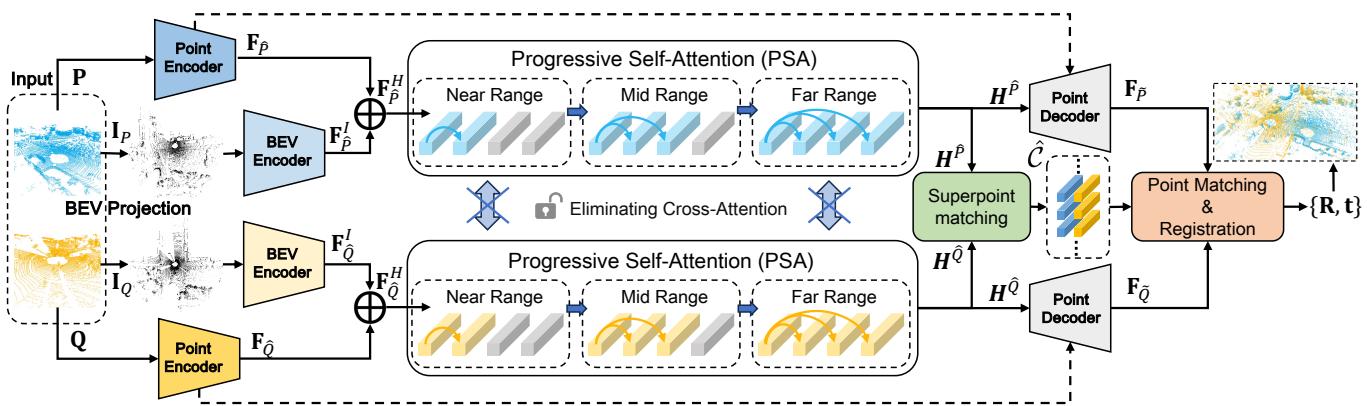
The pipeline consists of three main innovations:
- BEV (Bird’s Eye View) Feature Fusion: Incorporating 2D semantic clues.
- Cross-Attention Elimination: Removing the confusing signal.
- Progressive Self-Attention (PSA): A new way to handle scale and ambiguity.
Let’s break these down.
1. BEV Feature Fusion
Point clouds are sparse and unstructured. Sometimes, looking at them in 3D makes it hard to see the “big picture,” like the layout of a road intersection. To fix this, the authors project the 3D points into a 2D Bird’s Eye View (BEV) image.
The projection formula is straightforward. For a point \((x_i, y_i, z_i)\), the pixel coordinates \((u_i, v_i)\) are calculated as:

By processing this 2D image with a standard convolutional network (like ResNet) and fusing it with the 3D point features, the model gains valuable semantic context (e.g., distinguishing a corner from a straight road), which reduces ambiguity during matching.
The relationship between the 3D superpoints and the 2D BEV pixels is handled via indexing:

2. Progressive Self-Attention (PSA)
This is the heart of the paper’s contribution. Once cross-attention is removed, the network relies entirely on Self-Attention to understand the geometry within a single scan.
However, standard global self-attention has a flaw: it connects every point to every other point. In a large outdoor scene, this means a point on a car might be “attending” to a tree 100 meters away. This introduces noise and “feature ambiguity.”
The authors introduce Progressive Self-Attention. Instead of looking at the whole scene at once, the network starts small and gradually expands its view.
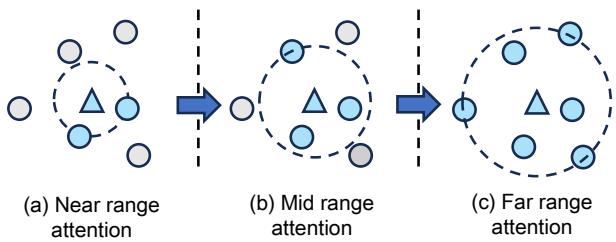
As illustrated in Figure 4:
- Initial Layer (Near Range): The model focuses only on the immediate neighbors. This captures fine local details without noise from distant objects.
- Middle Layers: The attention range expands.
- Final Layer (Far Range): The model looks at the global context.
The Mathematics of PSA
To implement this, they use a dynamic mask \(M\) in the attention calculation. The standard self-attention score is calculated as:

In PSA, this score is multiplied by a mask \(M\) that changes depending on the layer depth \(L\):

The mask is defined based on distance. For the \(k\)-th layer, the mask allows attention only if the distance \(d_{i,j}\) is within a certain fraction of the maximum distance:

This simple constraint forces the network to build features from the “bottom up”—solidifying local geometry before trying to understand the global scene.
Experiments and Results
The researchers subjected UGP to rigorous testing, specifically focusing on how well it generalizes to data it hasn’t seen before.
Cross-Distance Generalization
In this experiment, models were trained on KITTI data pairs with only 10m separation but tested on pairs separated by 20m, 30m, and 40m. This mimics a real-world scenario where a car moves faster than the training data anticipated.
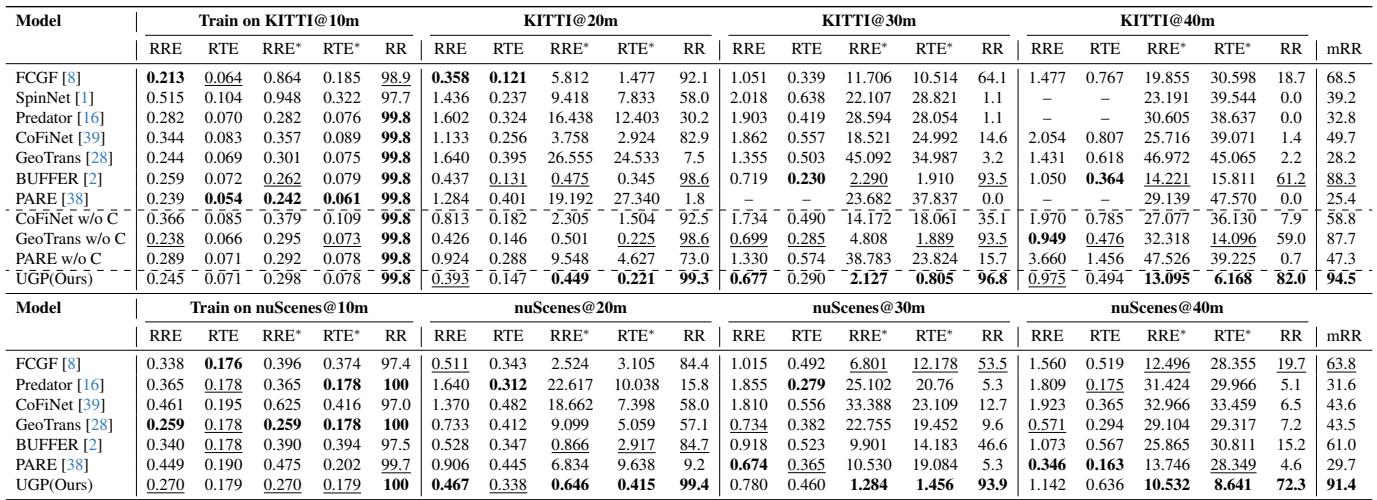
Table 1 is revealing. Look at the column KITTI@40m (RR):
- GeoTrans: 2.2% Recall
- PARE: 0.0% Recall
- BUFFER: 61.2% Recall
- UGP (Ours): 82.0% Recall
The improvement is massive. While other transformer-based methods (GeoTrans, CoFiNet) essentially fail completely at long distances, UGP remains robust. Even compared to BUFFER (a method designed for efficiency), UGP shows a 20% improvement.
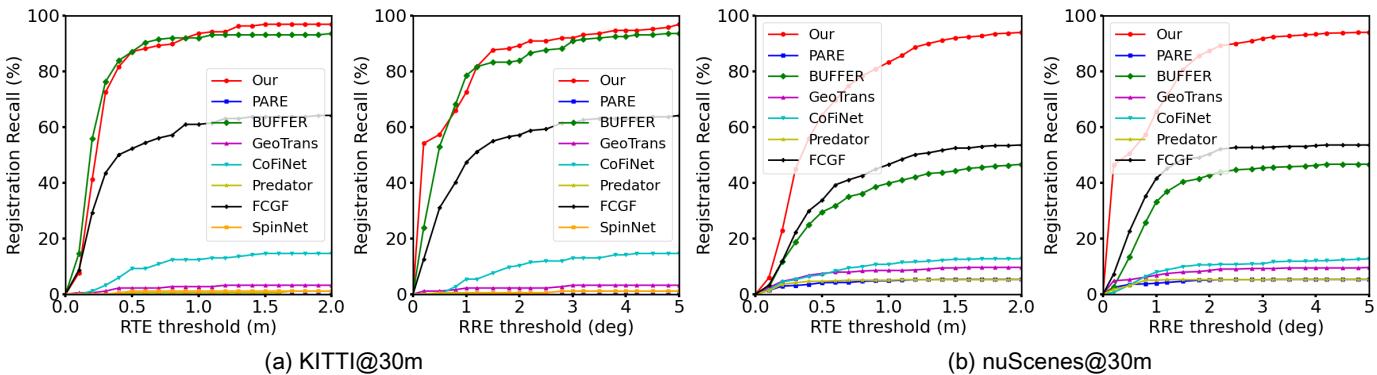
We can visualize this dominance in Figure 5, which plots Registration Recall against error thresholds. UGP (the red line) hugs the top left corner (high accuracy, high recall) much tighter than the competition.
Cross-Dataset Generalization
Generalizing from one sensor type to another is notoriously difficult. Here, the models were trained on nuScenes (32-line LiDAR) and tested on KITTI (64-line LiDAR).

Table 2 shows that UGP achieves a mean Registration Recall (mRR) of 90.9%, outperforming the next best method by over 6%. This proves that by removing the over-reliance on specific density patterns (via removing cross-attention), the model learns geometric features that are true across different sensors.
Visual Proof
Numbers are great, but what does this look like?
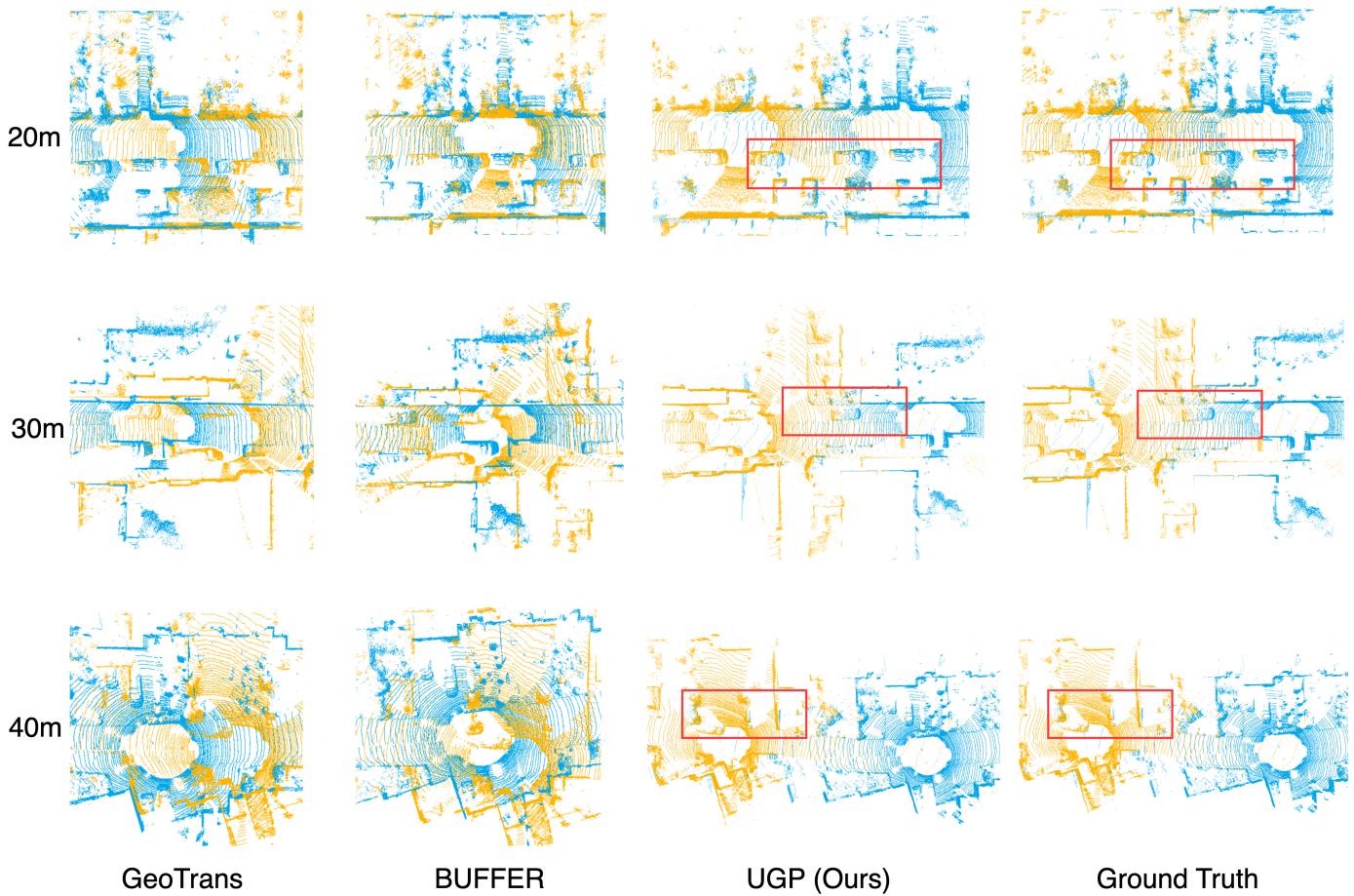
In Figure 9, we see the registration results on KITTI. The columns represent different methods.
- Row 3 (40m): Look at GeoTrans (first column). The alignment is completely broken; the red and blue points (source and target) are disjointed.
- UGP (Third column): The alignment is nearly perfect, visually indistinguishable from the Ground Truth.
Ablation Study: Did Removing Cross-Attention Actually Help?
A skeptic might ask: “Maybe it’s just the BEV features or the Progressive Attention that helped? Maybe Cross-Attention is still good?”
The authors conducted an ablation study to isolate the effects of each component.
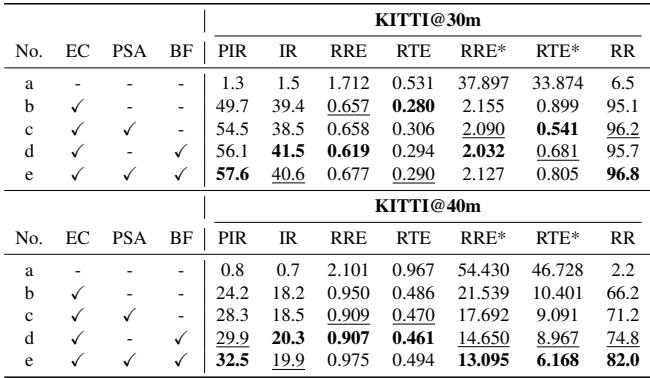
Table 4 breaks it down:
- Row (a): A baseline with standard cross-attention. RR @ 40m is 2.2%.
- Row (b) EC: “Eliminating Cross-attention.” Just removing this module jumps the performance to 66.2%. This is the definitive proof that cross-attention was the bottleneck.
- Row (c) PSA: Adding Progressive Self-Attention boosts it to 71.2%.
- Row (e) Full: Adding BEV features brings the final result to 82.0%.
The visualization of the “Matching Hit Ratio” further confirms this.
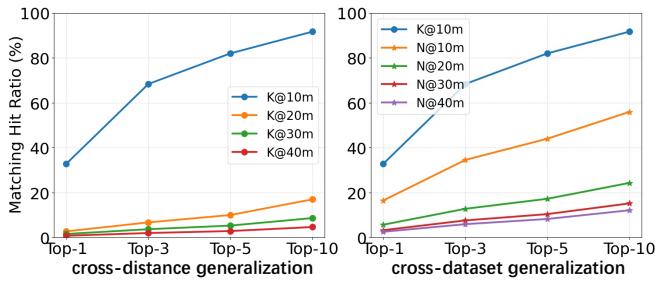
Figure 8 compares the matching hit ratio (how many feature matches were actually correct). UGP maintains a much higher hit ratio across generalization settings compared to baselines, indicating that the features it learns are genuinely descriptive of the geometry, not artifacts of the density.
Conclusion
The paper “Unlocking Generalization Power in LiDAR Point Cloud Registration” offers a compelling lesson for deep learning researchers: Complexity does not always equal performance.
In the specific domain of LiDAR registration, the popular Cross-Attention mechanism—while powerful for dense, consistent data—becomes a liability when facing the variable densities of the real world. By stripping it away and focusing on robust Intra-Frame feature extraction via Progressive Self-Attention and BEV fusion, UGP achieves unprecedented generalization capabilities.
For students and practitioners, this highlights the importance of understanding the physical characteristics of your data (like LiDAR density decay) rather than blindly applying architectures that work in other domains (like NLP or dense Computer Vision). Sometimes, to move forward, you have to take a component away.