](https://deep-paper.org/en/paper/2503.11651/images/cover.png)
Introduction
For decades, the field of computer vision has chased a specific “Holy Grail”: taking a handful of flat, 2D photos scattered around a scene and instantly transforming them into a coherent 3D model.
Traditionally, this process—known as Structure-from-Motion (SfM)—has been a slow, mathematical grind. It involves detecting features, matching them across images, solving complex geometric equations to find camera positions, and then running iterative optimization algorithms like Bundle Adjustment to refine everything. While effective, it is computationally expensive and often brittle.
In recent years, deep learning has attempted to streamline this. Models like DUSt3R showed us we could use neural networks to predict 3D points directly. However, even these modern approaches often rely on pairwise processing (looking at two images at a time) and still require slow post-processing optimization to glue everything together into a consistent scene.
Enter VGGT (Visual Geometry Grounded Transformer).
Proposed by researchers from the Visual Geometry Group at Oxford and Meta AI, VGGT represents a paradigm shift. It is a “foundation model” for 3D geometry. Instead of piecing together a scene bit by bit, VGGT ingests the entire collection of images—whether it’s one, two, or a hundred—and outputs the entire 3D structure, camera positions, and depth maps in a single forward pass.
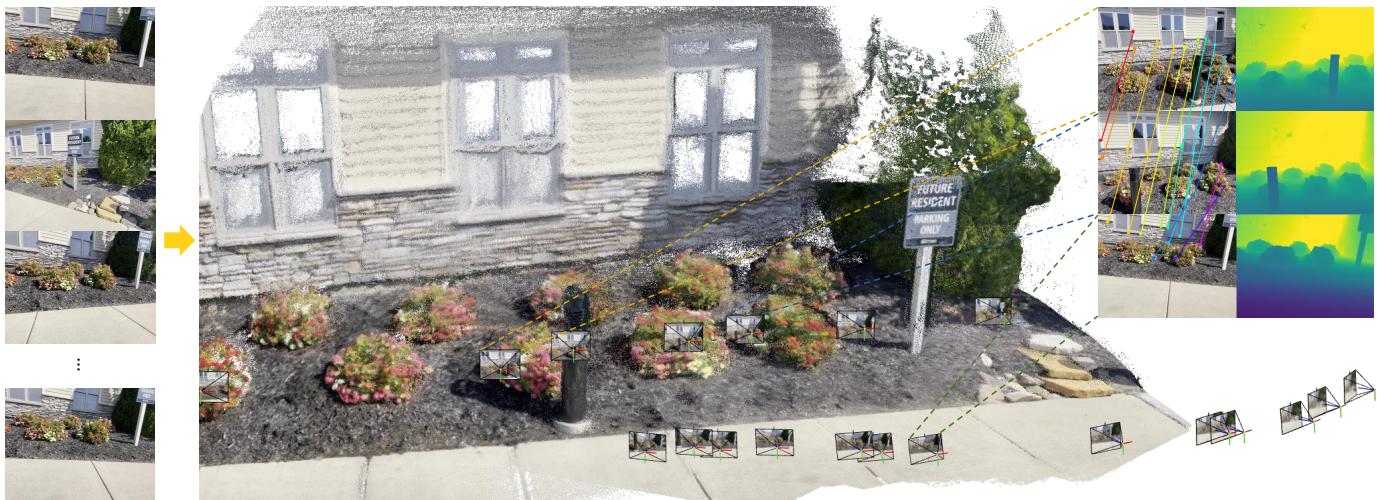
As shown in Figure 1, the model is incredibly fast, performing reconstructions in under a second that usually take traditional methods significantly longer. In this post, we will tear down the architecture of VGGT, explain how it manages to “hallucinate” accurate 3D geometry from 2D pixels, and look at the impressive results it achieves.
Background: From Geometry to Transformers
To appreciate VGGT, we need to understand the gap it fills.
The Traditional Pipeline
Classic 3D reconstruction relies on Visual Geometry. You take images, find “keypoints” (distinctive corners or edges), and match them between images. If you know how points move between images, you can mathematically triangulate where those points sit in 3D space and where the cameras must have been to see them that way. This is accurate but slow. If the images have few textures (like a white wall) or extreme changes in viewpoint, traditional math often fails.
The Neural Era
Deep learning brought us models that could “guess” depth from a single image or match features more robustly. Recently, models like DUSt3R and MASt3R moved towards end-to-end reconstruction. They treat 3D reconstruction as a regression problem—predicting the 3D coordinates for every pixel.
However, these models have a limitation: they typically operate on pairs of images. To reconstruct a scene with 100 images using DUSt3R, you have to compute results for many pairs and then use a global optimization step to align them all. This “Global Alignment” is a bottleneck, turning a fast neural inference into a slow overall process.
The VGGT Approach
The authors of VGGT asked: Why not just process all N images at once?
If a neural network acts like a brain, it should be able to look at a stack of photos and understand the spatial relationship between them immediately, without needing to mathematically stitch them together in a separate step. VGGT is designed to do exactly that: a feed-forward network that predicts all key 3D attributes simultaneously.
The Method: Inside the Transformer
The core philosophy of VGGT is to remove inductive biases. Instead of hard-coding the laws of geometry into the network, the researchers use a standard, powerful Transformer architecture and let it learn the geometry from massive amounts of data.
Problem Definition
Let’s define the task mathematically. We have an unordered set of \(N\) images, denoted as \((I_i)\). We want a function \(f\) that maps these images to their corresponding 3D attributes:

Here is what the model predicts for every single image \(I_i\):
- \(\mathbf{g}_i\) (Cameras): The intrinsic (focal length) and extrinsic (rotation and position) parameters.
- \(D_i\) (Depth Maps): The distance of every pixel from the camera.
- \(P_i\) (Point Maps): The 3D coordinate \((x, y, z)\) of every pixel in the world space.
- \(T_i\) (Tracks): Feature grids used to track points across different images.
Crucially, the Point Maps (\(P_i\)) are “viewpoint invariant.” This means that regardless of which camera is looking at a specific corner of a table, the model predicts the exact same \((x, y, z)\) coordinate for that corner. The coordinate system is anchored to the first image (Camera 1).
Architecture: The Alternating Attention Mechanism
The architecture is based on the Vision Transformer (ViT), specifically initializing with a pre-trained model like DINOv2. However, standard Transformers are designed to look at patches within a single image. VGGT needs to understand relationships between images.
To solve this, the authors introduce Alternating Attention (AA).
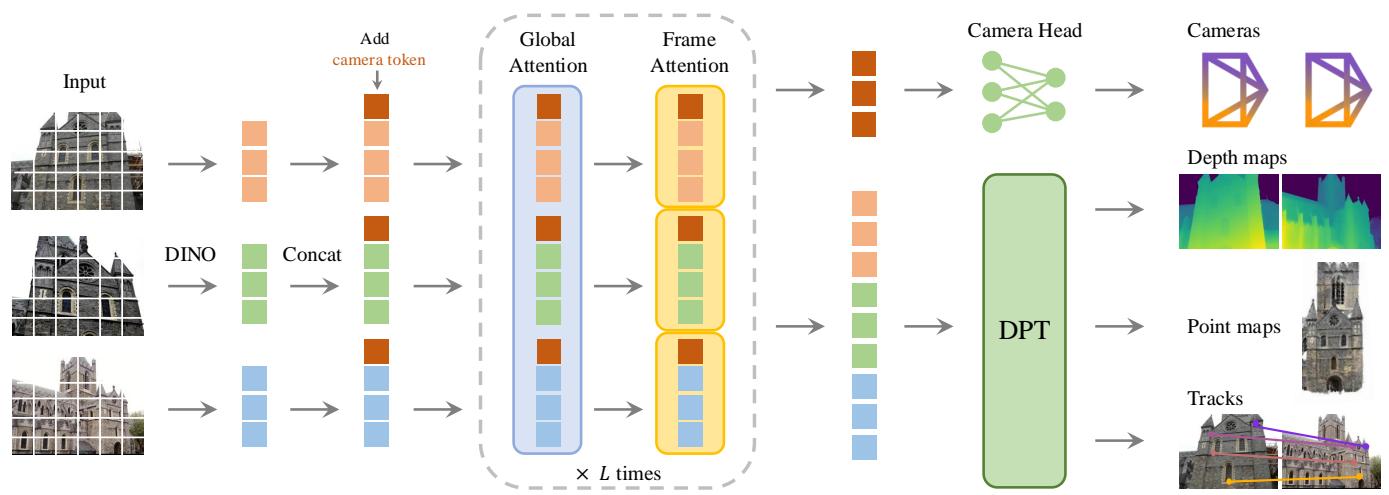
As illustrated in Figure 2, the image is first broken into patches (tokens). Then, the transformer processes these tokens through \(L\) layers (typically 24) that alternate between two modes:
- Frame-wise Self-Attention: The model looks at tokens within a single image. This builds a strong local understanding of what is in the picture (e.g., “this is a chair leg”).
- Global Self-Attention: The model allows tokens from all images to attend to each other. This is where the 3D magic happens. A token representing a chair leg in Image 1 can “talk” to a token representing the same chair leg in Image 5. This interaction allows the network to deduce that Image 5 must be to the left of Image 1.
This alternating design strikes a balance. It integrates information across views to solve the geometry while refining the representation of each specific image.
The Prediction Heads
Once the tokens have passed through the transformer, they hold rich 3D information. VGGT uses specific “heads” to decode this information into the final outputs:
- Camera Head: Special “camera tokens” are appended to the input. After processing, these tokens are fed into a small Multi-Layer Perceptron (MLP) to predict the 9 camera parameters (rotation, translation, focal length).
- Dense Prediction Head (DPT): For dense outputs like Depth and Point maps, the image tokens are reshaped back into 2D grids. A Deep Prior Transformer (DPT) decoder upsamples them to high resolution to predict the pixel-wise maps.
Training: Multi-Task Learning
How do you train a beast like this? You need a loss function that forces the model to be accurate across all its predictions. The authors train VGGT end-to-end using a multi-task loss:

The loss includes:
- \(\mathcal{L}_{camera}\): Measures how close the predicted camera position is to the true position.
- \(\mathcal{L}_{depth}\) & \(\mathcal{L}_{pmap}\): Measures the error in the depth maps and 3D point clouds. It also includes an uncertainty term—the model is allowed to be “unsure” about textureless areas (like a blue sky) to avoid penalizing it unfairly.
- \(\mathcal{L}_{track}\): A tracking loss that ensures the model knows which pixels in Image A correspond to which pixels in Image B.
Interestingly, the authors found that training on all these tasks simultaneously improves performance. Even though you can mathematically derive a point map from depth and camera, forcing the network to predict both explicitly makes the underlying features more robust.
The model was trained on a massive collection of datasets (CO3Dv2, ScanNet, MegaDepth, etc.) for 9 days on 64 A100 GPUs. This scale of data is what allows the “geometry-free” transformer to learn the rules of geometry implicitly.
Experiments and Results
The claims are bold: fast, accurate, and versatile. Let’s see how VGGT holds up against the state-of-the-art.
1. Visual Quality and Robustness
One of the most striking comparisons is against DUSt3R, the leading competitor in neural 3D reconstruction.
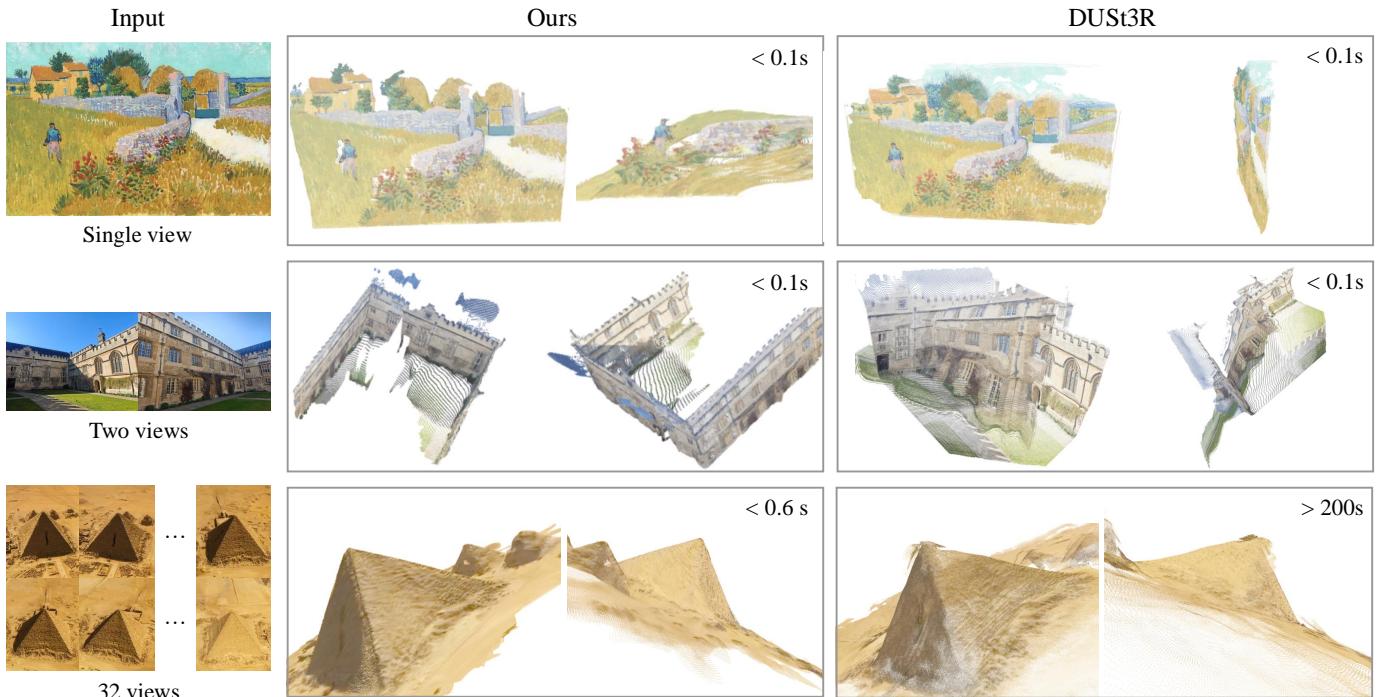
In Figure 3, we see several scenarios:
- Top Row (Oil Painting): VGGT recovers the geometric structure of a painting (Van Gogh) effectively.
- Middle Row (Wide Baseline): Two photos of a building from very different angles. VGGT fuses them correctly; DUSt3R fails because the overlap is tricky.
- Bottom Row (32 Views): This is the killer app. Processing 32 images of a pyramid structure takes VGGT 0.6 seconds. DUSt3R runs out of memory or takes over 200 seconds because of its pairwise optimization bottleneck.
2. Camera Pose Estimation
Can VGGT replace standard SfM for finding camera positions? The authors tested this on the RealEstate10K and CO3Dv2 datasets.
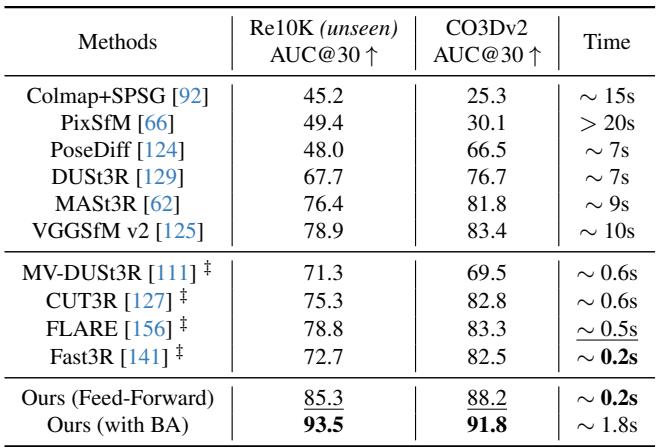
Table 1 highlights a crucial finding: Speed.
- Traditional methods (Colmap) and Hybrid methods (VGGSfM) take 10-15 seconds per scene.
- VGGT (Feed-Forward) takes 0.2 seconds and achieves higher accuracy (85.3 vs 78.9 on RealEstate10K).
It is worth noting the last row: “Ours (with BA)”. If you take the fast prediction from VGGT and use it as an initialization for Bundle Adjustment (BA), the accuracy jumps even higher (93.5). This suggests VGGT is an excellent “initial guesser” for solvers that need a good starting point.
3. Point Map Accuracy
The model predicts dense point clouds directly. Evaluating on the ETH3D dataset shows that VGGT is not just guessing; it is precise.
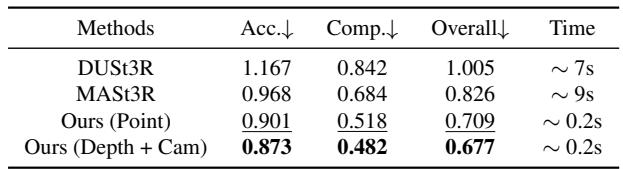
In Table 3, lower numbers are better. VGGT beats DUSt3R and MASt3R in accuracy (0.901 vs 1.167) while being orders of magnitude faster.
An interesting ablation here is “Ours (Depth + Cam).” The authors found that while the model predicts a specific “Point Map,” they can get even better results by taking the predicted Depth Map and unprojecting it using the predicted Camera. This suggests the specific heads for depth and camera are slightly more precise than the joint point map head during inference.
4. Scalability
One of the main selling points of VGGT is that it doesn’t choke on large numbers of images.

Table 9 shows the scaling. Processing 20 images takes roughly 0.3 seconds. Even 100 images can be processed in roughly 3 seconds. In contrast, pair-based methods see their runtime explode quadratically as the number of images increases.
5. Downstream Applications
VGGT isn’t just a reconstruction tool; it’s a feature extractor. The representations learned by the transformer are rich enough to drive other tasks.
Point Tracking
Tracking points in a video usually requires specialized temporal models. However, by fine-tuning a tracker (CoTracker) using VGGT’s pre-trained backbone, the researchers achieved state-of-the-art results on dynamic tracking benchmarks.
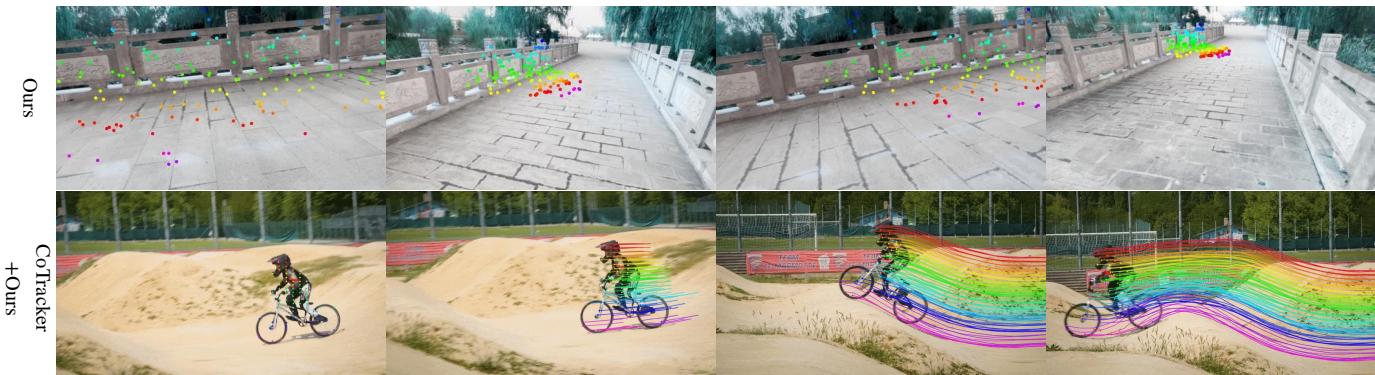
Figure 5 (Top) shows VGGT tracking points across unordered images of a static scene. The Bottom row shows the fine-tuned dynamic tracker handling a moving biker, visualizing the dense optical flow.
Novel View Synthesis
Can VGGT generate new views of a scene? By slightly modifying the head to output RGB colors instead of geometry, the authors turned VGGT into a view synthesizer.
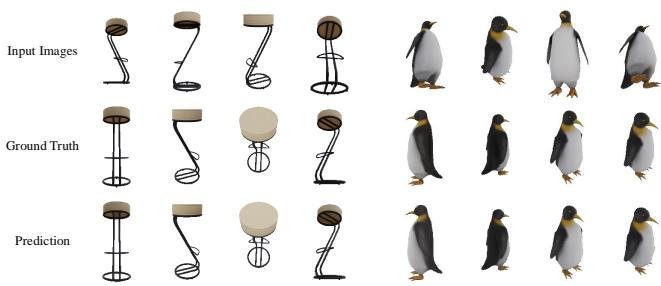
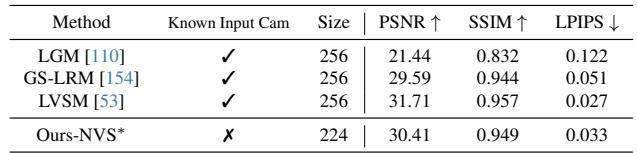
As seen in Figure 6 and Table 7, VGGT competes with specialized view synthesis models (like LGM or LVSM), even though it wasn’t given camera parameters for the input images—a restriction most other models cannot handle.
Conclusion and Implications
VGGT represents a significant step toward “solving” 3D reconstruction using pure neural networks. By abandoning the complex, multi-stage pipelines of the past and embracing a massive, feed-forward transformer, the authors have created a model that is:
- Fast: Sub-second inference for multi-view scenes.
- Simple: No need for RANSAC, triangulation, or pairwise matching graphs during inference.
- Holistic: It considers all images simultaneously via Global Attention.
- Versatile: It works for single images (monocular depth), stereo pairs, or large collections.
While it still struggles with extreme scenarios (like fisheye lenses or heavy non-rigid deformation) without fine-tuning, VGGT proves that large-scale transformers can internalize the laws of visual geometry. For students and researchers, this suggests a future where 3D vision looks less like a geometry problem and more like a data-driven token processing task—paving the way for real-time 3D understanding in robotics and AR/VR.