](https://deep-paper.org/en/paper/2503.11999/images/cover.png)
Introduction
If you ask a robot to pick up a coffee mug, it will likely succeed. The mug is rigid; its shape doesn’t change when you touch it. If you know where the handle is, you can calculate exactly how to grab it.
Now, ask that same robot to fold a crumpled t-shirt. The robot will likely fail miserably.
Cloth manipulation is one of the “Holy Grails” of robotics. Unlike rigid objects, cloth has near-infinite degrees of freedom. It crumples, folds over itself, and occludes its own shape. When a shirt is in a pile, you can only see a fraction of its surface. To a robot’s camera, a crumpled shirt looks like a chaotic, unidentifiable blob. Furthermore, the physics of cloth are complex and non-linear; pulling a sleeve might drag the whole shirt, or it might just stretch the fabric.
For years, researchers have used Graph Neural Networks (GNNs) to model these physics, treating cloth as a mesh of connected particles. While effective for simple tasks, GNNs often struggle to scale and fail to capture “long-horizon” dependencies—meaning the errors pile up the further into the future you try to predict.
In a recent paper titled “Diffusion Dynamics Models with Generative State Estimation for Cloth Manipulation,” researchers from UC San Diego and Hillbot Inc. propose a paradigm shift. Instead of just trying to calculate the physics, why not use the power of Generative AI to imagine them?
By adapting the same Diffusion models that power image generators like DALL-E or Midjourney, they have created UniClothDiff—a unified framework that can “hallucinate” the hidden parts of a crumpled shirt and accurately predict how it will move, enabling robots to fold laundry with unprecedented skill.
The Double Challenge: Blindness and Chaos
To manipulate cloth, a robot needs to solve two massive problems simultaneously:
- State Estimation (Perception): The robot looks at a pile of fabric (a partial point cloud) and needs to understand the full 3D shape (the mesh). Because cloth folds over itself (self-occlusion), most of the data is missing. The robot has to “fill in the blanks.”
- Dynamics Modeling (Prediction): Once the robot knows the shape, it needs to predict: “If I pull this point 10cm to the right, what will the shirt look like?” This is the dynamics model.
The researchers hypothesize that diffusion models are the key to solving both. Diffusion models are excellent at learning complex data distributions. If trained on enough data, they can learn the distribution of valid shirt shapes and valid shirt movements.
The Solution: UniClothDiff
The proposed framework, UniClothDiff, consists of two main engines: the Diffusion Perception Model (DPM) and the Diffusion Dynamics Model (DDM). Let’s break down how these work and how they fit together.
1. Perception: Imagining the Invisible
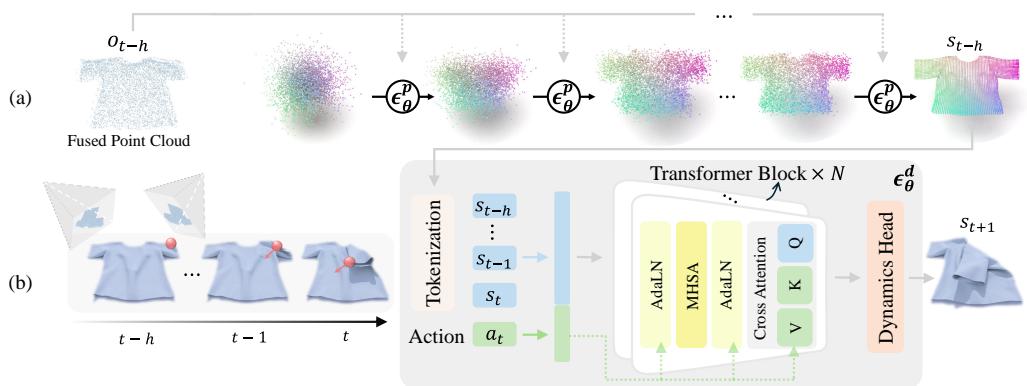
Look at Figure 1(a) above. The input is a “Partial Point Cloud”—this is what the robot actually sees. It’s sparse and incomplete. The goal is to get to the “Reconstructed State,” a complete, smooth 3D mesh.
Traditional methods try to map the pixels directly to a mesh, often resulting in jagged, unrealistic shapes when occlusions are heavy. The Diffusion Perception Model (DPM) takes a different approach. It treats state estimation as a conditional generation problem.
The process works like this:
- Conditioning: The model takes the partial point cloud and encodes it into a feature vector.
- Denoising: It starts with a mesh made of pure random noise. Over several steps (\(K\) steps), the model iteratively removes the noise.
- Guidance: Crucially, this denoising process is conditioned on the partial point cloud. The model asks, “Given what I can see (the partial cloud), what is the most likely full shape of this shirt?”
The architecture uses a Vision Transformer (ViT). The cloth mesh is broken down into “patches” (similar to how ChatGPT breaks text into tokens). This allows the model to process the geometry efficiently. By the end of the diffusion process, the model has effectively “imagined” the back of the shirt and the hidden folds based on the visible parts, much like a human intuitively knows a shirt has a back even if they can’t see it.
2. Dynamics: Predicting the Future
Once the robot has the estimated state (the mesh), it needs to move it. This is where the Diffusion Dynamics Model (DDM) comes in, illustrated in Figure 1(b).
Standard dynamics models (like GNNs) take the current state and action and output a single predicted next state. The problem is that cloth dynamics are highly uncertain. Small errors in the input can lead to massive errors in the output, especially over long sequences.
The DDM treats dynamics as a sequence generation task.
- Input: Current cloth state + Robot Action + History of previous states.
- Output: The next state of the cloth.
Instead of a simple regression (predicting a number), the DDM learns the probability distribution of possible future states. It generates the next state by denoising, conditioned on the current state and the robot’s action.
Why Transformers? The researchers found that Graph Neural Networks scale poorly. As the cloth mesh gets more detailed (more vertices), GNNs get slower and harder to train. Transformers, however, are excellent at handling long sequences and capturing global dependencies. By using a Transformer backbone, the DDM can reason about how pulling a sleeve affects the collar—a long-range interaction that GNNs often miss.
3. The Brain: Model-Based Planning
Having a model that predicts the future is useless if you don’t use it to make decisions. The researchers integrate their Diffusion Dynamics Model into a Model Predictive Control (MPC) framework.
Here is the logic flow:
- Sample Actions: The robot generates thousands of random potential action sequences (e.g., “grab here, move there”).
- Simulate: The DDM predicts the outcome for each sequence.
- Evaluate: The system calculates a “cost” for each outcome. The cost is simply the difference between the predicted state and the goal state (the folded shirt).
The objective function looks like this:
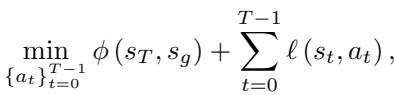
Here, \(\phi(s_T, s_g)\) represents the difference between the final predicted state (\(s_T\)) and the goal state (\(s_g\)), and the second term minimizes the cost of the actions themselves (to ensure smooth movement).
By minimizing this function, the robot selects the action sequence that most likely results in a neatly folded shirt.
Experimental Results
The theory sounds solid, but does it work? The researchers tested UniClothDiff in both simulation (using SAPIEN) and the real world.
Perception Performance
First, let’s look at how well the robot can “see.” The researchers compared their Diffusion Perception Model (DPM) against several baselines, including GarmentNets and other Transformer-based methods.
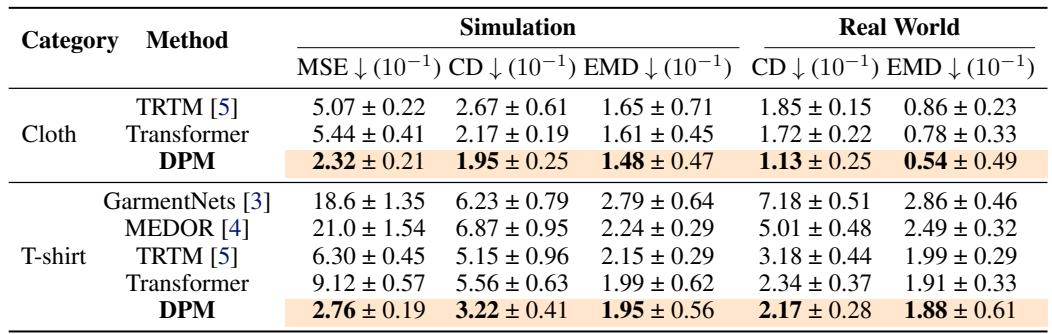
As shown in Table 1, the DPM achieves the lowest error rates (MSE and Chamfer Distance) for both simple cloths and complex T-shirts.
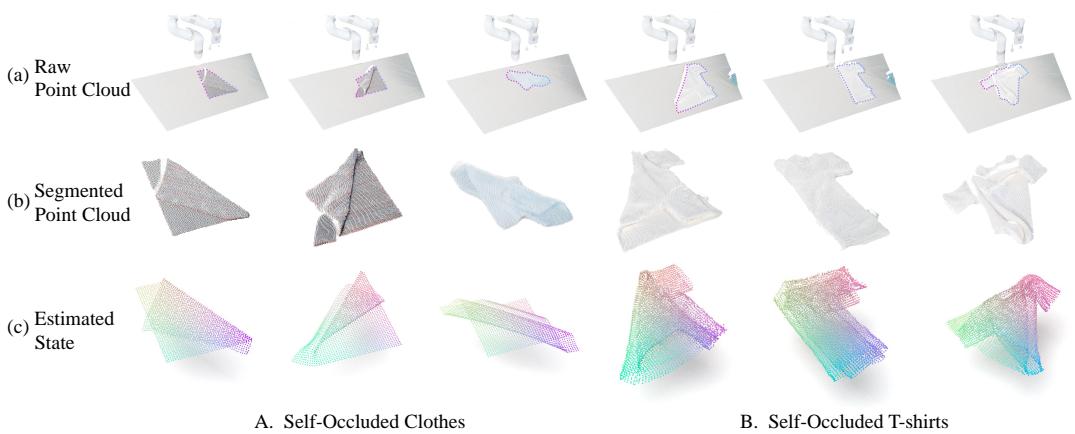
Qualitatively, the difference is stark. In Figure 2 below, look at the transition from the raw point cloud (Row a) to the predicted state (Row c). Even for highly crumpled real-world clothes, the model reconstructs a smooth, plausible mesh.
Dynamics Prediction
The most critical test is whether the model can accurately predict physics over time. If the model makes a small error at step 1, that error usually compounds. By step 20, the prediction is usually garbage.
The researchers compared their DDM against a standard GNN approach.
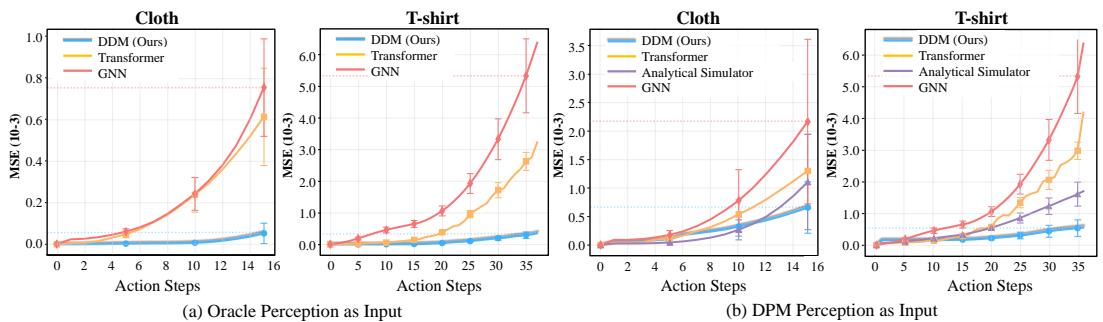
The charts in Figure 3 tell a compelling story. The Blue line (DDM - Ours) stays consistently low (near zero error) even as the number of action steps increases. The Red line (GNN), however, shoots up, indicating that GNNs struggle with error accumulation.
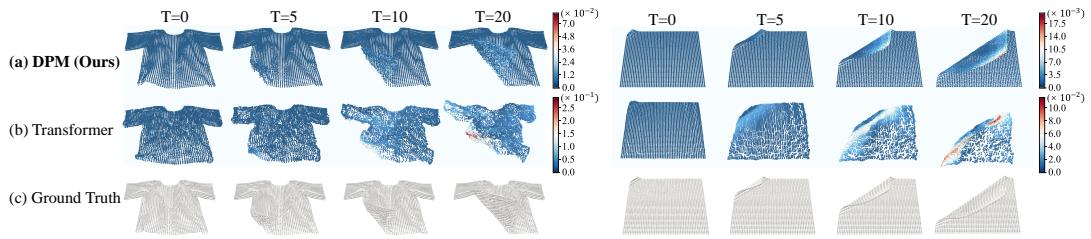
The qualitative difference in dynamics prediction is visualized in the heatmaps below. The “Transformer” baseline (Row b) starts to show red “hotspots” of high error as time goes on, distorting the shirt. The DDM (Row a) remains blue (low error), maintaining a realistic shape that closely matches the Ground Truth.
Real-World Folding
Finally, the ultimate test: putting the software on a physical robot. The researchers set up experiments involving folding varying types of clothing—from simple square cloths to long-sleeve shirts.
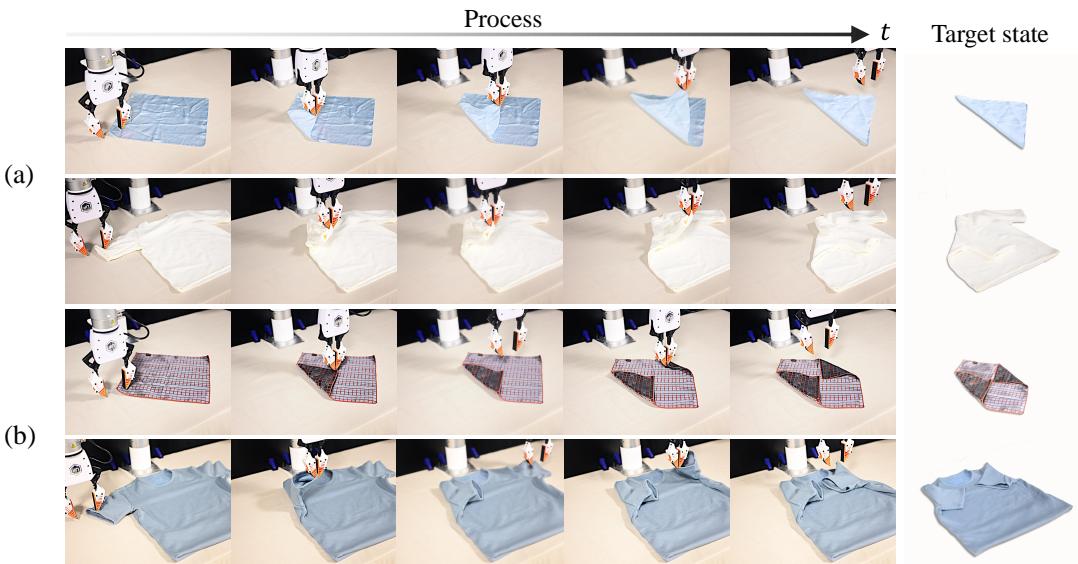
The system proved highly effective. In Figure 11, you can see the robot successfully manipulating a t-shirt from a crumpled state into a folded square.
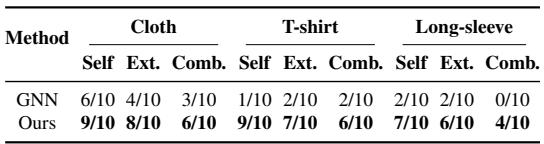
The success rates were quantified in Table 2 (below). For complex tasks like folding a T-shirt under “Combined” occlusion (where the arm and the cloth itself block the view), the standard GNN method failed almost completely (2/10 success). The proposed method succeeded 6/10 times—a massive improvement in robotic reliability.
Cross-Embodiment Generalization
One of the coolest features of this system is that the action space is “embodiment-agnostic.” The model cares about the effect of the gripper on the cloth, not the gripper itself. This means the same trained model can control a simple two-finger gripper or a complex multi-fingered robotic hand.
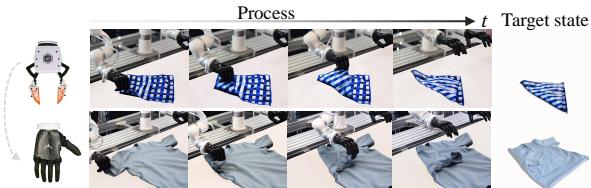
Figure 6 shows the same underlying logic driving two completely different robot hardware setups to achieve the same folding goal.
Why This Matters
This research represents a maturing of robotic manipulation. We are moving away from explicit, hard-coded physics calculations and toward learned, generative physics.
Here are the key takeaways for students and researchers:
- Generative AI as a Physics Engine: Diffusion models aren’t just for creating art. They can model the transition probabilities of physical objects, effectively acting as a learned simulator.
- Scalability over Inductive Bias: While GNNs have strong inductive biases for physics (nodes and edges), standard Transformers combined with Diffusion seem to scale better for complex, high-dimensional data like cloth meshes.
- The Importance of “Imagination”: The ability to reconstruct the hidden back-side of a shirt is what enables the robot to plan accurate folds. Without this generative perception step, the dynamics model would be operating on bad data.
UniClothDiff demonstrates that by teaching robots to imagine the unseen and predict the uncertain, we can enable them to handle the chaotic, crumpled reality of our daily lives—starting with the laundry.
The images used in this blog post are derived from the paper “Diffusion Dynamics Models with Generative State Estimation for Cloth Manipulation”.