](https://deep-paper.org/en/paper/2503.12096/images/cover.png)
In the rapidly evolving world of Artificial Intelligence, Vision-Language Models (VLMs) like CLIP have become superstars. They possess an uncanny ability to understand images and text simultaneously, allowing them to classify objects they have never seen before during training—a capability known as zero-shot inference.
To make these models even better, researchers use a technique called Test-Time Prompt Tuning (TPT). This method tweaks the model on the fly, adapting it to specific test samples without needing labeled training data. While TPT significantly boosts accuracy, it comes with a dangerous side effect: poor calibration.
A poorly calibrated model is like an overconfident student who guesses the wrong answer but insists they are 100% sure. In high-stakes fields like medical imaging or autonomous driving, this overconfidence can be disastrous. We need models that know when they don’t know.
In this post, we will dive deep into a paper titled “O-TPT: Orthogonality Constraints for Calibrating Test-time Prompt Tuning in Vision-Language Models.” We will explore why current tuning methods fail at calibration and how a geometric concept—orthogonality—can restore trustworthiness to these powerful AI systems.
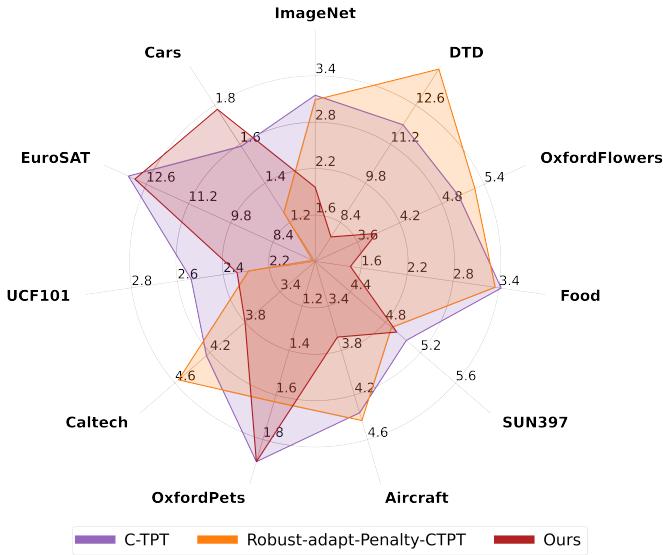
As shown in Figure 1, the method we are discussing today (O-TPT, in red) significantly outperforms existing methods in calibration (measured by ECE) across a wide variety of datasets.
The Background: VLMs, Prompts, and Calibration
To understand the solution, we first need to understand the architecture of the problem.
How CLIP Works
CLIP (Contrastive Language-Image Pre-training) consists of two main parts: an Image Encoder and a Text Encoder. It learns to map images and their corresponding text descriptions into a shared “embedding space.”
- If an image of a dog and the text “a photo of a dog” are close together in this space, the model predicts “dog.”
- To classify an image, we usually provide prompts like “a photo of a {class}” for every possible class and see which one aligns best with the image.
The Rise of Prompt Tuning
Hand-crafting prompts (e.g., guessing whether “a photo of a dog” works better than “a picture of a canine”) is tedious. Prompt Tuning automates this by treating the prompt tokens as learnable vectors. The model learns the best “soft prompt” to maximize accuracy.
Test-Time Prompt Tuning (TPT) takes this a step further. It adjusts these prompts dynamically for a single test image during inference. It minimizes the entropy (uncertainty) of the prediction, essentially saying, “Tune the prompt until the model is very confident about its prediction.”
The Calibration Crisis
While TPT makes the model more accurate, simply minimizing uncertainty forces the model to be overconfident. It pushes the predicted probabilities toward 1.0 (100%) even if the prediction is wrong.
Calibration measures how well the predicted confidence matches the actual accuracy. If a model predicts a class with 80% confidence, it should be correct 80% of the time. We measure this misalignment using the Expected Calibration Error (ECE).

In this equation:
- \(A_m\) represents a “bin” of samples (e.g., all predictions with 80-90% confidence).
- \(\text{acc}(A_m)\) is the actual accuracy of those samples.
- \(\text{conf}(A_m)\) is the average confidence predicted by the model.
- We want the difference between these two to be zero.
The Insight: Why Existing Methods Fail
Previous attempts to fix TPT calibration, such as C-TPT, focused on “Text Feature Dispersion.” The idea was simple: spread the text embeddings (feature vectors) apart in the vector space. The assumption was that if the features are far apart (dispersed), the model can distinguish between classes more reliably.
However, the authors of O-TPT discovered that simple dispersion isn’t enough. You can have vectors that are far apart in terms of Euclidean distance (distance in space) but still have very similar directions (angles).
The Angle Matters
In high-dimensional spaces like those used in CLIP, the angle between vectors (measured by Cosine Similarity) is often more important than the distance.
The researchers analyzed the relationship between the cosine similarity of text features and the calibration error (ECE). They found a strong correlation: lower cosine similarity (meaning larger angular separation) leads to better calibration.
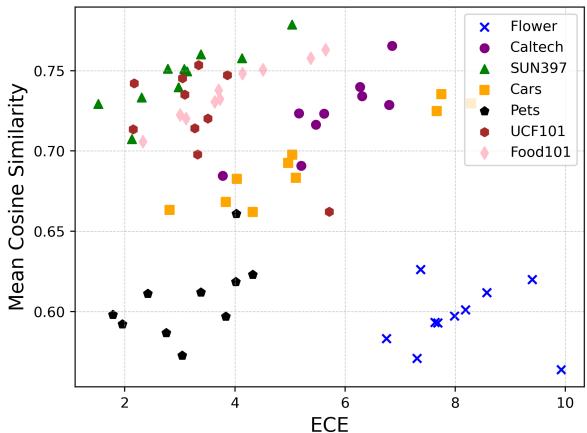
As visualized above, prompt styles that result in lower mean cosine similarity (bottom of the y-axis) generally yield lower calibration error (left of the x-axis).
This insight is further supported by looking at the probability density functions of cosine similarities for different prompts.
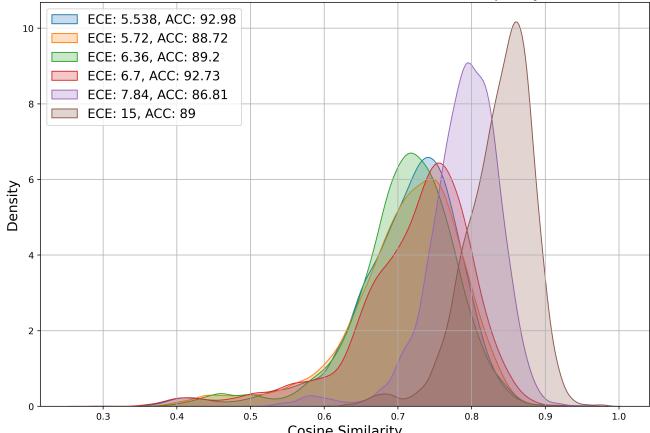
In Figure 2, the curves representing lower ECE (better calibration) are shifted to the left, indicating lower cosine similarity. This suggests that to calibrate a model, we shouldn’t just push features “away” from a center point; we need to make them point in distinct, orthogonal directions.
The Core Method: O-TPT
Based on these insights, the authors propose O-TPT (Orthogonal Test-time Prompt Tuning). The core idea is to impose an orthogonality constraint during the prompt tuning process.
Visualizing the Difference
To understand why orthogonality is better than simple dispersion, let’s look at a geometric comparison on a hypersphere (a circle, for simplicity).
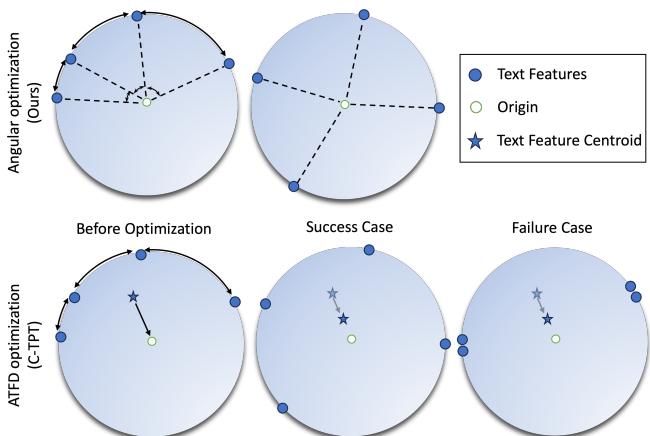
In Figure 3:
- ATFD Optimization (C-TPT): This method tries to disperse features away from a centroid. However, as seen in the “Failure Case,” features can move away from the centroid while still remaining clustered together in a specific angular region. They aren’t utilizing the full 360 degrees of the circle.
- Angular Optimization (Ours/O-TPT): By forcing features to be orthogonal, the method pushes them to be mutually perpendicular. This naturally distributes them evenly across the angular space, ensuring distinct decision boundaries between classes.
The Mathematical Formulation
How do we force a neural network to learn orthogonal vectors? We add a regularization term to the loss function.
Let \(\mathbf{E}\) be the matrix of text features for all classes. The matrix product \(\mathbf{E}\mathbf{E}^T\) represents the pairwise cosine similarities between every text feature.
- If all vectors are perfectly orthogonal (perpendicular), the dot product of distinct vectors is 0, and the dot product of a vector with itself is 1.
- Therefore, for perfectly orthogonal normalized vectors, \(\mathbf{E}\mathbf{E}^T\) should equal the Identity Matrix (\(I_C\)).
The O-TPT loss function is defined as:

Here is the breakdown:
- \(L_{TPT}\): The standard loss for prompt tuning (keeping accuracy high).
- \(\lambda\): A hyperparameter that balances the two objectives.
- \(\|\mathbf{E}\mathbf{E}^T - I_C\|^2\): This is the orthogonality constraint. It penalizes the model whenever the text features are not orthogonal to each other.
Stability in Optimization
One of the major benefits of this constraint is stability. Standard TPT allows text features to drift around wildly during tuning, often leading to high cosine similarities (features collapsing toward each other).
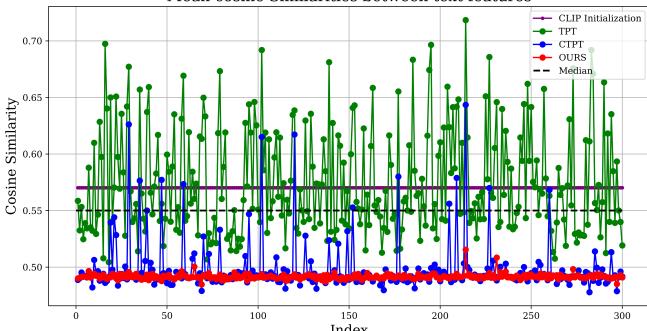
Figure 4 tracks the mean cosine similarity during the tuning steps.
- Green (TPT): Fluctuates wildly and drifts toward high similarity (bad for calibration).
- Red (Ours): Maintains a low, stable cosine similarity, very close to the ideal, ensuring the features remain angularly distinct.
Experiments and Results
The researchers tested O-TPT on a wide range of datasets, including ImageNet, fine-grained classification tasks (like flowers, food, and aircraft), and out-of-distribution datasets (to test robustness). They compared O-TPT against standard TPT and C-TPT.
Quantitative Performance
The results show a consistent improvement in calibration without sacrificing accuracy.
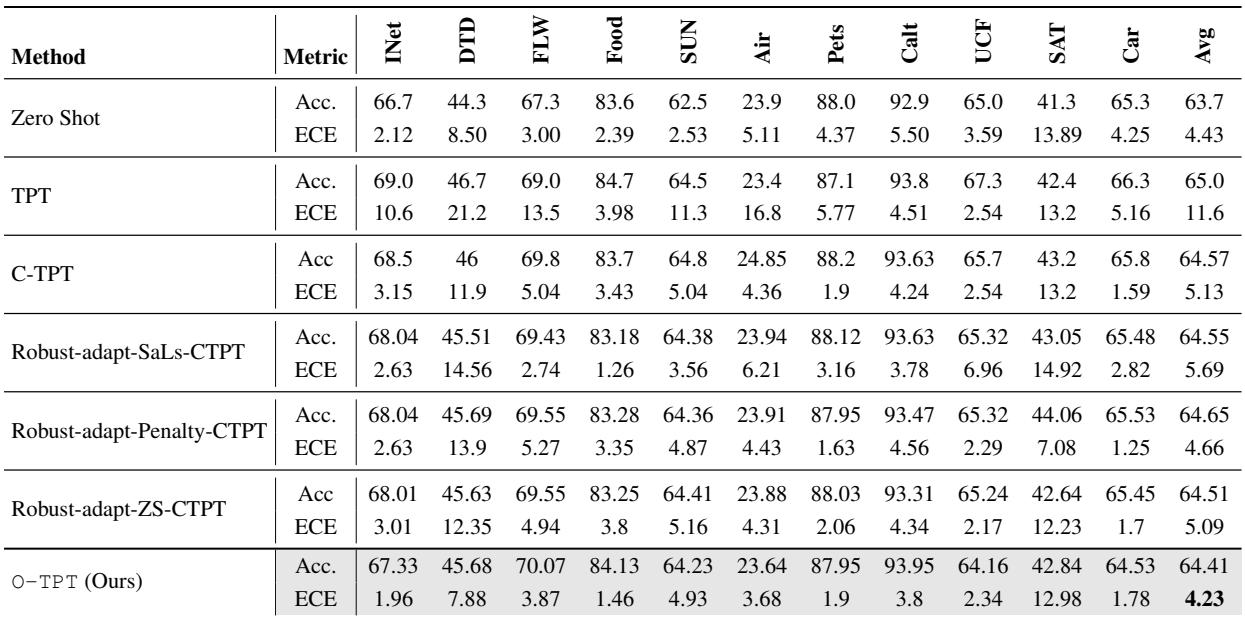
In Table 2, look at the ECE (Expected Calibration Error) rows.
- TPT often has very high ECE (e.g., 10.6 on ImageNet, 21.2 on DTD), indicating severe overconfidence.
- C-TPT improves this significantly.
- O-TPT (Ours) achieves the lowest ECE in almost every category, with an average ECE of 4.23 compared to TPT’s 11.6.
Reliability Diagrams
To visualize how the calibration improves, we use reliability diagrams. Ideally, the blue bars (outputs) should perfectly align with the diagonal line (perfect calibration). The pink area represents the “gap” or error.
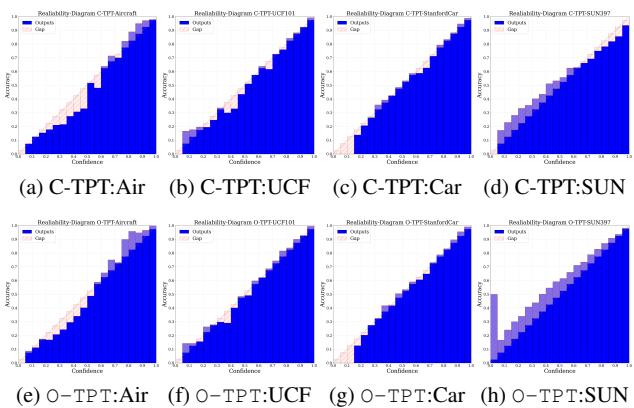
In Figure 8, compare the top row (C-TPT) with the bottom row (O-TPT):
- C-TPT often shows bars that are lower than the diagonal line in high-confidence regions, or irregular gaps.
- O-TPT shows bars that track the diagonal line much more closely. The reduction in the pink “gap” area visually confirms that O-TPT produces more reliable confidence estimates.
Comparison with Post-Hoc Methods
A common way to fix calibration is “Temperature Scaling,” a post-processing step. However, Figure 5 shows that O-TPT outperforms even TPT combined with Temperature Scaling (TPT+Temp).
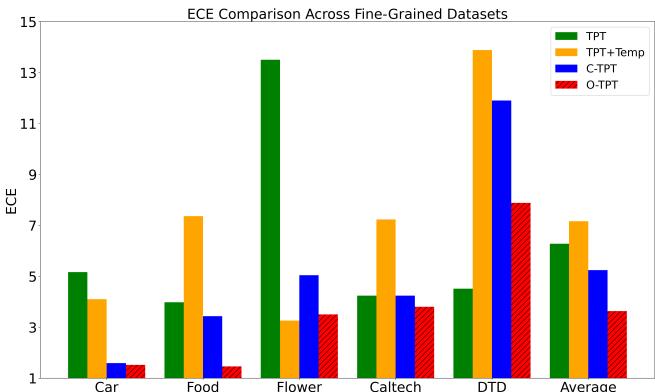
O-TPT (red striped bars) consistently has the lowest bar height (lowest error) across the datasets.
The Trade-off: Accuracy vs. Calibration
There is often a trade-off between being accurate and being calibrated. A Pareto front analysis allows us to see this relationship. We want methods that are in the top-left corner (High Accuracy, Low ECE).
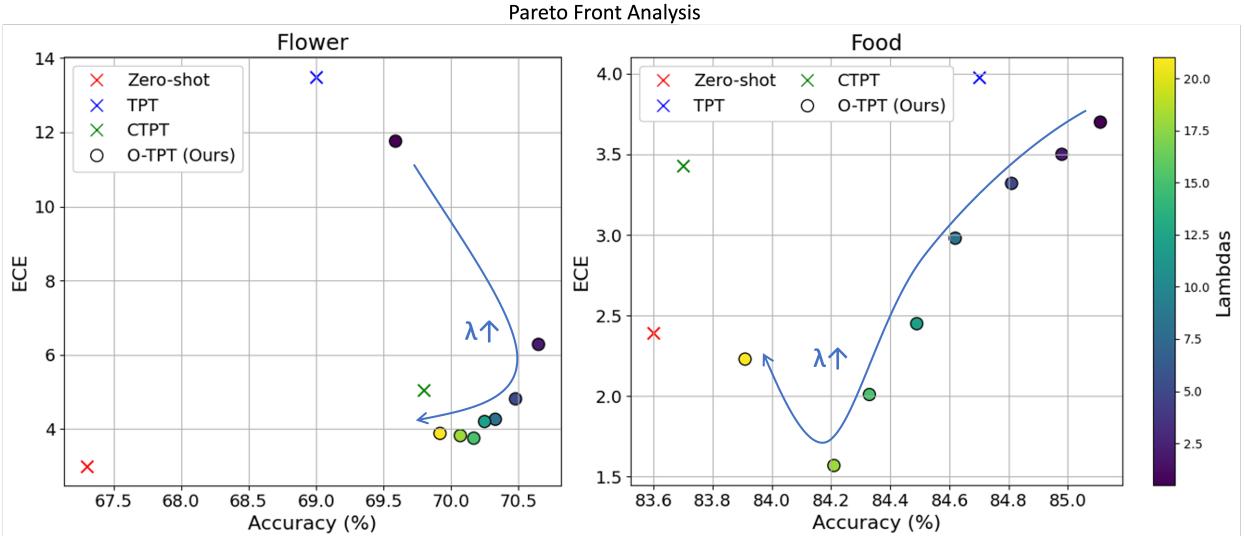
In Figure 10, the yellow circles (O-TPT) consistently appear in favorable positions relative to the blue crosses (TPT) and green crosses (C-TPT), indicating a superior balance between accuracy and trustworthiness.
Conclusion
The work presented in O-TPT highlights a crucial aspect of machine learning that is often overlooked in the race for higher accuracy: Geometry matters.
By understanding that text features in Vision-Language Models need distinct angular separation to be reliable, the authors introduced a simple yet powerful orthogonality constraint. This method forces the model to organize its knowledge more effectively in the embedding space.
Key Takeaways:
- Test-Time Prompt Tuning (TPT) boosts accuracy but destroys calibration, making models dangerously overconfident.
- Dispersion is not enough: Simply pushing features apart isn’t as effective as ensuring they point in different directions (orthogonality).
- O-TPT fixes this by mathematically enforcing orthogonality (\(EE^T \approx I\)) during the tuning process.
- The result is a model that is not only accurate but also trustworthy—a critical requirement for deploying AI in the real world.
As we continue to deploy Large Multimodal Models in safety-critical applications, techniques like O-TPT will be essential in ensuring that when an AI says “I’m sure,” it actually knows what it’s talking about.