](https://deep-paper.org/en/paper/2503.12886/images/cover.png)
The dream of the “digital twin”—a photorealistic, animatable avatar that looks and moves exactly like you—has long been a holy grail in computer graphics. Whether for the metaverse, video games, or next-generation telepresence, the demand for high-fidelity head avatars is skyrocketing.
However, creating these avatars typically involves a painful trade-off. You can have high quality, or you can have speed, but rarely both. Traditional methods might require expensive studio setups, while recent neural rendering techniques often take hours (or even days) of training time to learn a single face.
In this post, we are diving deep into RGBAvatar, a groundbreaking paper that shatters this trade-off. This new method reconstructs photorealistic head avatars from a short monocular video in just 80 seconds and renders them at a staggering 400 FPS. Even more impressively, it introduces an “online” mode capable of learning an avatar on-the-fly as a video stream comes in.
We will unpack how the researchers achieved this by combining 3D Gaussian Splatting with a clever “reduced” blendshape architecture and some serious GPU optimization.
The Problem: The Bottleneck of Digital Humans
To understand why RGBAvatar is significant, we first need to look at the current landscape of head avatar reconstruction.
Recently, 3D Gaussian Splatting (3DGS) has taken the field by storm. Unlike meshes (which use triangles) or NeRFs (which use expensive neural networks to query density), 3DGS represents a scene as millions of 3D “blobs” (Gaussians). Each blob has a position, color, opacity, and scale. This allows for incredible rendering speeds.
However, 3DGS is inherently static. To animate a head, you need to move these Gaussians. The standard approach is to attach these Gaussians to a 3D Morphable Model (3DMM), like the industry-standard FLAME model. FLAME provides a mesh that can move (jaw opening, eyebrows raising). Previous methods essentially “glue” the Gaussians to the FLAME mesh.
The Limitation: FLAME is a generic model. It uses a fixed set of “blendshapes” (pre-defined facial expressions). If you rely strictly on FLAME’s pre-defined bases, you inherit its limitations. To get high fidelity, you need a massive number of parameters, which slows down training and rendering. Existing methods struggle to capture fine details like wrinkles or subtle mouth movements without becoming computationally heavy.
The Solution: RGBAvatar
The researchers behind RGBAvatar propose a shift in perspective. Instead of relying on the fixed, generic blendshapes of FLAME, why not learn a compact, personalized set of blendshapes for the specific person being modeled?
Their approach relies on three core pillars:
- Reduced Gaussian Blendshapes: A learnable, compact representation of facial expressions.
- Color Initialization: A smart way to guess Gaussian colors to speed up training.
- Batch-Parallel Rasterization: A hardware optimization to fully utilize the GPU.
Let’s break these down.
1. The Core Architecture: Reduced Gaussian Blendshapes
The heart of this paper is how it handles facial expressions. In a traditional setup, if you wanted to represent a smile, you would activate the “smile” blendshape from the FLAME model.
RGBAvatar takes a different route. It uses the tracked FLAME parameters (which tell us the jaw pose, eye rotation, etc.) but passes them through a lightweight Multi-Layer Perceptron (MLP). This MLP acts as a translator. It converts the generic FLAME parameters into a set of Reduced Blendshape Weights (\(\psi\)).
These weights are then used to drive a set of Gaussian Blendshapes.
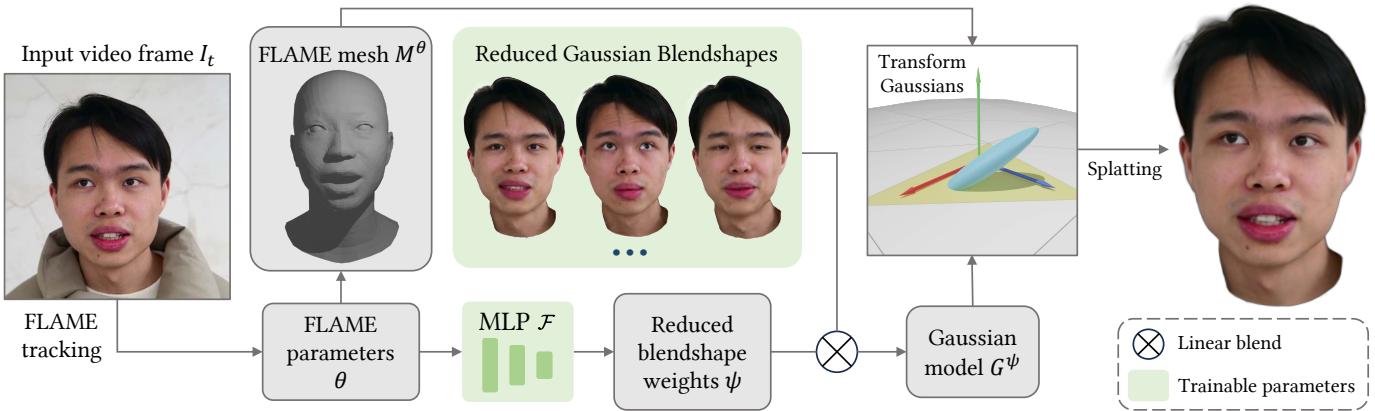
As shown in Figure 2, the pipeline works as follows:
- Input: A video frame is processed to extract standard FLAME parameters (\(\theta\)).
- Translation: An MLP (\(\mathcal{F}\)) maps these parameters to reduced weights (\(\psi\)).
- Blending: The system maintains a “Base” Gaussian model (\(G_0\)) and a set of learnable “Delta” models (\(\Delta G_k\)). These are linearly blended together.
- Deformation: The blended Gaussians are transformed based on the movement of the underlying mesh to ensure they stay attached to the face.
The mathematical formulation for the final Gaussian model \(G^\psi\) is a linear combination:
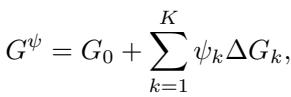
Here, \(G_0\) is the neutral face, and each \(\Delta G_k\) represents a change (like a raised eyebrow or a pucker). The weights \(\psi\) determine how much of each change to apply.
Why “Reduced”?
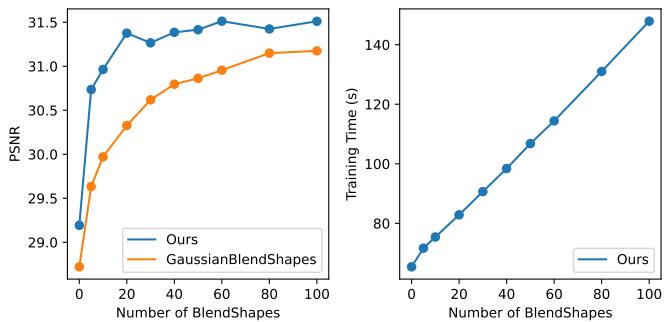
The magic lies in the number of blendshapes (\(K\)). Traditional models might need 50 to 100 generic blendshapes to get a decent result. RGBAvatar achieves state-of-the-art quality with as few as 20 blendshapes.
Because these blendshapes are learned specifically for the user (rather than being fixed generic shapes), they are incredibly efficient. They capture the specific idiosyncrasies of the user’s face—like how their specific crow’s feet form when they smile.
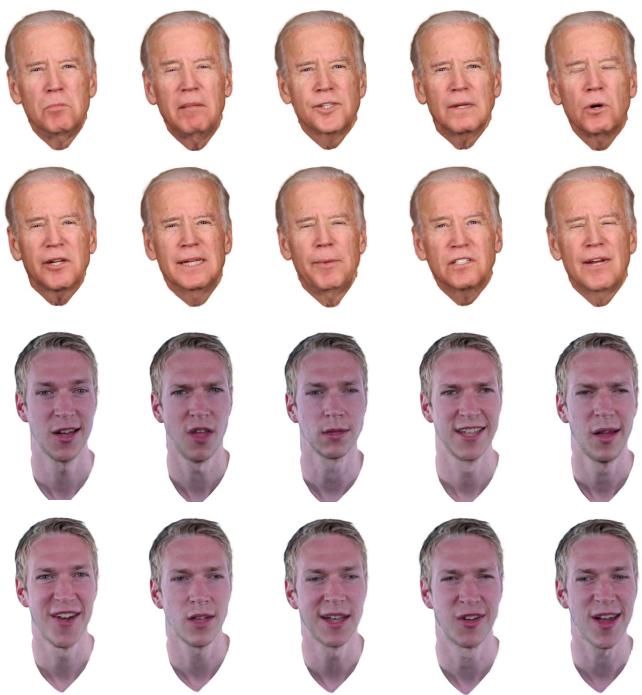
Figure 7 visualizes these learned shapes. You can see that they don’t necessarily correspond 1-to-1 with standard expressions like “mouth open.” Instead, the network learns the most efficient basis functions to reconstruct that specific person’s range of motion.
The researchers found that 20 blendshapes was the “sweet spot.” As shown in the graph below, increasing the number beyond 20 yields diminishing returns on quality (PSNR) while linearly increasing the training time.
2. Accelerating Convergence with Color Initialization
To achieve “online” reconstruction (building the avatar while the video is playing), the system needs to learn extremely fast. Standard Gaussian Splatting initializes points with random or neutral colors and relies on gradient descent to slowly find the right colors.
RGBAvatar introduces a heuristic to speed this up. The researchers observed that a 3D Gaussian, when projected onto the screen, is essentially a 2D Gaussian kernel. Therefore, for the very first frame where a Gaussian is visible, its color can be estimated directly from the input image using a convolution operation.
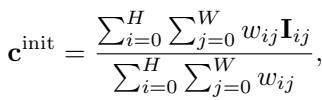
This equation calculates the initial color (\(c^{init}\)) by taking a weighted average of the pixels the Gaussian covers.
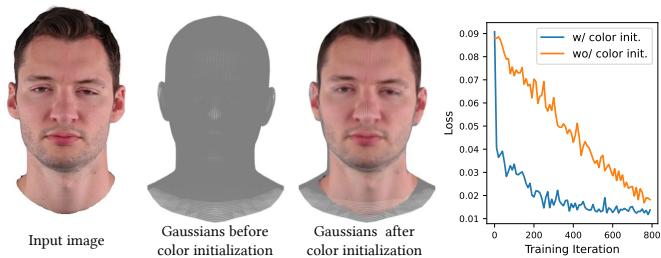
As seen in Figure 4, this simple change (the blue line) causes the loss to plummet much faster in the early stages compared to standard initialization (the orange line). This jump-start is crucial for real-time applications.
3. Batch-Parallel Gaussian Rasterization
The final piece of the speed puzzle is a hardware optimization. Training on head avatars poses a unique problem for high-end GPUs: the scene is too small.
A head avatar typically typically uses fewer than 100,000 Gaussians. A powerful GPU like an RTX 3090 can render this in a fraction of a millisecond. However, standard training loops render one image, calculate gradients, and update. This leaves the massive parallel computing power of the GPU sitting idle, waiting for the CPU to manage the loop overhead. GPU utilization often drops below 60% with existing methods.
RGBAvatar introduces Batch-Parallel Gaussian Rasterization.
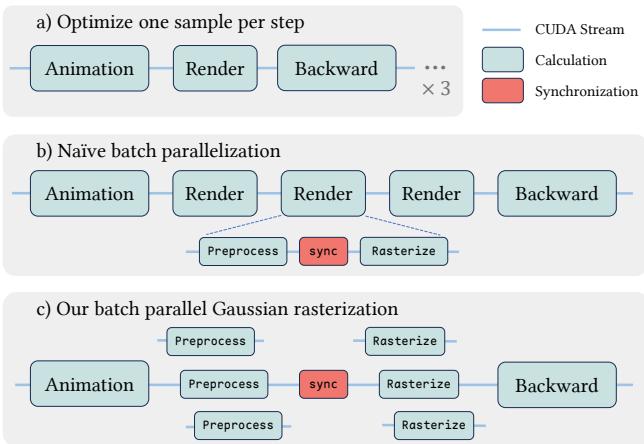
Instead of processing one frame at a time (Figure 5a), or naively batching them with frequent CPU-GPU synchronization (Figure 5b), RGBAvatar uses CUDA streams to process multiple frames in parallel (Figure 5c).
Because the rendering of frame A doesn’t depend on the rendering of frame B, they can be rasterized simultaneously on different streams. The system only synchronizes once per batch. This pushes GPU utilization to 100%, increasing training throughput from roughly 150 frames per second to 630 frames per second.
Online Reconstruction: Learning on the Fly
Perhaps the most exciting application of RGBAvatar is Online Reconstruction. Imagine joining a video call, and within the first minute, the system has built a photorealistic 3D avatar of you that tracks your movements perfectly.
The challenge here is the “data stream.” In offline training, the model can shuffle the entire video dataset, ensuring it doesn’t forget the beginning of the video while learning the end. In an online stream, data arrives sequentially. If the model only learns from the newest frames, it suffers from Catastrophic Forgetting—it forgets what you look like when you’re not talking once you start smiling.
To solve this, the researchers use a Local-Global Sampling Strategy:
- Local Pool (\(M_l\)): Stores the most recent 150 frames. This helps the model adapt quickly to new expressions.
- Global Pool (\(M_g\)): Stores a representative sample of historical frames (using reservoir sampling). This acts as the “long-term memory.”
In every training step, the batch includes a mix of frames from both pools. This ensures the avatar adapts to new data while retaining the ability to render previous expressions.
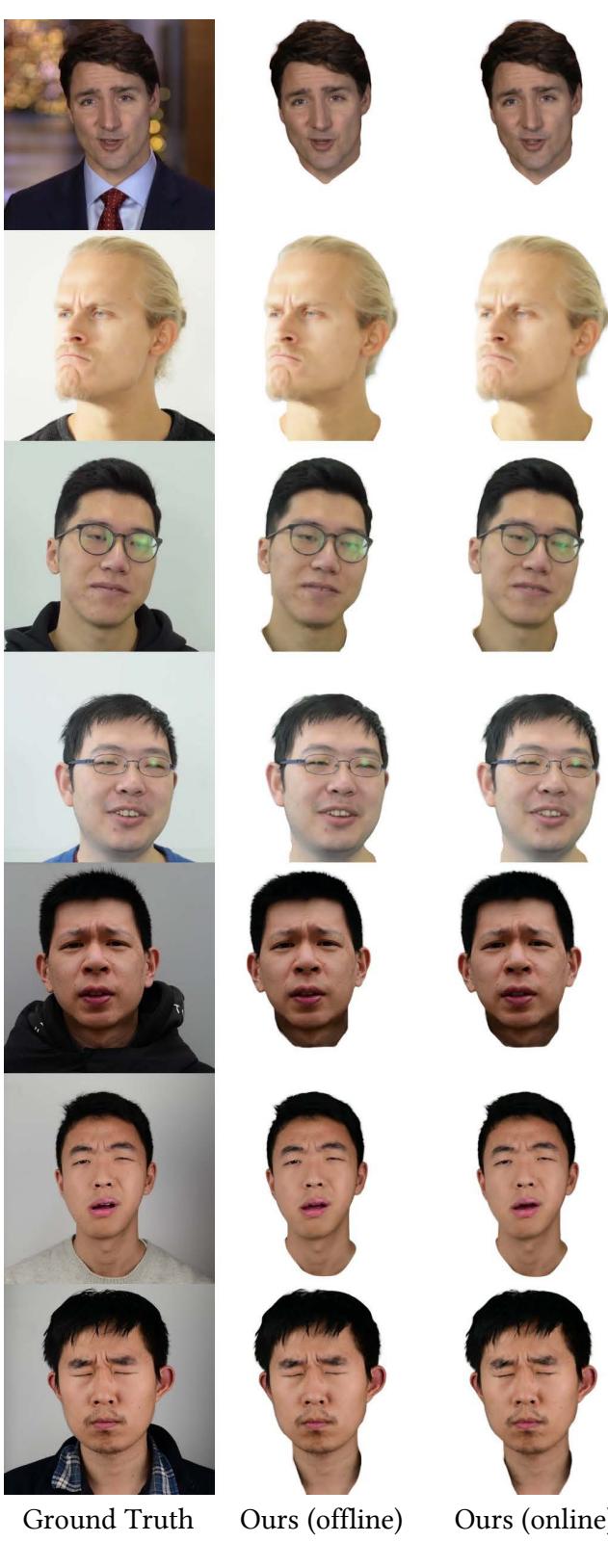
As shown in Figure 19, the online reconstruction (right column) achieves quality comparable to the offline method (middle column), preserving details like facial hair and skin texture.
Experimental Results
So, how does it stack up against the competition? The researchers compared RGBAvatar against state-of-the-art methods like SplattingAvatar, FlashAvatar, and MonoGaussianAvatar.
Visual Quality
The visual results are striking. Because the reduced blendshapes are learned per-subject, they can capture high-frequency details that generic blendshapes miss.
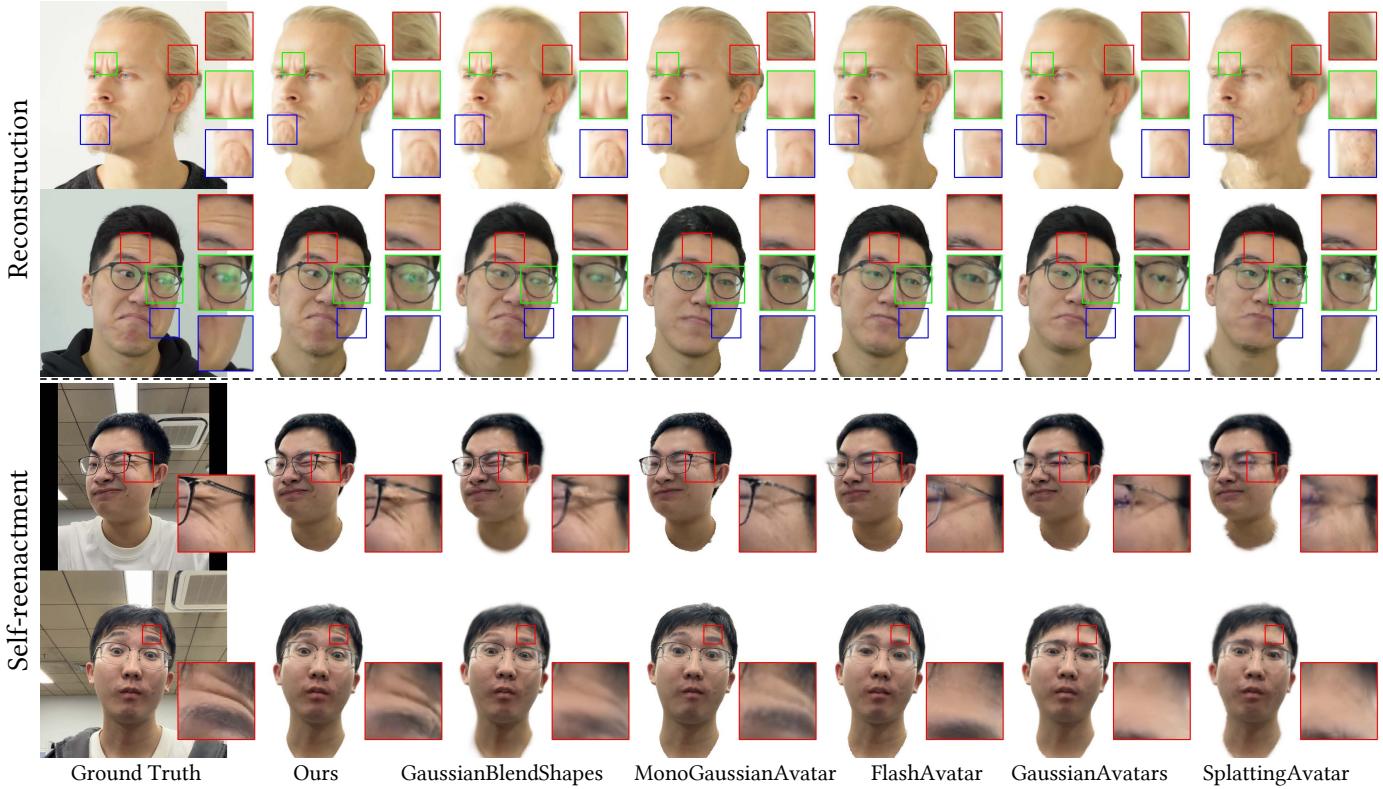
In Figure 6, look closely at the wrinkles and the mouth interior. Other methods often blur these areas or fail to close the lips correctly because the underlying FLAME mesh limits them. RGBAvatar captures the deep wrinkles and the precise geometry of the lips.
Speed and Efficiency
This is where RGBAvatar truly shines.
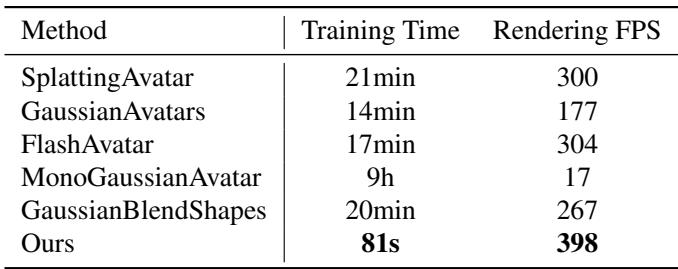
Table 2 reveals the massive performance gap.
- MonoGaussianAvatar takes 9 hours to train.
- SplattingAvatar takes 21 minutes.
- RGBAvatar takes 81 seconds.
Despite the blazing fast training time, it renders at nearly 400 FPS on an RTX 3090, making it more than ready for high-refresh-rate VR applications.
Conclusion
RGBAvatar represents a significant leap forward in the creation of digital humans. By moving away from rigid, pre-defined blendshapes and embracing a learned, reduced representation, the authors managed to improve reconstruction fidelity while drastically cutting down computational costs.
The combination of algorithmic innovation (Reduced Blendshapes) and systems engineering (Batch-Parallel Rasterization) allows for a system that is practically usable today. The ability to reconstruct a high-fidelity avatar in just over a minute—or even continuously during a live stream—opens up immediate possibilities for interactive applications, gaming, and virtual reality telepresence.
While limitations exist (such as artifacts when the head turns to extreme angles not seen in the training data), RGBAvatar proves that we don’t need massive, heavy models to achieve photorealism. We just need smarter, more adaptive ones.