](https://deep-paper.org/en/paper/2503.15005/images/cover.png)
Introduction
Imagine you are a robot walking into a room. You see a man sitting on a sofa. You hear someone say, “Peter is relaxing.” Your depth sensors tell you the sofa is against a wall.
As humans, we process all this information seamlessly. We don’t create a separate mental model for what we see, another for what we hear, and a third for spatial depth. We integrate them into a single understanding of the scene: Peter is on the sofa against the wall.
However, in the world of Computer Vision, this integration is incredibly difficult. For years, researchers have relied on Scene Graphs (SGs) to structure visual information. A Scene Graph turns a chaotic image into a structured graph where nodes are objects (e.g., “Man”, “Sofa”) and edges are relationships (e.g., “sitting on”).
Until now, research has been siloed. We have Image Scene Graphs (ISG), Text Scene Graphs (TSG), Video Scene Graphs (VSG), and 3D Scene Graphs (3DSG). But we haven’t had a good way to combine them.
In this post, we will dive deep into a paper titled “Universal Scene Graph Generation”. The researchers propose a novel framework, USG-Par, that unifies these modalities into a single, comprehensive Universal Scene Graph (USG). This is a significant step toward building AI agents that can truly perceive the world the way we do.
The Problem with Silos
Before we look at the solution, we need to understand the current landscape. A Scene Graph is a powerful tool because it abstracts raw pixels or text into semantic knowledge.
- Text SGs are great for abstract concepts (“Peter is relaxing”) but lack spatial precision.
- Image SGs provide visual details (“Red shirt”, “Leather sofa”) but miss 3D constraints.
- Video SGs capture temporal dynamics (“Peter sits down”) but are computationally heavy.
- 3D SGs offer spatial grounding (“Sofa is 2 meters from the door”) but often lack semantic richness.
In real-world applications—like autonomous driving or robotics—these modalities coexist. If we treat them separately, we end up with fragmented knowledge. The standard approach has been a “pipeline” method: generate a graph for the image, generate one for the text, and try to glue them together later.
This leads to two major problems:
- Redundancy and Conflict: If the image model sees a “person” and the text model reads “Peter,” the system often struggles to realize they are the same entity.
- Missed Information: Complementary strengths are ignored. The text might explain why someone is holding a bottle (to feed an elephant), while the image explains where they are standing.
The Solution: Universal Scene Graph (USG)
The researchers introduce the Universal Scene Graph (USG). The goal is to create a representation that is “modality-comprehensive.” This means the graph can ingest any combination of inputs—text, image, video, or 3D point clouds—and output a single, unified knowledge structure.
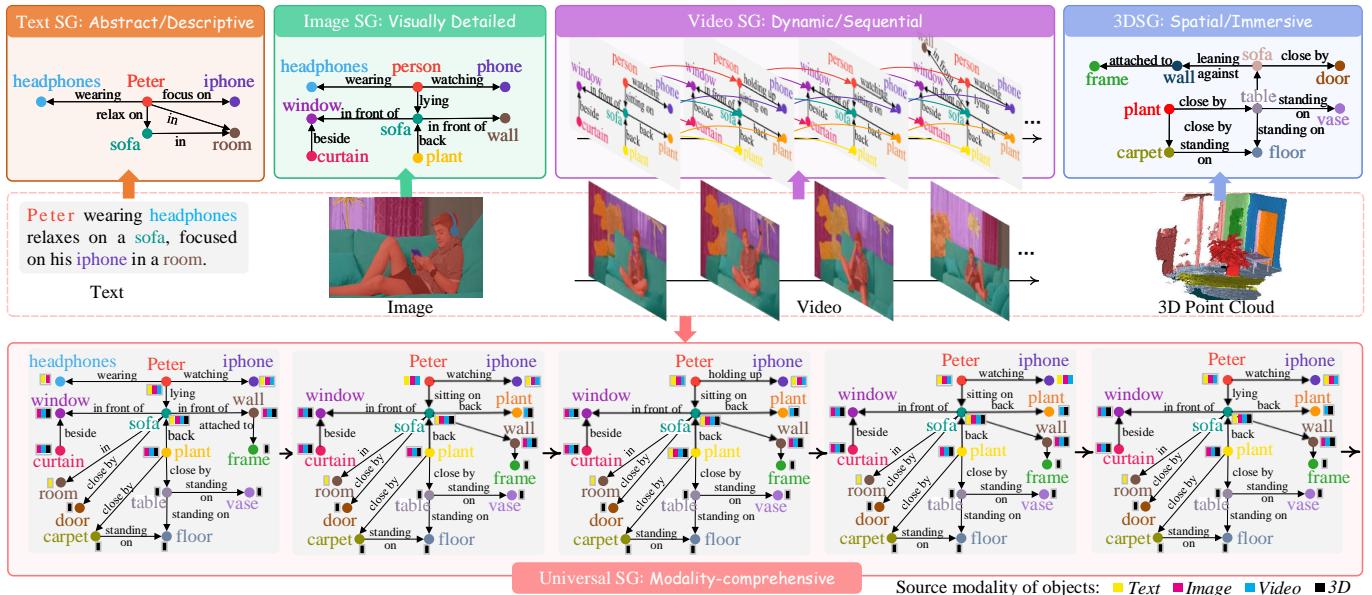
As shown in Figure 1 above, distinct modalities contribute different layers of information. The USG at the bottom integrates the abstract name “Peter” from the text (yellow node) with the visual object “Phone” from the video (blue node) and the spatial constraint “Floor” from the 3D data (black node).
This isn’t just about stacking graphs on top of each other; it’s about alignment. The system must recognize that the “Peter” in the text, the pixel blob in the image, and the 3D mesh on the sofa are the same entity.
The Core Method: USG-Par
To achieve this, the authors propose a new architecture called the USG-Parser (USG-Par). This is an end-to-end model designed to handle the complexity of cross-modal alignment.
Let’s break down the architecture step-by-step.
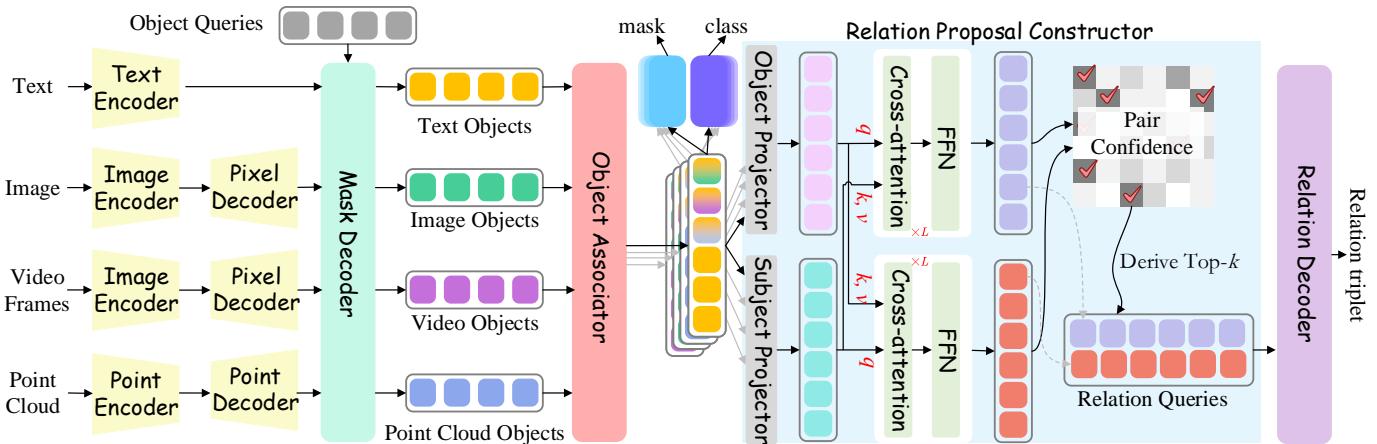
As illustrated in Figure 2, the pipeline consists of five distinct stages.
1. Modality-Specific Encoders
The system first needs to understand the raw input. Since text and point clouds are fundamentally different data formats, the model uses specialized encoders for each:
- Text: Uses Open-CLIP to extract contextual features.
- Image/Video: Uses a frozen CLIP-ConvNeXt backbone combined with a Pixel Decoder to get multi-scale visual features.
- 3D Point Clouds: Uses Point-BERT to encode spatial data.
These encoders output feature representations projected into a common dimension, preparing them for the unified processing that follows.
2. Shared Mask Decoder
Once features are extracted, the model needs to identify potential objects. Instead of separate detectors for every modality, USG-Par uses a Shared Mask Decoder.
This component uses “object queries”—learnable vectors that probe the features to find objects. It employs a masked attention mechanism, similar to architectures like Mask2Former.
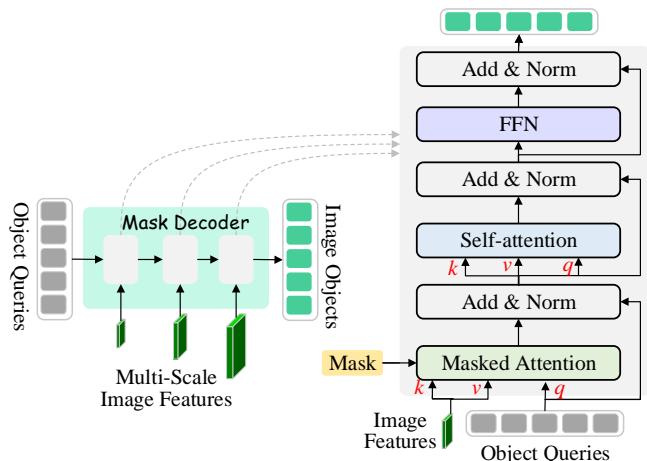
As seen in Figure 13, the decoder refines these queries layer by layer. For video data, it even includes a temporal encoder to track objects across frames. The output is a set of “Object Queries” representing every potential entity in the scene, regardless of which modality it came from.
3. The Object Associator
This is arguably the most critical innovation of the paper. We now have a bag of objects from the text, the image, and the 3D scan. How do we know which ones are duplicates?
A naive approach would be to just compare their feature vectors directly. However, an object represented in text space looks very different from an object in 3D point cloud space. There is a “modality gap.”
The Object Associator solves this by projecting objects into each other’s feature spaces before comparison.
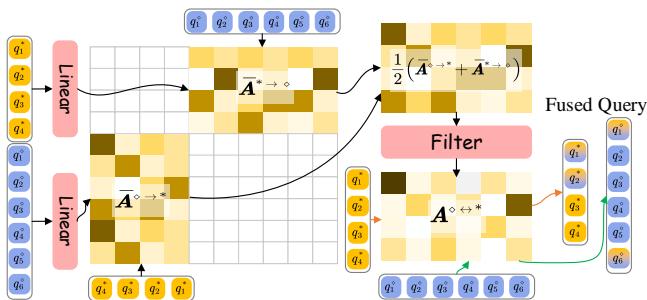
Referencing Figure 3, here is the process:
- Projection: To check if a visual object matches a text object, the model projects the visual query into the text feature space (and vice versa).
- Similarity Calculation: It calculates the cosine similarity between these projected features.
- Filtering: A CNN-based filter refines these associations to remove noise.
Mathematically, this is represented as computing an association matrix \(A\). If the score is high, the system knows that “Peter” (Text) and “Person 1” (Image) are the same node in the final graph.
4. Relation Proposal Constructor (RPC)
Now that we have a clean set of unique objects, we need to find the relationships between them. In a scene with 20 objects, checking every possible pair (\(20 \times 20 = 400\) combinations) is computationally expensive and mostly wasteful (the ceiling is rarely “eating” the floor).
The Relation Proposal Constructor (RPC) filters these pairs to find the most likely candidates.
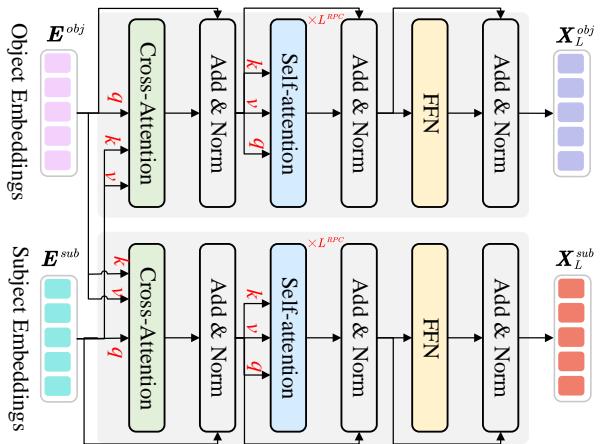
The RPC uses a mechanism called Relation-Aware Cross-Attention (Figure 14). It allows subject and object queries to “talk” to each other. For example, if a subject is a “human,” the module learns to pay attention to objects like “phone” or “chair” (likely interactions) rather than “sky.” It outputs a “Pair Confidence Matrix,” selecting only the top-\(k\) most likely pairs for detailed analysis.
5. Relation Decoder
Finally, the selected pairs are passed to the Relation Decoder. This module determines the exact semantic label of the relationship (e.g., “holding,” “standing on,” “behind”).
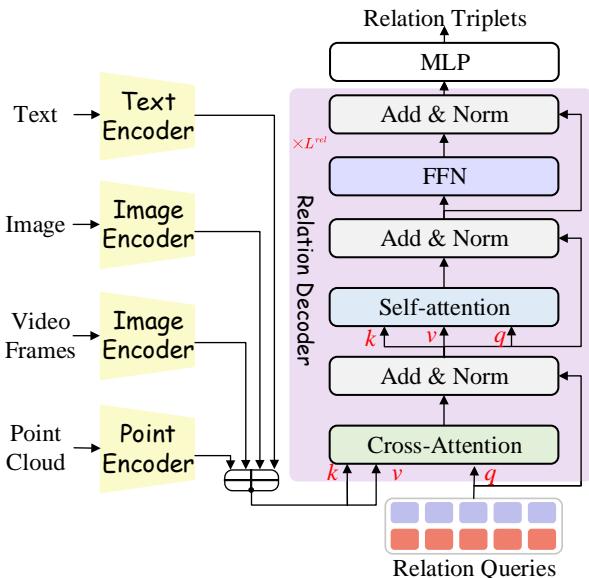
The decoder (Figure 15) takes the subject and object embeddings, concatenates them into a “Relation Query,” and uses cross-attention against the original multimodal features to predict the final predicate.
Addressing the Data Problem: Text-Centric Learning
Designing the architecture is only half the battle. The other hurdle is data.
- Lack of Universal Data: We have datasets for Image SGs and Video SGs, but very few datasets have aligned Text+Image+Video+3D annotations.
- Domain Imbalance: 3D datasets are usually indoor scenes. Video datasets are action-heavy. Text is generic.
To solve this, the authors propose Text-Centric Scene Contrastive Learning.
Since text is the most flexible modality (you can describe anything in text), the authors treat the text representation as the “anchor.”
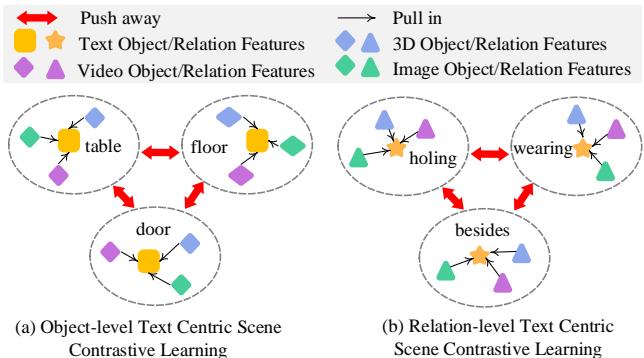
As shown in Figure 4, the model uses a contrastive loss function. It pulls the representation of a visual object (like a “table” in an image) closer to the representation of the word “table” in the text embedding space, while pushing it away from unrelated words like “door.”
This strategy allows the model to leverage the massive amount of single-modality data available while still learning a shared, universal representation.
Experiments and Results
Does this complex architecture actually work better than just running separate models and combining the results? The authors conducted extensive experiments to find out.
Performance on Single Modalities
First, they checked if USG-Par could handle standard tasks, like Image Scene Graph Generation, as well as specialized models.
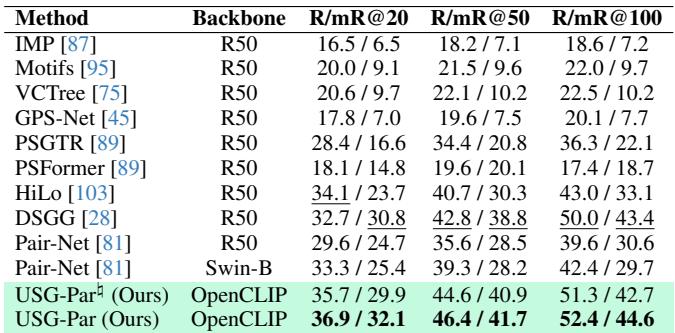
In Table 2, we see the results on the PSG (Panoptic Scene Graph) dataset. USG-Par outperforms state-of-the-art methods like HiLo and Pair-Net. This confirms that the universal architecture doesn’t dilute performance on specific tasks; in fact, the shared learning seems to boost it.
Multimodal Performance: The Real Test
The most important evaluation is how well the model generates graphs when given multiple inputs (e.g., Text + Image).
The authors compared USG-Par against a “Pipeline” baseline (training separate models and merging outputs).
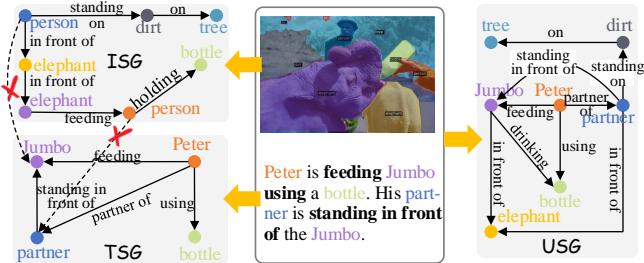
Figure 6 provides a compelling qualitative example.
- The Scene: Peter is feeding an elephant (“Jumbo”).
- The Pipeline Approach (Left/Middle): It gets confused. It creates an edge between “person” and “Jumbo” but fails to unify the context correctly, leading to fragmented graphs.
- The USG Approach (Right): It successfully merges the text “Peter” with the visual “Person.” It understands that “Peter” is the one “feeding” “Jumbo.” It correctly integrates the “tree” and “dirt” from the image background which weren’t in the text.
The Impact of Overlap
The researchers also analyzed how much the overlap between modalities matters. If the text describes exactly what is in the image, performance is higher.
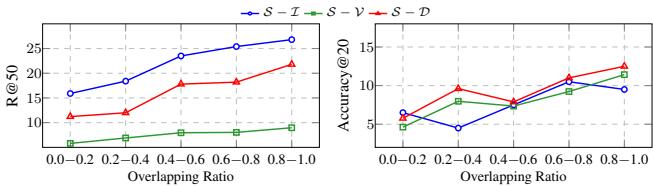
Figure 17 shows that as the Overlapping Ratio increases (meaning the text and image describe the same things more closely), the accuracy of the Scene Graph Generation improves significantly. This validates the effectiveness of the Object Associator: when the data aligns, the model successfully exploits the redundancy to reinforce its confidence.
Conclusion and Implications
The “Universal Scene Graph Generation” paper marks a shift in how we think about scene understanding. By moving away from modality-specific silos and toward a unified graph representation, we open the door for more robust AI systems.
Key Takeaways:
- Unified Representation: USG allows disparate data types (Text, Image, Video, 3D) to coexist in a single semantic structure.
- USG-Par Architecture: The modular design—specifically the Object Associator—effectively bridges the “modality gap,” allowing the system to understand that a pixel region and a text entity are the same object.
- Text-Centric Learning: Aligning visual and spatial data to text embeddings proves to be a powerful way to handle domain imbalances and data scarcity.
This work is particularly exciting for the future of Embodied AI. A robot equipped with USG-Par wouldn’t just see pixels or point clouds; it would understand the story of its environment, combining what it sees, what it knows from instructions, and how objects move in time into one coherent picture.