](https://deep-paper.org/en/paper/2503.15019/images/cover.png)
Imagine teaching a robot to understand the world. If you show it a photo of a kitchen, it might identify a “cup” and a “table.” But the real world isn’t a static photo; it is a continuous, dynamic stream of events. A person walks in, picks up the cup, and drinks from it. To truly perceive reality, an AI needs to understand not just what things are, but how they interact over time and space.
This is the domain of 4D Panoptic Scene Graph (4D-PSG) Generation. It’s a cutting-edge task that combines computer vision, temporal reasoning, and geometric understanding. However, researchers face a massive wall: data scarcity. Collecting and annotating 4D data (3D video with pixel-perfect labels and relationship graphs) is incredibly expensive and difficult.
In this post, we are diving deep into a fascinating paper titled “Learning 4D Panoptic Scene Graph Generation from Rich 2D Visual Scene” by researchers from the National University of Singapore, Nanyang Technological University, and Zhejiang University. They propose a clever solution: if we don’t have enough 4D data, why not teach the model to “hallucinate” the missing dimensions using the massive amounts of 2D data we already have?
1. The Challenge: Why 4D is Hard
To appreciate the solution, we first need to understand the problem. A Scene Graph (SG) is a structured representation of an image where objects are nodes and their relationships are edges (e.g., <man, holding, cup>).
A 4D Panoptic Scene Graph takes this to the next level. It doesn’t just list objects; it tracks them through time (the 4th dimension) and space (3D depth).
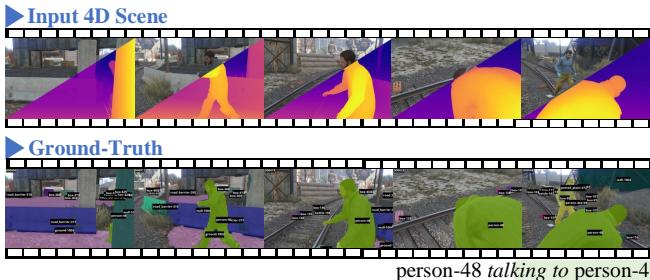
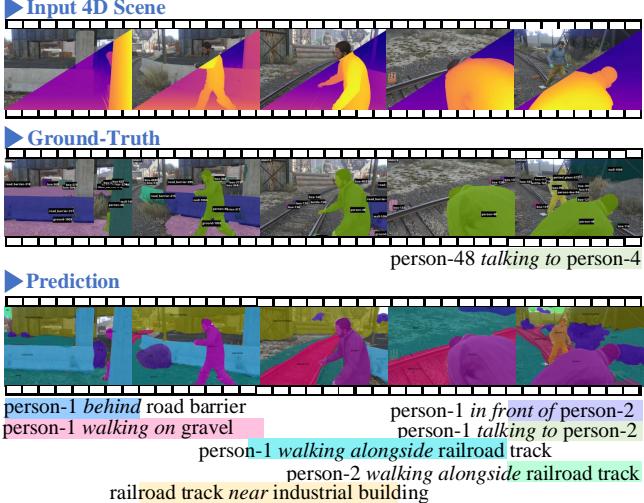
As shown in Figure 7 above, the input is a 4D scene (a sequence of RGB-D frames). The output is complex:
- Objects: Identified entities (e.g., person, road barrier).
- Mask Tubes: Binary masks that track the exact pixel shape of the object across every frame (the green silhouettes in the bottom row).
- Relations: Semantic interactions (e.g., “talking to”) defined over a specific time span.
The Data Bottleneck
The problem is that existing datasets for 4D-PSG are tiny. As illustrated in Figure 1 below, while we have millions of annotated 2D images (like the Visual Genome dataset), 4D datasets contain only a tiny fraction of that volume (roughly 1.7% of the size of 2D datasets).

This scarcity leads to two major issues:
- Poor Generalization: Models trained on small datasets struggle to recognize diverse scenes.
- Out-of-Vocabulary (OOV) Problems: If a model has never seen a “saxophone” in its tiny training set, it will never recognize one in the real world.
The researchers propose a novel framework that uses a 4D Large Language Model (4D-LLM) and a technique called 2D-to-4D Visual Scene Transfer to overcome these hurdles.
2. The Solution Architecture: The 4D-LLM
Traditional approaches to Scene Graph generation often use a “pipeline” method: first detect objects, then predict relations. This often leads to error propagation—if the detector fails, the relation predictor has no chance.
This paper introduces an end-to-end framework. At its heart lies a Large Language Model (LLM). Why an LLM? Because LLMs possess vast amounts of “world knowledge.” Even if the visual model hasn’t seen many examples of a “person riding a horse,” the LLM knows linguistically that “riders” usually sit on “horses.”
The architecture consists of three main components:
- 4D Scene Encoder: Uses ImageBind to extract features from RGB and Depth inputs.
- LLM (LLaMA2): Reasons about the scene and generates the scene graph text.
- 3D Mask Decoder (SAM2): Generates the pixel-wise “mask tubes” for the objects.
Let’s look at the high-level workflow in Step 1 of the diagram below.
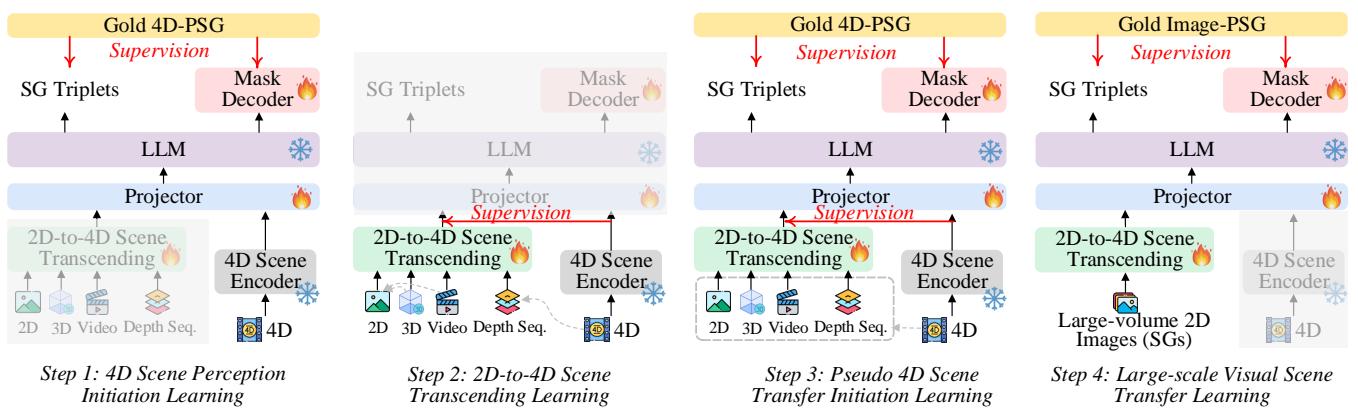
The model takes the 4D scene, encodes it, projects it into a language space, and feeds it to the LLM. The LLM then outputs a sequence of “triplets” (Subject-Predicate-Object) and special [Obj] tokens. These tokens are passed to the Mask Decoder to generate the visual segmentation masks.
The loss function used to train this initiation phase combines text generation loss with geometric losses (IoU, Dice, and Focal loss) to ensure the masks are accurate:

3. Soling the “Unknown”: Chained Scene Graph Inference
One of the coolest contributions of this paper is how they handle the Out-of-Vocabulary (OOV) problem. Standard models are limited to a fixed list of categories (e.g., 50 object types). This is useless in the real world where you might encounter thousands of different objects.
To fix this, the authors utilize the reasoning capabilities of the LLM through Chained Inference. Instead of asking the model to simply “output the graph,” they force it to “think” in steps, mimicking human reasoning.
The process has four stages:
- Object Description & Categorization: The model must first describe the object’s appearance (shape, texture) before assigning a category. This forces the model to look at visual features rather than just guessing.
- Semantic Relation Identification: It analyzes which pairs of objects might logically interact based on their position and context.
- Precise Relation Description: It describes the exact nature of the relationship (e.g., distinguishing “holding” from “touching”).
- Temporal Span Determination: Finally, it decides exactly when the interaction starts and ends.
By breaking the problem down, the model can leverage the LLM’s open-vocabulary knowledge to handle objects it wasn’t explicitly trained on.
4. The Core Innovation: 2D-to-4D Visual Scene Transfer
Now we arrive at the heavy lifting. How do we solve the data scarcity? The authors propose transferring knowledge from rich 2D datasets (like Visual Genome) to the 4D task.
The intuition is simple: A 2D image is just a 4D scene frozen in time and flattened in space. If we can teach a model to “imagine” the missing depth and time dimensions from a 2D image, we can turn millions of 2D images into pseudo-4D training data.
This process is called 2D-to-4D Scene Transcending, and it happens in several sub-steps.
A. The Estimators
To pretend a 2D image is 4D, the model uses three specialized “estimators” (neural networks) that are trained to hallucinate the missing data.
1. Depth Estimator (\(F_{de}\)): Takes a standard 2D RGB image and predicts its spatial depth features. It essentially learns to see 3D structure from a flat photo.

It is trained using a regression loss against ground-truth depth data:

2. RGB Temporal Estimator (\(F_{rte}\)): Takes a single static image and predicts what the temporal sequence should look like. It uses an autoregressive transformer to hallucinate the feature changes over time.
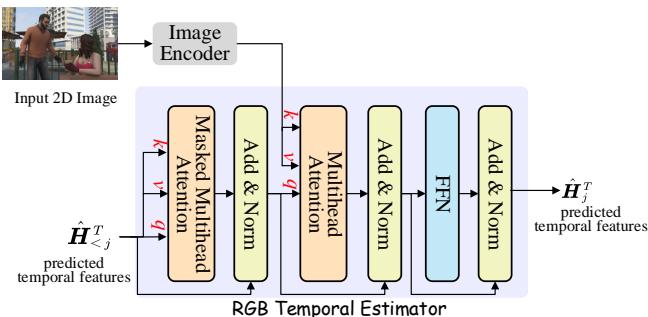
The mathematical formulation relies on predicting the feature at step \(j\) based on previous steps:


3. Depth Temporal Estimator (\(F_{dte}\)): Similar to the RGB estimator, but this one takes a single depth map and predicts how that depth map would evolve over time.

It is optimized similarly:

B. Putting it Together: The Transfer Process
Once these estimators are trained (Step 2 in Figure 2), the system performs Pseudo 4D Scene Transfer.
- Initiation (Step 3): They take a small amount of real 4D data to fine-tune these estimators, ensuring the “hallucinated” features align with reality. They use consistency losses to ensure the RGB predictions and Depth predictions make sense together.

- Large-Scale Transfer (Step 4): This is the payoff. They take the massive 2D datasets (Visual Genome), pass them through the trained estimators, and generate “Pseudo-4D” features. The 4D-LLM is then trained on this massive corpus. Even though the input was originally just 2D, the model “perceives” it as 4D thanks to the estimators.
The result? The model learns generic visual relationships (“cup on table,” “man wearing hat”) from millions of 2D examples, while understanding the 4D structure provided by the estimators.
The overall training objective combines all these losses:

5. Experiments and Results
Does this complex hallucination strategy actually work? The researchers tested their model on two benchmarks: PSG4D-GTA (synthetic data) and PSG4D-HOI (real-world egocentric video).
Quantitative Performance
The results were impressive. As seen in the table below, the 4D-LLM (ours) significantly outperforms previous baselines like PSG4DFormer.
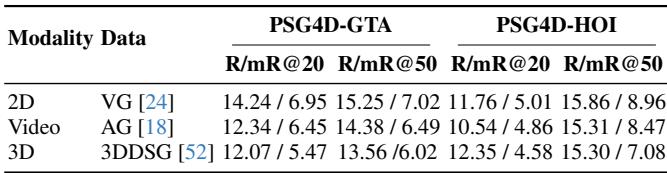 (Note: While the table caption refers to enhancing perception, the data rows clearly show the proposed method outperforming baselines across metrics).
Key takeaways from their data:
- End-to-End wins: Moving away from pipeline architectures reduced error propagation.
- Transfer Learning works: Adding the 2D-to-4D transfer (\(V^{2\rightarrow4}\)-VST) provided a massive boost in recall (R@K) and mean recall (mR@K).
- LLMs help: Even without the transfer learning, the base LLM model outperformed specialized specialist models, likely due to the LLM’s pre-trained knowledge.
Does the “Transcending” actually learn?
You might wonder if the estimators are just producing noise. The researchers analyzed the similarity between the “hallucinated” features and real ground-truth features.
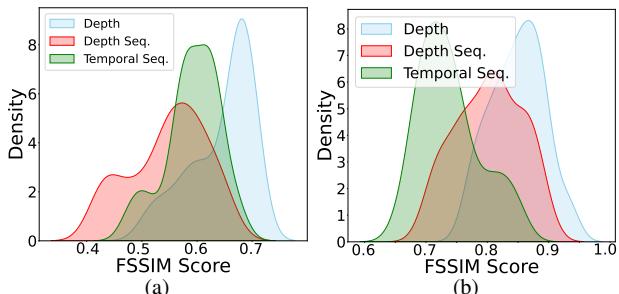
In Figure 4, the graphs show the Feature Similarity (FSSIM). Graph (b) shows the similarity with the proposed learning step. The peaks are shifted towards the right (higher similarity), indicating that the model successfully learned to generate pseudo-features that look like real 4D data.
Qualitative Results
Finally, let’s look at what the model actually sees. In Figure 11, we see the model tracking a hand interacting with a toy car.

Notice the row labeled “Predicted SG Triplets w/ Chained Inference.” The model accurately identifies complex actions like “hand reach toward toy car” and “hand pick up toy car,” complete with precise timestamps. It also correctly segments the objects (shown in the Mask Tubes).
Another example in Figure 6 shows the model handling an outdoor scene, accurately segmenting people walking along a railroad track.
6. Conclusion and Future Implications
This paper represents a significant step forward in making AI understand the dynamic world. By leveraging the power of Large Language Models and creatively bridging the gap between 2D and 4D data, the researchers have found a way to bypass the expensive bottleneck of 4D data annotation.
Key Takeaways:
- Don’t reinvent the wheel: LLMs already know a lot about how objects relate. Using them as the “brain” of a vision system is highly effective.
- Data is fungible: With the right geometric and temporal estimators, abundant 2D data can be “upgraded” to train 4D models.
- Step-by-step reasoning: Chained inference allows models to handle open-vocabulary scenarios much better than one-shot prediction.
This technology has massive implications for robotics (navigating changing environments), autonomous driving (predicting pedestrian behavior), and virtual reality. As we move toward general-purpose AI agents, the ability to understand 4D scenes from limited data will be a cornerstone capability.
This blog post explains the research paper “Learning 4D Panoptic Scene Graph Generation from Rich 2D Visual Scene” (2025).