](https://deep-paper.org/en/paper/2503.16429/images/cover.png)
Introduction
In the world of 2D computer vision, we are currently living in a golden age of self-supervised learning (SSL). Models like DINO and MAE have demonstrated that neural networks can learn robust, semantically rich representations of images without needing a single human-annotated label. You can take a pre-trained image model, freeze its weights, add a simple linear classifier on top (a process called “linear probing”), and achieve results that rival fully supervised training.
However, when we step into the third dimension—processing 3D point clouds—the story changes dramatically. Despite the massive importance of 3D perception in autonomous driving, robotics, and mixed reality, 3D self-supervised learning has lagged behind. Current state-of-the-art models often fail the “linear probing” test, achieving abysmal accuracy unless they are fully fine-tuned (re-trained) for a specific task.
Why is there such a gap? Why do 3D models struggle to learn reliable representations on their own?
In this post, we dive into a fascinating paper titled “Sonata: Self-Supervised Learning of Reliable Point Representations.” The researchers identify a fundamental flaw in previous 3D SSL methods—a phenomenon they coin the “Geometric Shortcut.” They propose a new framework, Sonata, which effectively blocks this shortcut, forcing the model to learn deep semantic concepts.
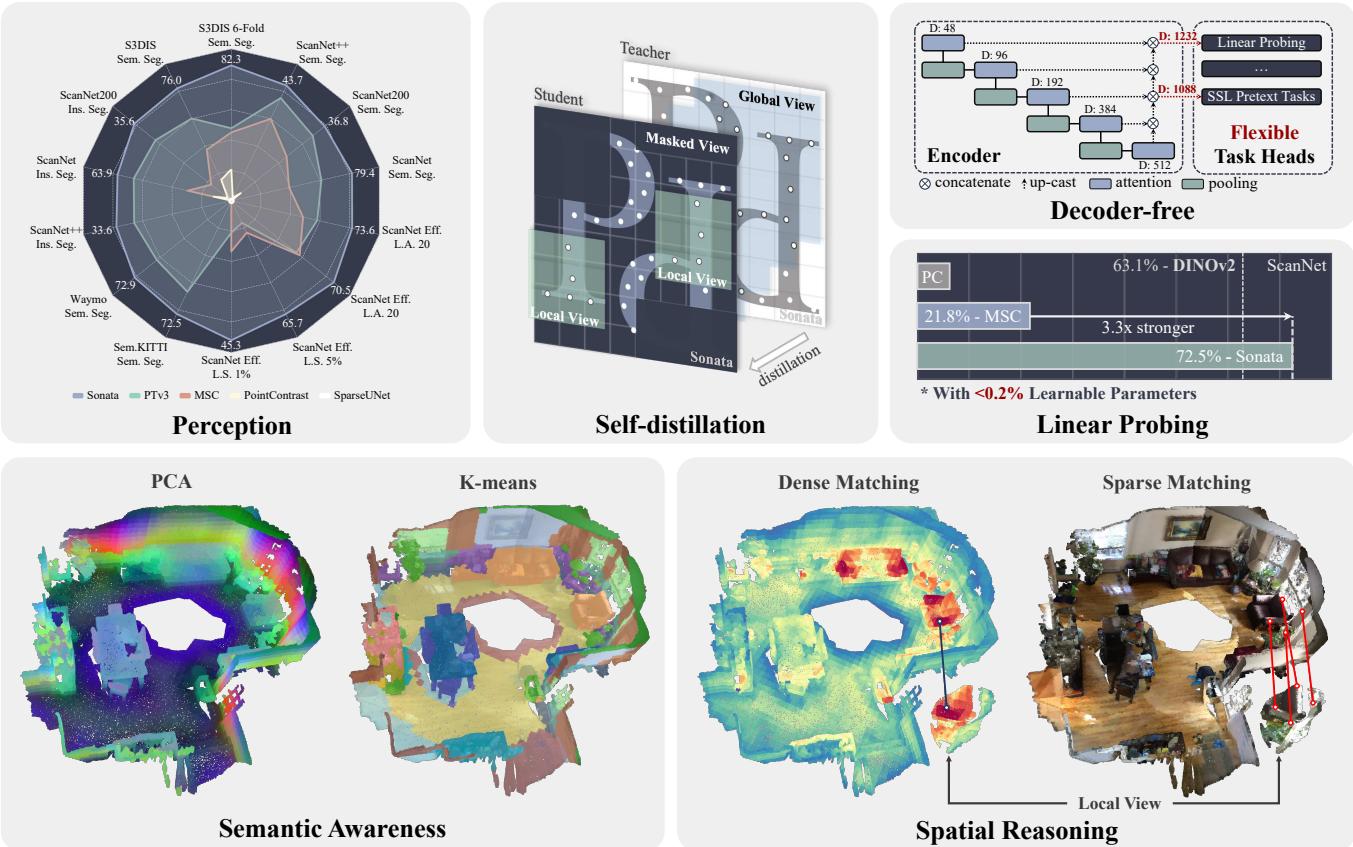
As shown in Figure 1, Sonata essentially rewrites the rules for 3D pre-training. It boosts linear probing accuracy on the ScanNet benchmark from a previous best of 21.8% to a staggering 72.5%, unlocking a new era of reliable 3D perception.
Background: The Struggle of Point Cloud SSL
To understand why Sonata is such a breakthrough, we first need to understand the problem it solves.
Self-supervised learning usually works by creating a “pretext task.” For example, in 2D images, we might mask out a portion of a photo and ask the model to predict the missing pixels. To do this well, the model must understand what objects look like (e.g., “this looks like a dog, so the missing patch should be fur”).
In 3D point clouds, researchers have tried similar approaches. They mask out points and ask the model to reconstruct them or contrast different views of the same scene. However, these methods have consistently produced “weak” representations. When you visualize what the model learned, it often understands surface normals (which way a wall is facing) or height (Z-coordinates), but it has no idea what a “chair” or a “table” actually is.
The Geometric Shortcut
The authors of Sonata hypothesize that the root cause is the Geometric Shortcut.
In a 2D image, if you remove the color information (the input features), you are left with a blank grid. The position of a pixel (\(x, y\)) carries no information on its own.
In a 3D point cloud, the data is sparse. The “position” (\(x, y, z\)) is not just a grid index; it is the data. Even if you mask out the feature information (like color or intensity), the geometric structure—the shape of the chair, the flatness of the floor—is still explicitly present in the coordinates.
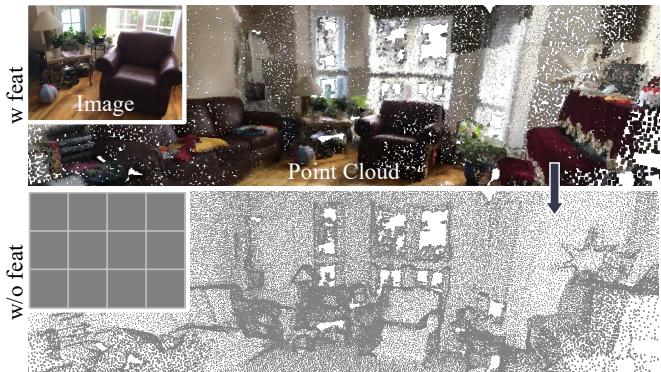
As Figure 3 illustrates, this leads to a “lazy” model. The neural network realizes it doesn’t need to learn complex semantic relationships to solve the pretext task. Instead, it can just look at the neighboring coordinates to guess the answer. It cheats.
Evidence of this cheating is visible in heatmaps of feature similarity. In a good model, pointing to a sofa arm should make the model “light up” other sofa arms in the room.
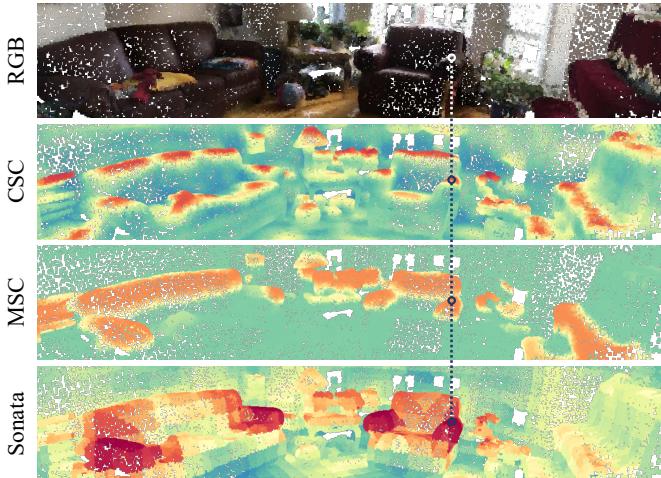
Figure 2 shows this stark contrast. Previous methods like CSC and MSC collapse to trivial solutions:
- CSC focuses on surface normals (lighting up anything facing the same direction).
- MSC overfits to height (lighting up anything at the same vertical level).
- Sonata, however, successfully identifies other sofa arms, proving it has learned the semantic concept of the object, not just its geometry.
Core Method: Composing the Sonata
To overcome the geometric shortcut, the researchers introduce Sonata, a self-distillation framework designed to make the learning process “harder” in a way that forces the model to abandon simple geometric cues and learn semantics.
1. The Self-Distillation Framework
At a macro level, Sonata uses a student-teacher architecture, similar to methods used in image SSL (like DINO).
Here is how the workflow operates:
- View Generation: The system creates multiple views of a 3D scene. “Global views” see a large portion of the scene, while “Local views” and “Masked views” see smaller or corrupted chunks.
- Student vs. Teacher: The “Student” network processes the difficult, masked, and local views. The “Teacher” network (which is a stable, moving average of the Student) processes the clean, global views.
- The Goal: The Student must match its output to the Teacher’s output. To do this, it has to infer the global context and missing information from its limited, masked input.
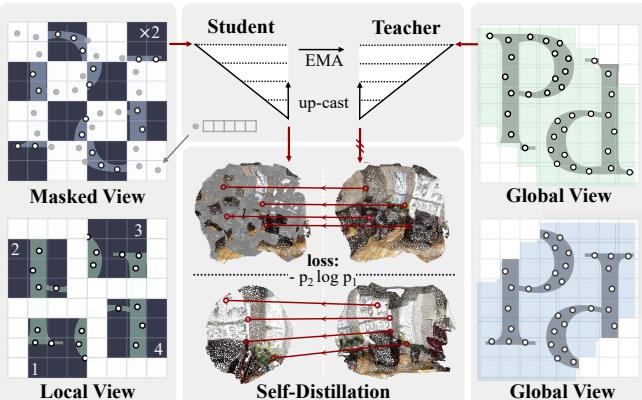
Figure 5 outlines this process. The key mechanism is that the Student is trying to align its understanding of a specific point in a masked view with the Teacher’s understanding of that same point in the global view.
2. Micro Designs to Block the Shortcut
The macro framework is standard, but the micro designs are where Sonata shines. The researchers implemented specific strategies to obscure spatial info and emphasize input features.
Removing the Decoder (The U-Net Trap)
Most 3D backbones use a U-Net structure: an Encoder that downsamples data to learn broad features, followed by a Decoder that upsamples it back to the original resolution.
The researchers realized the Decoder is a trap. By forcing the model to predict features at the original, high-resolution scale, the Decoder re-introduces fine-grained geometric coordinates. This gives the model easy access to the geometric shortcut again.
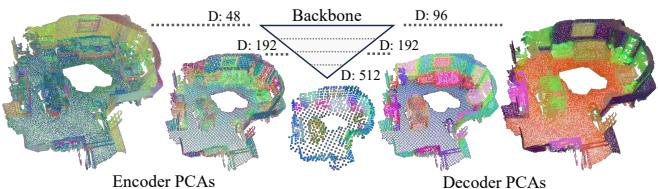
As shown in Figure 4, the Encoder naturally learns diverse, dispersed patterns (semantics). The Decoder, however, produces uniform, structured representations that are overly reliant on local geometry.
The Fix: Sonata abandons the U-Net for pre-training. It performs self-distillation strictly on the Encoder output. This forces the model to operate at a coarser resolution where geometric cheating is harder.
Feature Up-Casting
If we remove the decoder, we lose the ability to describe fine details, right? To solve this without re-introducing the U-Net “trap,” the authors use a parameter-free method called Feature Up-casting.
They take the coarse features from the encoder and project them back to higher resolutions using the known pooling indices. It’s like a “Hypercolumn” approach. This allows the model to maintain multi-scale awareness without training a learnable decoder that could overfit to geometry.
Masked Point Jitter
To further confuse the model’s reliance on exact coordinates, Sonata applies aggressive Gaussian jitter specifically to the coordinates of masked points.
If the model tries to look at the exact XYZ position of a masked point to guess its feature, it will find that the position has been rattled around. This noise forces the model to rely on the context provided by the surrounding unmasked points (the semantic context) rather than the precise geometry of the masked point itself.
Progressive Parameter Scheduling
Learning semantics is hard; cheating with geometry is easy. If you make the task too hard too fast, the model might just collapse or fail to learn anything.
Sonata uses a curriculum learning approach. It starts with small masks (easy) and progressively increases the mask size and ratio (hard) during training. It essentially guides the model away from geometric reliance step-by-step, “trapping” it into learning semantics.
3. Scaling Up
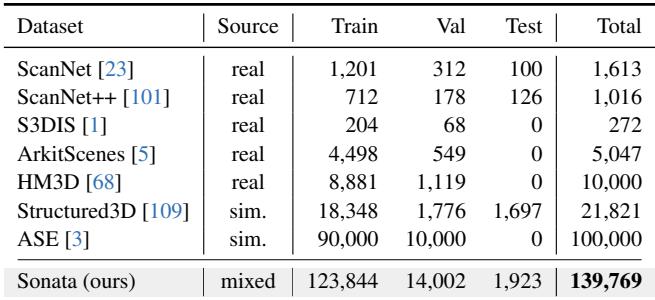
Finally, to ensure the representations are robust, the authors scaled up the data significantly. While previous methods often trained on smaller datasets like ScanNet (approx. 1.6k scenes), Sonata is trained on a massive collection of 140,000 scenes combining real-world data (ScanNet, ArkitScenes, HM3D) and simulated data (Structured3D, ASE).
Experiments & Results
The evaluation of Sonata centers on one crucial question: Is the representation reliable?
To answer this, the authors primarily use Linear Probing. This involves freezing the pre-trained Sonata encoder and training a single linear classification layer on top of it. If the encoder has learned good semantics (e.g., “this cluster of points is a chair”), a simple linear layer should be able to label it easily.
The Roadmap to Reliability
The improvement is not just due to one trick; it is the combination of the strategies mentioned above. The authors provide a roadmap showing how each component contributed to the final performance.
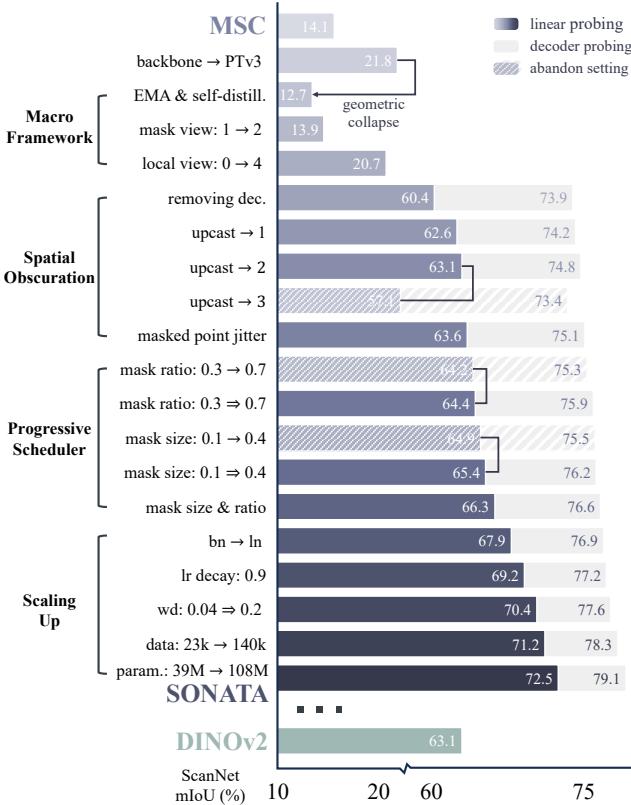
As Figure 6 demonstrates:
- Starting with MSC (a previous method), performance is around 21.8%.
- Switching to the Self-Distillation framework improves results.
- Obscuring Spatial Information (removing the decoder) provides a massive jump.
- Scaling Up the model and data pushes the boundary further.
- The final Sonata model achieves 72.5% mIoU on ScanNet linear probing.
This is a paradigm shift. Previously, self-supervised 3D models were considered “initialization weights” to speed up training. Sonata proves they can be feature extractors in their own right.
Comparison with DINOv2
Since the architecture is inspired by image SSL, how does Sonata compare to lifting 2D features from state-of-the-art image models like DINOv2 into 3D?
While DINOv2 is incredibly powerful, it lacks explicit 3D spatial reasoning.
- DINOv2 (Linear Probing on 3D): 63.1% mIoU.
- Sonata (Linear Probing): 72.5% mIoU.
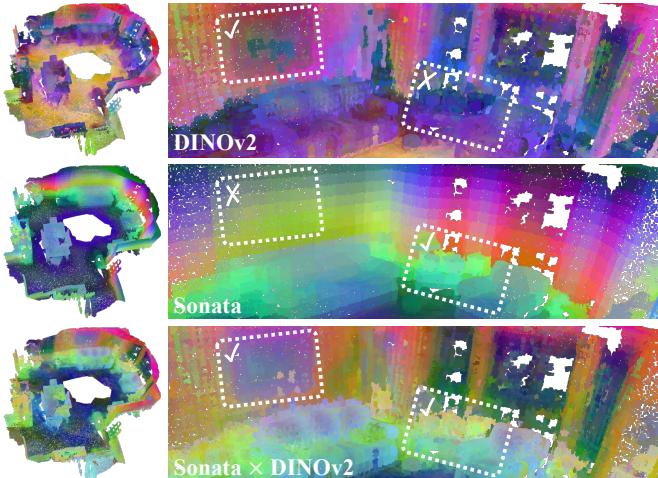
Figure 7 visually compares them. DINOv2 (left) is great at photometric details (texture/color) but can be inconsistent spatially. Sonata (middle) captures the spatial coherence of objects better.
Interestingly, the best result comes from combining them (Right). Because Sonata learns 3D structure and DINOv2 learns 2D texture, they are complementary. Fusing their features leads to even higher accuracy (76.4%).
Data Efficiency
One of the main promises of SSL is that it should reduce the need for annotated data. Sonata delivers on this front.
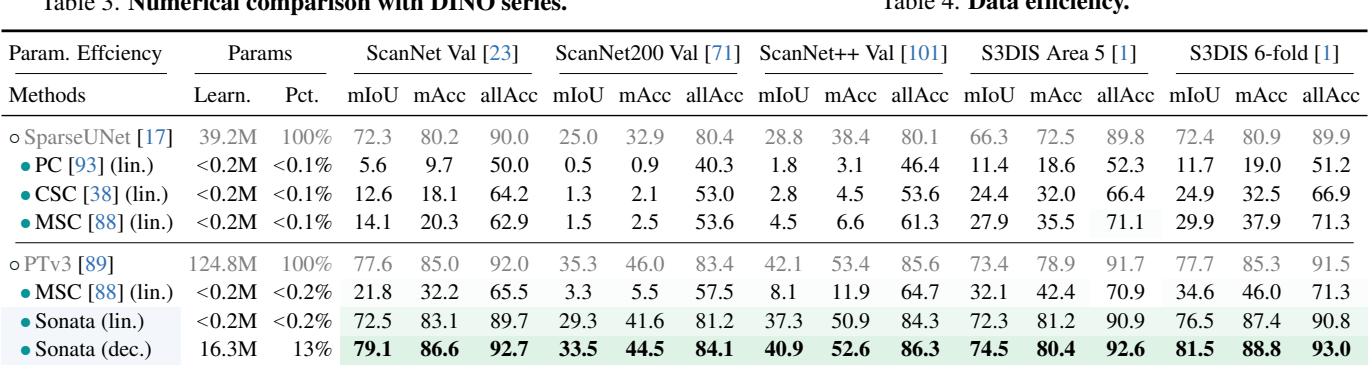
Looking at Table 4, with only 1% of the annotated data from ScanNet, Sonata achieves 45.3% mIoU (full fine-tuning). Previous methods like SparseUNet or PTv3 trained from scratch achieve roughly 25-26% in this setting. This means Sonata allows us to build capable 3D systems with a fraction of the labeling effort.
Zero-Shot Capabilities
Perhaps the most visually impressive result is Sonata’s ability to “match” points across different scenes without any training.
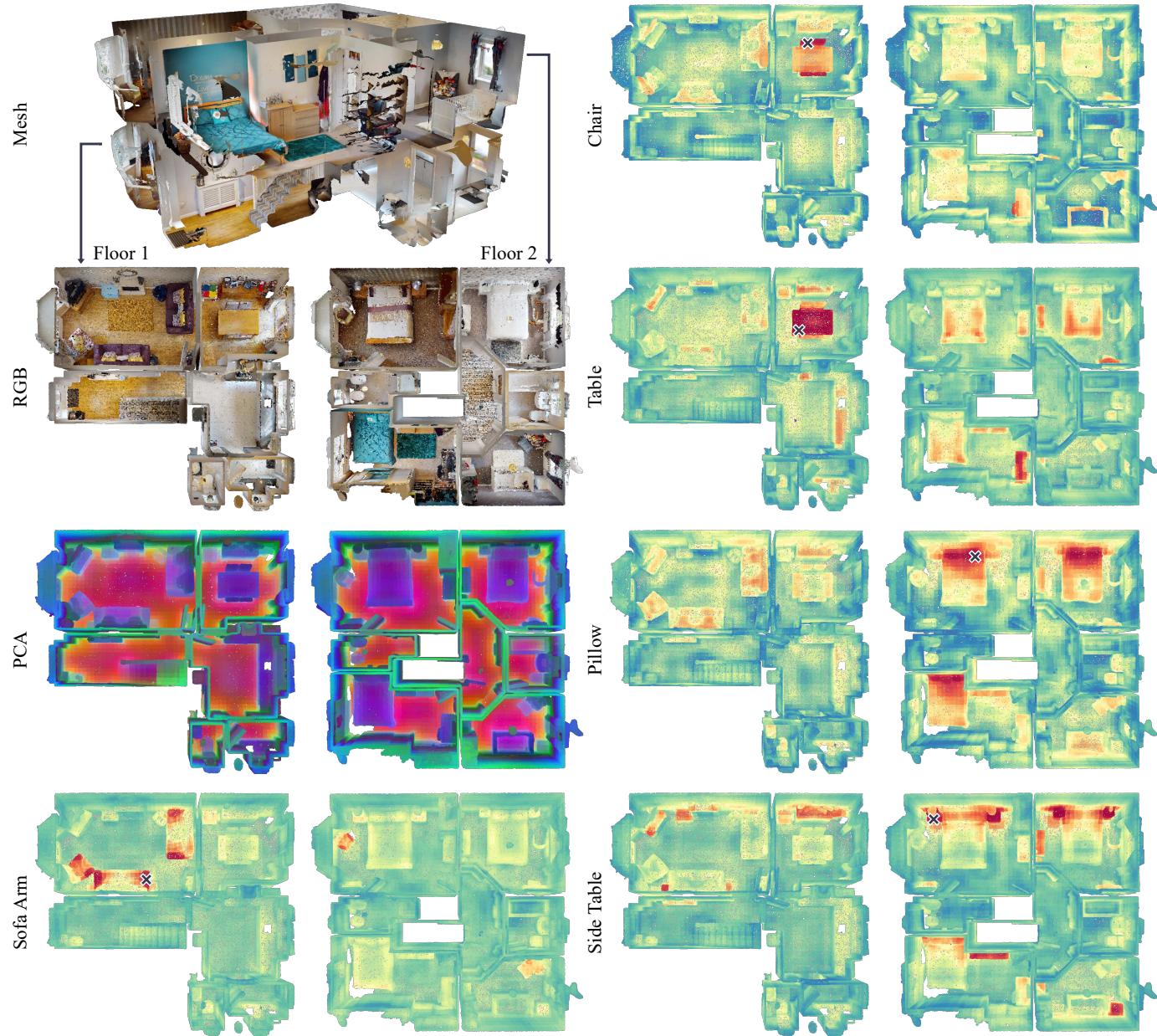
In Figure 8, the authors visualize feature similarities across a large house. If you pick a point on a pillow in one room, Sonata automatically highlights pillows in other rooms. It groups floors, tables, and chairs purely based on the similarity of their learned representations. This indicates that the model has developed a generalized understanding of what these objects are, invariant to their specific location or slight variations in shape.
Geometric Understanding
Does blocking the “geometric shortcut” mean the model forgets geometry? Surprisingly, no. By forcing the model to understand the context of geometry rather than just coordinates, it becomes better at surface reconstruction.
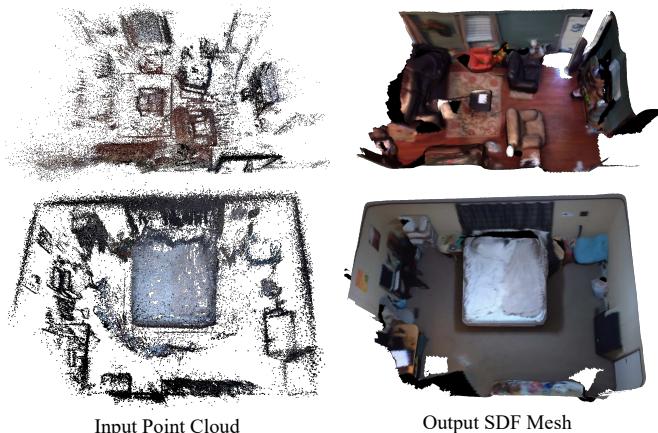
Figure 11 shows that a frozen Sonata backbone can be used to reconstruct high-fidelity surfaces (Signed Distance Fields), proving that the learned representations are geometrically rich, just not geometrically “dependent” in a lazy way.
Conclusion & Implications
Sonata represents a significant milestone in 3D computer vision. For years, the field has struggled with the “Geometric Shortcut”—the tendency of point cloud models to overfit to low-level coordinates rather than learning high-level semantics.
By identifying this problem and systematically dismantling it through decoder removal, masked point jitter, and progressive training schedules, the researchers have created a model that is truly reliable.
Key Takeaways:
- 3D is different: You cannot simply copy-paste 2D SSL methods to 3D because the geometry itself leaks information.
- Less is More: Removing the decoder during pre-training forces the encoder to become much stronger.
- Linear Probing is the new standard: We should demand that 3D SSL models perform well with simple linear classifiers, just like their 2D counterparts.
The implications are exciting. We are moving toward a future where 3D backbones can be pre-trained once on massive datasets and deployed across a variety of robotics and AR/VR tasks with minimal fine-tuning. Furthermore, the successful combination of Sonata with DINOv2 suggests that the future of perception is multi-modal—combining the structural truth of Sonata with the visual richness of image foundation models.