](https://deep-paper.org/en/paper/2503.16944/images/cover.png)
Introduction
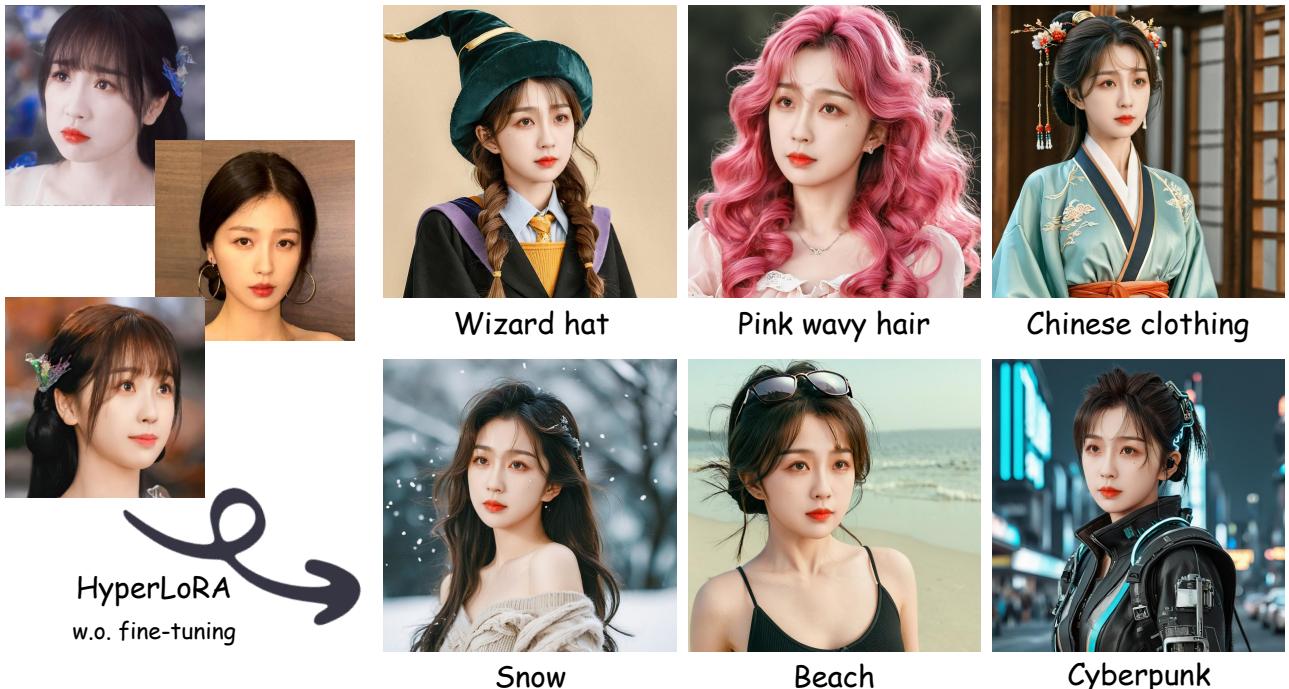
In the rapidly evolving world of Generative AI, one desire stands out above almost all others: Personalization. We all want to put ourselves, our friends, or specific characters into new, imagined worlds. Whether it’s seeing yourself as an astronaut, a cyberpunk warrior, or an oil painting, the goal is high fidelity (it looks exactly like you) and high editability (you can change the background, lighting, and style).
For a long time, we have been stuck between two extremes to achieve this:
- Tuning-based methods (e.g., DreamBooth, LoRA): These yield incredible results. You train a model on a few photos of a person. However, it takes time (minutes to hours), requires GPU resources for every single person, and managing hundreds of LoRA files is a logistical nightmare.
- Tuning-free methods (e.g., IP-Adapter, InstantID): These are fast. You upload a photo, and the model uses an “adapter” to inject features on the fly. No training required. But, the results often look “waxy,” suffer from identity bleed (where the background of your selfie leaks into the generation), or simply lack the photorealistic texture of a true fine-tune.
Enter HyperLoRA.
Proposed by researchers from ByteDance, HyperLoRA attempts to bridge this gap by asking a fundamental question: What if, instead of training a LoRA for every person, we had a neural network that could instantly predict the LoRA weights for us?
In this deep dive, we will explore how HyperLoRA works, the mathematical tricks it uses to predict millions of parameters instantly, and how it achieves a balance of fidelity and editability that rivals per-subject fine-tuning.
Background: The Context
To understand why HyperLoRA is a breakthrough, we need to quickly revisit the technologies it builds upon.
The Problem with Fine-Tuning
When you use a method like standard LoRA (Low-Rank Adaptation), you are freezing the massive Stable Diffusion model and training tiny additional matrices (Low-Rank matrices) that influence the output. Even though LoRA is efficient, it still requires an optimization process. You show the model images, calculate loss, update weights, and repeat. This is “online training,” and it is the bottleneck for real-time applications.
The Limits of Adapters
Alternatives like IP-Adapter utilize a separate encoder (like CLIP) to extract features from your face image. These features are then injected into the main model’s attention layers via a “decoupled cross-attention” mechanism.
While efficient, this method essentially just “hints” to the model what the image should look like. It doesn’t fundamentally change the model’s behavior the way modifying weights does. This often leads to a loss of fine-grained details—like the specific texture of skin or the exact shape of an eye—resulting in the dreaded “AI smoothness” or oversaturated looks.
The Hypernetwork Approach
HyperLoRA takes a different path. It is a Hypernetwork—a network designed to generate the weights of another network. Specifically, HyperLoRA takes a face image as input and outputs a set of LoRA weights that can be immediately plugged into Stable Diffusion XL (SDXL).
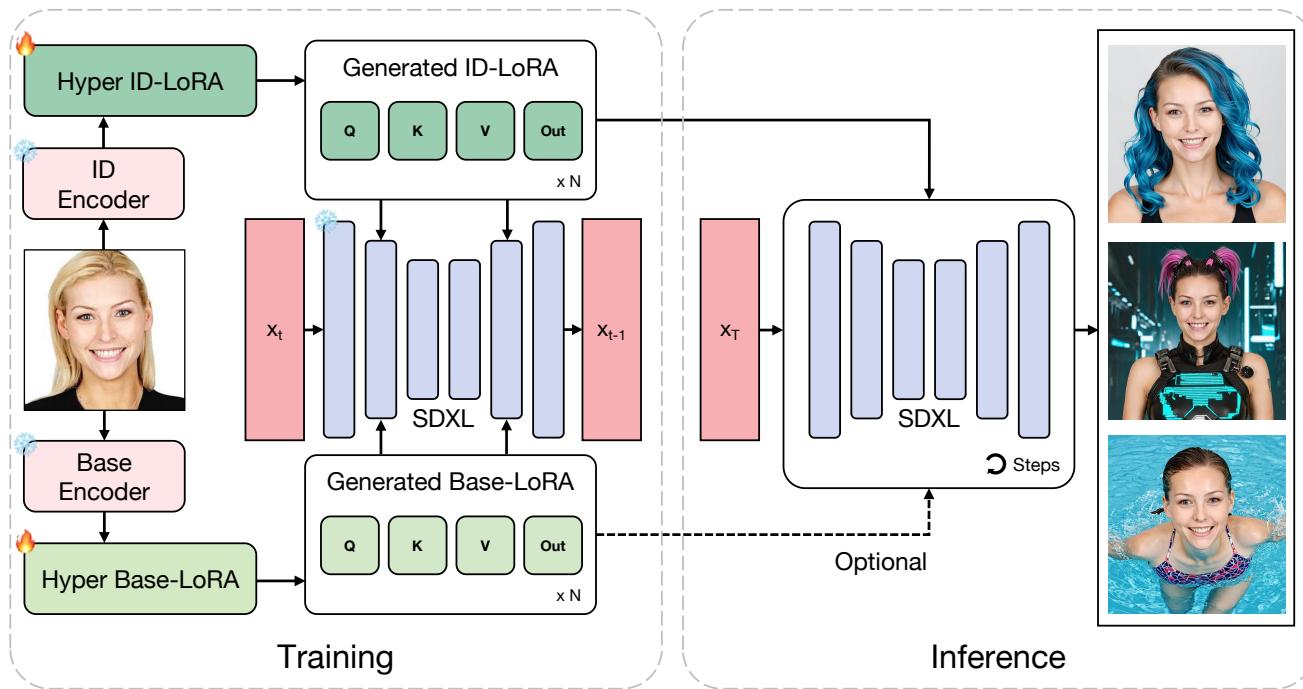
As shown in Figure 2, the process is completely tuning-free during inference. You feed an image, the HyperLoRA module predicts the weights, and you generate your image.
Core Method: How to Predict 11 Million Parameters
The headline problem with generating LoRA weights is dimensionality. A standard LoRA for SDXL, even with a low rank, contains millions of parameters. Predicting 11 million floating-point numbers from a single image in one forward pass is incredibly difficult and computationally expensive.
HyperLoRA solves this using three clever strategies:
- Low-Dimensional Linear LoRA Space
- Parameter Decomposition (Base vs. ID)
- Adaptive Weight Generation
1. The Linear LoRA Space
The researchers realized they didn’t need to predict every single parameter from scratch. Due to the mathematical properties of Low-Rank matrices, they are highly interpolatable (mixable).
The authors constructed a Linear LoRA Space. Instead of predicting the LoRA matrix \(\mathbf{M}\) directly, they created a set of learnable “Basis” matrices. Think of these as the fundamental building blocks or “ingredients” of a LoRA.
If we have \(K\) basis matrices (the authors chose \(K=128\)), the specific LoRA for your face can be described just by mixing these ingredients together with specific strengths.
Therefore, the Hypernetwork doesn’t predict millions of parameters; it only needs to predict 128 coefficients (scalars).
Let’s look at the math. The ID (Identity) LoRA matrix \(\mathbf{M}_{id}\) is calculated as:
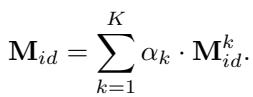
Here:
- \(\mathbf{M}_{id}^k\) are the learnable basis matrices (shared across everyone).
- \(\alpha_k\) are the coefficients predicted from your specific face image.
This reduces the complexity of the prediction task by orders of magnitude (from ~11.6 million parameters to just a few hundred coefficients), making the model lightweight and fast.
Does compressing LoRA into such a small space ruin the quality? Surprisingly, no.
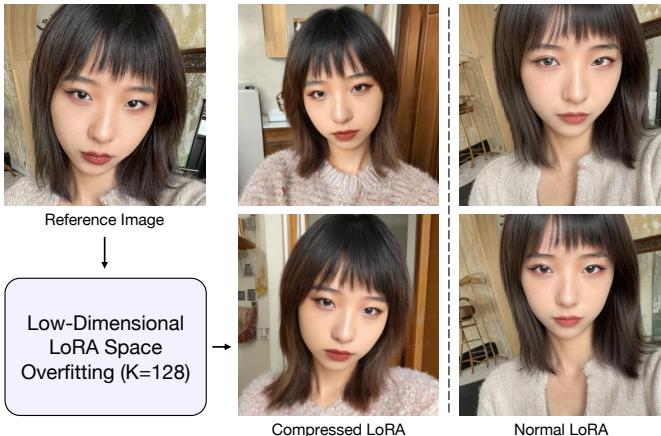
As seen in Figure 3, even when projecting the parameters into this 128-dimensional linear space, the model can reconstruct the identity of the reference image with high fidelity.
2. Decomposition: Splitting ID and Background
One of the most annoying problems in personalized generation is overfitting. If you upload a photo of yourself wearing a blue shirt in a garden, the AI often refuses to generate you in a spacesuit; it keeps trying to bring back the blue shirt and the garden.
This happens because the model entangles your facial identity with your surroundings.
HyperLoRA explicitly solves this by decomposing the weights into two parts:
- ID-LoRA: Focuses strictly on facial features.
- Base-LoRA: Captures the “irrelevant” data (lighting, background, clothes, composition).
The system generates two sets of weights. The Base-LoRA is calculated similarly to the ID-LoRA but uses its own basis matrices and coefficients (\(\beta\)):
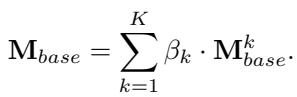
During inference (generation), you combine them:

The Trick: During training, the Base-LoRA is forced to learn the background and clothing, while the ID-LoRA is guided to focus on the face. During inference, you can simply turn off the Base-LoRA (set its weight to 0) or reduce it. This keeps your face (ID-LoRA) but throws away the blue shirt and garden (Base-LoRA), giving you massive flexibility.
3. The Network Architecture
How does the model actually go from pixels to those \(\alpha\) and \(\beta\) coefficients? The architecture is illustrated in Figure 4.
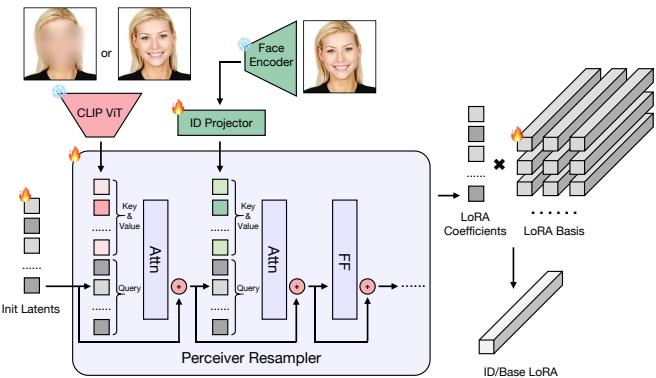
The pipeline works as follows:
- Encoders: The input image is processed by two encoders:
- CLIP ViT: Extracts dense, pixel-level features and structural information.
- AntelopeV2 (Face Encoder): Extracts abstract, high-level identity embeddings (pure “who is this person” data).
- Perceiver Resampler: This component (borrowed from Flamingo and IP-Adapter) acts as a translator. It takes the disparate features from CLIP and the Face Encoder and attends to them to produce a fixed number of tokens.
- Coefficient Prediction: These tokens are projected to output the coefficients (\(\alpha\) and \(\beta\)).
- Weight Construction: The coefficients are multiplied by the stored Basis Matrices to form the final LoRA layers, which are injected into the SDXL UNet.
The Training Strategy
You cannot simply train this entire stack at once and hope for the best. The authors devised a multi-stage training curriculum to ensure the decomposition between “ID” and “Base” actually happens.
Stage 1: Base-LoRA Warm-up
First, they train only the Base-LoRA. Crucially, they blur the face in the input image during this stage.
- Why? By blurring the face, the Base-LoRA is physically unable to learn facial features. It is forced to learn everything else: the hair, the ears, the clothes, the background style.
Stage 2: ID-LoRA with CLIP
Next, they freeze the Base-LoRA and start training the ID-LoRA. They use the CLIP image features here.
- Why? CLIP is great at understanding structure and general composition. It helps the model learn the shape of the head and general appearance quickly.
Stage 3: ID-Embedding Fine-tune
Finally, they focus on the specific face embeddings (AntelopeV2).
- Why? CLIP often misses fine details (like exact eye shape or subtle scars). The face recognition embeddings are laser-focused on identity. This stage polishes the likeness.
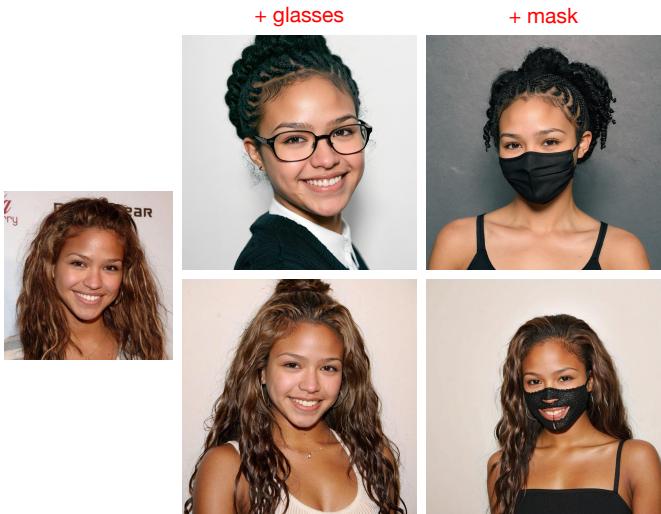
The impact of using both embeddings is visualized below. Using only CLIP results in a loss of prompt adherence (editability), while combining it with ID embeddings allows for complex edits like adding glasses or masks.
Experiments and Results
So, how does HyperLoRA stack up against the competition? The researchers evaluated it against IP-Adapter, InstantID, and PuLID.
Fidelity vs. Editability
There is always a trade-off. If a model looks exactly like the input photo (high fidelity), it usually struggles to change the scene (low editability).
- IP-Adapter: Good editability, but often low fidelity and poor texture quality.
- InstantID: High fidelity, but often “burns” the image (oversaturation) and struggles with complex prompt changes.
- HyperLoRA: Strikes a “Goldilocks” balance. It achieves higher fidelity than adapters because it modifies weights directly (like a fine-tune), but maintains editability because of the Base/ID decomposition.
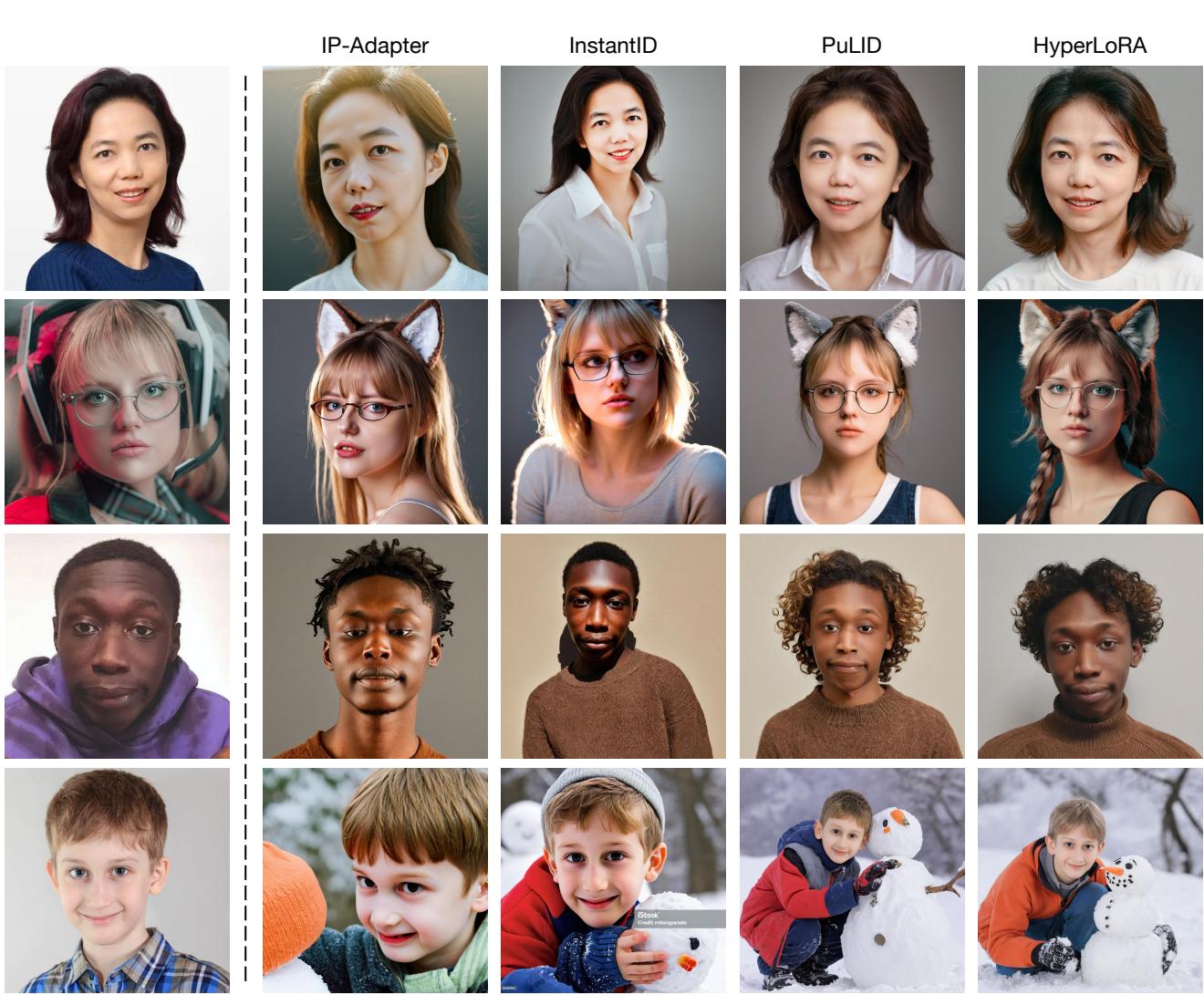
In Figure 7, look at the “Wolf Ears” column. IP-Adapter struggles to blend the identity naturally. InstantID works but looks slightly artificial. HyperLoRA integrates the wolf ears while keeping the skin texture and lighting photorealistic.
The Importance of Base-LoRA
The authors claim that splitting the LoRA is vital for editability. Is it?
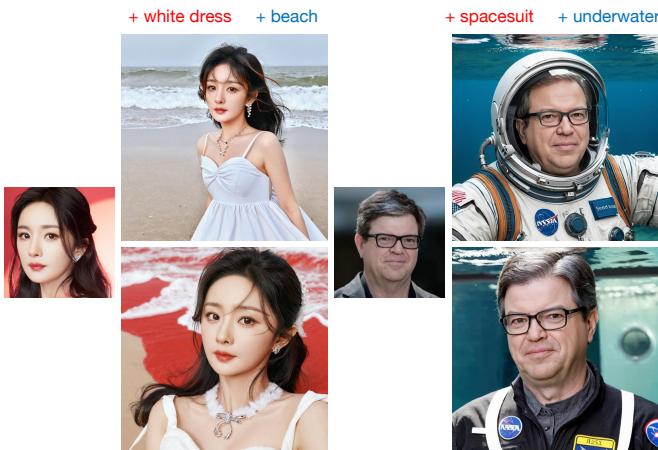
Figure 8 provides the proof. In the bottom row (trained without Base-LoRA), the model sees the input person in a casual top and refuses to put them in a white dress or a spacesuit. The identity is “entangled” with the clothes. In the top row (HyperLoRA), the Base-LoRA absorbed the clothing info. By discarding the Base-LoRA during inference, the model is free to dress the subject in a white dress or spacesuit as requested by the prompt.
Multiple Inputs & Interpolation
Because HyperLoRA operates in a linear space, mixing identities is as simple as mathematical averaging.
If you have 5 photos of a person, you don’t need to run the model 5 times. You run the Hypernetwork on each photo to get 5 sets of coefficients (\(\alpha\)), calculate the average \(\alpha\), and generate one robust LoRA.
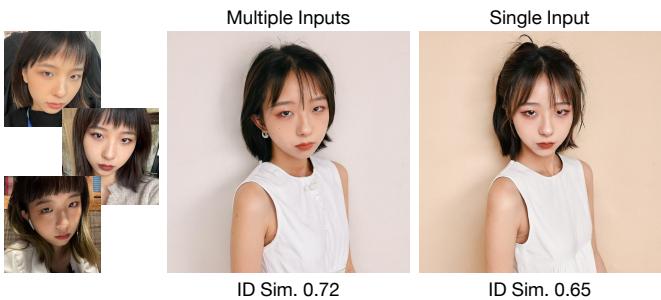
This averaging (shown in Figure 10) smooths out weird expressions or bad lighting from a single photo, resulting in a definitive version of the person’s identity.
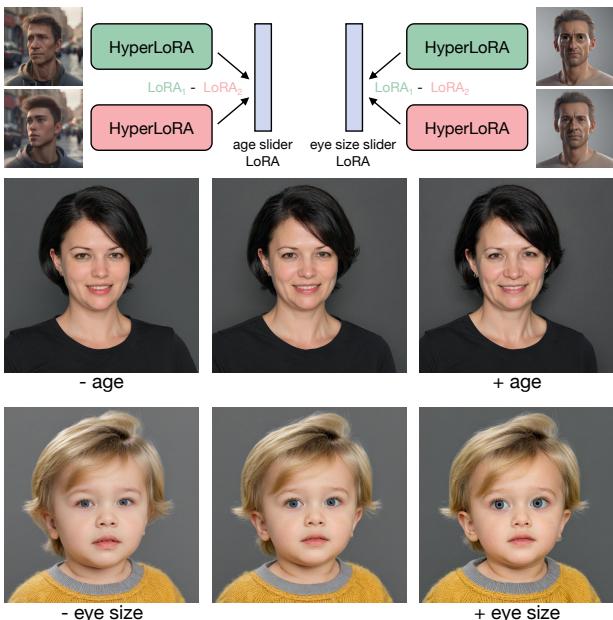
Furthermore, you can interpolate between people or even create “Slider LoRAs.” By taking a photo of a person and an edited photo of them (e.g., aged up), HyperLoRA can subtract the two weight sets to create an “Age Slider” that can be applied to any image.
Inference Speed
One of the main selling points is speed. While HyperLoRA takes slightly longer in the preprocess stage (predicting the weights) compared to InstantID, it makes up for it during the actual diffusion generation. It doesn’t add heavy cross-attention layers to the UNet, keeping the main inference loop clean and fast.

Conclusion
HyperLoRA represents a significant shift in personalized image generation. It moves away from the dichotomy of “slow training” vs. “fast but lower quality adapters.”
By treating LoRA weights not as fixed parameters to be optimized, but as predictable outputs of a linear system, the authors have created a way to “fine-tune” a model instantly. The decomposition into ID and Base components solves the persistent problem of background leakage, making the tool highly versatile for creative applications.
For students and researchers, HyperLoRA offers a fascinating lesson in parameter efficiency. It reminds us that massive neural networks often operate on lower-dimensional manifolds. We don’t always need to move mountains (all 11 million parameters); sometimes, we just need to find the right 128 levers to pull.
As generative AI moves toward real-time personalization, techniques like HyperLoRA—which prioritize speed without sacrificing the rich detail of weight modification—will likely become the new standard.