](https://deep-paper.org/en/paper/2503.16964/images/cover.png)
Introduction
Drones have revolutionized how we capture the world. From inspecting massive bridges to surveying urban landscapes and preserving cultural heritage, the ability to put a camera anywhere in 3D space is invaluable. However, turning those aerial photos into accurate, photorealistic 3D models is a computational nightmare, especially when the real world refuses to sit still.
Traditional methods like photogrammetry and recent Neural Radiance Fields (NeRFs) have pushed the boundaries of what is possible. More recently, 3D Gaussian Splatting (3DGS) has taken the field by storm, offering real-time rendering speeds that NeRFs could only dream of. But there is a catch: most of these algorithms assume the world is perfectly static and that we have perfect camera coverage.
In reality, drone footage is “in the wild.” Cars drive by, pedestrians walk through the frame, and the drone might not capture every single angle of a building due to obstacles or battery limits. When you feed this imperfect data into standard 3DGS, the results are often filled with “ghost” artifacts from moving objects or distorted geometry where the views were sparse.
Enter DroneSplat.
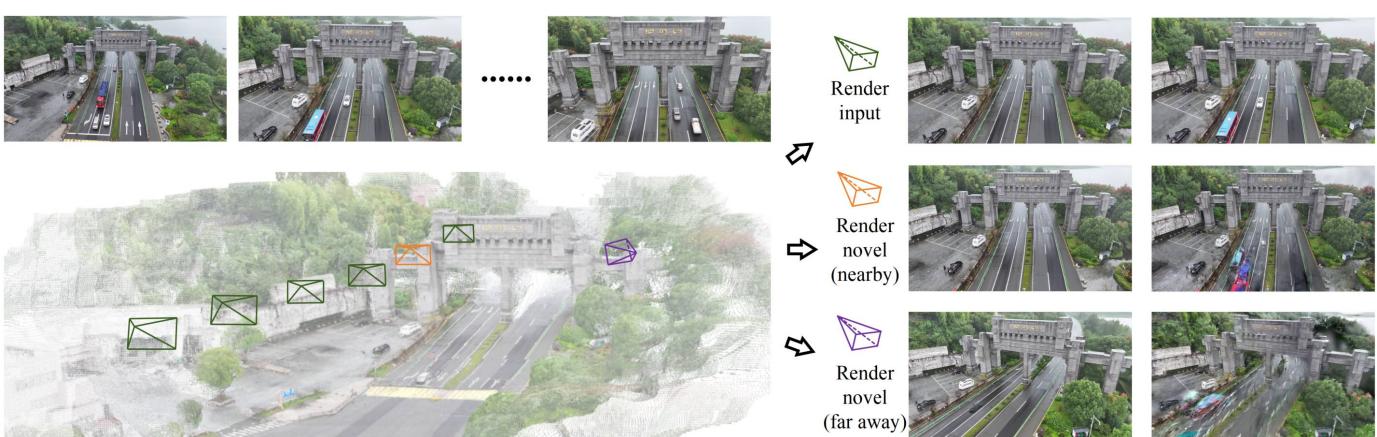
In this deep dive, we will explore a new framework designed specifically to handle the chaos of real-world drone imagery. We will look at how DroneSplat intelligently masks out moving “distractors” and uses voxel-guided optimization to reconstruct geometry even when the camera angles are limited.
The Twin Challenges: Dynamics and Sparsity
To understand why DroneSplat is necessary, we first need to appreciate the fragility of current reconstruction methods. Algorithms like 3DGS work by finding consistency across multiple images. If a point in space looks the same from three different angles, the algorithm confidently places a 3D Gaussian there.
However, “in-the-wild” drone imagery introduces two major deal-breakers, as illustrated below:
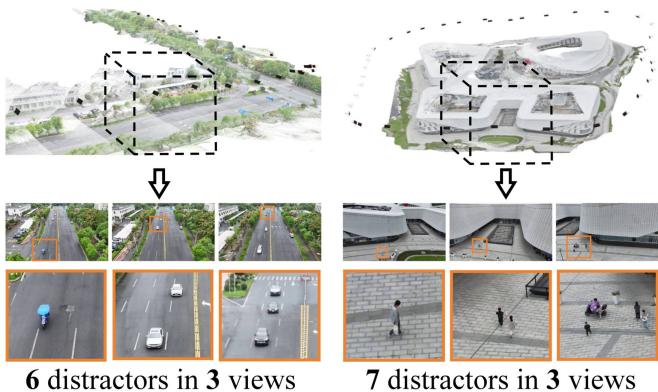
1. Scene Dynamics (Distractors)
Imagine a drone hovering over a parking lot. In the first second, a red car is entering the lot. Ten seconds later, the car has parked. To the algorithm, this is confusing. The pixels representing that car have changed location, violating the “multi-view consistency” assumption. Standard algorithms try to average this out, resulting in blurry, semi-transparent ghosts in the final 3D model.
2. Viewpoint Sparsity
Drones are maneuverable, but they aren’t magic. In a single flight path, a drone might fly over a street in a straight line. This results in many images, but they might all be looking at the scene from a similar direction. This “limited view constraint” poses a problem for 3DGS, which tends to overfit to the training images. Without views from multiple sides to constrain the geometry, 3DGS often generates “floaters”—artifacts that look correct from the training angle but are actually floating in mid-air when you rotate the model.
The DroneSplat Framework
DroneSplat addresses these issues by fundamentally altering how the 3DGS pipeline handles data. It doesn’t just treat every pixel as equal; it actively judges which pixels are reliable (static) and which are not (dynamic), while simultaneously using geometric priors to guide the reconstruction in sparse areas.
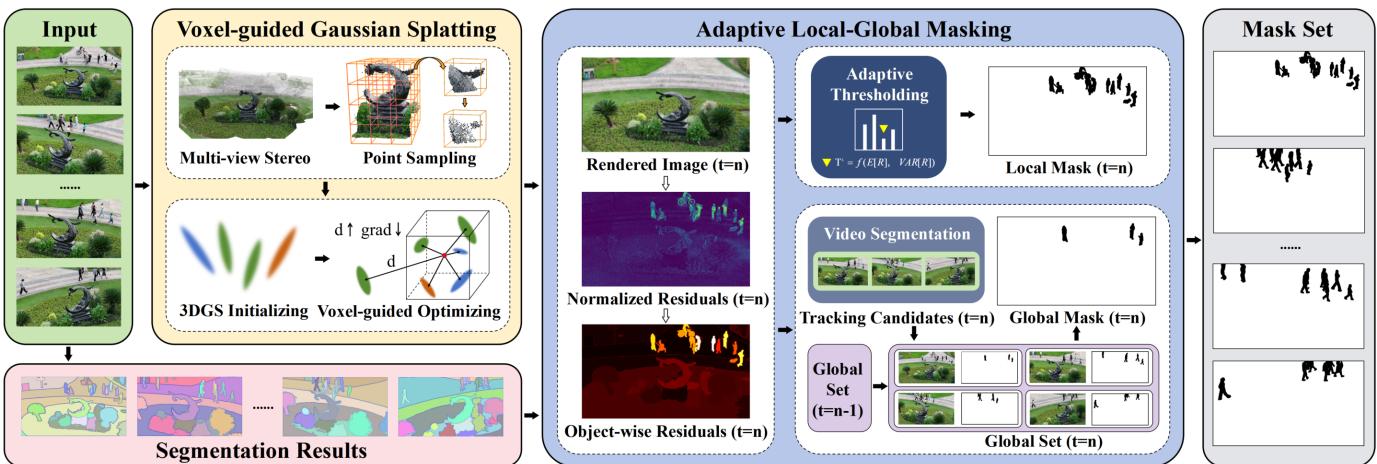
The framework is built on two main pillars: Adaptive Local-Global Masking for dynamic objects and Voxel-Guided Gaussian Splatting for geometry. Let’s break these down.
Part 1: Solving Dynamics with Adaptive Masking
The standard way to remove moving objects is to use a semantic segmentation network (like an AI that knows what a “car” looks like) and mask them out. But this is brittle. What if you want to keep parked cars but remove moving ones? A standard semantic mask would remove both.
DroneSplat takes a smarter approach by combining residuals (error rates) with segmentation.
The Logic of Residuals
When the 3D model renders an image, it compares it to the ground truth photo. Static parts of the scene usually match well (low residual). Moving objects, because they aren’t in the same place in the 3D model, create a high error (high residual).
The researchers calculate a combined residual based on L1 loss and Structural Similarity (D-SSIM):

However, you can’t just pick a single “error number” and say everything above it is a car. The error rates change as the model trains, and they vary from scene to scene. This requires an adaptive approach.
Adaptive Local Masking
The authors observed a statistical trend: residuals for static objects usually fall within a specific statistical range (mean plus variance), while dynamic objects are outliers.
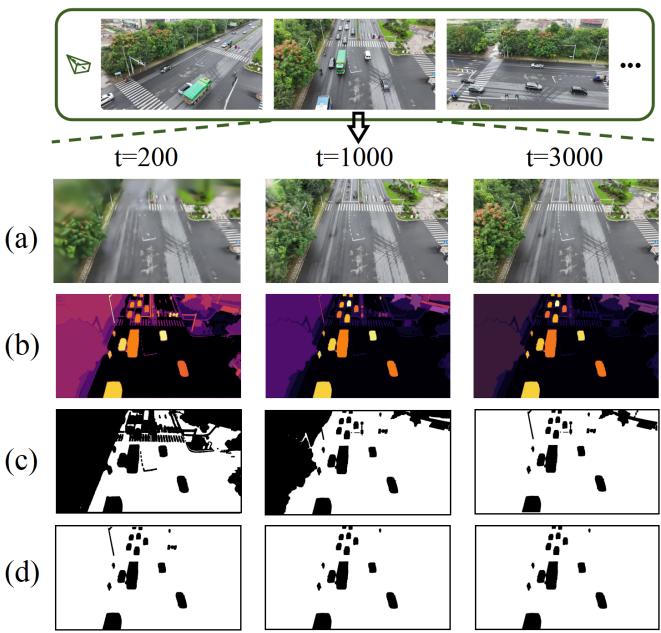
Instead of a hard-coded threshold, DroneSplat calculates a dynamic threshold \(\mathcal{T}^L\) for every image at every iteration.

By applying this threshold, the system generates a Local Mask. It identifies regions where the error is statistically too high to be part of the static scene.
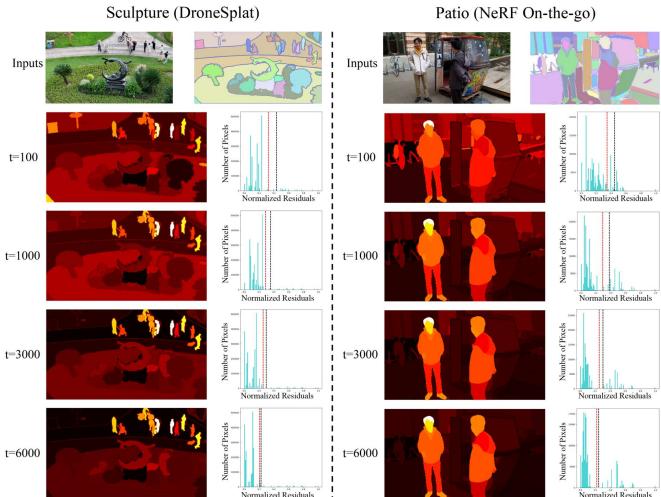
As shown in the histograms above, the static background (the large bump on the left) is distinct from the dynamic objects (the long tail on the right). DroneSplat cuts the tail off.
The visual result is striking. Where a hard threshold might miss parts of a moving object or accidentally delete a complex static texture, the adaptive mask evolves with the training.
Complementary Global Masking
There is a flaw in the local approach: The Stoplight Problem. Imagine a car drives down the street and then stops at a red light for 10 seconds. During those 10 seconds, the car is effectively “static.” The local residual method might decide the car is part of the permanent scenery because the error is low in those specific frames.
To fix this, DroneSplat introduces Global Masking using the Segment Anything Model v2 (SAM 2).
- If an object is identified as a distractor (high residual) in some frames (when it was moving), the system marks it as a “tracking candidate.”
- It uses SAM 2 to track that specific object backward and forward through the video sequence.
- Even if the object stops moving, SAM 2 knows it is the same object that was moving earlier, and the system masks it out.
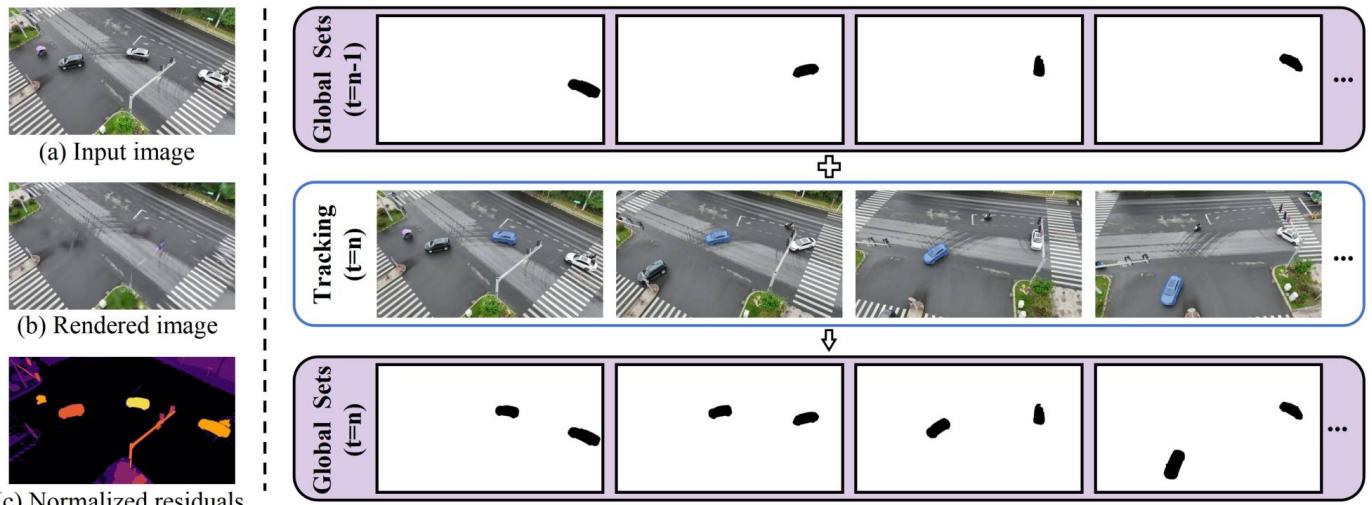
By uniting local statistics with global video understanding, the system catches both fast-moving distractors and the tricky “stop-and-go” ones.
Part 2: Solving Sparsity with Voxel-Guided Optimization
Now that the moving objects are gone, we are left with the static scene. But as mentioned, drone footage often lacks the perfect 360-degree coverage needed for standard 3DGS.
Standard 3DGS initializes points randomly or sparsely (using basic SfM). When views are limited, the optimization process panics, stretching these points into giant, flat splats to cover the empty space, resulting in bad geometry.
DroneSplat solves this by enforcing geometric priors.
Step A: Multi-View Stereo (MVS) Initialization
Instead of starting from scratch, the authors use a state-of-the-art MVS method called DUSt3R. This deep learning model predicts a dense point cloud from the drone images. This gives the 3DGS model a “cheat sheet” of where the geometry roughly is before it even starts training.
Step B: Geometric-Aware Point Sampling
The point cloud from DUSt3R is dense—often too dense (millions of points). Initializing a Gaussian on every single point would melt the GPU memory and slow down training.
DroneSplat uses a smart sampling strategy. It divides the world into voxels (3D grid cells) and selects points based on confidence and FPFH (Fast Point Feature Histograms). FPFH is a metric that describes how “geometrically interesting” a point is (e.g., a corner or an edge vs. a flat wall).
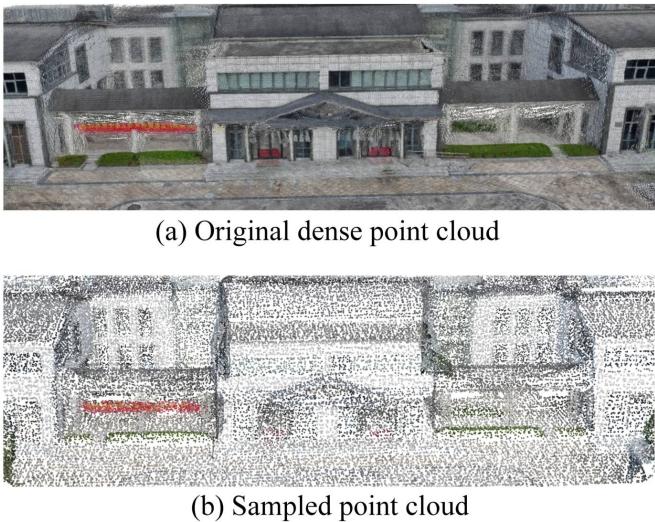
This ensures that the initialized Gaussians are placed exactly where they are needed to represent complex shapes, without wasting resources on flat surfaces.
Step C: Voxel-Guided Optimization
This is the critical constraint. Even with good initialization, 3DGS can “break” the geometry during training if it isn’t watched carefully.
DroneSplat sets strict boundaries. Because the initialization came from a reliable point cloud, the system assumes the true surface is near those initial points. It divides the scene into voxels and assigns Gaussians to them.
If a Gaussian tries to move too far or grow too large (leaving its assigned voxel), the system flags it as “unconstrained.” The gradients (the signals telling the Gaussian how to change) are penalized based on how far the Gaussian has drifted. If it drifts too far, it is split or pruned.
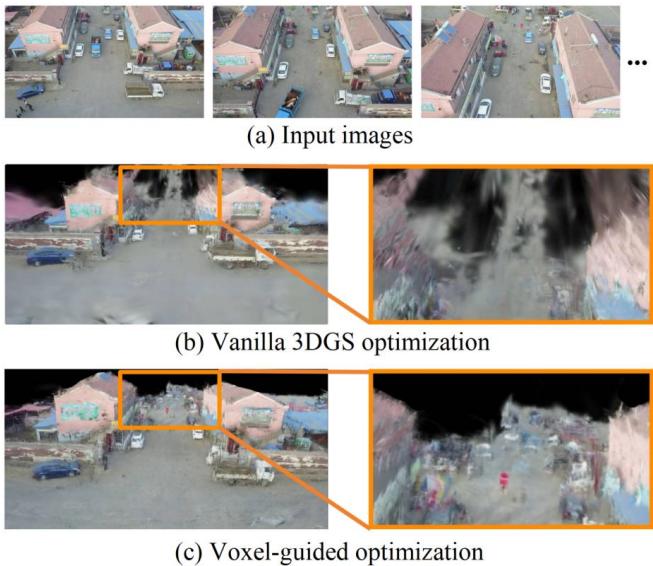
This forces the 3DGS model to respect the underlying geometry provided by the MVS prior, preventing the “exploding” artifacts common in sparse-view scenarios.
Experimental Results
The researchers validated DroneSplat against a wide range of baselines, including RobustNeRF, NeRF On-the-go, and other Gaussian-based methods like WildGaussians. They also introduced a new DroneSplat Dataset featuring diverse urban scenes.
1. Removing Distractors
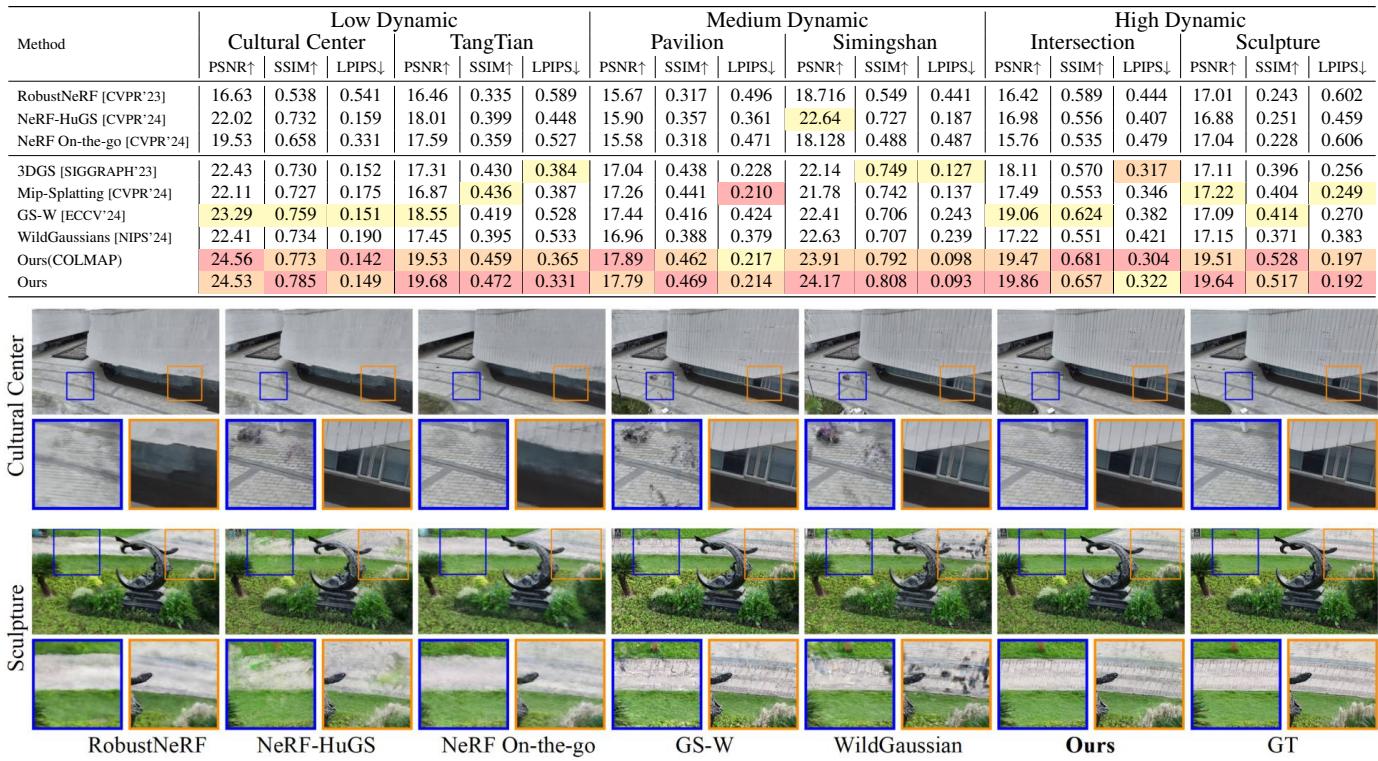
In tests involving dynamic scenes, DroneSplat demonstrated superior ability to scrub moving objects while retaining background detail.
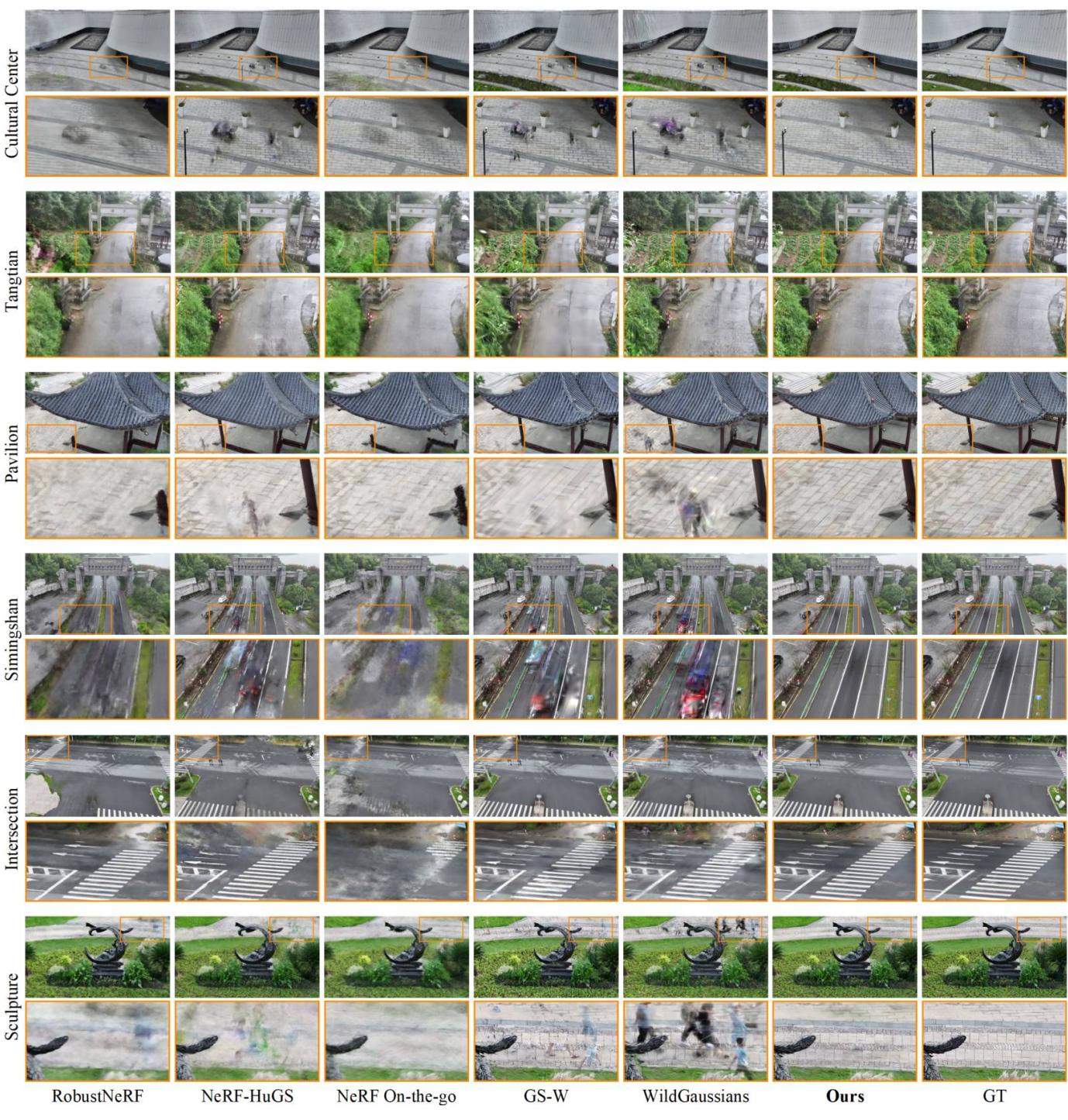
Quantitative metrics (PSNR, SSIM, LPIPS) confirmed this visual improvement. The table below highlights that DroneSplat consistently achieves the highest Peak Signal-to-Noise Ratio (PSNR), indicating better image fidelity.
2. Handling Sparse Views
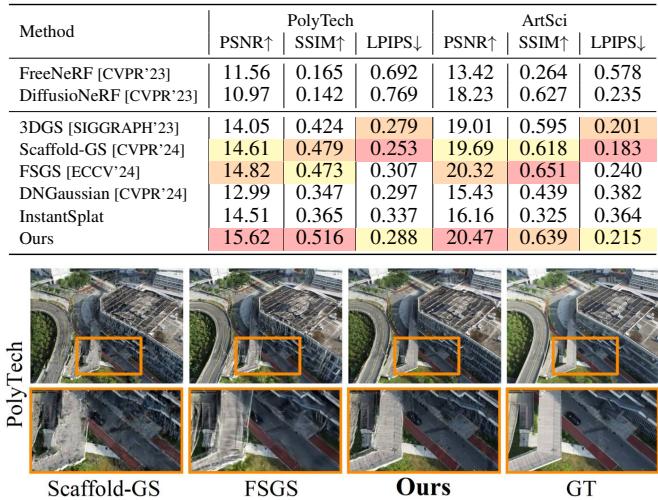
For the limited-view experiments (using only 6 input images!), the difference was equally dramatic. NeRF-based methods often failed to capture geometry entirely, while standard 3DGS produced noisy results.
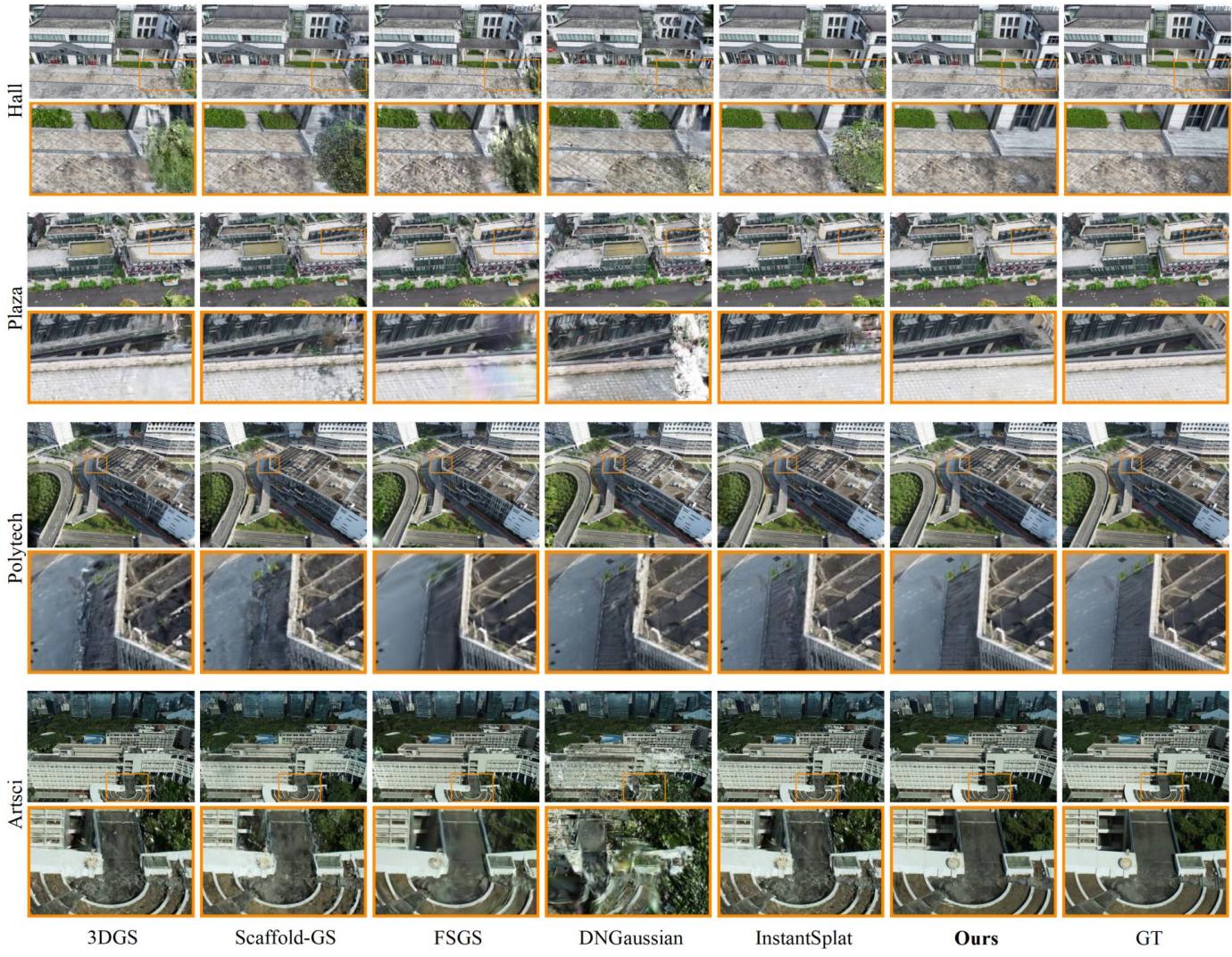
The voxel-guided strategy ensures that even with minimal data, the model “knows” where the buildings should be.
Conclusion and Future Implications
DroneSplat represents a significant step forward for 3D reconstruction in uncontrolled environments. By acknowledging that the real world is messy—full of moving cars, pedestrians, and imperfect flight paths—the researchers have built a system that is robust enough for practical application.
The key takeaways from this work are:
- Don’t trust every pixel: Adaptive masking based on residuals and statistics is more reliable than fixed thresholds for identifying moving objects.
- Context matters: Using video segmentation (SAM 2) allows the system to understand that a stopped car is still a car, solving the “intermittent motion” problem.
- Geometry comes first: In sparse viewing conditions, relying on purely photometric (color) optimization isn’t enough. Using geometric priors (from MVS) and constraining optimization via voxels provides the guardrails needed for accurate 3D modeling.
For students and researchers in computer vision, DroneSplat illustrates the power of hybrid approaches—combining the speed of Gaussian Splatting, the geometric reasoning of Multi-View Stereo, and the semantic understanding of segmentation models to tackle the complexities of the wild.