](https://deep-paper.org/en/paper/2503.17032/images/cover.png)
Introduction
Imagine putting on an Augmented Reality (AR) headset like the Apple Vision Pro and having a conversation with a holographic projection of a friend or a virtual assistant. For the experience to be immersive, this avatar needs to look photorealistic, move naturally, and—crucially—respond in real-time.
While we have seen incredible advances in digital human rendering, a significant gap remains between high-fidelity graphics and real-time performance on mobile hardware. Current industry standards often require massive computational power or rely on artist-created rigs that don’t scale well. On the academic side, neural methods like NeRF (Neural Radiance Fields) offer realism but are often too slow for mobile devices.
Enter TaoAvatar, a new system developed by researchers at Alibaba Group. TaoAvatar leverages the speed of 3D Gaussian Splatting (3DGS) and combines it with a clever “Teacher-Student” learning framework to create full-body, talking avatars that are both lifelike and lightweight.
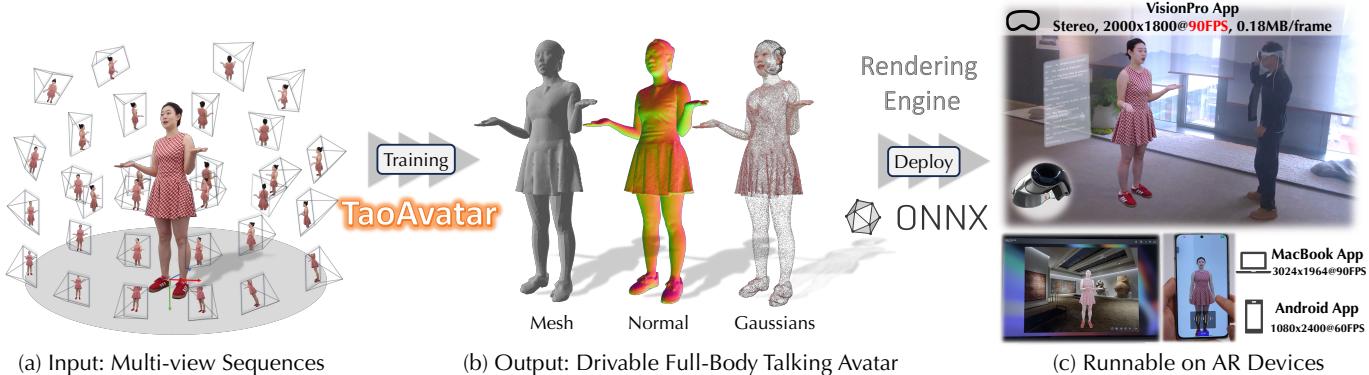
As shown in Figure 1, the system takes multi-view video sequences as input and outputs a drivable avatar that can run at 90 FPS on high-end AR devices, rendering at 2K stereo resolution. In this post, we will dissect the architecture of TaoAvatar, explaining how it balances the trade-off between visual fidelity and computational efficiency.
Background: The Challenge of Digital Humans
To understand why TaoAvatar is significant, we need to look at the limitations of existing approaches.
Parametric Models (SMPL/SMPLX)
Computer graphics have long relied on parametric models like SMPL or SMPLX. These are mathematical models of the human body derived from thousands of scans. They allow you to control a 3D mesh using a few parameters for pose (skeleton) and shape (body type).
- Pros: Very easy to control and animate.
- Cons: They are usually “naked” meshes. They struggle to represent loose clothing (like skirts), hair, or fine details.
Implicit vs. Explicit Representations
Recent AI research has moved toward Implicit Representations (like NeRF), where a neural network predicts the color and density of a point in space. While these produce stunning images, the process of “volume rendering” (sampling hundreds of points along a ray for every pixel) is computationally expensive.
3D Gaussian Splatting (3DGS) is an Explicit Representation. Instead of a neural network answering queries, the scene is represented by a cloud of 3D ellipsoids (Gaussians), each with position, rotation, scale, opacity, and color. These can be rasterized (drawn to the screen) incredibly fast.
The Problem
While 3DGS is fast, animating it is hard. If a person moves their arm, millions of Gaussians need to move correctly. Simply attaching Gaussians to a skeleton (Linear Blend Skinning) often results in artifacts, especially for clothing that should wrinkle or sway independently of the bone structure.
TaoAvatar solves this by creating a hybrid system: it uses a highly detailed mesh as a base and binds Gaussians to it, then uses deep learning to handle the complex, non-rigid deformations (like cloth physics) in real-time.
The TaoAvatar Method
The core philosophy of TaoAvatar is to decouple high-frequency details (which are hard to render fast) from the base geometry, and then re-integrate them using efficient neural networks. The pipeline consists of three main stages:
- Template Reconstruction: Creating a “clothed” SMPLX++ model.
- The Teacher: A heavy, high-quality network that learns complex deformations.
- The Student: A lightweight network that learns from the Teacher to run on mobile devices.
Let’s break these down.
1. The Clothed Parametric Template (SMPLX++)
Standard SMPLX models are insufficient because they don’t account for clothing. If you put a texture of a dress on a naked body mesh, it looks like body paint.
TaoAvatar introduces SMPLX++. The researchers reconstruct the geometry of the person in a T-pose (a reference frame) using NeuS2 (a neural surface reconstruction technique). They then segment non-body components—like hair, skirts, and shoes—and bind them to the standard SMPLX skeleton.

As visualized in Figure 7 above, the pipeline segments the mesh and applies “auto skinning,” which transfers the movement weights from the body skeleton to the clothing. This creates a personalized template that can move, but now includes the geometry of the outfit.
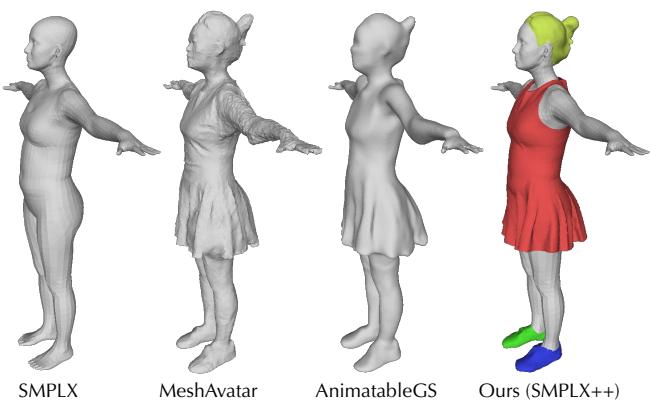
Why is this better? Look at Figure 8 below. The standard SMPLX (left) misses the dress entirely. Other methods like MeshAvatar try to create a mesh from scratch but lose the precise control of hands and face. SMPLX++ (right) retains the expressiveness of the standard model while accurately capturing the volume of the clothing.
2. Binding Gaussians to the Mesh
With the SMPLX++ mesh ready, the system needs to add the high-fidelity texture and volume that 3D Gaussians provide. Instead of letting Gaussians float freely in space, TaoAvatar binds them to the mesh triangles.
For every triangle in the mesh, the system initializes \(k\) Gaussians. Crucially, the attributes of these Gaussians (position, rotation, scale) are defined relative to the triangle’s local coordinate system. This means when the mesh moves (e.g., the avatar lifts an arm), the Gaussians naturally follow.
The transformation from local triangle coordinates to world space is governed by the following equations:
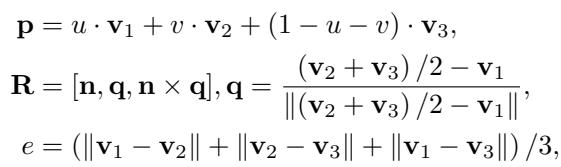
Here, \(\mathbf{p}\) is the point on the triangle surface determined by barycentric coordinates \((u, v)\). \(\mathbf{R}\) represents the local rotation frame of the triangle.
Once the local position is established, the final world attributes for the Gaussian are calculated:

In this equation:
- \(\mathbf{u}_w\): The final world position of the Gaussian.
- \(\mathbf{r}_w\): The world rotation.
- \(\mathbf{s}_w\): The world scaling (scaled by the average edge length \(e\)).
- \(\gamma \mathbf{R}\mathbf{n}\): An offset along the normal vector, giving volume to the surface.
3. The Teacher-Student Framework
This is the most innovative part of the paper. A mesh driven by a skeleton can move rigidly, but it cannot simulate non-rigid deformations—the way a skirt swishes when you turn, or how a shirt wrinkles when you bend.
To solve this, the authors use a Knowledge Distillation strategy.
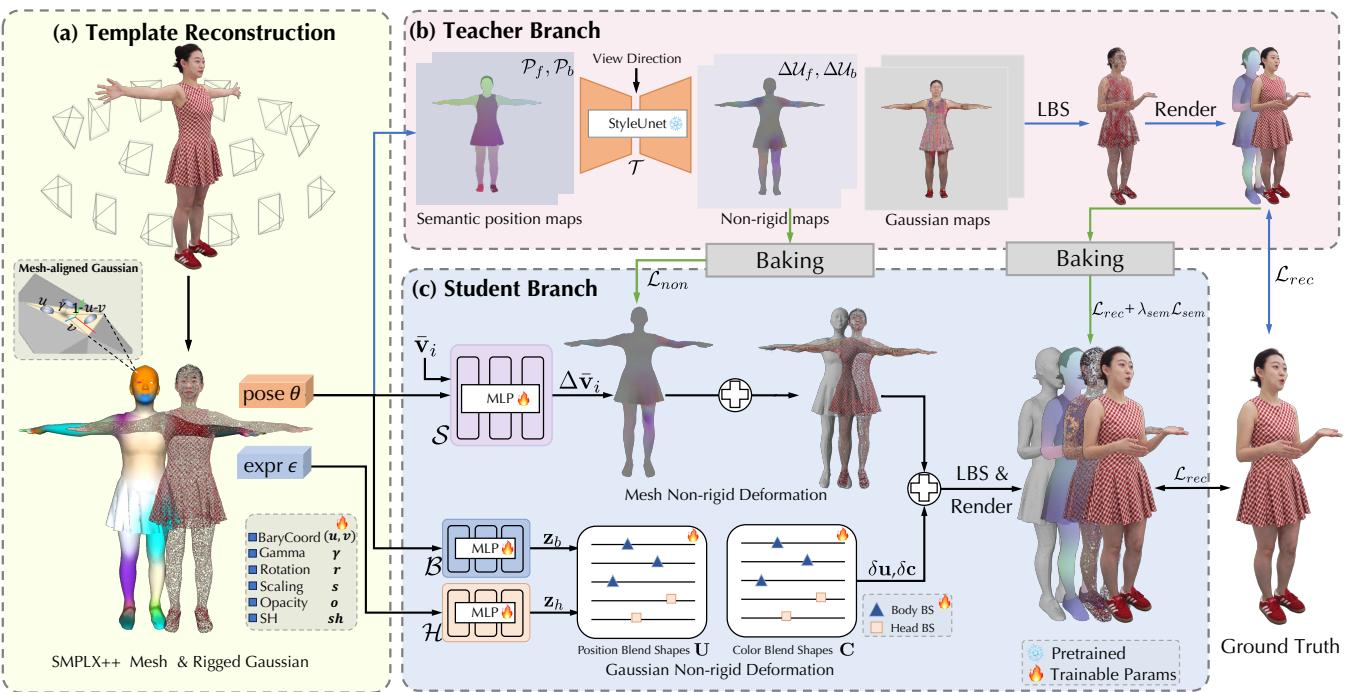
Referencing Figure 2 (branch b), the “Teacher” is a powerful deep learning model based on StyleUnet.
- It takes “position maps” (images encoding the posed mesh) as input.
- It outputs non-rigid deformation maps. These are essentially 2D images that tell the system how to offset the Gaussians to create wrinkles and sway.
- The Problem: The Teacher network is massive and slow. It cannot run on an AR headset.
This leads to Figure 2 (branch c): The “Student.” The Student is a tiny, lightweight Multi-Layer Perceptron (MLP). Instead of processing heavy image maps, the Student takes the pose parameters (angles of joints) and a latent code directly. It tries to predict the same deformations the Teacher would produce.
Baking Non-Rigid Deformations
The process of transferring knowledge from the Teacher to the Student is called “baking.” The researchers train the Student network to mimic the Teacher’s output.
The Student network architecture is compact, designed for speed:
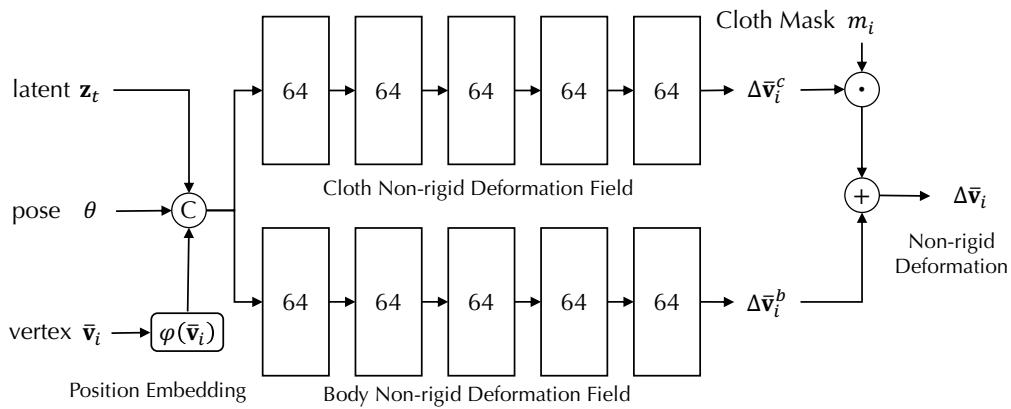
The Student predicts offsets for the mesh vertices (\(\Delta \bar{\mathbf{v}}_i\)). By modifying the underlying mesh shape based on the pose, the bound Gaussians move along with it, simulating cloth dynamics without heavy physics simulations.
To ensure the Student learns correctly, several loss functions are used. The Non-rigid Loss ensures the Student’s predicted offsets match the Teacher’s:

Additionally, a Semantic Loss is used to prevent the clothing from clipping into the body (a common issue in 3D animation). It ensures that the semantic labels (identifying which part is skin vs. cloth) remain consistent.

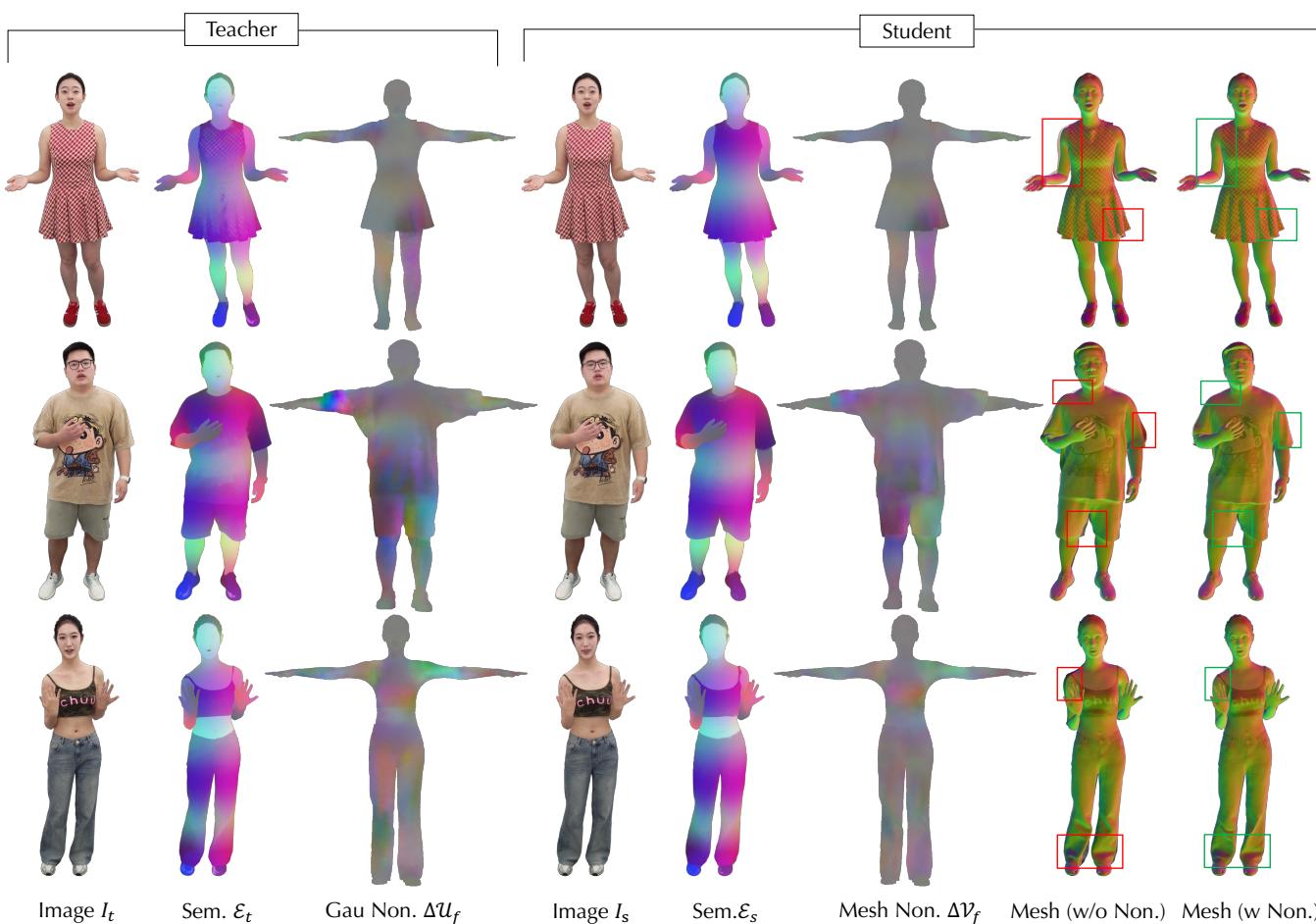
The impact of this baking process is visible in Figure 12. Notice how the “Mesh (w Non.)” (Mesh with Non-rigid deformation) correctly deforms the skirt area compared to the rigid version.
4. Blend Shape Compensation
Even with the Student network predicting mesh deformations, some high-frequency details (like subtle lighting changes or very fine wrinkles) might be lost because the Student is a simplified model.
To fix this, TaoAvatar introduces Learnable Gaussian Blend Shapes. Blend shapes are a standard technique in facial animation (e.g., a “smile” shape + a “frown” shape). Here, the authors apply it to the Gaussians.
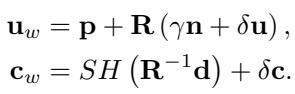
The system learns specific offsets for Gaussian positions (\(\delta \mathbf{u}\)) and colors (\(\delta \mathbf{c}\)) based on the pose.

Here, \(\mathbf{z}_h\) and \(\mathbf{z}_b\) are coefficients for the head and body. These offsets are added to the final world calculations, allowing the avatar to have highly detailed expressions and lighting effects that the mesh alone couldn’t support.
Experiments and Results
The researchers validated TaoAvatar using a new dataset called TalkBody4D, which focuses on full-body talking scenarios with rich gestures.
Performance vs. Quality
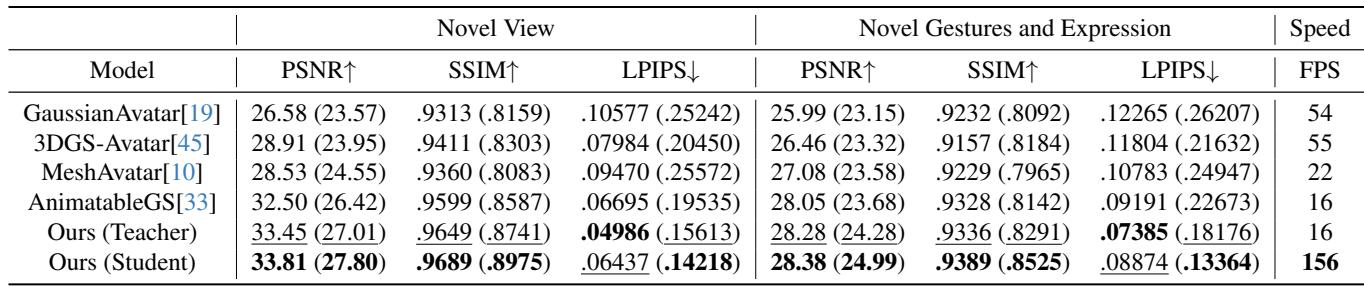
The most striking result is the efficiency. As shown in Table 1, TaoAvatar (Student) runs at 156 FPS on an RTX4090, while the Teacher model runs at only 16 FPS. Crucially, the quality drop is minimal. The Student model outperforms existing state-of-the-art methods like AnimatableGS and GaussianAvatar in terms of visual quality (PSNR/SSIM metrics) while being vastly faster.
Visual Comparisons
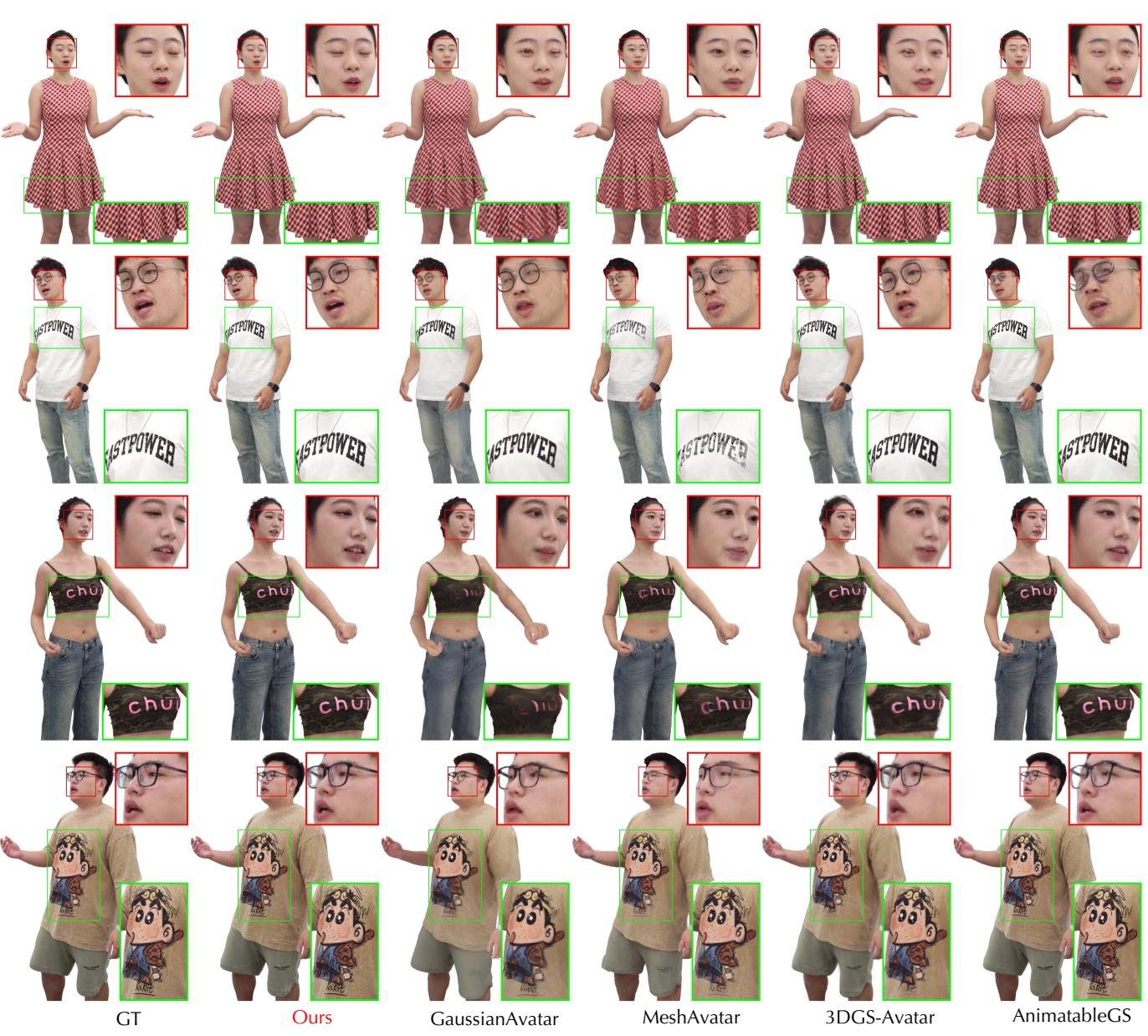
Qualitatively, TaoAvatar captures details that other methods miss. In Figure 3, you can see that competing methods often blur the face or fail to render the clothing texture realistically. TaoAvatar maintains sharp facial features and realistic clothing folds.
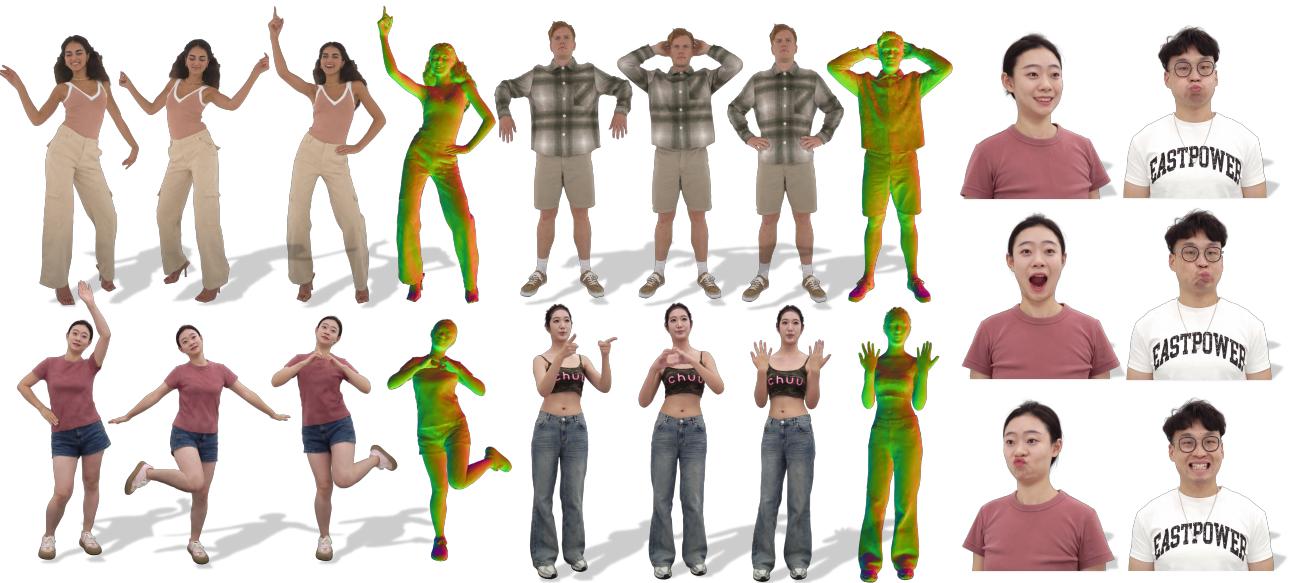
Furthermore, the method is robust enough to handle challenging, exaggerated poses that were not in the training set, as seen in Figure 4.
Ablation Study
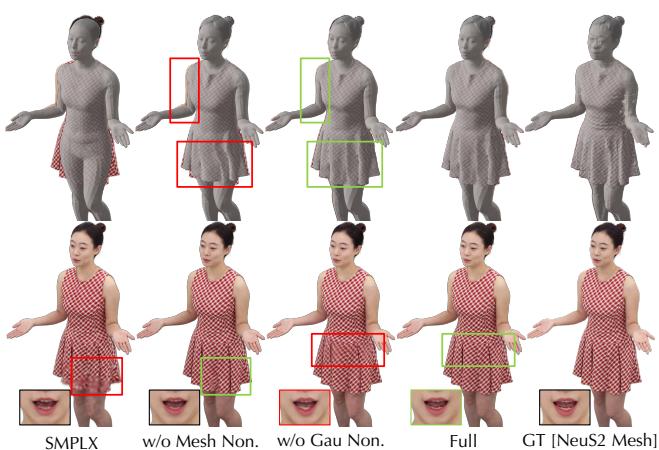
Does every part of the system matter? The authors performed an ablation study (removing parts to see what breaks).
- w/o Mesh Non-rigid: If you remove the Student’s mesh deformation, the clothing becomes rigid and inaccurate (Red boxes in Figure 6).
- w/o Gaussian Non-rigid: If you remove the blend shape compensation, you lose fine surface details.
Application: The Digital Human Agent
The ultimate goal of this research is deployment. The authors successfully integrated TaoAvatar into a pipeline running on the Apple Vision Pro.
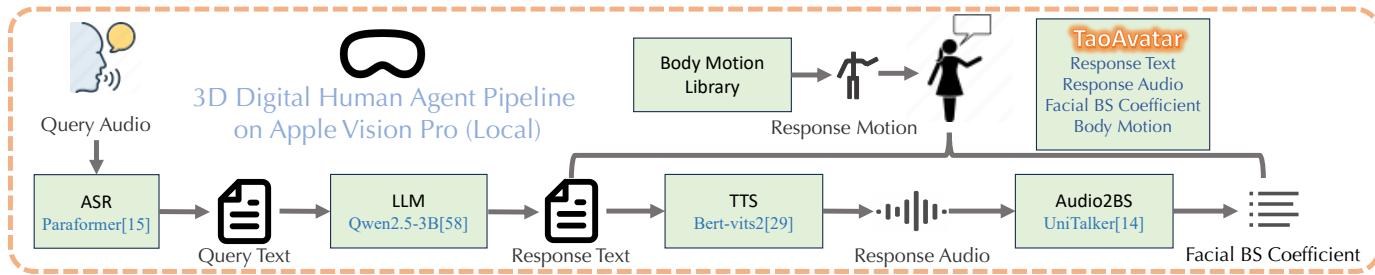
The pipeline, illustrated in Figure 13, connects a Large Language Model (LLM) for text generation, a Text-to-Speech (TTS) engine, and the TaoAvatar rendering engine. Because the Student model is so lightweight, the entire “talk” cycle—from audio generation to 3D rendering—happens in real-time on the device.
Conclusion
TaoAvatar represents a significant step forward for AR and VR communications. By combining the structural control of parametric meshes (SMPLX++) with the rendering speed of 3D Gaussian Splatting, and bridging them with a Teacher-Student distillation process, the authors have cracked a difficult code: High-Fidelity + Real-Time Performance.
The ability to run these avatars at 90 FPS on mobile hardware opens the door for holographic telepresence, interactive gaming NPCs, and virtual assistants that feel genuinely present in our physical space. While some limitations remain, such as handling extreme clothing dynamics (like a long flowing dress in a storm), the “baking” approach presented here is a blueprint for the future of mobile graphics.