](https://deep-paper.org/en/paper/2503.17860/images/cover.png)
When Vector Search Fails: Teaching Retrieval Systems to Think Logically
If you have ever built a search engine or a RAG (Retrieval-Augmented Generation) pipeline, you are likely familiar with the magic of vector embeddings. You take a user’s query, squish it into a dense vector, and search for documents that are “close” to that vector in high-dimensional space. It is efficient, scalable, and generally works well for semantic similarity.
But there is a catch.
Vector search is excellent at finding things that are similar, but it is notoriously bad at understanding logic. If a user asks for “benefits of Vitamin D,” vector search shines. But if a user asks for “benefits of Vitamin D NOT related to bone health,” the system often fails spectacularly. Why? because the vector for “Vitamin D benefits NOT bone health” is still mathematically very close to the vector for “bone health.” The embedding model sees the words “bone health” and pulls those documents in, completely ignoring the negation.
Today, we are diving deep into a fascinating paper titled “Enhancing Retrieval Systems with Inference-Time Logical Reasoning” by researchers from MIT and Accenture. They propose a novel framework called Inference-Time Logical Reasoning (ITLR) that fixes this fundamental flaw by marrying the semantic power of Large Language Models (LLMs) with the precision of logical operations.
The Problem: The “Fuzzy” Nature of Embeddings
Modern retrieval systems rely on Cosine Similarity. When you type a query, the system transforms that entire sentence into a single point in space. This works on the principle that semantically similar concepts cluster together.
However, complex user queries often contain logical instructions:
- Negations: “NOT this”
- Conjunctions: “A AND B”
- Disjunctions: “A OR B”
Standard embedding models struggle to encode these logical operators into the fixed geometry of a vector. As the authors of the paper point out, a query like “What are the benefits of vitamin D, focusing on benefits other than bone health?” often retrieves documents about bone health because the embedding is dominated by the semantic weight of the phrase “bone health.”

As shown in Figure 1, the goal is to separate these concepts. We want documents that fall into the yellow/blue overlap (Vitamin D) but strictly exclude the blue circle (Bone Health). Traditional dense retrieval cannot easily draw these “boundaries” because it processes the query as a single semantic blob.
The Solution: Inference-Time Logical Reasoning (ITLR)
The researchers propose a framework that doesn’t require retraining the embedding model. Instead, it changes how we process the query at inference time. The core idea is to decompose a complex natural language query into atomic parts, score them individually, and then recombine them using logic.
The process involves three distinct steps:
- Logical Query Transformation: Converting natural language into a logical formula.
- Term Embedding: Scoring each “atom” of the formula separately.
- Score Composition: Using fuzzy logic math to calculate the final relevance score.
Let’s break these down in detail.
Step 1: Logical Query Transformation
The first step is to stop treating the query as a single string of text. The system uses an LLM (like Llama-3) to parse the user’s natural language question and rewrite it into a structured logical expression.
The grammar for this expression is simple but powerful. It allows for nested terms using AND, OR, and NOT.
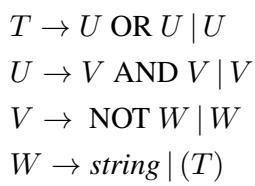
For example, if the user asks: “I want to know about cats or dogs, but I don’t want to see anything about giraffes,” the LLM transforms this into:

Here, \(t_1\) is “cat”, \(t_2\) is “dog”, and \(t_3\) is “giraffe”. This transformation is critical because it explicitly isolates the negative constraint (\(t_3\)) from the positive search terms.
Step 2: The Parse Tree and Independent Scoring
Once the query is transformed into a logical expression, the system parses it into a tree structure. This is where the method diverges significantly from standard retrieval.
In standard retrieval, you would embed the whole sentence. In ITLR, you only embed the terms (\(t_1, t_2, t_3\)).
- You calculate a similarity score (\(s_{1i}\)) between the document and “cat”.
- You calculate a similarity score (\(s_{2i}\)) between the document and “dog”.
- You calculate a similarity score (\(s_{3i}\)) between the document and “giraffe”.
These calculations happen in parallel, making the process highly efficient. The system essentially asks: “How much is this document about cats? How much about dogs? How much about giraffes?” independently.

Figure 2 illustrates this hierarchy. The left side shows the logical parse tree derived from the query. The right side shows the “Graph of Operations.” This graph dictates how the independent similarity scores (\(s_{1i}, s_{2i}, s_{3i}\)) flow up the tree to produce a final score for the document.
Step 3: Score Composition (Math with Meaning)
Now for the most mathematically interesting part: How do you combine these scores?
The researchers treat the retrieval scores as truth values in a fuzzy logic system. In classical logic, a statement is either True (1) or False (0). In retrieval, a document is “partially true” regarding a query—represented by its cosine similarity score (usually between 0 and 1).
We need mathematical functions to represent AND, OR, and NOT that work on these continuous scores. The general formula for composing the final score \(s_i\) for a document \(D_i\) is:

But what exactly are \(OP_{AND}\), \(OP_{OR}\), and \(OP_{NOT}\)? The authors experimented with several mathematical definitions common in fuzzy logic (like Gödel logic or Product logic).
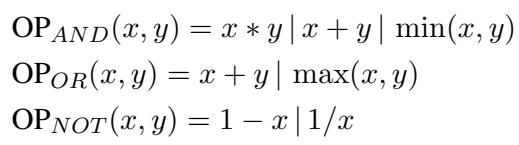
Through experimentation, they found the following combination worked best:
- AND (\(x * y\)): Multiplication. If a document needs to be about A and B, it needs a high score in both. If either score is low (near 0), the product drops significantly.
- OR (\(x + y\)): Addition. If a document is about A or B, the scores accumulate. (Note: The scores are usually not capped at 1 in this intermediate stage, or are normalized later).
- NOT (\(1 - x\)): Inversion. If a document has a high similarity to the excluded term (e.g., 0.9 similarity to “giraffe”), the NOT operator flips it to 0.1.
A Concrete Example
Let’s look at a complex query involving animals to see the math in action:
Query: ("dog" OR "cat" AND "mouse") AND NOT "giraffe"
This structure implies we want documents about dogs, OR documents about cats and mice, provided they do NOT mention giraffes.
The computational graph for the final score \(s\) looks like this:

If a document is highly relevant to “giraffe” (\(s_{giraffe} \approx 1\)), the term \((1 - s_{giraffe})\) becomes \(\approx 0\). Because the final operation is a multiplication (the outer AND), the total score for the document becomes 0. The document is effectively filtered out, regardless of how much it talks about dogs or cats. This provides the “hard” logical constraint that vector search usually lacks.
Experiments & Results
To validate this approach, the authors tested ITLR against standard embedding models on both synthetic and real-world datasets.
Synthetic Benchmarks
The researchers first created a controlled environment. They generated synthetic documents and queries with increasing logical complexity (e.g., 2 terms, 3 terms, 4 terms).
They compared two approaches:
- Base: Feeding the complex query string directly into a standard embedding model (like OpenAI’s
text-embedding-3). - ITLR (Logical): Using the proposed decomposition method.
The results on scaling were revealing:
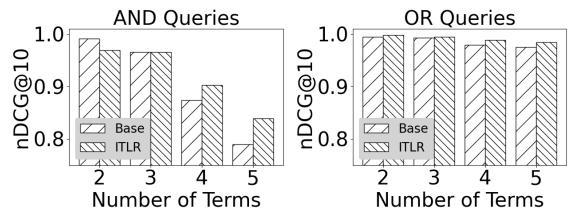
In Figure 3, look at the “AND Queries” chart on the left. As the number of terms increases (getting more specific), the Base model (patterned gray) performance drops significantly. It struggles to satisfy all conditions simultaneously. The ITLR method (diagonal lines), however, maintains near-perfect performance.
They also broke down performance by embedding model to ensure this wasn’t just a quirk of one specific AI.
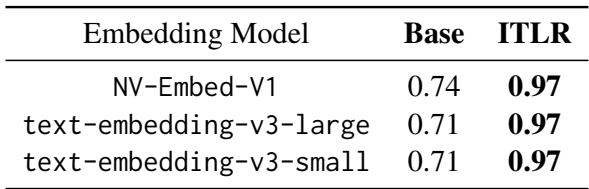
As Table 5 shows, the improvement is consistent across Nvidia, Mistral, and OpenAI models. The logical reasoning layer acts as a “performance booster” regardless of the underlying embedding engine.
Real-World Performance
Synthetic data is great for sanity checks, but does this work in the wild? The authors tested on three datasets from the BEIR benchmark: NFCorpus (Medical), SciFact (Scientific claims), and ArguAna (Argument retrieval).
They compared ITLR against:
- Base: Standard dense retrieval.
- BRIGHT: A “Chain-of-Thought” method where an LLM first reasons about the query and generates a reasoning trace, which is then embedded.
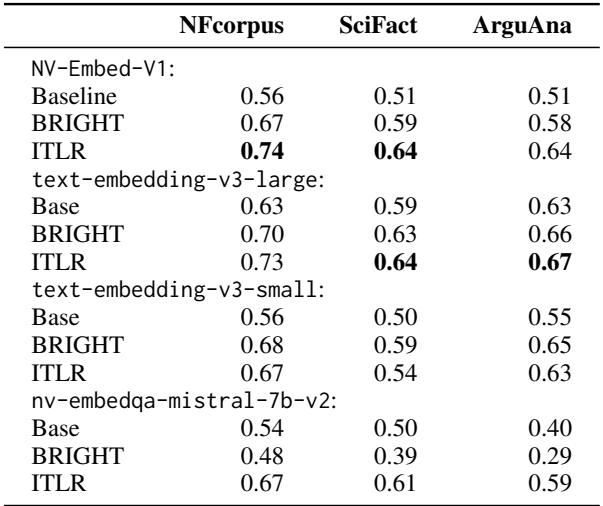
The results in Table 3 are compelling. ITLR (the bottom row for each model) consistently outperforms the Base and BRIGHT baselines. The gap is particularly noticeable in NFCorpus, a medical dataset where queries often involve strict inclusions/exclusions (e.g., “treatments for cancer NOT involving chemotherapy”).
The Power of Negation
The authors hypothesized that the main driver of this performance boost is the handling of negations. To prove this, they segmented the NFCorpus results by the number of negation terms in the query.
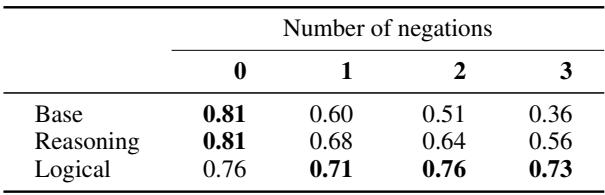
Table 4 confirms the hypothesis. Look at the column for 3 negations.
- The Base model’s performance crashes to an nDCG of 0.36. It is essentially guessing.
- The Logical (ITLR) method maintains a score of 0.73.
This massive delta highlights the brittleness of standard vector search. When you tell a standard model “NOT X,” it often just hears “X” and brings it to you anyway. ITLR listens to the logic.
Why This Matters
This research highlights a growing trend in AI: Neuro-Symbolic approaches. Pure neural networks (like embedding models) are intuition machines—they are great at fuzzy matching and general vibes. Symbolic systems (like logical formulas) are precision machines.
By using an LLM to translate user intent (Intuition) into a logical formula (Symbolic), and then using vector search (Intuition) to score the atoms, ITLR gets the best of both worlds.
Key Takeaways
- Vector Search has a Logic Blindspot: It treats queries as a “bag of meaning,” often ignoring operators like NOT, AND, and OR.
- Logic can be Decomposed: Complex queries are just combinations of simple queries. We can solve the simple parts in parallel and combine them mathematically.
- No Retraining Required: This is an inference-time technique. You can apply it on top of your existing
text-embedding-3or open-source embeddings today. - Efficiency: Because term embeddings can be computed in parallel, the latency overhead is minimal compared to the gain in accuracy.
Conclusion
The “Enhancing Retrieval Systems with Inference-Time Logical Reasoning” paper provides a robust blueprint for the next generation of search systems. As users become more accustomed to interacting with AI, their queries are becoming more complex. They aren’t just searching for keywords; they are giving instructions.
Traditional “black box” embedding approaches are hitting a ceiling with these complex instructions. By explicitly modeling logic at inference time, we can build systems that actually listen to what the user doesn’t want, just as well as what they do.
While this method requires an extra step (the LLM query transformation), the dramatic increase in accuracy for complex queries suggests that logical reasoning layers will likely become a standard component in future Information Retrieval architectures. If you are building RAG systems that need to handle precise constraints, it might be time to stop relying solely on cosine similarity and start teaching your system some logic.