](https://deep-paper.org/en/paper/2503.18223/images/cover.png)
Decoding the Wild: How Multimodal AI is Revolutionizing Wildlife Monitoring in the Swiss Alps
Imagine attempting to document the daily lives of elusive mountain creatures—Red Deer, Wolves, or Mountain Hares—without ever stepping foot in the forest. For decades, ecologists have relied on camera traps to act as their eyes in the wild. These motion-activated sensors capture millions of images and videos, offering an unprecedented glimpse into biodiversity.
However, a new problem has emerged: we have too much data. With modern camera traps capable of recording high-definition video for weeks on end, researchers are drowning in footage. Manually annotating this data to understand not just what animal is present, but what it is doing (behavior), is a Herculean task.
This brings us to a groundbreaking research paper titled “MammAlps: A multi-view video behavior monitoring dataset of wild mammals in the Swiss Alps.” In this post, we will explore how researchers from EPFL in Switzerland are bridging the gap between ecology and computer vision. We will dive into their creation of a unique, multimodal dataset and the development of sophisticated Deep Learning benchmarks designed to understand animal behavior in the wild automatically.
The Context: From Snapshots to Cinema
To understand the significance of MammAlps, we first need to look at the current landscape of wildlife monitoring. Historically, researchers have used two main methods:
- Animal-centric sensors: Bio-loggers (like GPS collars) attached to specific animals. These are great for tracking movement over huge distances but require capturing the animal and don’t tell us much about their interaction with the immediate environment.
- Habitat-centric sensors: Camera traps fixed to trees. These observe the environment and capture any animal that passes by.
Recently, camera traps have evolved from taking grainy photos to recording high-resolution videos. This shift allows us to study complex behaviors—courtship, foraging, and social interactions—at scale. However, computer vision models (the AI brains analyzing this footage) need training data to learn these behaviors.
The Data Gap
Existing datasets usually fall into two buckets:
- Fieldwork Data: Collected by scientists in specific locations. These are realistic but often small and limited to a few common behaviors.
- Web-Scraped Data: Collected from YouTube or documentaries. These are vast and diverse but often lack the “messiness” of real research conditions (bad lighting, occlusions, rain).
MammAlps fills a critical void. It is a curated fieldwork dataset that is both multimodal (using video, audio, and environmental maps) and multi-view (using multiple cameras for one scene).
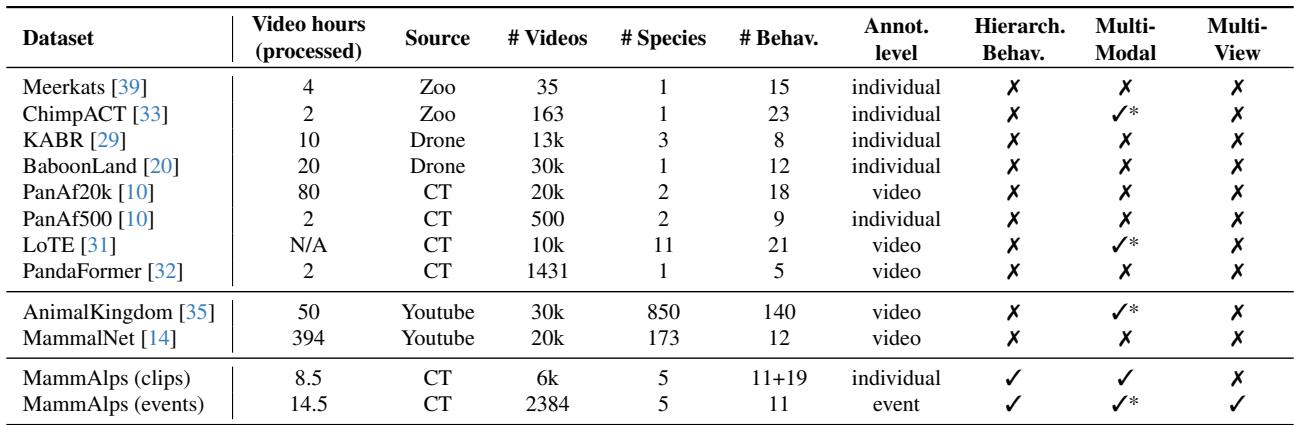
As shown in the table above, MammAlps stands out by offering hierarchical behavior annotations and multi-view setups—features rarely found in previous datasets like PanAf20k or MammalNet.
The MammAlps Dataset: Building the Foundation
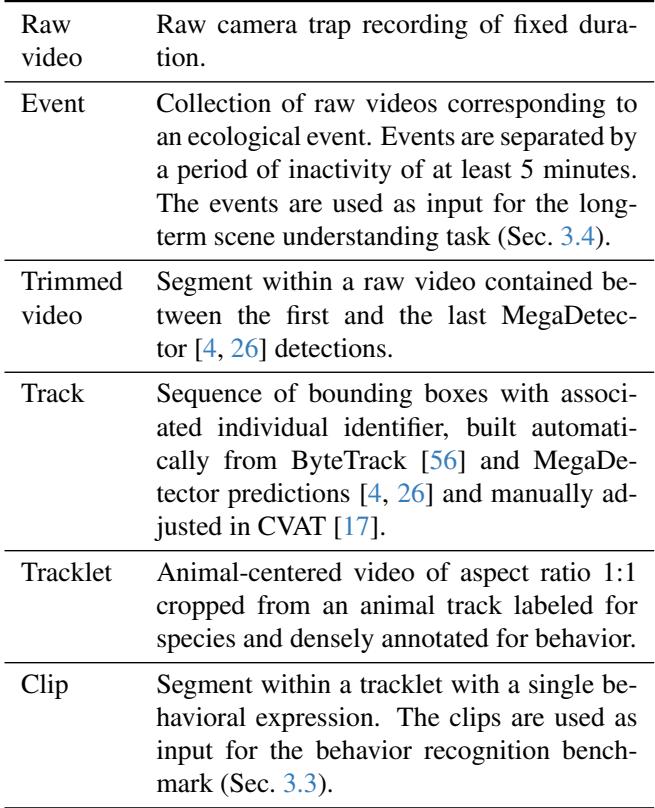
The researchers deployed nine camera traps across three different sites in the Swiss National Park. This location is vital because the European Alps are particularly vulnerable to climate change, making the monitoring of local fauna essential.
The Setup
At each site, three cameras were positioned at different angles. This multi-view approach is crucial. An animal might be hidden behind a tree in Camera 1 but perfectly visible in Camera 2. The cameras recorded video and audio whenever motion was detected, operating day and night (using infrared flashes).
The Pipeline: From Raw Footage to Insights
Creating a dataset isn’t just about leaving cameras in the woods. The raw data underwent a rigorous processing pipeline:
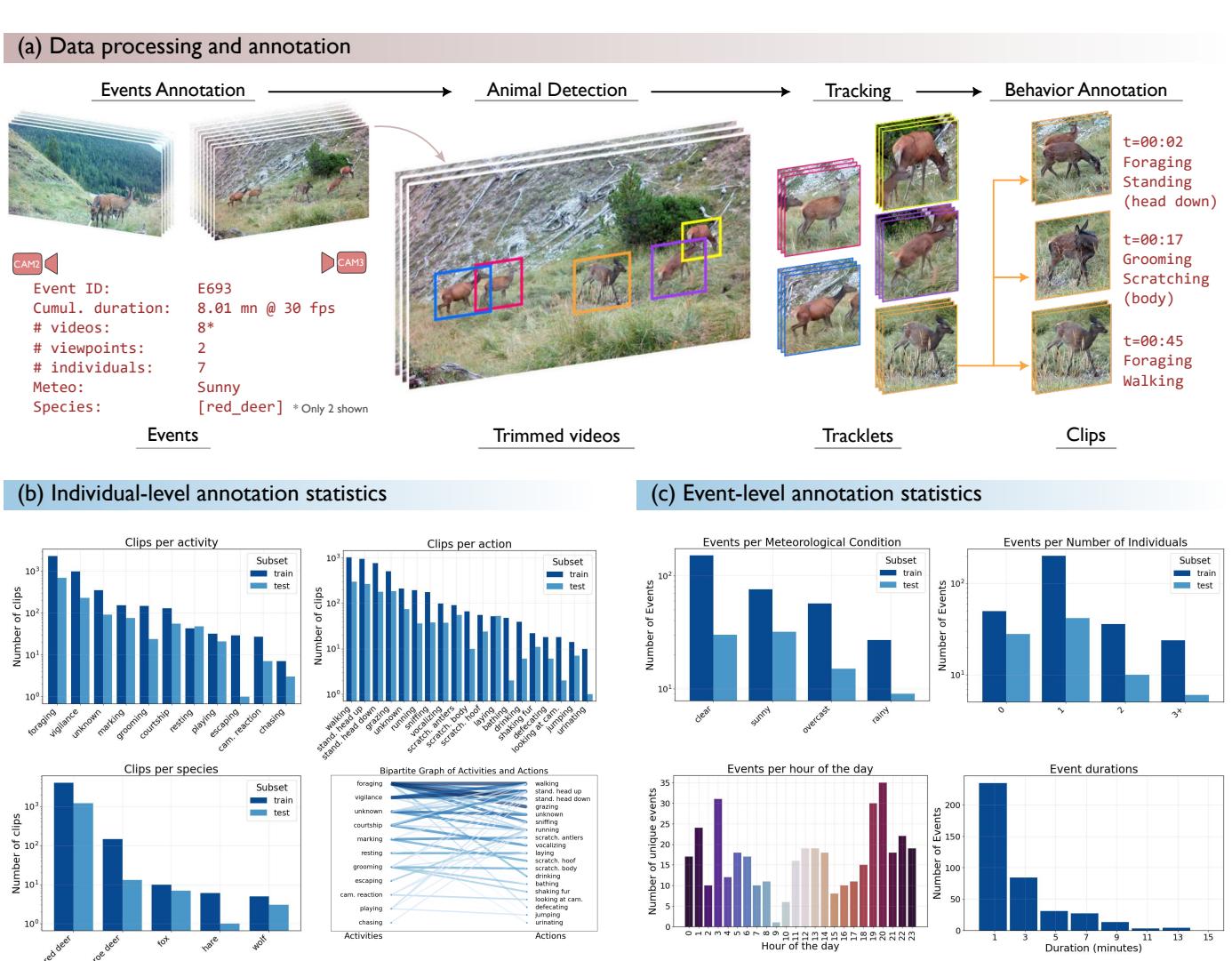
- Event Aggregation: Raw videos were grouped into “events” (ecological scenes separated by 5 minutes of inactivity).
- Detection & Tracking: The team used MegaDetector to find animals and ByteTrack to track individual animals across frames.
- Manual Correction: Experts reviewed the tracks to fix errors, ensuring high-quality ground truth.
- Annotation: This is where MammAlps shines. The data was annotated at two levels of complexity.
Hierarchical Behavior: Actions vs. Activities
Animal behavior is complex and layered. A deer might be “walking” (a physical movement) while simultaneously “foraging” (a high-level goal). To capture this, the researchers annotated the data hierarchically:
- Actions (Low-level): Stereotypical movements like walking, standing head up, or grazing.
- Activities (High-level): The context or goal, such as foraging, courtship, or vigilance.
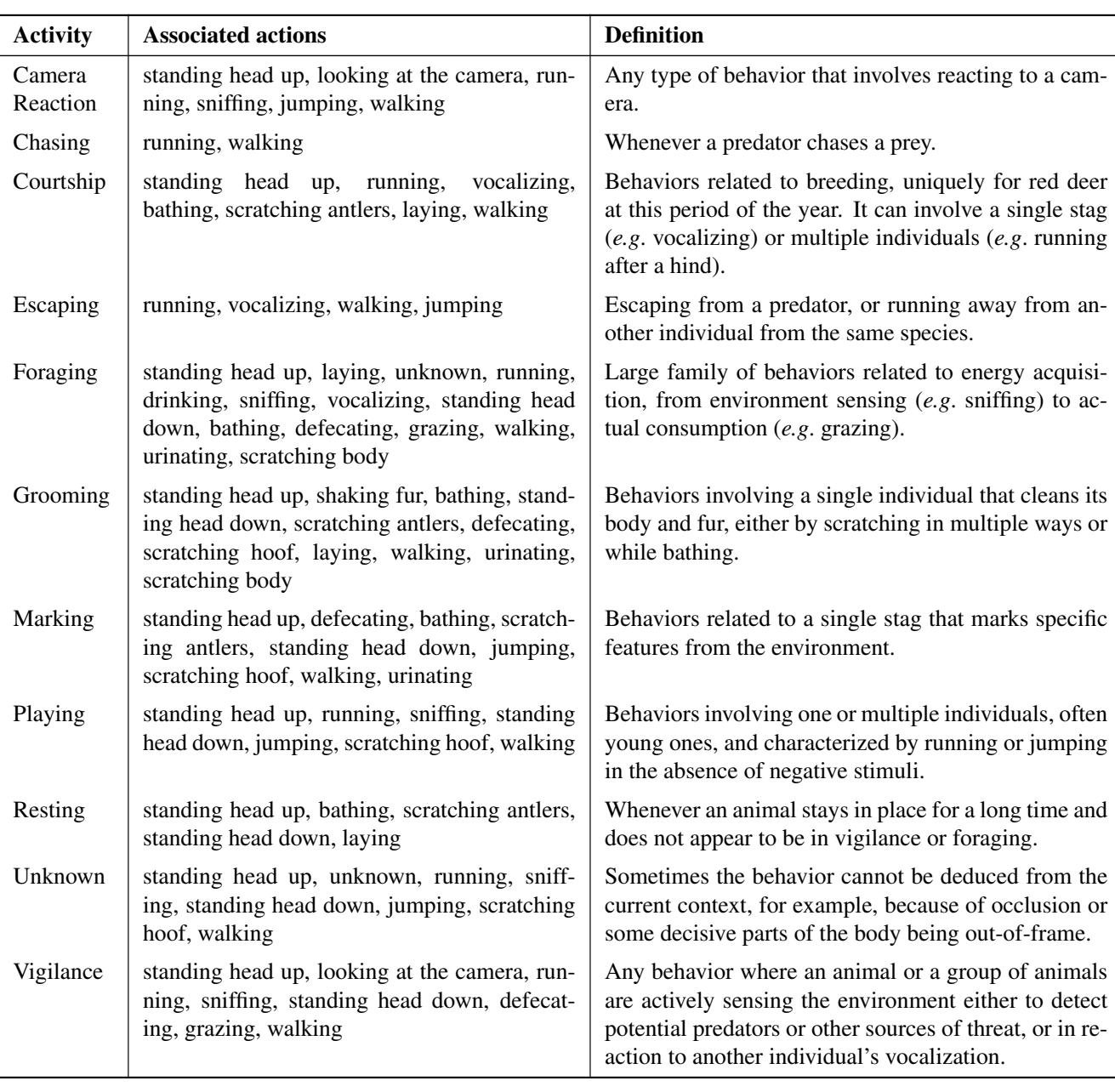
This hierarchical approach, detailed in the table above, allows models to learn the nuances of behavior. For example, “running” could be part of “playing,” “chasing,” or “escaping.” Context matters.
Benchmark 1: Multimodal Species and Behavior Recognition
The first major contribution of the paper is a benchmark task focused on identifying species and behaviors from short video clips.
Most existing wildlife models only look at the video (pixels). However, nature is a multisensory experience. The sound of a deer calling or the crunch of leaves can distinguish behaviors. Furthermore, the environment itself provides clues; an animal is more likely to drink if water is present.
The Multimodal Approach
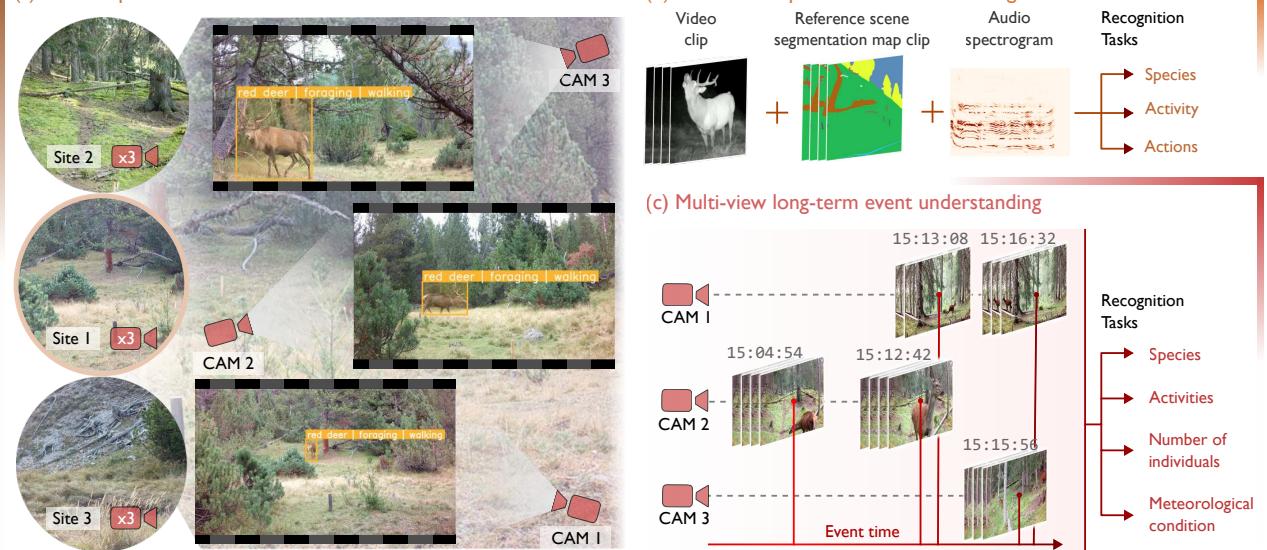
To leverage this, the researchers adapted a VideoMAE (Video Masked Autoencoder) architecture to accept three inputs:
- Video: The visual movement of the animal.
- Audio: Spectrograms of the sound recorded by the camera.
- Segmentation Maps: A semantic map of the background scene (identifying grass, water, trees, etc.).
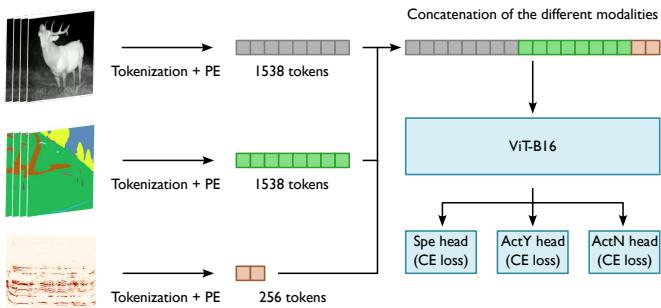
As illustrated in Figure 7, the model processes these three streams and fuses them to make predictions.
Does it work?
The results were compelling. Adding audio to the video inputs significantly improved performance.
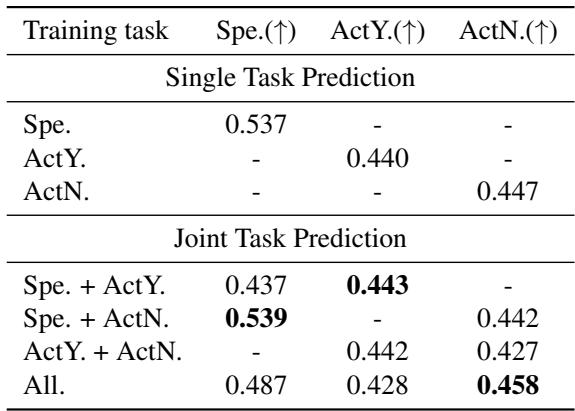
Looking at the results table:
- Video Only (V): Achieved an average Mean Average Precision (mAP) of 0.453.
- Video + Audio (V+A): Jumped to 0.473.
The audio modality was particularly helpful for classes with distinct sounds, such as “vocalizing” or “marking.” Interestingly, the segmentation maps (S) didn’t help much when combined with video, likely because the video frames already implicitly contain background information. However, they did boost performance when used with audio alone, proving they hold valuable contextual signal.
Benchmark 2: Multi-view Long-term Event Understanding
The second benchmark addresses a more holistic challenge: Event Understanding.
In ecology, researchers aren’t just interested in a 5-second clip of a deer walking. They want to know: Over this 10-minute period, how many animals were here? What were they doing collectively? What was the weather?
This task involves processing long sequences (up to 12 minutes) from multiple camera angles.
The Challenge: Computational Cost
Standard Transformer models (the architecture behind tools like ChatGPT and VideoMAE) struggle with long sequences because their memory usage grows quadratically with the length of the input. Processing 15 minutes of video frame-by-frame is computationally prohibitive.
The Solution: Offline Token Merging
To solve this, the researchers devised an Offline Token Merging strategy inspired by the ToME (Token Merging) algorithm.
The core idea is simple but powerful: video contains a lot of redundancy. The sky in frame 1 looks the same as the sky in frame 10. We don’t need to process both as separate “tokens.”
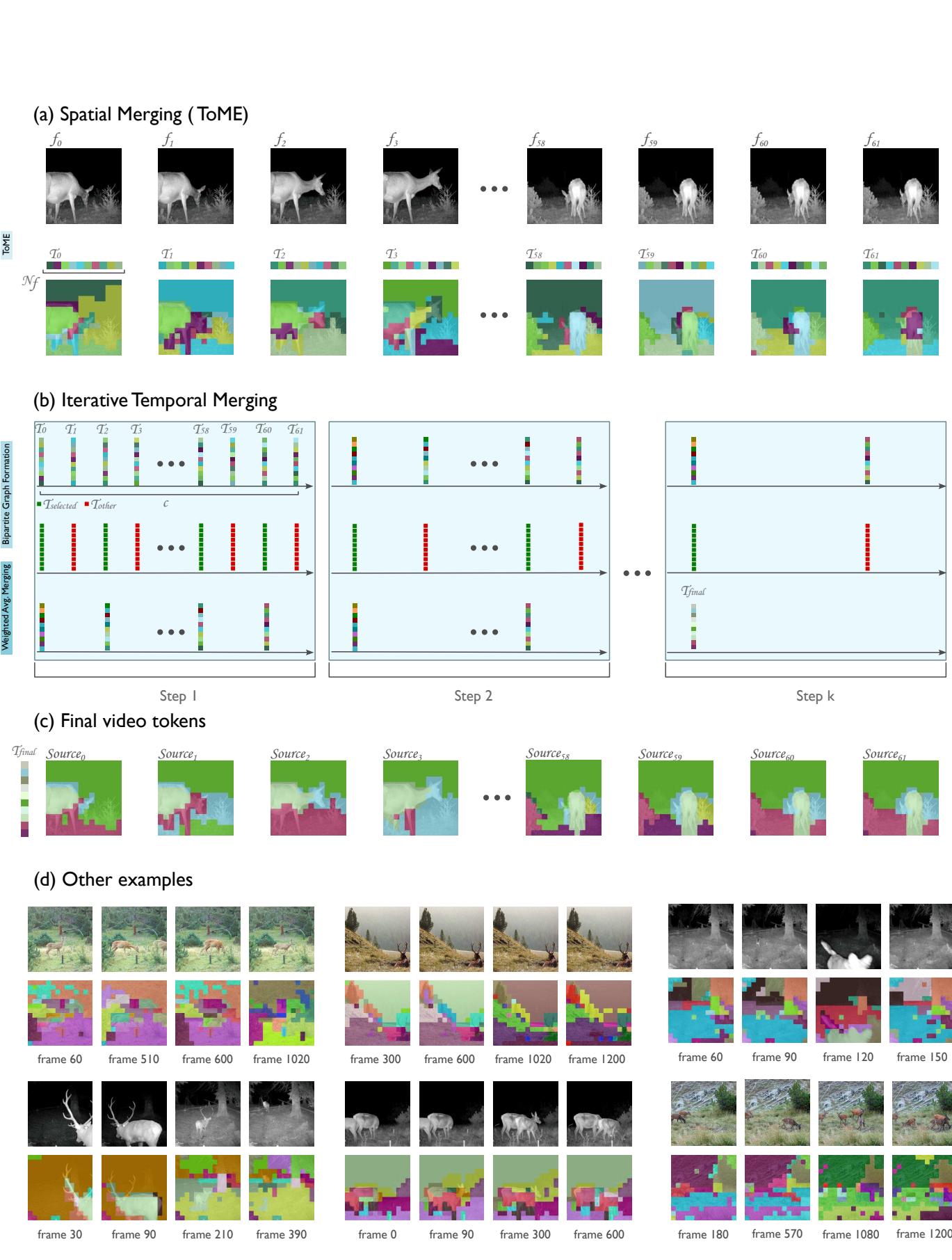
How it works (Step-by-Step):
- Spatial Merging: In each individual frame, similar patches (e.g., all the grass patches) are merged into a single representation.
- Temporal Merging: The algorithm looks across time. If a patch in Frame 2 is very similar to a patch in Frame 4, they are merged.
- Result: A 10-minute video containing tens of thousands of patches is condensed into a few hundred rich “video tokens” that represent the essence of the scene.
These condensed tokens are then fed into a standard Transformer Encoder to predict:
- Species present.
- Activities performed.
- Number of individuals (group size).
- Meteorological conditions.
Results: Understanding the Big Picture
This approach allowed the model to effectively process long-term events. The researchers tested the importance of using multiple camera views and found that jointly using data from different cameras significantly improved the ability to count individuals and recognize activities.
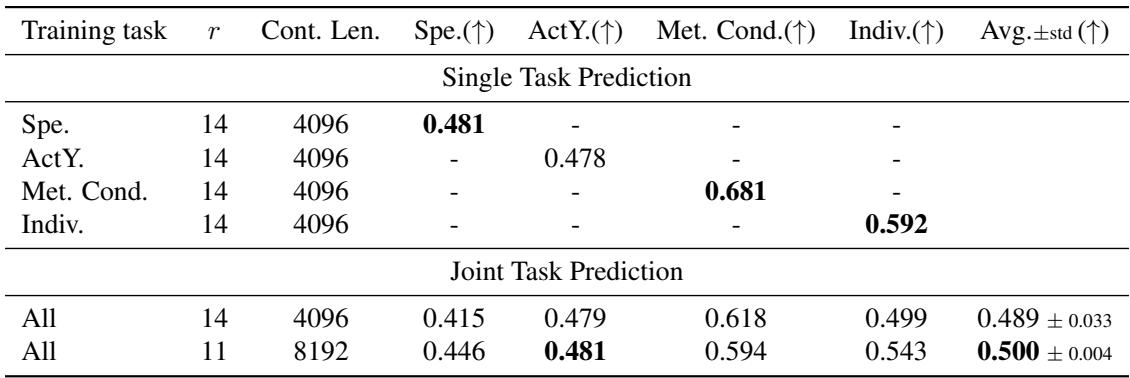
The table above shows that the model achieved a solid 0.500 mAP on the joint task prediction. The “Counting” task (Indiv.) remains the hardest, as it requires the model to track unique identities across different camera views over time—a task difficult even for humans!
Why This Matters
The MammAlps paper represents a significant step forward in “AI for Earth.” By releasing this dataset and these benchmarks, the authors are providing the tools necessary to automate wildlife monitoring.
- Efficiency: Ecologists can spend less time tagging videos and more time analyzing trends.
- Depth: We move beyond simple “species detection” to complex “behavioral analysis.”
- Accuracy: Multimodal and multi-view approaches mimic how expert field biologists observe nature, leading to more robust AI models.
The distinct combination of audio, visual context (segmentation), and long-term temporal processing opens new doors. Future models might be able to detect a predator not just by seeing it, but by hearing the alarm calls of prey or noticing a sudden hush in the forest.
MammAlps is not just a dataset; it is a blueprint for the future of computational ecology, where machines help us decipher the intricate language of the wild.
Terminology Quick-Ref
For students tackling this paper, here is a quick reference to the specific terminology used in the study: