](https://deep-paper.org/en/paper/2503.18337/images/cover.png)
If you have ever tried to fine-tune a Large Language Model (LLM) or a massive Vision Transformer (ViT), you know the struggle: these models are heavy. Full-parameter fine-tuning is computationally expensive and memory-intensive.
To solve this, the community turned to Parameter-Efficient Fine-Tuning (PEFT). The most famous example is LoRA (Low-Rank Adaptation), which freezes the pre-trained model and injects small, trainable rank decomposition matrices. Most of these methods focus on the linear projection layers—the weights (\(W_q, W_k, W_v\)) that transform your data.
But what if we are looking at the wrong part of the model?
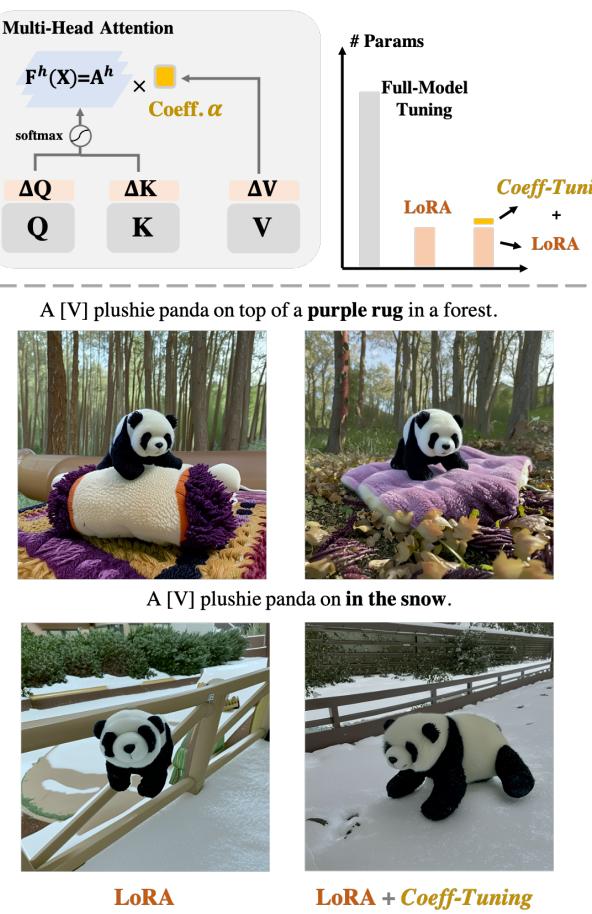
In a fascinating new paper, “Coeff-Tuning: A Graph Filter Subspace View for Tuning Attention-Based Large Models,” researchers from Purdue University propose an orthogonal approach. Instead of tweaking the weight matrices, they look at the attention map itself. They propose a method that achieves state-of-the-art results by tuning a tiny set of coefficients—introducing as few as 0.001% additional parameters—while offering a mathematically richer way to process information.
Let’s dive into how they turned Multi-Head Attention into a Graph Convolution problem and why “remixing” your attention heads might be the future of fine-tuning.
The Setup: Re-imagining Attention
To understand Coeff-Tuning, we first need to look at the Transformer’s Multi-Head Attention (MHA) through a different lens.
Typically, we think of attention as a mechanism that calculates alignment scores between queries and keys. However, this paper argues for a Graph Signal Processing perspective.
Imagine every token in your sequence (or patch in your image) is a node in a fully connected graph. The attention mechanism defines the edges (connections) between these nodes.
- The Attention Map acts as a Graph Filter. It dictates how information flows from one node to another.
- The Projection Weights (\(W_v\)) act as feature transformations on the nodes.
When a Transformer performs attention, it is essentially running a graph convolution where the filter is dynamic (data-dependent).
\[ \mathbf { F } ^ { h } ( \mathbf { X } ) = \operatorname { s o f t m a x } ( \mathbf { X } \mathbf { W } _ { q } \mathbf { W } _ { k } ^ { \top } \mathbf { X } ^ { \top } ) . \]In Multi-Head Attention, we have several of these “filters” (\(H\) heads) working in parallel. The model learns \(H\) different ways to aggregate information across the graph.
The Problem: The Convex Hull Trap
Here is the core insight of the paper, and it identifies a major limitation in standard attention mechanisms.
In standard attention, we apply a Softmax function to the query-key correlations. Softmax has two rigid properties:
- All values are positive (between 0 and 1).
- All values in a row sum to 1.
Mathematically, this means the output of an attention layer is a convex combination of the input value vectors. In geometry, if you take a set of points and create a convex combination of them, the result must lie inside the “Convex Hull” (the shape formed by connecting the outermost points).
Why is this bad? It limits the expressiveness of the model during fine-tuning. Even if you adjust the weight matrices (\(W_q, W_k\)) using LoRA, the attention scores are still trapped between 0 and 1. The model can shift the points around, but it cannot move the output vector outside the geometric bounds of the input values.
The authors illustrate this limitation beautifully with a toy example:
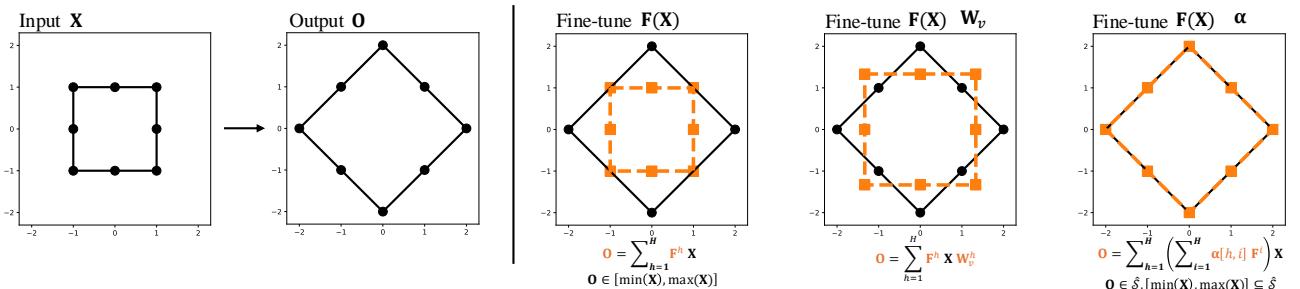
In Figure 3 above:
- Input X (Left): A diamond shape.
- Target O (Second from left): A rotated square.
- Fine-tuning F(X) (Third): If you only tune the attention weights (standard fine-tuning), the output is stuck inside the bounds of the input. The model fails to match the target shape because it’s trapped in the convex hull.
- Fine-tuning \(\alpha\) (Right): This is the proposed method. By breaking the constraints, the model successfully transforms the input to the target.
The Solution: Coeff-Tuning
To escape the convex hull, the researchers propose Coeff-Tuning.
Instead of treating the \(H\) attention heads as fixed, separate entities, the authors view them as a basis set that spans a “Filter Subspace.” They propose learning a small matrix of Subspace Coefficients (\(\alpha\)) to linearly combine these existing attention heads into new, more powerful filters.
How it Works
- The Subspace: We take the pre-trained attention maps from all heads: \(\{ \mathbf{F}^1, \mathbf{F}^2, ..., \mathbf{F}^H \}\).
- The Remix: We define a learnable coefficient matrix \(\alpha \in \mathbb{R}^{H \times H}\).
- The New Filter: We create a new attention map \(\hat{\mathbf{F}}^h\) for head \(h\) by calculating a weighted sum of all original heads using \(\alpha\). \[ \hat { \mathbf { F } } ^ { h } ( \mathbf { X } ) = \sum _ { i = 1 } ^ { H } \alpha [ h , i ] \mathbf { F } ^ { i } ( \mathbf { X } ) . \]
- The Key: The coefficients in \(\alpha\) are unconstrained. They can be negative!
Because \(\alpha\) can be negative, the new attention map is no longer bound by Softmax constraints. It can have negative values or sum to numbers other than 1. This allows the model to perform subtractive operations (e.g., “take the focus of Head 1 and remove the pattern from Head 2”).
This simple change expands the feature space, allowing the output to land outside the convex hull of the values, drastically increasing the model’s expressiveness with almost no computational cost.

As shown in Figure 2, the process integrates seamlessly into the standard Transformer block. The graph convolution happens on the right, and the subspace coefficients (\(\alpha\)) mix the filters before the final output.
Stability and Regularization
To make this training stable, the authors introduce two clever engineering tricks:
- Residual Parameterization: Instead of learning \(\alpha\) from scratch, they learn it as a residual of the Identity matrix: \(\alpha' = \alpha + I\). This means at the start of training, the model behaves exactly like the pre-trained original.
- Coefficient Dropout: Because \(\alpha\) is so small but powerful, it can overfit. They apply Dropout directly to the \(\alpha\) matrix, randomly zeroing out elements during training to force the model to learn robust combinations.
Experiments & Results
The paper validates Coeff-Tuning across a variety of tasks, showing that it plays well with others (it can be combined with LoRA) and often outperforms much heavier methods.
1. Few-Shot Image Classification (ViT)
The researchers tested the method on the VTAB-1k benchmark using a Vision Transformer (ViT-B/16).
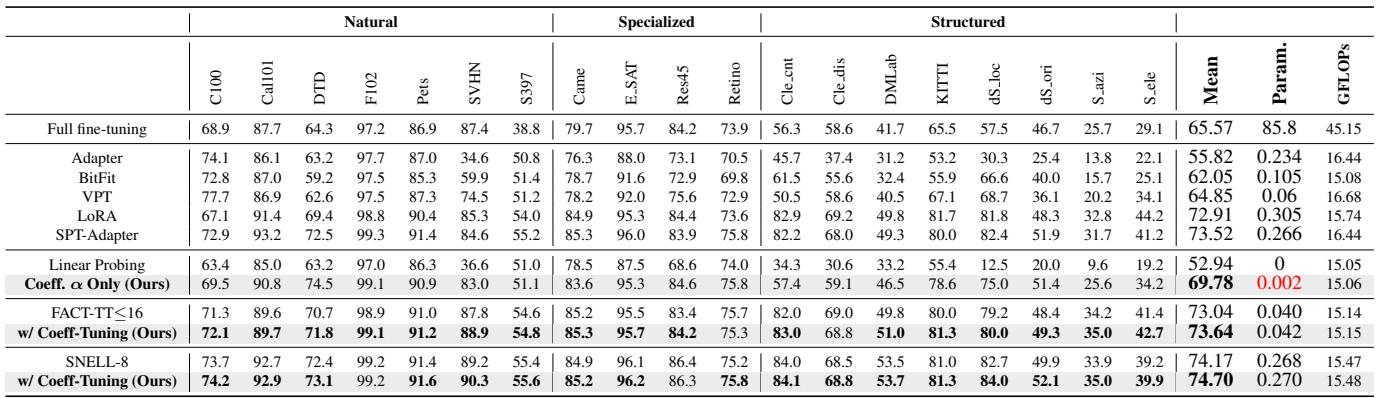
Key Takeaways from Table 1:
- Efficiency: Look at the “Param.” column. Standard “Full fine-tuning” updates 85.8M parameters. LoRA updates 0.30M. Coeff. \(\alpha\) Only updates just 0.002M parameters (approx. 2,000 parameters total!).
- Performance: Despite using a fraction of the parameters, “Coeff. \(\alpha\) Only” (69.78%) beats Linear Probing (52.94%) and rivals LoRA (72.91%).
- Combination: When combined with other methods (like SSF or LoRA), it achieves the best performance (74.70%) while adding virtually zero cost.
2. Personalized Text-to-Image Generation
Perhaps the most visually striking results come from fine-tuning Stable Diffusion (SDXL) for concept customization (e.g., teaching the model what a specific plushie looks like).
In generative models, a common issue with fine-tuning is “concept bleeding”—the model learns the object but also overfits to the background or loses text alignment (e.g., you ask for a panda in the snow, but it ignores the “snow” part).
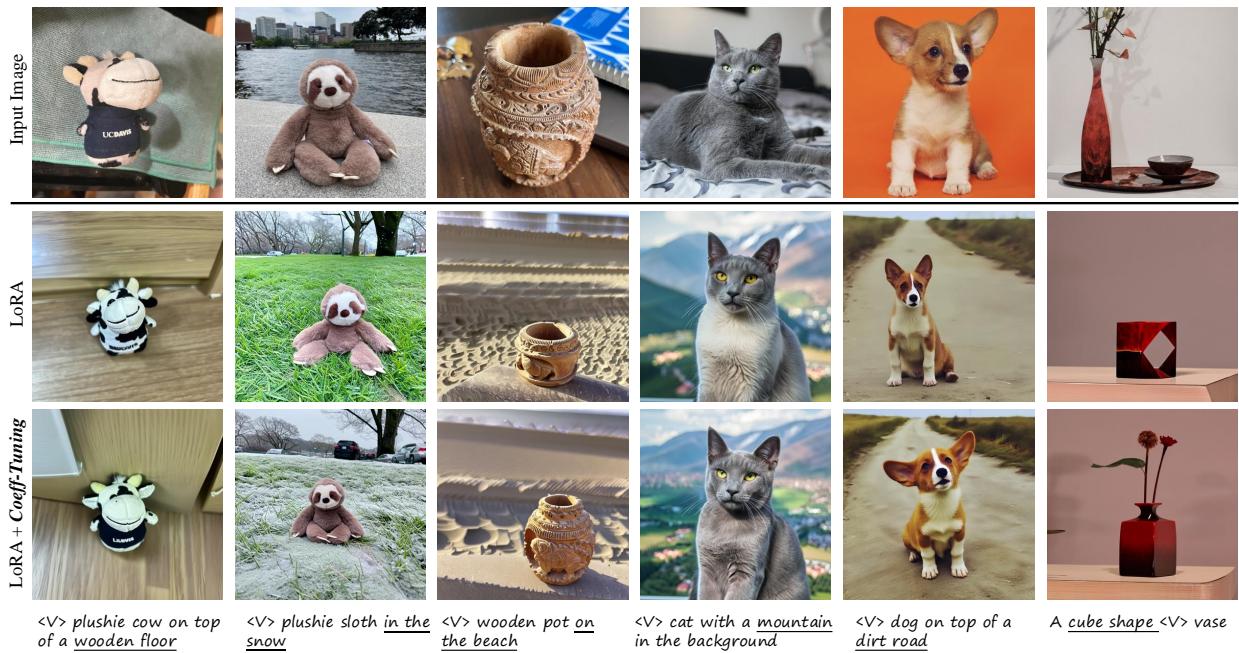
In Figure 4, compare the Middle Row (LoRA) with the Bottom Row (Coeff-Tuning):
- Column 4 (The Cat): The prompt asks for a “cat with a mountain in the background.” LoRA keeps the original background. Coeff-Tuning successfully puts the cat in the mountains while preserving the cat’s identity.
- Column 2 (The Sloth): The prompt is “plushie sloth in the snow.” LoRA generates the sloth on grass (overfitting to the training data?). Coeff-Tuning correctly places it in the snow.
The unconstrained coefficients allow the model to better separate the “object” features from the “background” features, leading to higher fidelity and better text alignment.
3. Complexity Analysis
One of the strongest arguments for Coeff-Tuning is its cost.
- LoRA introduces parameters proportional to the rank \(r\) and the model dimension \(d\): \(\approx 2 \cdot L \cdot d \cdot r\).
- Coeff-Tuning introduces parameters proportional only to the square of the number of heads \(H\): \(L \cdot H^2\).
Since \(H\) (usually 12 or 16) is much smaller than the hidden dimension \(d\) (usually 768 or 1024), Coeff-Tuning is incredibly lightweight. For a standard ViT, it adds about 0.001% additional parameters.
Conclusion
“Coeff-Tuning” offers a fresh perspective on the architecture of Transformers. By stepping back and viewing Multi-Head Attention as a Graph Convolution with a Filter Subspace, the authors identified a geometric bottleneck (the convex hull) that limits standard fine-tuning.
Their solution—learning to “remix” attention heads with unconstrained coefficients—is elegant, theoretically grounded, and empirically effective. It demonstrates that we don’t always need to tune massive weight matrices to adapt a model; sometimes, a tiny, strategic nudge to the attention mechanism is all it takes.
For students and practitioners, this method is particularly exciting because it is plug-and-play. It can be added on top of LoRA, DoRA, or Adapters with negligible overhead, offering a “free” boost in expressiveness for your next fine-tuning project.