](https://deep-paper.org/en/paper/2503.18361/images/cover.png)
Introduction
Reconstructing a high-quality 3D surface from a set of 2D images is one of the “Holy Grail” problems in computer vision. It sounds simple—humans do it effortlessly with two eyes—but for algorithms, converting a collection of photos into a watertight, smooth 3D mesh is incredibly difficult. This is especially true for indoor scenes, which are plagued by textureless walls, complex occlusions, and reflective surfaces.
Modern approaches often rely on priors—pre-learned knowledge about what the world should look like—to guide the reconstruction process. Traditionally, these priors come from massive datasets. The logic is: “I’ve seen a thousand chairs before, so I know this shape is probably a chair.” However, this approach fails when the algorithm encounters something it hasn’t seen during training, or when the dataset bias doesn’t match the specific scene.
In this post, we are diving into NeRFPrior, a research paper that flips this script. Instead of relying on a massive external dataset, NeRFPrior asks a different question: What if we could learn a prior from the scene itself?
By quickly training a Neural Radiance Field (NeRF) on the specific scene at hand and using it as a guide, the researchers achieved state-of-the-art results in indoor reconstruction without needing external data. Let’s explore how this “overfitting” strategy creates accurate, robust 3D geometry.
The Background: Why We Need Priors
To understand NeRFPrior, we first need to understand the limitations of current methods.
Neural Implicit Surfaces
State-of-the-art reconstruction uses Neural Implicit Surfaces. Instead of storing a mesh directly, a neural network learns a Signed Distance Function (SDF). For any point in 3D space, the network predicts the distance to the nearest surface. The zero-level set (where distance = 0) defines the object’s surface.
While powerful, optimizing an SDF from images alone is ambiguous. A white wall looks the same from many angles, making it hard to determine exactly where the wall sits in 3D space. This is why we need guidance, or “priors.”
The Problem with Data-Driven Priors
Many methods (like MonoSDF) pre-train networks on large datasets to estimate depth and surface normals. These act as “data-driven priors.” They work well if your test scene looks like your training data. But as shown below, they struggle with generalization.
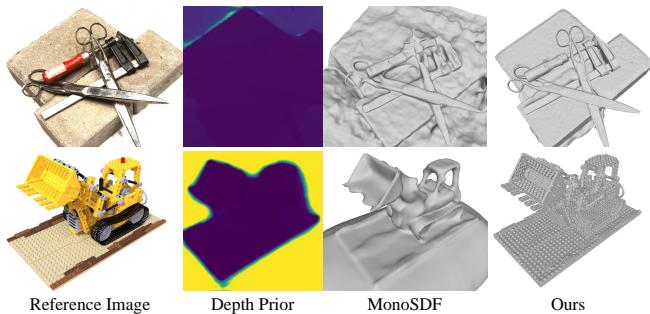 Figure 2: When a method relying on pre-trained depth priors (MonoSDF) encounters an object different from its training set (like these tools or the excavator), the reconstruction fails significantly. NeRFPrior (Ours) handles it robustly.
The alternative is using “overfitting priors,” like traditional Multi-View Stereo (MVS) point clouds. These are specific to the scene but are often sparse and lack color information, which is crucial for verifying if a surface is actually visible or occluded.
The Core Method: NeRF as a Teacher
The key insight of NeRFPrior is that Neural Radiance Fields (NeRFs) are excellent at capturing the density and color of a scene, even if their geometry is a bit “foggy” or noisy.
The authors propose a two-stage pipeline:
- Train a NeRF Prior: Quickly train a grid-based NeRF on the input images. This takes minutes and “overfits” the scene, capturing specific geometric and color details.
- Train the SDF: Optimize the surface reconstruction network using the NeRF’s density and color as a guide (supervision).
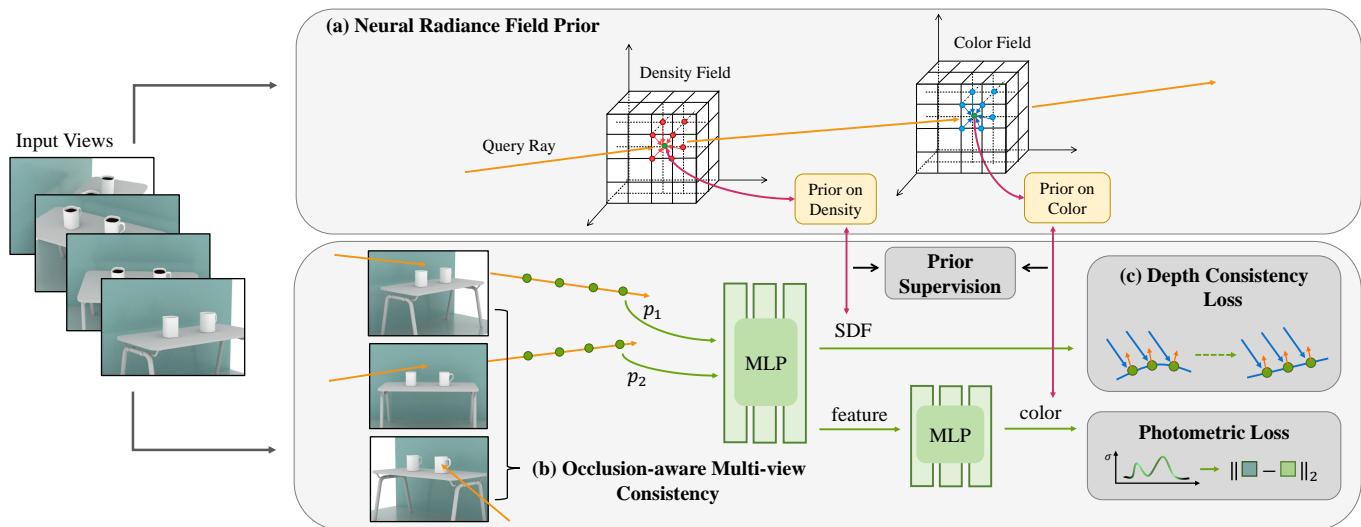 Figure 1: The NeRFPrior pipeline. (a) A fast Grid-NeRF is trained to provide Density and Color priors. (b) These priors guide the SDF learning, enabling occlusion-aware multi-view consistency. (c) A specialized depth consistency loss handles textureless areas.
1. The NeRF Prior Setup
The team uses a voxel-grid based NeRF (similar to TensoRF) for speed. This network provides two spatially varying fields:
- Density (\(\sigma_{prior}\)): How opaque a point in space is.
- Color (\(c_{prior}\)): What color a point emits (dependent on viewing direction).
To use this as a prior, the system queries these fields and uses them to supervise the SDF network. The equations below show how the prior is extracted:

Here, interp refers to trilinear interpolation within the voxel grid.
During the surface reconstruction phase, the SDF network predicts its own density and color. These predictions are forced to align with the NeRF prior using the following loss functions:
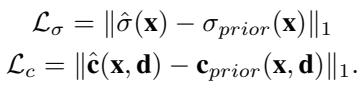
This alignment ensures that the SDF network starts with a very strong “guess” about where the geometry is, effectively bypassing the initial ambiguity that plagues other methods.
2. Occlusion-Aware Multi-View Consistency
The most sophisticated part of NeRFPrior is how it handles visibility.
In reconstruction, a powerful constraint is “photometric consistency”: a point on a surface should look consistent when projected into different camera views. However, this breaks if an object is blocking the view (occlusion). If you blindly force consistency on an occluded point, you destroy the geometry.
NeRFPrior uses the NeRF prior to perform a visibility check.
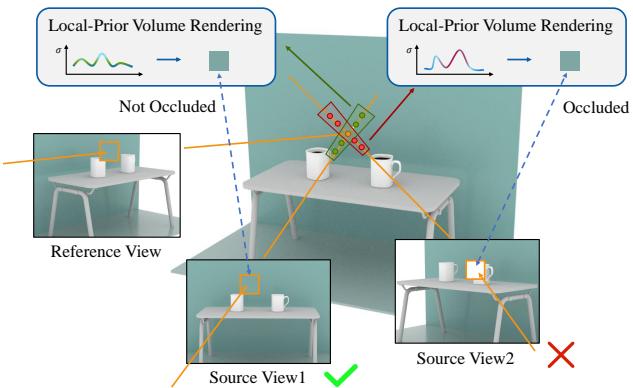 Figure 3: To check if an intersection point is visible from a source view, the system performs a “local” volume rendering using the NeRF prior. If the rendered color matches the image pixel, the point is visible.
How it works:
- Trace a ray from the camera to the surface intersection point \(\mathbf{p}^*\).
- To check if \(\mathbf{p}^*\) is visible from a different source view, trace a ray from that source view to \(\mathbf{p}^*\).
- Local Volume Rendering: Instead of rendering the whole ray, sample a small area around \(\mathbf{p}^*\) using the NeRF prior’s density and color.
- Compare this locally rendered color (\(\mathbf{c}_s^*\)) with the actual pixel color in the source image (\(\mathbf{c}_s^{proj}\)).
The local rendering equation allows for a quick check:
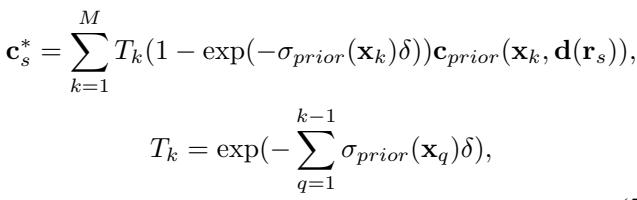
If the difference between the rendered color and the pixel color is below a threshold \(t_0\), the point is considered visible.

This method is significantly more robust than traditional projection methods because the NeRF prior captures view-dependent effects (like specular highlights), whereas simple pixel matching fails under changing light.
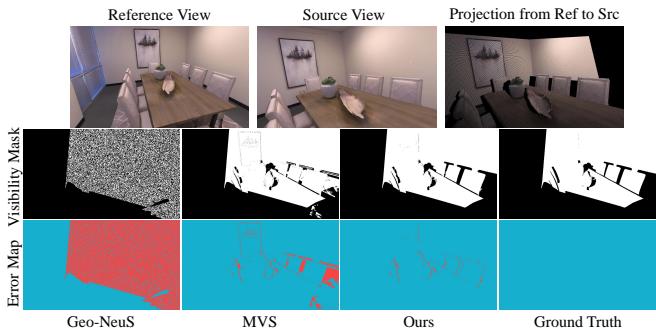 Figure 4: The second row shows visibility masks. Notice how NeRFPrior (“Ours”) produces a clean, accurate mask (white areas) compared to the noisy or sparse results of MVS and Geo-NeuS.
3. Handling Textureless Areas (The Depth Loss)
Indoor scenes are full of white walls and floors. These are “textureless areas.” Multi-view consistency fails here because a white pixel on a wall looks identical to a white pixel slightly to the left or right.
To fix this, NeRFPrior introduces a Depth Consistency Loss with confidence weights.
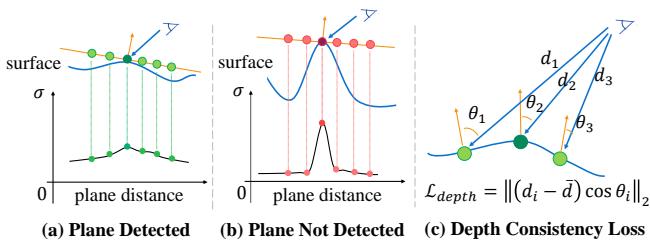 Figure 5: The system analyzes the variance of density and color. (a) If variance is low, it implies a flat, textureless plane. (c) The system then forces neighboring rays to have consistent depths along the surface normal.
The logic is elegant:
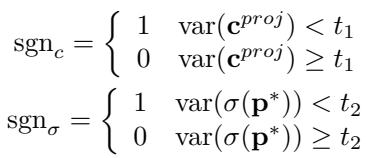
- Check Color Variance: Is the area uniform in color? (Likely textureless).
- Check Density Variance: Is the NeRF prior density uniform? (Likely a flat plane).
- If both are true, enforce a constraint that the depth of the current ray should match the depths of neighboring rays, projected onto the surface normal.
This mathematically enforces smoothness exactly where it’s needed (walls) without over-smoothing detailed objects.

The terms \(\text{sgn}_c\) and \(\text{sgn}_\sigma\) act as switches, turning the loss on only when the confidence conditions (low variance) are met.
An ablation study visually demonstrates why this is necessary. Without this loss, walls become wavy and distorted.
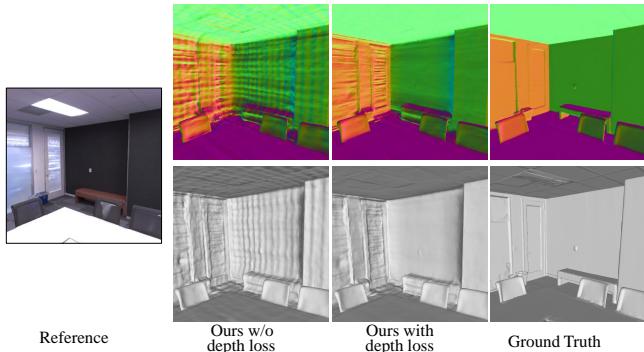 Figure 10: Top row (Without depth loss) shows severe artifacts and warping on the walls. Middle row (With depth loss) recovers smooth, planar surfaces.
Experiments and Results
The researchers evaluated NeRFPrior on standard benchmarks: ScanNet (real-world indoor), BlendSwap, and Replica (synthetic).
Visual Quality
The results show a marked improvement in recovering fine details and thin structures compared to baselines like NeuS, MonoSDF, and Geo-NeuS.
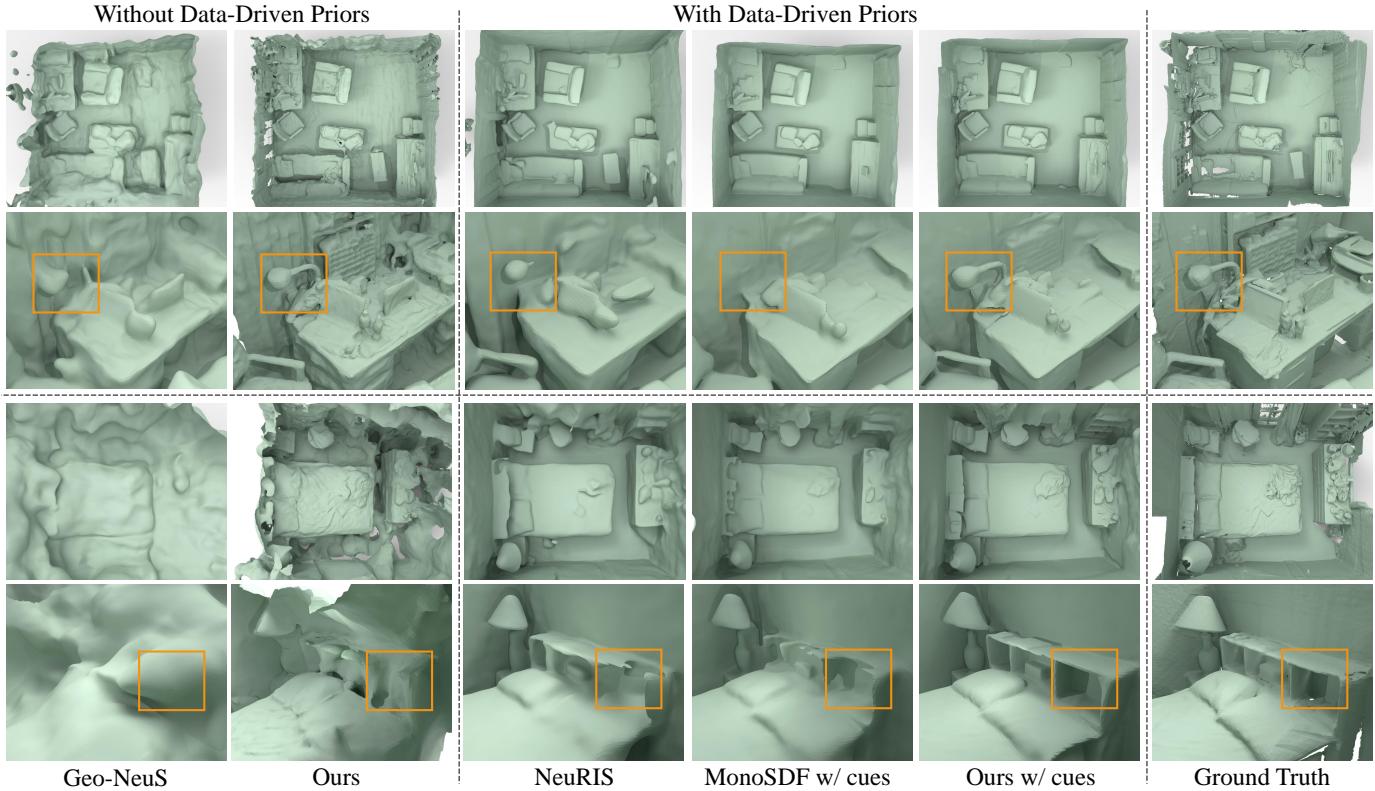 Figure 6: On ScanNet, NeRFPrior (Ours) reconstructs thin legs of chairs and lamps that other methods miss or blur out.
In the synthetic BlendSwap dataset, the difference is even more pronounced. Look at the clean geometry of the staircase and the lamp in the figure below.
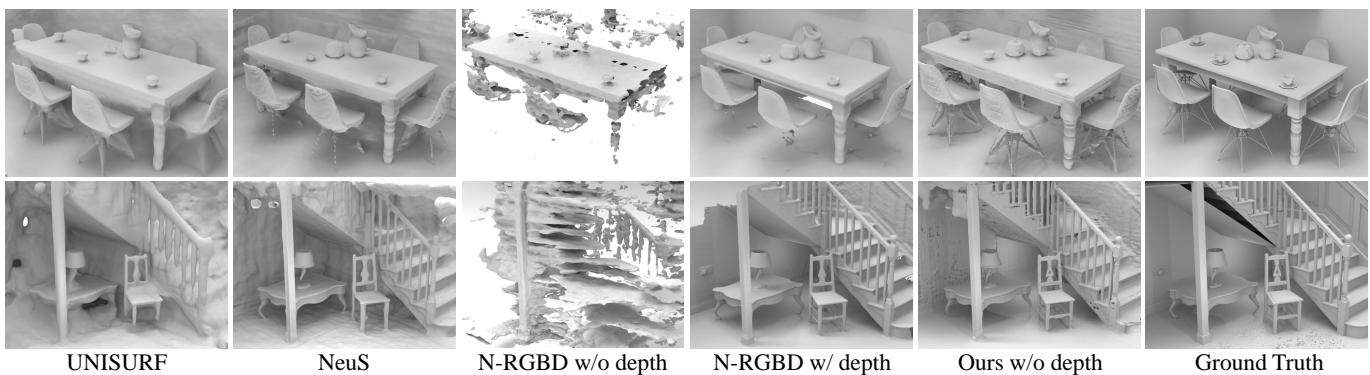 Figure 7: Note the artifacts in “N-RGBD w/o depth” compared to the clean solution from “Ours”.
Quantitative Performance
The tables below confirm the visual results. On ScanNet, NeRFPrior achieves the lowest scores in Accuracy (Acc) and Completeness (Comp) errors—lower is better.
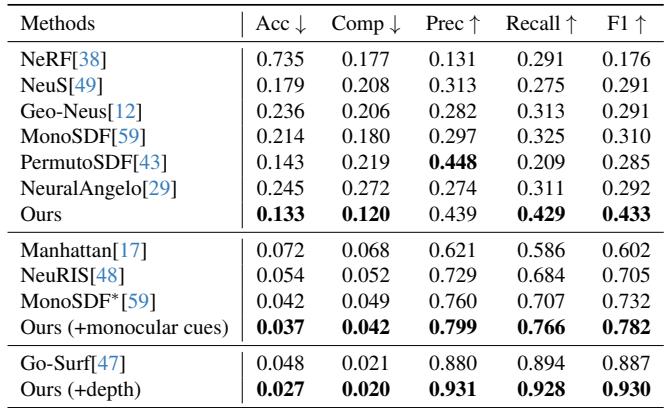
It is worth noting that NeRFPrior outperforms MonoSDF even though MonoSDF uses a prior pre-trained on a massive dataset. This validates the hypothesis that a scene-specific prior is often better than a generic one.
Speed
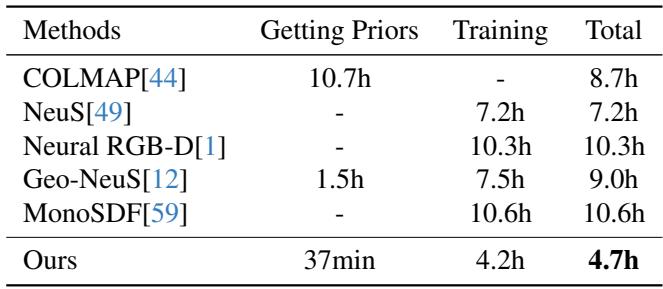
One might think that training a NeRF before the actual reconstruction would be slow. However, because modern grid-based NeRFs are incredibly fast, the “Getting Priors” stage only takes about 37 minutes. The guidance provided by this prior actually speeds up the subsequent training, resulting in a total training time that is half that of competing methods like MonoSDF or Neural RGB-D.
Conclusion
NeRFPrior presents a compelling argument for “overfitting” as a strategy for priors. Rather than relying on massive external datasets that may not generalize, this method uses the scene’s own internal consistency to teach itself.
By training a fast NeRF first, the system gains a rough-but-complete map of density and color. This map allows the rigorous SDF reconstruction process to verify visibility intelligently and smooth out textureless walls effectively.
The key takeaways are:
- Self-Supervision works: A prior learned from the test scene itself can outperform priors learned from thousands of other scenes.
- Color matters for Geometry: Using the NeRF’s color ability allows for robust occlusion checking, which purely geometric priors (like sparse point clouds) cannot provide.
- Targeted Regularization: The depth consistency loss shows that we can apply smoothing intelligently—only where the data suggests the surface is flat and featureless.
This approach paves the way for more autonomous 3D scanning systems that can produce high-fidelity models of indoor spaces without needing extensive pre-training on external data.