](https://deep-paper.org/en/paper/2503.18420/images/cover.png)
Imagine you are standing in a beautiful cathedral. You take a photo with your standard smartphone camera. That photo captures a “Narrow Field of View” (NFoV)—essentially a small rectangle of the whole scene. Now, imagine asking an AI to take that small rectangle and hallucinate the rest of the cathedral—the ceiling, the floor, and everything behind you—to create a perfect 360-degree sphere that you can view in a VR headset.
This task is called Panorama Outpainting. It is one of the most exciting frontiers in Computer Vision, with massive implications for Virtual Reality (VR) and 3D content creation.
However, there is a hidden problem in the current state-of-the-art research. While recent AI models generate images that look high-definition and artistic, they are fundamentally “cheating.” They prioritize pretty pixels over correct geometry. When you wrap these generated images onto a sphere, straight lines curve weirdly, and the room layout warps unnaturally.
In this deep dive, we will explore the paper “Panorama Generation From NFoV Image Done Right,” which exposes this “visual cheating” phenomenon. We will analyze how the authors diagnose the problem using a novel metric called Distort-CLIP and how they solve it using a new architecture called PanoDecouple.
The Problem: Visual Cheating
To understand the problem, we first need to understand the format of a 360-degree image. Panoramas are usually stored as Equirectangular Projections. This is similar to a world map where the globe is flattened out; the north and south poles are stretched across the top and bottom.
When an AI tries to generate a panorama from a standard photo, it must learn two things simultaneously:
- Content Completion: What should the missing parts of the room look like? (e.g., textures, objects, lighting).
- Distortion Guidance: How should these objects be warped so that they look straight when viewed in VR?
Most existing methods use a single diffusion model to learn both. The authors of this paper discovered that these models tend to get lazy. They focus entirely on making the texture look good (Content) while ignoring the complex geometric warping (Distortion).
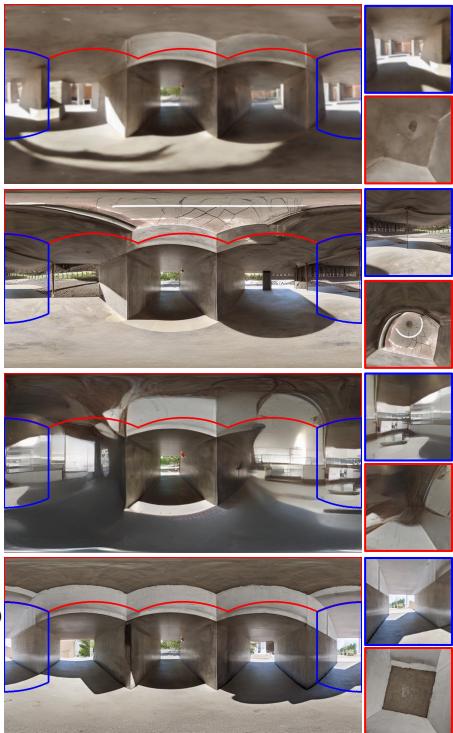
As shown in Figure 1, if you look at the raw panorama (the stretched strip), the competitors (like 2S-ODIS) seem to generate detailed images. However, look at the “Projected Views” (the red and blue boxes). These views simulate what a human sees in VR.
- Existing Methods: The columns and arches are bent and warped. The AI failed to understand the 3D geometry.
- Ours (PanoDecouple): The lines are straight, and the architecture makes structural sense.
The authors call this the “Visual Cheating” phenomenon: sacrificing geometric accuracy to boost visual quality scores.
Diagnosis: Why Existing Metrics Fail
Why hasn’t this been noticed before? The problem lies in the yardsticks we use to measure success.
The standard metrics in this field are FID (Fréchet Inception Distance) and CLIP-Score. These metrics use pre-trained neural networks (InceptionNet and CLIP) to judge image quality. The issue is that these networks were trained on massive datasets of normal, flat images. They are excellent at detecting if a dog looks like a dog, but they are terrible at detecting if a panoramic curve is mathematically correct.
To prove this, the researchers conducted an experiment. They compared the feature similarity of different image pairs using standard metrics versus their proposed solution.
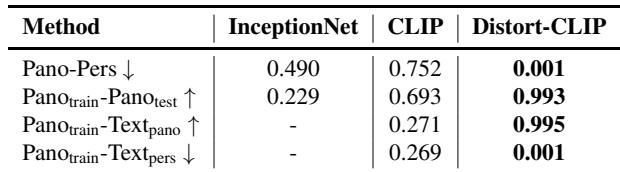
In Table 1, look at the “Pano-Pers” row. This measures the similarity between a panorama and a perspective (flat) image of the same scene. Standard CLIP gives a high similarity score (0.752) because it sees the same content. However, the geometry is totally different! A metric that judges distortion should see these as very different.
The Solution: Distort-CLIP
To fix the measurement problem, the authors introduce Distort-CLIP. This is a CLIP model fine-tuned specifically to be sensitive to geometric distortion.
The training process uses Contrastive Learning. The model is fed three types of images:
- Panorama Images (P): Correctly distorted 360 images.
- Perspective Images (N): Flat, normal images.
- Random Distortion Images (R): Images warped randomly.
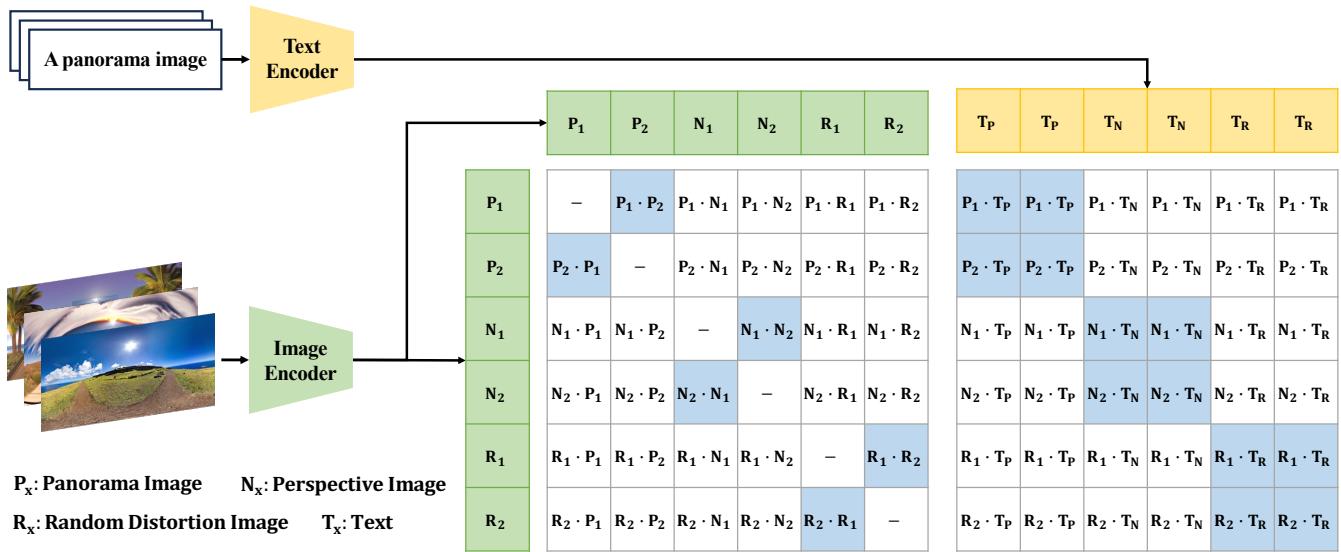
As visualized in Figure 2, the model consists of an Image Encoder and a Text Encoder. The goal is to force the model to pull images with the same distortion type closer together in the feature space and push different types apart.
The loss function for the Image Encoder (\(\mathcal{L}_{ie}\)) ensures that a panorama image matches other panorama images but not perspective images, even if they share the same content.

Similarly, the Text Encoder (\(\mathcal{L}_{te}\)) is trained to associate images with their textual descriptions (“A panorama image”, “A perspective image”).

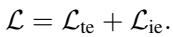
The total loss combines these two objectives:
By using Distort-CLIP, the researchers can finally measure the “cheating” quantitatively.
The Core Method: PanoDecouple
Now that we can diagnose the problem, how do we solve it? The authors propose PanoDecouple.
The core insight is Decoupling. Instead of forcing one network to learn both artistic texture and mathematical geometry, PanoDecouple splits the job into two specialized branches:
- DistortNet: Responsible strictly for geometry and warping guidance.
- ContentNet: Responsible strictly for filling in visual details.
These two branches feed into a frozen, pre-trained U-Net (from Stable Diffusion) to generate the final result.
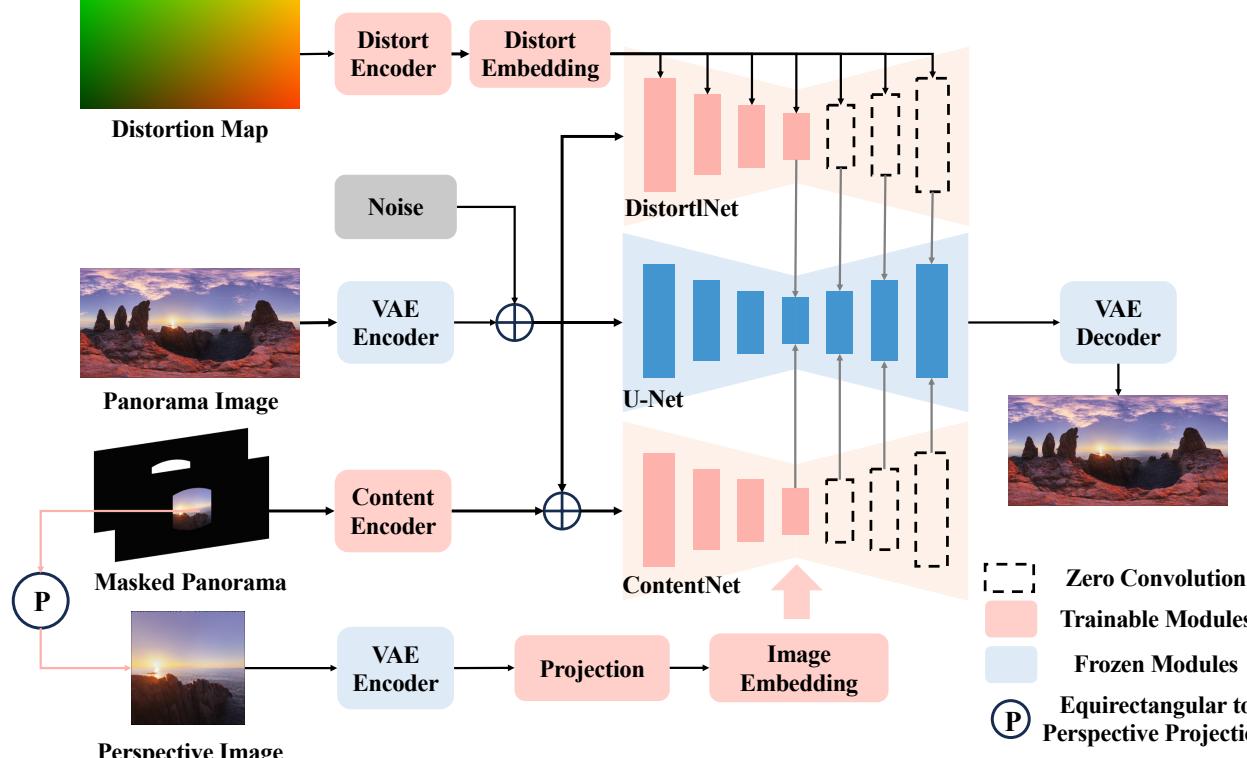
Let’s break down the architecture shown in Figure 3.
1. DistortNet: Learning the Sphere
The input to DistortNet is not an image of a scene, but a Distortion Map. This is a mathematical representation of the spherical coordinates.
A panorama maps a 2D grid of pixels \((i, j)\) to a 3D sphere \(S(\theta, \phi, r)\). The relationship is defined by:
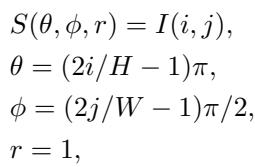
Here, \(\theta\) is the longitude (azimuth) and \(\phi\) is the latitude (elevation). The raw distortion map \(D\) is simply these coordinates stored as a 2D image:
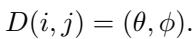
However, there is a catch. In a 360 image, the far left edge (\(-\pi\)) and the far right edge (\(+\pi\)) are actually the same point in space. A standard neural network viewing a 2D map doesn’t know this “looping” property. To solve this, the authors apply a Taylor Expansion Positional Encoding to make the values continuous across the boundary:
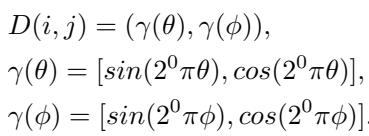
This encoded map allows the network to understand exactly where every pixel sits on the 3D sphere.
Condition Registration Mechanism: Standard Conditional networks (like ControlNet) usually inject their guidance only at the beginning or in specific blocks. However, geometry is fundamental. If the network forgets the geometry at deep layers, the distortion breaks. Therefore, DistortNet injects the distortion features (\(de\)) into every single block (\(b\)) of the network:

This ensures the geometric constraints are enforced from start to finish.
2. ContentNet: Handling the Visuals
The ContentNet focuses on the “look” of the image. It follows a standard Masked Outpainting approach. It takes the partial NFoV image (what we already see) and a mask (what is missing).
A clever modification here is the use of Perspective Image Embedding. Instead of just describing the scene with text (e.g., “a living room”), the authors project the center of the panorama back into a flat perspective image (\(c_n\)) and encode it.

This ensures that the style of the generated surroundings matches the specific camera lens characteristics of the input photo.
3. Fusion and Loss
The outputs from the main U-Net (\(\mathcal{F}_m\)), the ContentNet (\(\mathcal{F}_{cn}\)), and the DistortNet (\(\mathcal{F}_{dn}\)) are fused using Zero Convolutions (\(\mathcal{Z}\)), which allow the model to slowly learn to use the new information without breaking the pre-trained weights.

Finally, to explicitly punish the model for “visual cheating,” the authors introduce a Distortion Correction Loss. During training, they take the generated image \(x\), encode it with the frozen Distort-CLIP text encoder, and check its similarity to the text prompts “Panorama”, “Perspective”, and “Random Distortion”.

The final training objective combines the standard reconstruction loss (\(\mathcal{L}_{rec}\)) with this new distortion loss (\(\mathcal{L}_{dist}\)):

Experiments and Results
The researchers compared PanoDecouple against state-of-the-art methods like OmniDreamer, PanoDiff, and 2S-ODIS. They used the SUN360 and Laval Indoor datasets.
Quantitative Results:

As shown in Table 2:
- Distort-FID (Lower is better): PanoDecouple achieves a score of 0.92 on SUN360. Compare this to PanoDiff (2.68) or 2S-ODIS (8.23). This huge gap quantifies the “visual cheating” of other models—they generate pretty images that are geometrically wrong.
- FID (Image Quality): PanoDecouple also wins here (62.19), proving that you don’t need to sacrifice image quality to get correct geometry.
- Data Efficiency: Remarkably, PanoDecouple was trained on only 3,000 samples, whereas older methods like OmniDreamer used 50,000. This efficiency comes from the architecture effectively separating the tasks.
Qualitative Results:
Numbers are great, but visuals tell the true story.
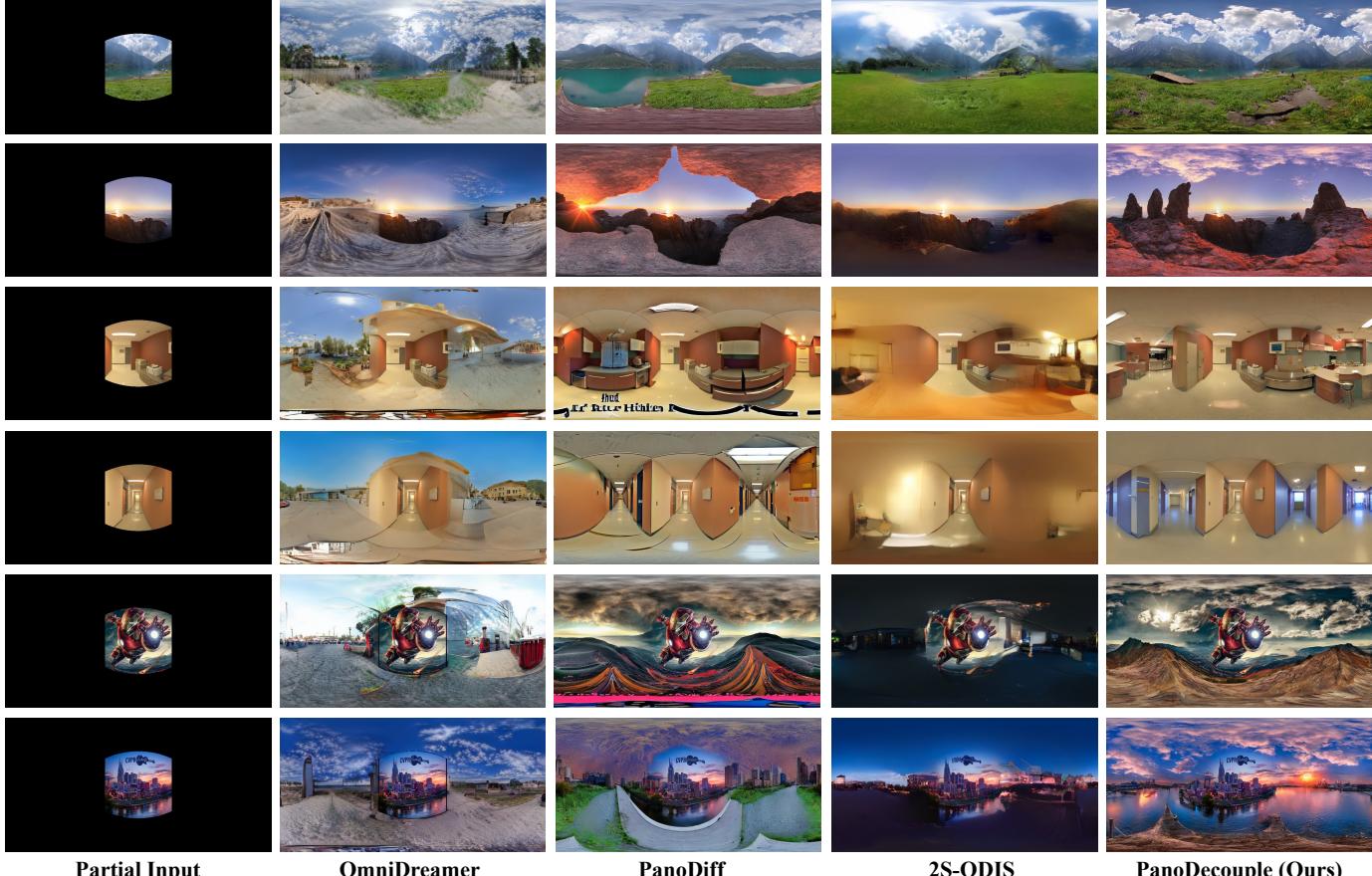
In Figure 4, we see the progression:
- Partial Input: The small sliver of image the model starts with.
- OmniDreamer: Often blurs the boundaries.
- PanoDecouple (Ours): Generates seamless 360 views.
For a clearer look at the geometry, we can inspect the generated images projected back into perspective views (how a human would see them).
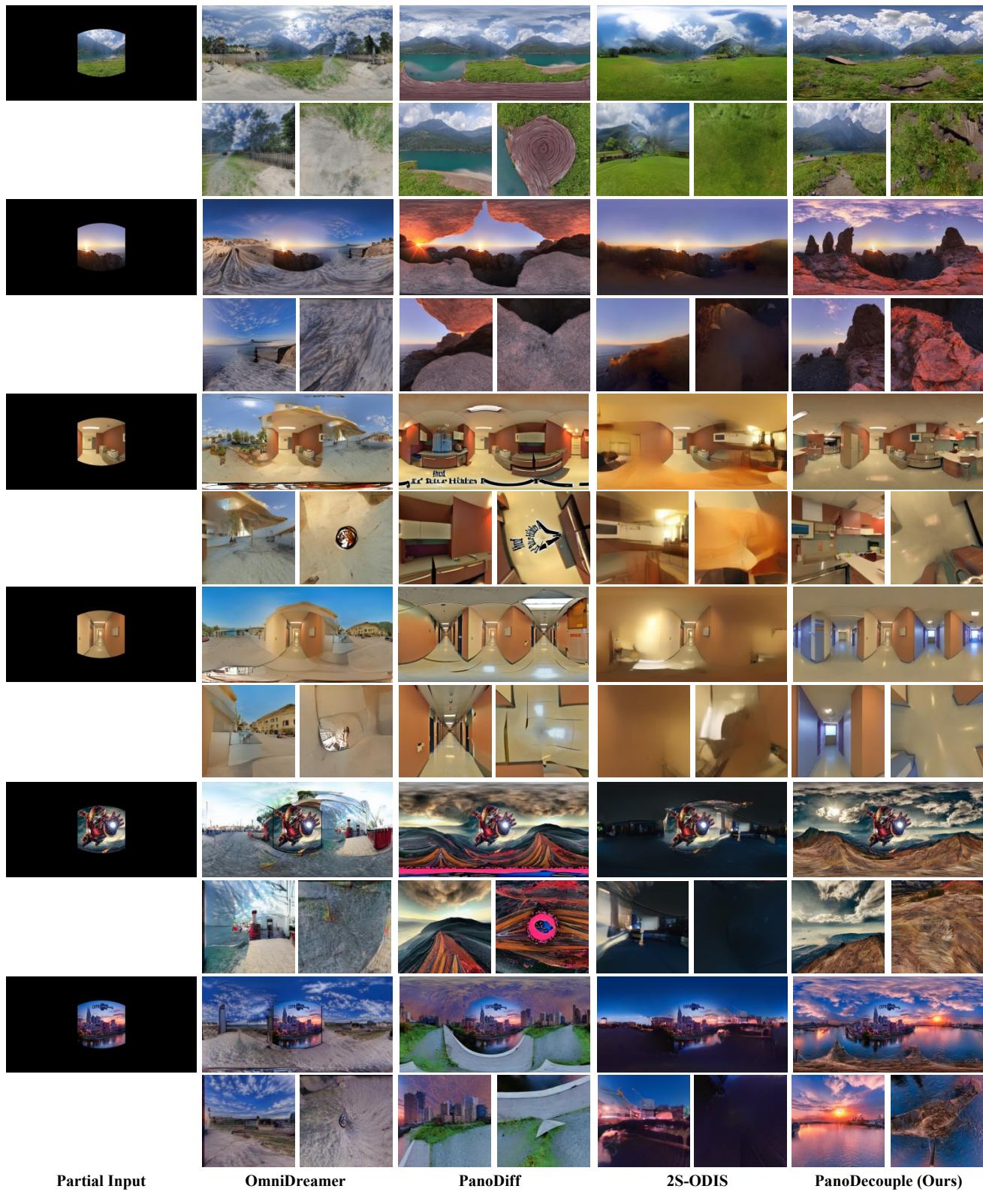
In Figure S10, look at the hospital corridor (row 4) or the room interiors (row 3). PanoDecouple creates straight walls and coherent structures. Other methods often result in “wobbly” rooms when viewed in perspective.
Ablation Study: Does Decoupling Matter?
The authors performed an ablation study to verify their design choices.
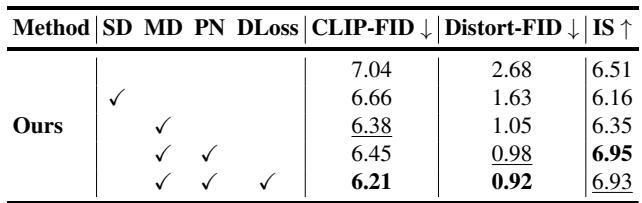
Table 3 shows a clear trend. As they add each component—starting from a basic diffusion model, then adding the Distortion Map (MD), then the Perspective Embedding (PN), and finally the Distortion Loss (DLoss)—the Distort-FID drops drastically from 2.68 to 0.92. This confirms that decoupling the tasks is the key to success.
Beyond Outpainting: New Applications
Because PanoDecouple understands spherical geometry fundamentally, it can be applied to tasks beyond just filling in missing image parts.
1. Text-to-Panorama Generation: You can generate a standard image using a model like SDXL and then use PanoDecouple to expand it into a full world.
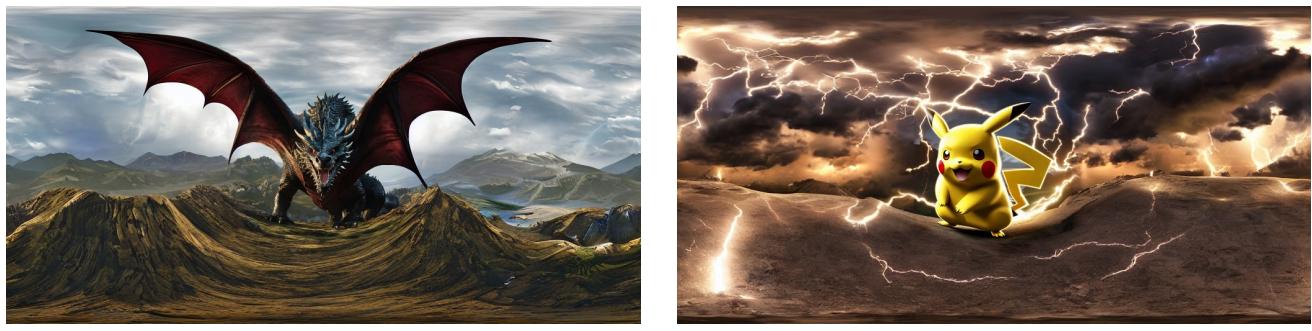
Figure 5 shows panoramas generated purely from text prompts like “The dragon in Game of Thrones” or “Pikachu using Thunderbolt.” The model creates a consistent 360-degree environment around the subject.
2. Text Editing: The model can also take an existing NFoV image and change the environment based on text, while keeping the geometry correct.

In Figure S8, a simple snowy mountain view is transformed into a desert or a volcano (“A firing mountain”) seamlessly.
Conclusion
The paper “Panorama Generation From NFoV Image Done Right” teaches us a valuable lesson in AI architecture: Specialization beats generalization.
By trying to force a single network to learn both artistic content and strict geometric rules, previous methods fell into the trap of “visual cheating”—creating images that looked good at a glance but fell apart under scrutiny.
By identifying this failure mode with Distort-CLIP and solving it by decoupling the network into ContentNet and DistortNet, the authors achieved state-of-the-art results with a fraction of the training data. This work paves the way for high-fidelity, geometrically accurate VR content generation, bringing us one step closer to generating complete virtual worlds from a single photograph.